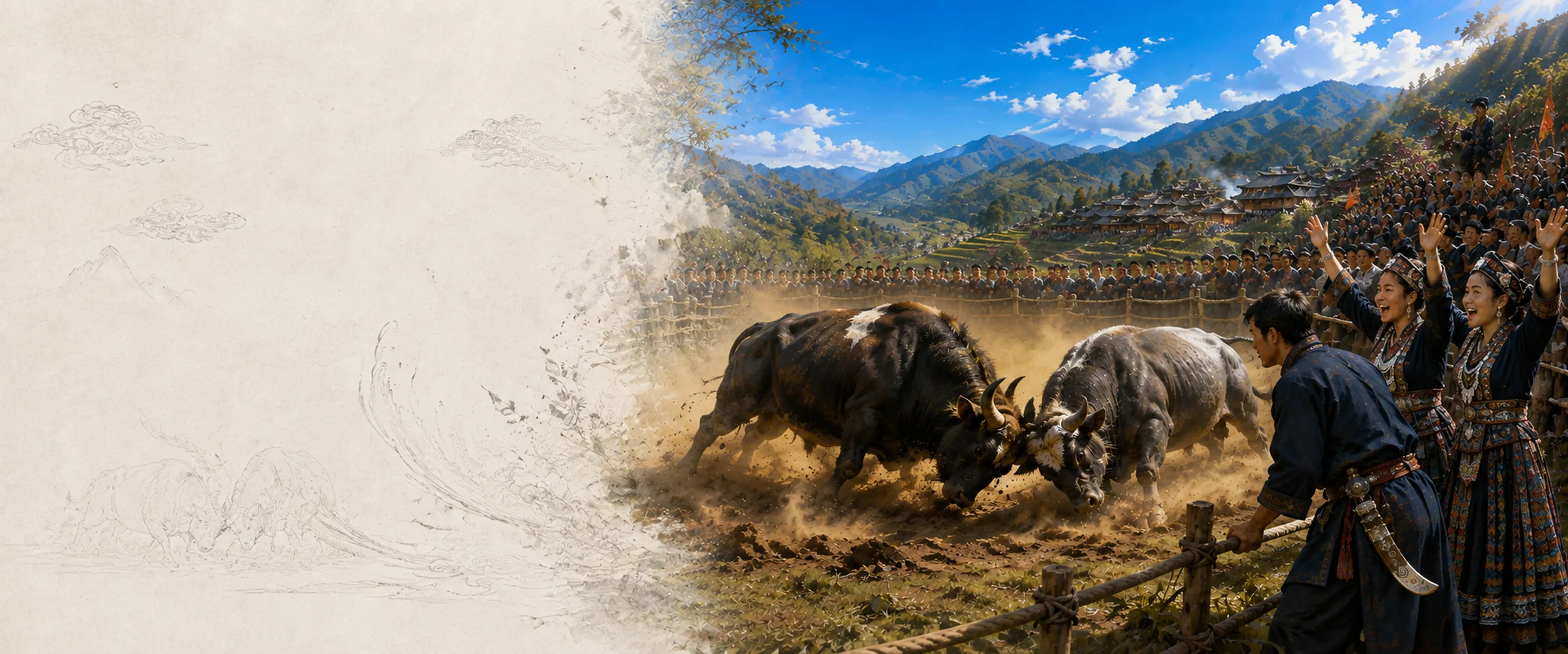

The Miao New Year is the most solemn festival of the year for the Miao people. The dates vary across regions, but it is generally held after the autumn harvest, around the tenth month of the lunar calendar. During the festival, Miao people dress in their finest attire — women don full sets of silver ornaments, dazzling and brilliant; men play the lusheng, its melodious tones echoing through the valleys. “Celebrating the Miao New Year on the Wind‑and‑Rain Bridge” — festivities unfold in every corner of the Miao villages. The long table feast is the most distinctive culinary custom of the festival — dozens of tables are joined in a row, laden with sour‑fish soup, cured meat, glutinous rice, and other delicacies, with the whole village seated together for a grand communal meal. The Miao New Year is also an important occasion for young men and women to socialise — singing antiphonal songs, dancing the lusheng dance, and seeking their beloved amidst joy and laughter. “A pot of rice wine, a plate of peanuts — celebrating the Miao New Year from the viewing terrace.” The Miao New Year is both a celebration of the passage of time and a continuation of cultural heritage.
Festival Journey
Origins & Legends
History · Evolution · Legend
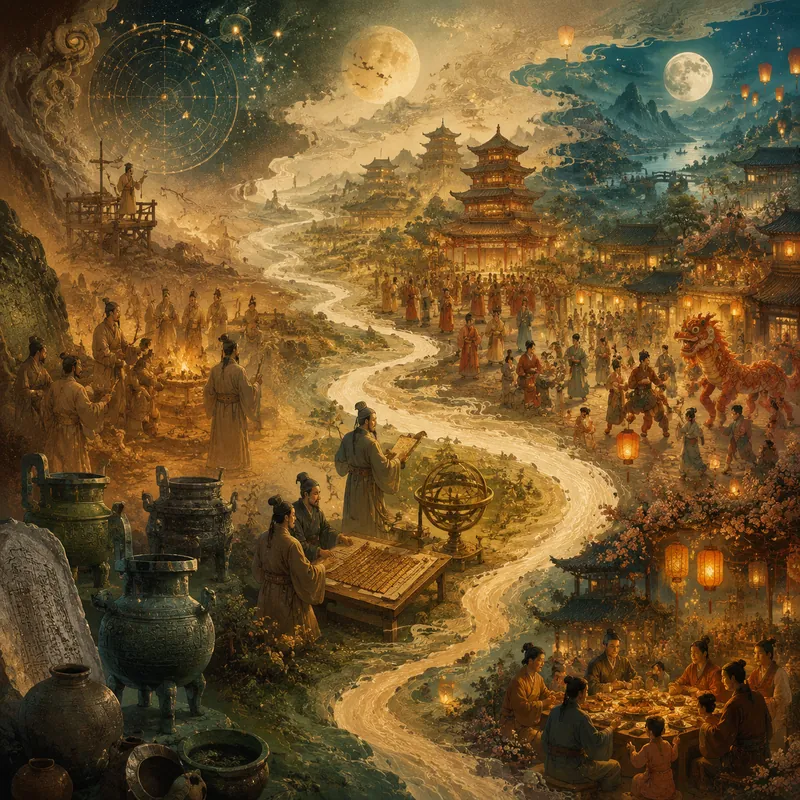
Tracing the Source · Historical Development
- The Ancient Chiyou Period The history of the Miao New Year can be traced back to the ancient period of Chiyou
- Qin and Han Dynasties The Qin and Han dynasties were an important period for the development of the Miao New Year
- Migration and Transmission Through the Ages The Miao are a people who have undergone a long migration
- Contemporary Era On 7 June 2008, the Miao New Year was approved by the State Council and included in the second batch of China’s National Intangible Cultural Heritage list, with the heritage number Ⅹ‑83
Festival Customs
Customs · Local Traditions · Everyday Life
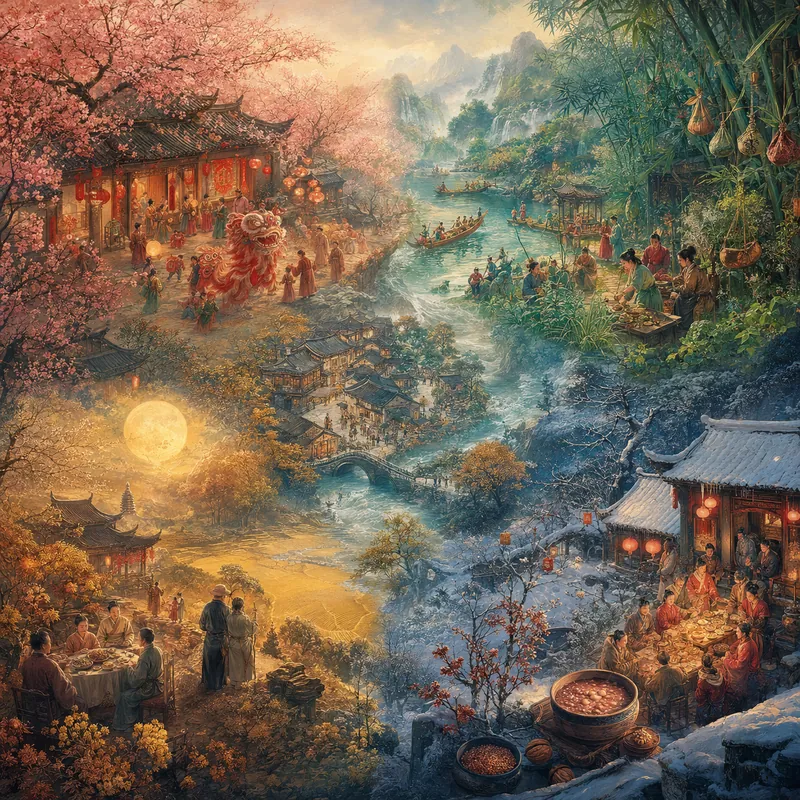
Seasonal Snapshots · Customs & Local Life
Festival Foods
Food Traditions · Local Flavors · Taste
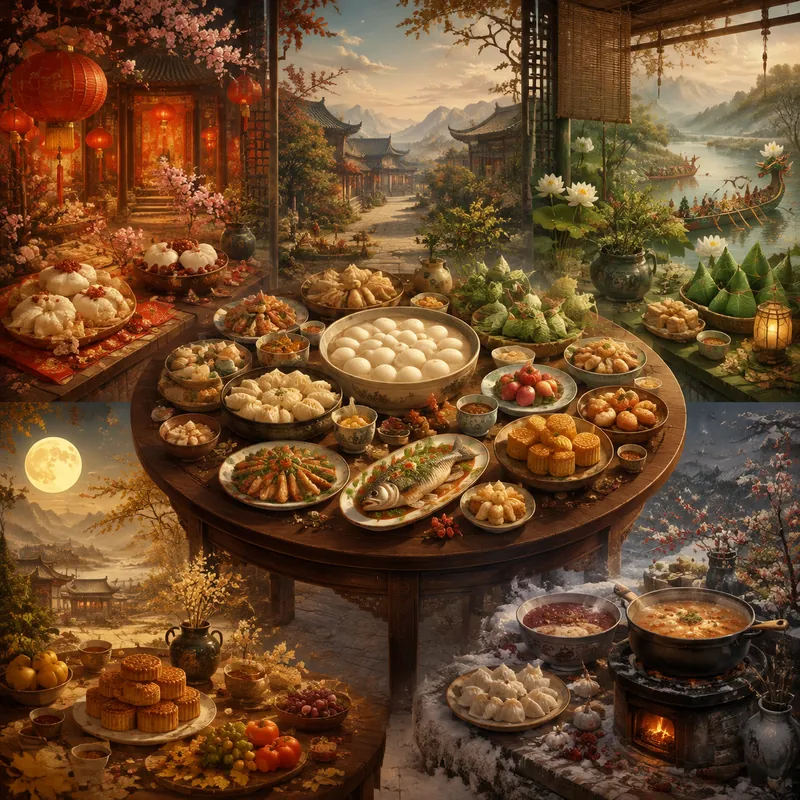
Seasonal Flavours · Seasonal Menu
Folk Arts
Song & Dance · Living Tradition · Heritage

Living Folk Arts · Of Song and Dance
Through Song and Dance · A Living Tradition
Opening Verse: 笙吹奏丰收曲,银饰闪亮贺苗年。 Introduction: Poetry associated with the Miao New Year often centers on lusheng music and dance, together with the brilliance of ceremonial silver ornaments. During the festival, “芦笙吹奏” and “银饰闪亮” are among its most characteristic images. Such poems frequently portray the festive scenes of Miao communities slaughtering pigs and sheep, honoring their ancestors, dancing to the lusheng, and holding bullfighting and bird-fighting contests. The Miao New Year is the grandest traditional festival of the Miao people, and poetry about the celebration often depicts lusheng music and dance alongside elaborate silver adornment. During the festival, men play the lusheng while women, wearing complete sets of silver ornaments, dance gracefully. The crisp chime of silver pendants mingles with lusheng melodies and song, creating the festival’s moving musical texture. Ancient Miao songs record both the origins of the Miao New Year and its traditional ways of celebration—slaughtering pigs and sheep, making glutinous-rice cakes, worshipping ancestors, sharing the year-end reunion meal, and drinking wine from village to village. Although Miao New Year poetry has not produced as many celebrated works handed down through the centuries as the festival poetry of the Han tradition, it finds rich expression in Miao folk literature, where plain and direct language records the joy with which this ancient people bids farewell to the old year and welcomes the new.
Global Features
Overseas · Chinese Communities · Celebrations
Overseas Celebrations · Lights of Chinese Communities
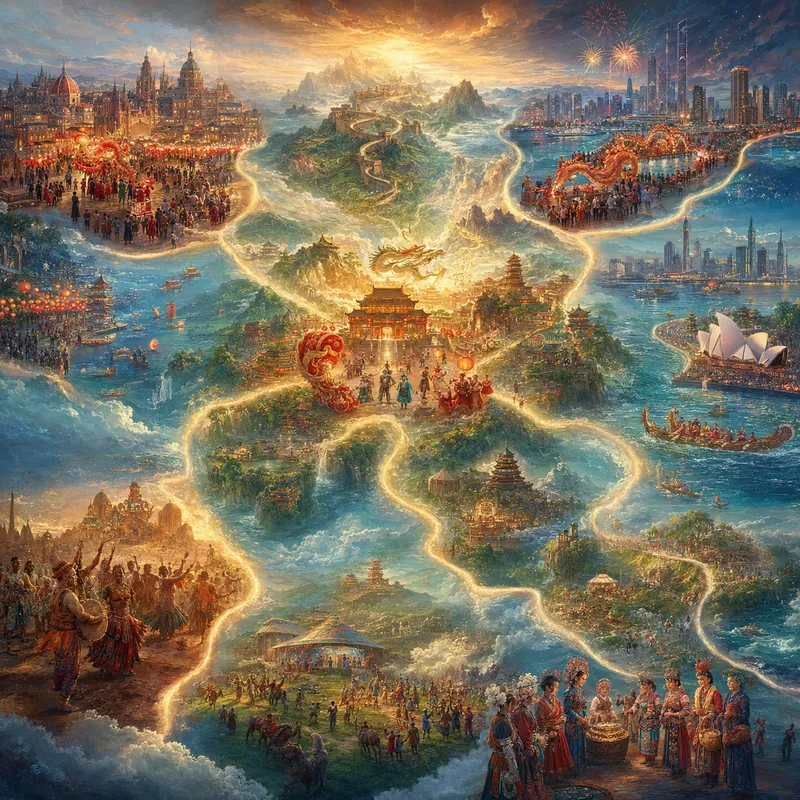
Laos is one of the countries with the largest concentrations of Miao people outside China. Miao New Year, also known as Hmong Xyoo Tshiab, is one of the most important festivals in the Miao calendar. As the capital of Laos, Vientiane hosts one of the grandest Miao New Year celebrations, renowned for its lively atmosphere, cultural displays, and large-scale gatherings of the Miao community. One of the most striking features of Miao New Year in Vientiane is the display of brilliantly colored traditional clothing. The Miao are renowned for their finely embroidered garments; different Miao branches have their own distinctive styles, and during New Year celebrations people wear their most magnificent dress, displaying vivid colors, intricate patterns, silver ornaments, headdresses, and other traditional accessories. Rituals form a central part of the festival, including offerings to ancestors and deities—families prepare traditional foods and arrange carefully decorated altars to pray for blessings in the coming year and express gratitude for the harvest of the year just passed. Traditional games and activities provide enjoyable ways for community members to celebrate together. Among the most popular are ball-tossing games, in which small bean-filled bags are thrown toward a series of hoops or targets; traditional Miao music and dance performances are indispensable to the celebrations; and traditional wrestling, known as “Miao wrestling,” is another festival highlight. Food plays a central role in Miao New Year festivities, with traditional dishes prepared and shared among relatives and friends, including Miao sausages, sticky rice, and Miao-style soups and stews. The communal character of the festival is reinforced through shared meals and social gatherings—relatives and friends come together for feasts, exchange gifts, and celebrate the New Year.
Thailand has a large Miao community, mainly distributed across the mountainous regions of the north, with Chiang Mai and Chiang Rai among the principal centers. The history of Thailand’s Miao population can be traced to migration from southwest China from the late nineteenth to the early twentieth century, giving the community a history of more than a century. Miao New Year is the grandest festival of the Miao people in Thailand and is held on the fifteenth day of the twelfth lunar month. Celebrations last for more than five days and include ancestral rites, banquets for guests, and numerous forms of entertainment, with the entire village taking part in ceremonial dress. Festival activities include striking gongs, tossing embroidered balls, playing the lusheng, bullfighting, cockfighting, and more. In the culture of Thailand’s Miao people, lusheng dance lies at the heart of both funerals and festivals, and lusheng melodies are an important vehicle of cultural transmission. Thailand’s Miao communities have also attracted Miao people from around the world through gatherings promoted as “Miao people from across the world reunite in Thailand for Miao New Year.” According to records, from January 7 to 13, 2021, Miao people from around the world gathered in Thailand to celebrate Miao New Year. Such transnational gatherings have made Thailand an important node in global Miao cultural exchange.
In Vietnam, an important Miao festival corresponds to China’s Huashan Festival (花山节) and is generally held from the third to the tenth day of the first lunar month. Vietnamese Miao communities also celebrate the Shicheng Festival (十成节), a traditional harvest festival observed in parts of southern China and Vietnam by several ethnic groups, including Han communities in some areas as well as Zhuang, Yi, Hani, Jing, Miao, and others. Among the Miao, the Shicheng Festival is the most important festival and is known as Bagu Festival (罢谷节) or Jiyang Festival (祭仰节).
In China, Miao New Year is the grandest festival in places such as the Qiandongnan Miao and Dong Autonomous Prefecture of Guizhou and Rongshui Miao Autonomous County in Guangxi. Leishan Miao New Year: an intangible-heritage parade of tens of thousands. Leishan County was one of the main gathering points of the fifth great migration of the Miao people in China. Miao residents account for 84% of the county’s total population, and the area has long been known as a “sacred land of the Miao frontier.” On November 4, 2025, Leishan County was immersed in the bustle and anticipation preceding the festival, as it prepared to formally launch a Miao New Year celebration lasting more than a month. Tens of thousands of people gathered there, rehearsing intensively in preparation for a spectacular “intangible-heritage parade of tens of thousands.” In 2017, the Leishan Miao New Year Intangible Cultural Heritage Showcase opened on a grand scale. Miao celebration groups from more than 20 countries and regions, including the United States, Canada, Australia, Thailand, France, and Laos, gathered in Leishan to celebrate Miao New Year together with 160,000 Miao people of Leishan. The parade, stretching for several kilometers and involving tens of thousands of participants, incorporated displays of Leishan County’s 13 national-level intangible cultural heritage items—including a five-starred red flag embroidered using multiple Miao embroidery techniques, a gigantic silver headdress 1.5 meters in diameter, and an enormous Miao wooden drum so heavy that more than a dozen strong Miao men were needed to carry it. The lusheng sounded melodiously, bronze drums rang with force, silver bells rustled, embroidered skirts swirled through the air—at that moment, Leishan truly lived up to its reputation as a global showcase center for Miao culture. During Miao New Year, traditional entertainment also includes bullfighting, horse racing, bird fighting, lusheng dancing, and drum dancing. The festival is an important window for the concentrated display of intangible cultural heritage such as Miao clothing, silverwork, and embroidery. Rongshui Miao New Year: “Da Tongnian” and the experience of French artists. Rongshui Miao Autonomous County in Liuzhou, Guangxi, is another important center of Miao New Year celebrations. In December 2025, a group of French artists traveled to Mengwu Miao Village in Rongshui to experience the Miao celebration of “Miao New Year · Da Tongnian (打同年)”, encountering the essence of original local culture and art. On January 20, 2026, during the Great Cold solar term, Dangjiu Village in Gandong Township, Rongshui County, held its traditional Miao New Year celebration. Local residents and visitors played the lusheng, sang Miao songs, performed Miao dances, and shared a hundred-family banquet amid cold winds and light rain. Mengwu Miao Village in Shuanglonggou, Rongshui, is a new village established through relocation for poverty alleviation. There, around one hundred local Miao people and visitors gathered joyfully to “Da Tongnian,” welcoming the New Year in the traditional Miao way. At a Da Tongnian event held in Baiyun Township in 2024, more than 40 media organizations broadcast the celebration live to global audiences, attracting more than five million viewers in a single broadcast. The custom has already moved beyond the boundaries of Miao villages, with Dong, Yao, Zhuang, and other ethnic groups joining the celebrations.
Visitor Guide
Preparation · Etiquette · Take Part with Confidence
Readers’ Comments
Calendar and traditional culture enthusiasts from around the world, sharing the same moon.
Sign in or register to join the conversation. Your comment account is created automatically the first time you use a connected account.
No comments yet
Share your thoughts with readers around the world.