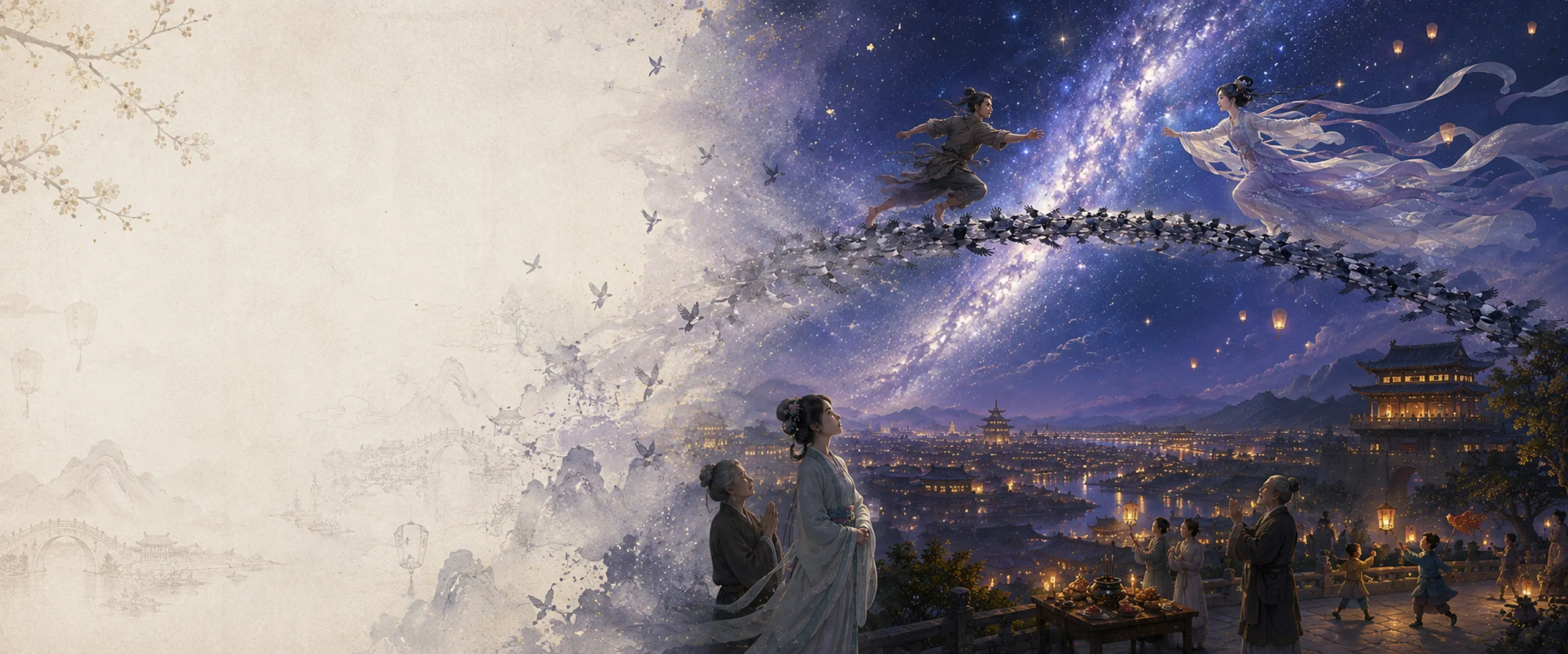
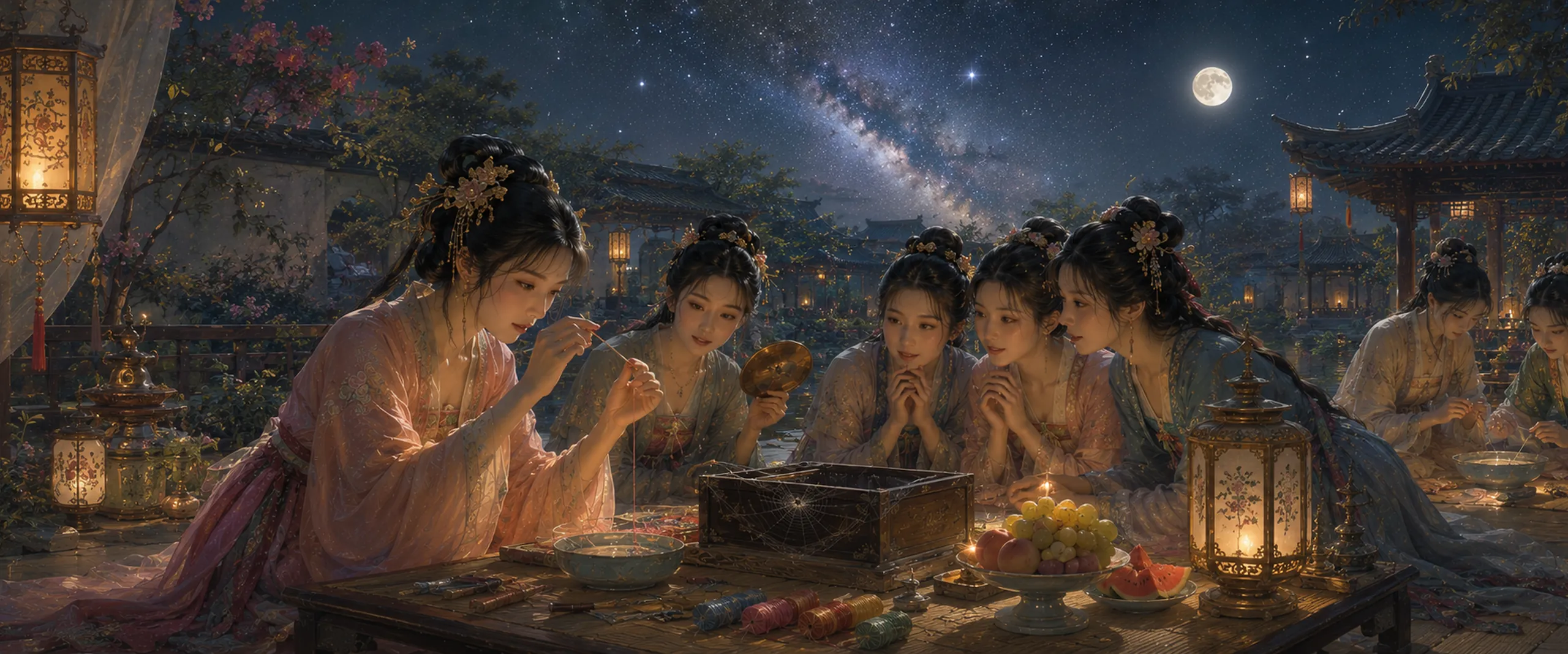
The most widespread customs of Qixi Festival are the various qiqiao (乞巧, pleading for skill) activities performed by women on the night of the seventh day of the seventh lunar month. Girls traditionally tested their dexterity by threading needles, made small handicrafts to compete in skill, and arranged fruits and melons as offerings while praying for ingenuity. Specific forms of qiqiao included “threading needles to plead for skill,” “seeking signs of skill from spiders,” “threading needles by moonlight,” “competing in skill on the Night of the Seventh,” and “testing skill by floating needles.” Because young women were the principal participants, Qixi was also called the “Qiqiao Festival” and the “Daughters’ Festival.” The earliest records of Qixi date to the Western Han dynasty, and the festival reached its height during the Song dynasty. Other traditional customs included airing books and clothing.
Main Customs
Worshipping the Seventh Sister (Worshipping the Weaver Girl)
Basic Information
- Category: Sacrificial Worship and Prayers for Blessings
- Popular Regions: Nationwide, especially prevalent in Guangdong, Fujian, and other regions
- Time: Evening of Qixi
- Also Known As: Worshipping the Weaver Girl, Qiniang Gathering, Birthday of the Seventh Sister
Activities
The story connecting Qixi with the star of the Weaver Girl originated in ancient Chinese celestial worship. The Seventh Sister was modeled on the Weaver Star and came to be regarded as the guardian deity of lovers, women, and children, with the seventh day of the seventh lunar month considered her birthday. People therefore worship the Seventh Sister on the evening of that day to pray for blessings, make wishes, plead for skill, pray for a favorable marriage, and ask for the protection and safety of children.
The “Worshipping the Seventh Sister” tradition of Guangzhou, Guangdong, is particularly distinctive. Girls prepare all manner of ingenious small objects in advance using colored paper, pith, string, and other materials. Grain seeds and mung beans are placed in small containers and soaked in water until they sprout; these are called “immortal-worshipping grain” (拜仙禾) and “deity-worshipping vegetables” (拜神菜). From the evening of the sixth day through the evening of the seventh, girls dress in new clothes and jewelry, burn incense and light candles, and kneel beneath the stars in a ritual called “welcoming the immortals” (迎仙), performing seven rounds of worship from the third to the fifth watch of the night. In Dongguan, Guangdong, the “Worshipping the Seventh Sister on Qixi” ceremony includes presenting offerings, cleansing the hands, offering incense, and performing acts of worship.
In southern Fujian, Qixi is called “Qiniangma’s Birthday” (七娘妈生). Offerings include seven kinds of fruit, seven sets of fragrant flowers and cosmetics, seven pairs of chopsticks, and seven wine cups. On a child’s first Qixi after birth, a “new bond” (新契) is established by worshipping Qiniangma as the child’s qimu (契母, ritual godmother). Taiwan’s Qixi customs descend from the same southern Fujian tradition: every household prepares sacrificial animals and wine, fruits, and flower powder, and burns paper beneath the eaves to celebrate Qiniangma’s birthday.
Historical Origins
The custom of worshipping the Seventh Sister has a long history. Worship of the Weaver Star can be traced back to celestial observation in ancient times. Through observation of the stars, ancient people came to refer collectively to the “Ox Mansion Star” and the “Weaver Star” as the “Cowherd and Weaver Girl.” After the Eastern Han dynasty, the legend of the Cowherd and Weaver Girl gradually became associated with Qixi Festival. By the Northern and Southern dynasties, the practice of offering fruits and melons to the two stars had begun to take shape.
How to Participate
On the evening of Qixi, an incense table may be set up in the courtyard with seasonal fruits, flowers, fragrant powder, and other offerings. Incense can be burned in worship of the Weaver Star while silently making a wish. In Guangdong, visitors may participate in communal worship ceremonies such as the Qiniang Gathering (七娘会). In Fujian and Taiwan, one may learn about the cultural significance of belief in Qiniangma (七娘妈).
Threading Needles to Plead for Skill
Basic Information
- Category: Competitive Games and Recreation
- Popular Regions: Nationwide
- Time: Evening of Qixi
- Also Known As: Competing in Skill, Threading Needles by Moonlight
Activities
Threading needles to plead for skill is one of the most central forms of qiqiao during Qixi Festival. Women compete in threading needles beneath the moonlight, with speed determining the winner. In Guangdong, after the ritual of “welcoming the immortals,” girls hold colored threads and attempt to thread needle eyes by lamplight. A girl who can thread seven needle eyes in one continuous attempt is said to have “obtained skill” (得巧) and is called a “skillful hand” (巧手); anyone unable to thread all seven is said to have “lost in skill” (输巧). After Qixi, girls exchange the small handicrafts they have made as tokens of friendship.
Historical Origins
Threading needles to plead for skill is the earliest recorded form of qiqiao. Ge Hong’s Xijing Zaji (《西京杂记》) of the Eastern Jin dynasty records: “汉彩女常以七月七日穿七孔针于开襟楼,人俱习之”. This is the earliest known record of qiqiao in ancient literature. The Tang poet Wang Jian wrote: “阑珊星斗缀珠光,七夕宫娥乞巧忙”.
How to Participate
On the evening of Qixi, prepare needles and thread and compete with friends in threading needles beneath moonlight or lamplight. You may also prepare seven needles and try to pass a thread through all seven needle eyes in one continuous attempt, experiencing the pleasure of “obtaining skill.”
Seeking Signs of Skill from Spiders
Basic Information
- Category: Divination and Prayers for Blessings
- Popular Regions: Nationwide
- Time: From the evening of Qixi until the following morning
- Also Known As: Divining Skill from Spider Webs
Activities
Seeking signs of skill from spiders is another form of qiqiao. A woman catches a small spider and places it in a box. The next morning, she opens the box and judges whether she has “obtained skill” according to the density of the web the spider has spun. If the spider has woven a web inside the box, it means that she has “successfully pleaded for skill.” The denser the web, the greater the skill believed to have been obtained.
Historical Origins
The custom of seeking signs of skill from spiders was already recorded during the Northern and Southern dynasties. Zong Lin’s Jingchu Suishiji (《荆楚岁时记》) of the Liang dynasty records: “七月七日,……陈瓜果于庭中以乞巧,有喜子网于瓜上,则以为符应。” The xizhu (喜蛛) was also known as xizi (喜子), and ancient people regarded a spider spinning its web as an auspicious sign. The custom became widespread during the Tang and Song dynasties and continued into the Ming and Qing periods.
How to Participate
On the evening of Qixi, a small spider may be placed in a clean box. Open the box the following morning to see whether it has spun a web. If a web has appeared, it may be regarded as an auspicious sign of “obtaining skill.”
Testing Skill by Floating Needles
Basic Information
- Category: Divination and Prayers for Blessings
- Popular Regions: Nationwide, especially prevalent during the Ming and Qing dynasties
- Time: Qixi Day
- Also Known As: Divining Skill from Needle Shadows
Activities
Testing skill by floating needles was a form of qiqiao popular during the Ming and Qing dynasties. Women place a bowl of water in the sun. After a thin film forms on the surface, an embroidery needle is gently laid upon the water. If the needle remains floating without sinking and casts various shapes as shadows or projections on the bottom of the bowl, this is regarded as “obtaining skill.” The more exquisite the projected form, the greater the skill believed to have been obtained.
Historical Origins
The custom of testing skill by floating needles arose relatively late and flourished during the Ming and Qing dynasties. It expanded qiqiao from a simple competition in threading needles into a more playful form of divination, reflecting the continuing enrichment and evolution of Qixi’s qiqiao customs.
How to Participate
On Qixi Day, place a bowl of clear water in the sunlight. Once a thin film has formed on the surface, gently lay an embroidery needle on the water and observe whether it floats and what kind of projection appears on the bottom. This activity may be carried out indoors or on a balcony.
Eating Qiaoguo
Basic Information
- Category: Food Custom
- Popular Regions: Nationwide
- Time: Around Qixi Festival
- Main Ingredients: Flour, oil, sugar, sesame, and others
- Also Known As: Qiaoshi (巧食), Qiqiao Guozi (乞巧果子)
Activities
Qiaoguo (巧果) is an iconic food of Qixi Festival. In Hangzhou, Ningbo, Wenzhou, and other parts of Zhejiang, flour is shaped into various small forms and fried in oil, producing what are known as qiaoguo. At night, qiaoguo, lotus seedpods, white lotus roots, red water caltrops, and other foods are displayed in the courtyard, while girls thread needles by moonlight to plead for skill. In Jiaodong and other parts of Shandong, young women use flour to make cakes and buns decorated in the shapes of peonies, lotuses, plum blossoms, orchids, chrysanthemums, and other flowers. With their delicate and varied forms, qiaoguo serve both as offerings to the Weaver Girl and as displays of women’s dexterity.
Historical Origins
The custom of eating qiaoguo on Qixi has a long history. The making and eating of qiaoguo was already a Qixi tradition during the Song dynasty. By the Ming and Qing dynasties, their preparation had become increasingly elaborate, and qiaoguo had become an indispensable seasonal food of the festival.
Cultural Meaning
The name qiaoguo (巧果) derives from qiqiao (乞巧, pleading for skill). Eating qiaoguo expresses the hope of becoming as intelligent and dexterous as the Weaver Girl. Their exquisite forms likewise display women’s craftsmanship and ingenuity.
How to Participate
Around Qixi, qiaoguo can be made at home by kneading flour with sugar, sesame, and other ingredients into a dough, shaping it into small pastries in the forms of flowers or animals, and frying or baking them until golden and crisp. Ready-made qiaoguo may also be purchased from markets for tasting.
Storing Qixi Water
Basic Information
- Category: Health and Prayers for Blessings
- Popular Regions: Guangxi, Guangdong, and other areas
- Time: Morning of Qixi
- Also Known As: Double-Seven Water, Seventh-Day-of-the-Seventh-Month Water
Activities
In western Guangxi, Guangdong, and other areas, legend holds that fairies descend to the mortal world to bathe on the morning of the seventh day of the seventh lunar month, and that drinking their bathwater can ward off evil, cure illness, and prolong life. This water is known as “Double-Seven Water” (双七水). At the crowing of the rooster, people rush to the riverside to collect water, which is then stored in a new earthen jar for future use. In Baise, Jingxi, and other parts of Guangxi, people enter rivers to bathe on Qixi. Folk belief holds that the water on this day is exceptionally sacred and pure, capable not only of warding off evil and disease but also of bringing fulfillment in love and happiness in life.
Historical Origins
The custom of storing Qixi water has a long history and is associated with the legend of the Seven Fairies descending to the mortal world to bathe. Ancient people believed that Qixi water possessed extraordinary divine power and could dispel illness and prolong life. Widely transmitted across southern China, the custom reflects ancient reverence for water and prayers for good health.
How to Participate
On the morning of Qixi, water may be collected from a river or well and stored as a symbolic experience of this ancient custom. City residents may rise early and collect tap water, experiencing the traditional meaning associated with “Qixi water.”
Collecting Dew
Basic Information
- Category: Health and Prayers for Blessings
- Popular Regions: Rural Zhejiang
- Time: Qixi Night
- Also Known As: Qixi Dew
Activities
In rural Zhejiang, there is a widespread Qixi custom of collecting dew in a washbasin. According to legend, the dew of Qixi consists of the tears shed by the Cowherd and Weaver Girl when they reunite. Applying it to the eyes and hands is believed to make the eyes keen and the hands quick.
Historical Origins
The custom of collecting dew is directly connected with the legend of the Cowherd and Weaver Girl meeting upon the Magpie Bridge. Ancient people believed that the tears shed during their reunion on Qixi night became dew imbued with magical power. The custom reflects the romantic imagination with which folk tradition has surrounded the love story of the Cowherd and Weaver Girl.
How to Participate
On the evening of Qixi, place a clean washbasin in the courtyard. Collect the dew the following morning and symbolically apply it to the eyes and hands.
Dyeing Fingernails
Basic Information
- Category: Beauty and Prayers for Blessings
- Popular Regions: Southwest China, including Sichuan, Guizhou, Yunnan, and other areas
- Time: Around Qixi Festival
- Also Known As: Dyeing the Fingers, Dyeing Nails with Flowers and Plants
Activities
Dyeing fingernails is a Qixi custom found in southwestern China. Using flowers and plants to color the nails is a favorite festive pastime among many women and children and is also closely connected with fertility beliefs. In many regions, young women also wash their hair with tree sap diluted in water during the festival. According to legend, this not only helps them remain young and beautiful, but also allows unmarried women to find a desirable husband sooner.
Historical Origins
The custom of dyeing fingernails has long circulated in southwestern China. Numerous county gazetteers from Sichuan, as well as records from Guizhou and Guangdong, document the practice. This custom extended the Qixi idea of qiqiao beyond needlework and women’s handicrafts into beauty and adornment, reflecting women’s pursuit of beauty.
How to Participate
Around Qixi, fingernails may be dyed with the juice of balsam flowers and other plants. Plant sap diluted with water may also be used to wash the hair, offering an experience of traditional beauty practices.
Incense Bridge Gathering
Basic Information
- Category: Sacrificial Worship and Prayers for Blessings
- Popular Regions: Yixing in Jiangsu, Jiaxing in Zhejiang, and other areas
- Time: Evening of Qixi
- Also Known As: Magpie Bridge Gathering
Activities
The Incense Bridge Gathering (香桥会) evolved from the legend of the Magpie Bridge. In Yixing, Jiangsu, people gather every Qixi to construct an incense bridge. Long, thick sticks of wrapped incense are used to build a bridge approximately four or five meters long and about half a meter wide. Railings are added, and flowers made from five-colored threads are tied to the structure as decoration. After nightfall, people worship the two stars and pray for blessings. The incense bridge is then burned, symbolizing that the two stars have crossed the bridge and joyfully reunited.
Historical Origins
The Incense Bridge Gathering originated in the legend of the Cowherd and Weaver Girl meeting upon the Magpie Bridge. The incense bridge represents the Magpie Bridge itself. Through the rituals of constructing and burning the bridge, people express their blessings for the reunion of the Cowherd and Weaver Girl and their longing for a happy marriage. This custom has been preserved to the present day in Yixing, Jiangsu, Jiaxing, Zhejiang, and other areas.
How to Participate
On the evening of Qixi, visitors may travel to Yixing in Jiangsu or Jiaxing in Zhejiang to observe an Incense Bridge Gathering. A small incense bridge may also be constructed at home from incense sticks as a way of experiencing this distinctive folk tradition.
Binding Qiaogu
Basic Information
- Category: Sacrificial Worship and Prayers for Blessings
- Popular Regions: Loess Plateau region of Shaanxi
- Time: Evening of Qixi
- Also Known As: Making Qiaogu
Activities
On the Loess Plateau of Shaanxi, women traditionally bind straw figures dressed in colorful clothing during Qixi, calling them Qiaogu (巧姑). On Qixi night, women from each household hold a bowl of clear water, place cut bean sprouts and green scallions into it, and divine whether they will be skillful or unskillful by observing the shadows cast by the objects under the moonlight. Women also compete in threading needles, sewing, and cutting window-paper decorations to see whose hands are the most skillful.
Historical Origins
The custom of binding Qiaogu has long been practiced on the Loess Plateau of Shaanxi. The straw figure symbolizes the Weaver Girl, while divination and competitions are used to pray for dexterity, embodying the distinctive qiqiao culture of northern China.
How to Participate
On the evening of Qixi, a small straw figure may be made and dressed in colorful clothing to symbolize Qiaogu. Prepare a bowl of clear water, add bean sprouts and green scallions, and observe the shadows they cast beneath the moonlight, experiencing the traditional practice of divining one’s dexterity.
Regional Variations
North China
Beijing:Qiqiao activities primarily involve testing dexterity by threading needles. In Shanxi and some other parts of North China, there is also a tradition of sewing cloth tigers (布老虎). As part of Qixi qiqiao activities, older generations sew their affection into these cloth figures, expressing their hopes and blessings for the younger generation.
Hebei:Qixi qiqiao activities mainly center on testing dexterity through threading needles.
Shanxi:During Qixi qiqiao activities, there is a tradition of sewing cloth tigers (布老虎), embodying the hopes and blessings of older generations for the young.
Inner Mongolia:Qixi customs mainly consist of traditional qiqiao activities.
Northeast China
Liaoning / Jilin / Heilongjiang:Qixi customs are similar to those of North China, with qiqiao activities at their core.
East China
Shanghai:Qixi customs mainly include traditional activities such as qiqiao and eating qiaoguo.
Jiangsu:In Yixing, there is a Qixi custom known as the Incense Bridge Gathering (香桥会), derived from the legend of the Magpie Bridge. People use long, thick sticks of wrapped incense to construct a bridge approximately four or five meters long and about half a meter wide, complete with railings and flowers made from five-colored threads. After nightfall, people worship the two stars and pray for blessings, then burn the incense bridge, symbolizing that the two stars have crossed the bridge and joyfully reunited. The old village of Doujing in Tanghui Township, Jiaxing, also observes the Incense Bridge Gathering.
Zhejiang:In the past, Kanshan Town in Xiaoshan, Hangzhou, held an annual Qixi ritual called “Worshipping the Stars and Pleading for Skill” (祭星乞巧). An Eight Immortals table was placed in the courtyard with decorative edgings, seasonal fruits, and sacrificial wine arranged in the shape of a heart; young women offered wine to the Cowherd and Weaver Girl and prayed for deft hands and ingenuity. In old Ningbo, women picked hibiscus leaves, crushed them for their juice, and washed their hair with it; legend held that the Weaver Girl washed her hair with hibiscus-leaf juice, which was why it remained black. Young women also gathered among eggplant plants, lay on the ground with their ears pressed close, and listened for sounds; those who heard a clanging sound were considered to have “obtained skill.” In Wenzhou, flour was fashioned into various small forms and fried in oil, producing qiaoguo (巧果). At night, qiaoguo, lotus seedpods, white lotus roots, and red water caltrops were displayed, while girls threaded needles under the moon; alternatively, spiders were placed in boxes, and if a web had been spun when the box was opened the next day, this was called “obtaining skill” (得巧). Jiaxing has the Incense Bridge Gathering. In Jinhua, every household kills a rooster, meaning that if no rooster crows at dawn when the Cowherd and Weaver Girl meet, the pair can remain together forever. Wuyi’s custom of “Welcoming the Fairy on Qixi” is a provincial-level intangible cultural heritage practice: rural girls gather Vitex branches and Chinese tallow leaves, pound them for their juice, and wash their hair with it, while women set up incense tables with fruits and pastries and worship the Seven Fairies from afar. In Shitang Town, Wenling, Taizhou, the “Shitang Children’s Festival” (石塘小人节) is a national-level intangible cultural heritage practice. Elders pray to Qiniangma (七娘妈) on Qixi for children under the age of sixteen, and households with children set up offering tables with colorful pavilions, decorated sedan chairs, and other objects to worship Qiniangma. In Guanxi Village, Quzhou, the folk temple fair held on the seventh day of the seventh lunar month began in the Ming dynasty and has continued for centuries. In rural Zhejiang, the custom of collecting dew in a washbasin is widespread; according to legend, the dew consists of the tears shed when the Cowherd and Weaver Girl reunite.
Anhui:Qixi customs mainly include traditional activities such as qiqiao and eating qiaoguo.
Fujian:In southern Fujian, Qixi is called “Qiniang’s Birthday” (七娘生) or “Qiniangma’s Birthday” (七娘妈生). Many customs are associated with the number seven: seven kinds of fruit offerings, seven sets of fragrant flowers and cosmetics, seven pairs of chopsticks, and seven wine cups. In Quanzhou, Qixi customs include “pleading for skill,” “displaying fruits,” and “children worshipping Tiansun (天孙).” A child’s first Qixi after birth requires a “new bond” (新契), through which the child worships Qiniangma as a qimu (契母, ritual godmother). On that day, the “life-prolonging cords” tied around the wrists during the Dragon Boat Festival are removed. People also make tangguo (糖粿)—red and white glutinous-rice balls with a depression pressed into the center—as offerings to Qiniangma. Women thread needles by moonlight in competitions to “obtain skill”; on Qixi night, young women and newly married women set up incense tables beneath the moonlight, burn incense, and worship the Weaver Girl. In Fuzhou, women arrange an incense burner together with tea, wine, the “five seeds” or wuzi (五子)—longan, red dates, hazelnuts, peanuts, and melon seeds—and cosmetics to worship the two stars. After the ritual, half the cosmetics are thrown onto the roof for the Weaver Girl, while the other half is kept for the women’s own use.
Jiangxi:Qixi customs mainly involve traditional activities such as qiqiao and displaying fruits and melons.
Shandong:In Jinan, Huimin, Gaoqing, and other places, qiqiao activities are very simple: fruits and melons are displayed for qiqiao, and if a lucky spider spins a web over the offerings, it is regarded as having “successfully pleaded for skill.” In Juancheng, Cao County, Pingyuan, and other areas, people eat qiaoqiao rice (巧巧饭): seven girls gather grain and make dumplings together, placing a coin, a needle, and a red date inside different dumplings. Whoever eats the coin is blessed with good fortune, whoever finds the needle will be dexterous, and whoever gets the red date will marry early. In Jiaodong, people commonly worship the Goddess of the Seven Sisters (七姐神). Young women dress in new clothes, gather together to form bonds as seven sworn sisters, and sing qiqiao folk songs. Around Zhucheng, Teng County, and Zou County, rain falling on Qixi is called “rain of longing” (相思雨) or “tears of longing” (相思泪). In southwestern Shandong, seven girls place water in a copper basin and expose it to the sun; after patterns appear on the water’s surface at noon, they “cast a needle” (抛针) to plead for skill. If the needle floats on the surface, the girl is considered a “skillful person” (巧人). After dinner, fruits and offerings are displayed, incense is lit, and the women kneel to worship the Weaver Star.
Central China
Henan:Qixi customs mainly center on qiqiao activities.
Hubei:The customs of Yunxi Qixi were included in the fourth batch of China’s national intangible cultural heritage list in 2014. In the Han River basin, including northwestern Hubei, Qixi is marked by three days and three nights of folk sacrificial rites, singing, and dancing.
Hunan:In Changsha, women in both urban and rural areas place fruits and melons in the courtyard and pray to the two stars for peace and safety. Girls learning embroidery thread needles beneath the moonlight, asking the Weaver Girl to teach them embroidery skills. On the night before Qixi, they place “mandarin-duck water” (鸳鸯水)—half well water and half river water—in buckets or basins and leave it outdoors overnight. The Youxian Gazetteer (《攸县志》) of Xiangtan records: “七月七日,妇女采柏叶、桃枝,煎汤沐发”.
South China
Guangdong:In the Cantonese-speaking region, Qixi is called the “Birthday of the Seventh Sister” (七姐诞). Guangzhou’s “Worshipping the Seventh Sister” (拜七姐), also known as the “Qiniang Gathering” (七娘会), is particularly distinctive. Girls prepare various ingenious small objects in advance using colored paper, pith, and other materials. They soak grain seeds and mung beans until they sprout, calling them “immortal-worshipping grain” (拜仙禾) and “deity-worshipping vegetables” (拜神菜). From the evening of the sixth day to the evening of the seventh, girls put on new clothes and new jewelry, burn incense and light candles, and kneel beneath the stars in a rite called “welcoming the immortals” (迎仙), performing seven rounds of worship from the third to the fifth watch of the night. In the lamplight they hold thread and pass it through needle eyes; anyone who can thread seven needle eyes in a single attempt is said to have “obtained skill” (得巧) and is called a “skillful hand” (巧手). In Daojiao Town, Dongguan, the “Qixi Offering Table” (七夕贡案) is a traditional moon-worshipping custom. Its rites include arranging displays of craftsmanship, worshipping the immortals, pleading for skill, and washing with Seventh Sister water. Early on the sixth day, women arrange the sacrificial tables while crowds gather to view the offerings; at midnight on the seventh day, paper garments for the Seventh Sister are burned as part of the worship. In Zhu Village, the “Displaying for Qiniang” custom includes arranging displays of skill, worshipping the immortals, pleading for skill, eating Qiniang rice, and watching Qiniang opera. Guangzhou also has a Qixi custom in which women travel by boat to Shimen Chenxiangpu, decorating the boats with jasmine and Arabian jasmine flowers. In Guangdong folk tradition, Sterculia nobilis fruit (苹婆) is used as an offering. In Guangdong, Guangxi, and other regions, people traditionally store “Seventh-Day-of-the-Seventh-Month Water” (七月七水), also known as “Seventh Sister Water” (七姐水) or “Double-Seven Water” (双七水), which legend says can cure illness.
Guangxi:According to legend, fairies descend to the mortal world to bathe on the morning of Qixi, and drinking their bathwater can ward off evil, cure illness, and prolong life. This water is called “Double-Seven Water” (双七水). At the crowing of the rooster, people rush to the riverside to collect the water, storing it in a new earthen jar for later use. Children who are frail or frequently ill often wear a red cord tied with seven knots around their necks as a prayer for good health.
Hainan:Qixi customs resemble those of other parts of South China, with qiqiao activities at their core.
Hong Kong and Macao:Hong Kong shares many Qixi customs with Guangdong, including worship of the Seventh Sister. Macao’s Qixi customs belong to the same cultural tradition as those of the Cantonese-speaking region.
Southwest China
Sichuan:In southwestern China, there is a Qixi custom of dyeing fingernails.
Chongqing:Qixi customs mainly center on qiqiao activities.
Guizhou:Qixi customs resemble those of other parts of Southwest China.
Yunnan:Qixi customs mainly center on qiqiao activities.
Tibet:Qixi customs mainly consist of traditional qiqiao activities.
Northwest China
Shaanxi:On the Loess Plateau, women traditionally observe the Qixi custom of “binding Qiaogu” (结扎巧姑). Straw is tied into a roughly one-meter-tall figure called Qiaogu (巧姑, the Skillful Maiden, symbolizing the Weaver Girl), dressed in a green jacket and red skirt and seated in the courtyard. Women offer fruits and melons and bring out bean sprouts and scallion shoots grown in advance, known as “growing life” (种生) or “qiaoyaya” (巧芽芽). They cut bean shoots and green scallions and place them in bowls of clear water, judging their skill or lack of it by the shadows cast beneath the moon. They also compete in threading needles and hold paper-cutting competitions to test dexterity and ingenuity. Provincial-level intangible cultural heritage projects include the “Qixi Legend of Shipomiao Temple in Doumen, Chang’an” and the “Dali Qiqiao Festival.”
Gansu:The Qiqiao Festival in Xihe County and Li County, Longnan, has been passed down for more than 1,800 years and is known as a “living fossil” of ancient Chinese qiqiao customs. In 2008 it was included in the national intangible cultural heritage list. Activities begin on the evening of the thirtieth day of the sixth lunar month and end on the evening of the seventh day of the seventh lunar month, lasting seven days and eight nights. They are divided into seven stages: zuoqiao (坐巧), yingqiao (迎巧), jiqiao (祭巧), baiqiao (拜巧), yuqiao (娱巧), buqiao (卜巧), and songqiao (送巧). Zuoqiao is the preparation stage; yingqiao is the first ritual, in which girls dress in their finest clothes and form a procession outside the village to welcome Qiao Niangniang (巧娘娘) down to the mortal world; jiqiao consists of daily worship; baiqiao continues from the second through the sixth day, with participants visiting and worshipping together; yuqiao involves girls singing qiqiao songs and performing qiqiao dances; buqiao is the climax, when qiaoya sprouts are pinched off using “sacred water” and placed into water, with the projected patterns used to divine the future; during songqiao, late on the night of the seventh day, people sing the Songqiao Song (《送巧歌》), carry the image of Qiao Niangniang to the riverside, burn it, and send her back to the celestial realm. The qiqiao folk customs of Xihe County originated in the Qin and Han dynasties, developed through the Tang and Song dynasties, and flourished during the Ming and Qing dynasties.
Ningxia:Qixi customs mainly consist of traditional qiqiao activities.
Qinghai:Qixi customs mainly consist of traditional qiqiao activities.
Xinjiang:Qixi customs mainly consist of traditional qiqiao activities.
Taiwan:On Qixi, people worship Qiniangma (七娘妈). Every household prepares sacrificial animals and wine, fruits, flower powder, and other offerings, burns paper beneath the eaves, and celebrates Qiniangma’s birthday, burning together with the offerings the five-colored threads worn by children. Tainan’s “Coming of Age at Sixteen” (做十六岁) ceremony is the most famous. When a child reaches sixteen, the parents take the child to a Qiniangma temple to give thanks for her protection throughout infancy, childhood, and adolescence. Students dress in the robes of a top imperial examination scholar and, accompanied by their parents, pass beneath the “Qiniangma Pavilion” (七娘妈亭), symbolizing that they have “grown into adulthood.” Taiwanese folk practice also includes preparing a small bowl of oily rice to worship the Bed Mother (床母) inside the home. The custom of worshipping Qiniangma on Qixi has been passed down since the Kangxi reign period.
North
In northern China, Qixi Festival centers on qiqiao (pleading for skill) and douqiao (斗巧, competing in skill), emphasizing the competition and display of women’s craftsmanship. In Jinan, Huimin, Gaoqing, and other parts of Shandong, fruits and melons are displayed for qiqiao; if a lucky spider spins a web over them, this is regarded as having “successfully pleaded for skill.” In Juancheng, Cao County, Pingyuan, and other places in Shandong, people eat qiaoqiao rice (巧巧饭): seven girls gather grain and make dumplings together, placing a coin, a needle, and a red date in different dumplings. The person who finds the coin is blessed with good fortune, the one who finds the needle will be dexterous, and the one who finds the red date will marry early. On the Loess Plateau of Shaanxi, women bind figures of Qiaogu, and hold competitions in threading needles, sewing, and cutting window-paper decorations. Kaifeng in Henan has a children’s custom involving Mohele (磨喝乐). Northern Qixi places greater emphasis on displaying and competing in women’s skills.
South
In southern China, “Worshipping the Seventh Sister” and “storing Qixi water” are among the most distinctive Qixi customs. Guangzhou’s “Worshipping the Seventh Sister”, or “Qiniang Gathering”, is particularly representative. Girls prepare small objects from colored paper, pith, and other materials in advance, and soak grain seeds and mung beans until they sprout, calling them “immortal-worshipping grain” and “deity-worshipping vegetables.” From the evening of the sixth day through the evening of the seventh, they perform seven rounds of worship. Guangxi has a custom of storing “Double-Seven Water”, which legend says can ward off evil, cure illness, and prolong life. In southern Fujian and Taiwan, Qixi developed into “Qiniangma’s Birthday,” a festival associated with protecting children as they grow. Zhejiang has romantic customs such as collecting dew and listening for whispered conversations beneath melon trellises. Southern Qixi places greater emphasis on sacrificial ritual and traditions of water worship.
Northwest
In northwestern China, the Xihe Qiqiao Festival of Gansu is the most celebrated Qixi tradition. The Qiqiao Festival of Xihe County and Li County has been passed down for more than 1,800 years and is praised as a “living fossil” of ancient Chinese qiqiao customs. In 2008, it was included in the national intangible cultural heritage list. Beginning on the evening of the thirtieth day of the sixth lunar month and ending on the evening of the seventh day of the seventh lunar month, the festival lasts seven days and eight nights and consists of seven stages: zuoqiao, yingqiao, jiqiao, baiqiao, yuqiao, buqiao, and songqiao. The Loess Plateau region of Shaanxi also preserves distinctive customs such as binding Qiaogu and divining through the shadows of objects placed in water.
Closing Note
The folk customs of Qixi Festival form an expansive cultural scroll devoted to “pleading for skill” and “making wishes.” From contests in threading needles to the devout worship of the Seventh Sister, from the playful divination of seeking signs of skill from spiders to the ingenious game of testing skill by floating needles, from storing Qixi water in hopes of dispelling illness and receiving blessings to the sweet hopes embodied in eating qiaoguo—the customs of Qixi bring together the ancient reverence for the stars, the pursuit of craftsmanship, the longing for love, and prayers for a fulfilling life.
Qixi is a festival of qiqiao—pleading for skill. The Weaver Girl is regarded as a beautiful, intelligent, and exceptionally dexterous immortal maiden. On Qixi night, women in the mortal world pray to her for wisdom and skill, hoping to become proficient in needlework and textile crafts. “Threading needles to plead for skill,” “seeking signs of skill from spiders,” and “testing skill by floating needles”—every form of qiqiao embodies the aspirations of women in ancient China toward the virtue of being clever of mind and skillful of hand. In the traditional society of men farming and women weaving, dexterity was regarded as one of the foundations upon which a woman established herself in life.
Qixi is also a festival of making wishes. Women prayed not only for skill, but also for children, longevity, beauty, and love. Countless men and women joined by affection would look toward the stars on this night and pray for a happy marriage. Qixi has always been intertwined with the legend of the Cowherd and Weaver Girl, a beautiful love story passed down through the ages. “金风玉露一相逢,便胜却人间无数”, from Qin Guan’s Queqiao Xian (《鹊桥仙》), is one of the most romantic literary expressions of Qixi.
The customs of Qixi achieve a perfect union between “pleading for skill” and “making wishes.” Pleading for skill expresses the pursuit of craftsmanship; making wishes expresses the longing for happiness. Pleading for skill was regarded as a foundation of women’s lives, while making wishes speaks to an eternal theme of human existence. Qixi Festival was included in the first batch of China’s national intangible cultural heritage list in 2006. From the complete seven-day-and-eight-night qiqiao rituals of Xihe, Gansu, to Guangzhou Tianhe’s distinctive Qiniang Gathering, from the Children’s Festival of Wenling, Zhejiang, dedicated to protecting children as they grow, to three days and three nights of sacrificial rites, song, and dance in Yunxi, Hubei—the customs of Qixi have traversed more than two thousand years and continue to thrive within the spiritual homeland of the Chinese nation through their distinctive cultural vitality. The customs of Qixi are both a concentrated expression of the Chinese tradition of “diligence and wisdom” and an embodiment in everyday life of the Chinese spirit of “pursuing what is beautiful and good.” Between pleading for skill and making wishes, Qixi Festival has carried on, again and again, a profound dialogue about craftsmanship, about love, and about life.
—-
Readers’ Comments
Calendar and traditional culture enthusiasts from around the world, sharing the same moon.
Sign in or register to join the conversation. Your comment account is created automatically the first time you use a connected account.
No comments yet
Share your thoughts with readers around the world.