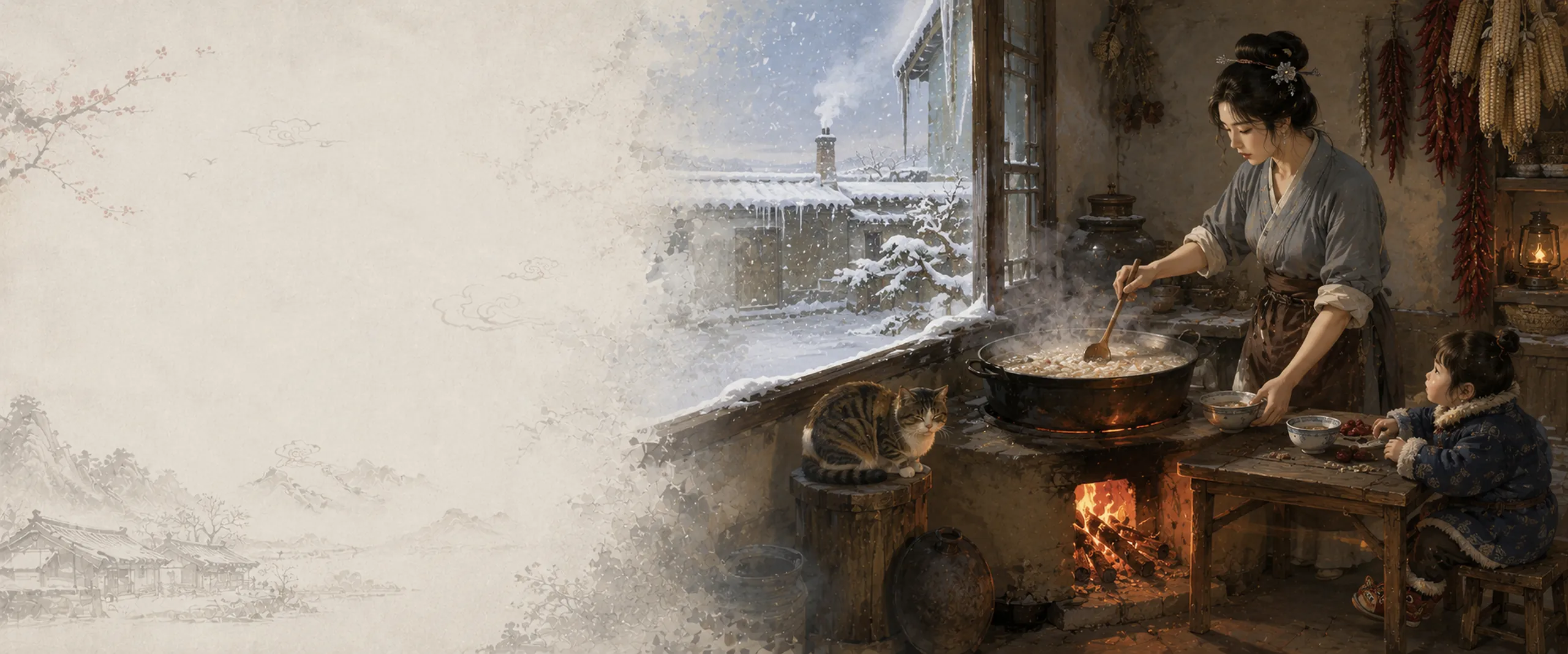

Laba Festival

Laba FestivalGlobal Spread

「 腊月八日粥,传自梵王国。 」

The Laba Festival originated from Buddhism. It is said that the eighth day of the twelfth lunar month is the day of the Buddha Sakyamuni’s enlightenment, and the festival gradually evolved into a traditional folk celebration. Du Fu, in his poem…

The overseas spread of the Laba Festival is closely connected with Buddhist culture. In Thailand, Malaysia, Singapore, and other parts of Southeast Asia, local Chinese Buddhist temples hold porridge-distribution activities during the festival, and worshippers visit temples to receive Laba porridge and pray for peace and good fortune. In North America, Chinese communities and Buddhist temples in cities such as New York, Los Angeles, and Vancouver likewise prepare Laba porridge during the festival and distribute it free of charge to local residents and worshippers, conveying warmth and blessings through food.

Laba porridge is made by simmering together a variety of grains, beans, dried fruits, and other ingredients, symbolizing “abundant harvests of the five grains and completeness for the whole family.” The Laba Festival is not only the prelude to the Spring Festival; through a bowl of hot porridge, it also connects overseas Chinese with their homeland. Wherever one may be, drinking a bowl of Laba porridge is a warm signal that the year-end festive season is drawing near.

Laba Festival / Global Spread
84 days until Laba Festival January 15, 2027 · Lunar 腊月初八

Celebrated Worldwide

Regional Highlights
01

The Americas

United States

The United States is home to one of the world’s largest Chinese communities. Although the Laba Festival is not as widely known as the Spring Festival or Mid-Autumn Festival, celebrations have been growing year by year through the efforts of Chinese communities and Buddhist centers.

Flushing, New York: Shaolin Temple’s “Blessed Laba Porridge.” Ahead of the 2025 Laba Festival, the Overseas Headquarters of New York Shaolin Temple organized a cultural event in Flushing under the theme “Taste Porridge in the Twelfth Lunar Month, Welcome the New Spring · Shaolin Continues to Send Auspicious Blessings.” A specially arranged “Blessed Laba Porridge” session offered participants steaming bowls of Laba porridge, using traditional food to convey warmth and blessings.

The porridge, symbolizing reunion and auspiciousness, was warmly welcomed by local residents and added a strong sense of warmth to the festival. Lan Chaohai, head of the New York Shaolin Temple Kung Fu Center, joined guests at the event in a solemn yet warm blessing ceremony. Lan said that the Laba Festival is an important occasion symbolizing harvest, health, peace, and harmony, and carrying people’s hopes for a better life in the future.

Fo Guang Shan New York Buddhist Center likewise held a celebration in Flushing on the day of the Laba Festival, also observed there as Dharma Day (法宝节), distributing more than one thousand portions of Laba porridge to the community and forming connections with the public through the shared porridge. From the streets of Flushing to Buddhist centers across Chinese-populated neighborhoods, bowl after bowl of steaming Laba porridge carried the warmth of the festival into thousands of New York households.

Florida: The story of Laba told through shadow puppetry. On January 25, 2026, the Three Acts of Goodness Chinese School at Guang Ming Temple, Fo Guang Shan, Florida, held the premiere of a shadow-puppet play titled “The Origins of Laba Porridge” to celebrate Dharma Day. More than 180 students and worshippers watched the performance and then tasted Laba porridge together.

Everything in the production—from character design, background music, narration, lighting control, prop-making, and stage execution—was handmade and carried out by members of the youth group. No phones were used, no AI was used, and there was no automated editing. The Chinese narration was performed by senior students from the Chinese school.

After the premiere, Venerable Ruyuan, abbot of Guang Ming Temple, said the performance represented a form of “transmission of faith” by teaching children the story of the Buddha’s enlightenment through shadow puppetry. It was also a form of “new branches growing from an old trunk”: for a tree to grow strong, it must continually send out new branches.

On Dharma Day, Guang Ming Temple also distributed Laba porridge to the Orange County government and the Orange County Asian Association, where it was accepted by the chief of staff from the county mayor’s office. Laba porridge thus moved from the temple into an American local government office.

Los Angeles and Atlanta: Laba porridge reaches Michelin-starred dining tables. Hu Xiaojun, vice chairman of the National Chinese Restaurant Alliance, said that he himself is a devoted “fan” of Laba porridge and drinks a bowl every year during the festival. Even his Michelin-starred restaurant, “Lao Sichuan,” specially serves Laba porridge to diners.

In Atlanta, Yifan Restaurant introduced a special Laba Festival event designed to “warm both heart and stomach.” Laba porridge thus moved from the family kitchen onto the tables of Chinese restaurants in the United States, entering the commercial dining space.

Canada

Laba celebrations within Canada’s Chinese communities are equally varied, with Buddhist centers at their core and traditions that have gradually continued for many years.

Toronto: Cham Shan Temple’s “Bring Blessings Home.” For many Chinese residents of Toronto, visiting Cham Shan Temple each year during the Laba Festival for a bowl of porridge has long become a custom.

On January 26, 2026, the day of the Laba Festival, Cham Shan Temple in the Greater Toronto Area held a public-interest event themed “Bring Blessings Home and Welcome the Year of the Horse.” Through the free distribution of calligraphic works featuring the character 福 (fu, “blessing” or “good fortune”) and the offering of Laba porridge, the temple welcomed the approaching Spring Festival together with the public.

From 10 a.m. onward, visitors arrived to receive Laba porridge and calligraphy bearing the character fu. The aroma of Laba porridge mingled with the fragrance of fresh ink, making the winter days of Vancouver and Toronto feel particularly different through this warmth.

Richmond: The porridge-giving tradition at the Shaolin Temple Cultural Center. Every Laba Festival, the Shaolin Temple Cultural Center of Canada distributes Laba porridge free of charge in Richmond, sharing joy and blessings with local residents and attracting more than one hundred participants.

According to the center, on the day of the Laba Festival, Shaolin-related institutions and disciples around the world collectively distributed more than 300,000 portions of Laba porridge to the public. Porridge-giving activities generally begin with a solemn Pudu Dharma assembly, during which participants chant sutras and offer prayers according to Shaolin Buddhist ritual procedures, sincerely praying for world peace and human well-being.

Brazil — South America’s Largest Laba Porridge Distribution

Brazil is the country in Latin America where the Laba Festival has spread most deeply. During Dharma Day each year, Fo Guang Shan centers across the country hold large-scale activities in which Laba porridge is offered to the public.

In 2026, Fo Guang Shan centers across Brazil celebrated Dharma Day by distributing Laba porridge to local government agencies, worshippers, and visitors between January 18 and 26, giving out a total of 2,200 bowls.

In Rio de Janeiro, members of Buddha’s Light International Brazil began preparing ingredients and cooking Laba porridge early on the morning of the 18th. Early the following morning, monastics led eight association officers carrying freshly cooked, steaming porridge to 88 shops in central Rio, bringing it directly to worshippers as they opened their businesses. Over two days, 300 bowls were distributed.

In São Paulo, Zu Lai Temple distributed Laba porridge to the public at designated locations on January 25. Monastics led nearly seventy volunteers from Buddha’s Light International, the youth group, Fo Guang Scouts, and other groups in packing and distributing the porridge, giving out a total of 1,500 bowls.

Many Brazilian visitors said the Laba porridge was exceptionally delicious. After learning about its origins, some happily ate two or even three bowls.

Even more notably, Zu Lai Temple delivered Laba porridge to a Brazilian municipal government for the first time. On January 26, Dharma Day, Venerable Miaoyou visited the city government and presented 50 bowls of Laba porridge. Mayor Wellington Formiga praised its flavor and expressed strong agreement with the importance of “harmony and integration”, arranging with Zu Lai Temple to expand the porridge distribution at city hall the following year so that more people could learn about Dharma Day.

Laba porridge had moved from a Chinese Buddhist temple into a Brazilian city hall.

In 海習飛, Fo Guang Yuan likewise organized a Laba porridge-sharing activity on January 26. From Rio de Janeiro to São Paulo and then to 海習飛, the fragrance of Laba porridge spread through multiple Brazilian cities, becoming a warm witness to cultural exchange between China and Brazil.

02

Europe

France

France is one of the European countries where Laba Festival celebrations are particularly active. Sharing Laba porridge is the largest year-end activity for Fo Guang devotees in Paris.

Every Dharma Day, Fo Guang Shan Fahua Chan Temple, Fo Guang Shan Paris, and the Paris Association of Buddha’s Light International mobilize the broader Fo Guang community to promote Laba porridge, using it to form wholesome connections with the public and convey the Buddha’s original spirit of compassion and relief for the world.

From January 9 to 10, 2025, Fahua Chan Temple and Fo Guang Shan Paris held commemorative Dharma assemblies for the Buddha’s enlightenment and prepared Laba porridge as an offering to the Buddha and to share with the public, distributing 2,000 bowls over two days.

France was once again facing an epidemic. For reasons of epidemic prevention and safety, some chapter officers voluntarily prepared Laba porridge at home and distributed it among neighbors so that all could share in the joy of the Buddha’s enlightenment. Many French friends praised the porridge after tasting it.

Many Fo Guang devotees received steaming, delicious Laba porridge with smiles of happiness. Under the pressure of a severe epidemic, a bowl of “peace porridge” warmed both the stomach and the heart. The Paris Association of Buddha’s Light International also delivered Laba porridge to the Taipei Representative Office in France and the French newspaper European Times.

Germany

In Germany, the Laba Festival is likewise valued by Chinese communities and Buddhist centers.

On January 7, 2025, Venerable Jueyan, superintendent of Fo Guang Shan Frankfurt, led nearly forty volunteer bodhisattvas in preparing and delivering 800 bowls of Laba porridge, sharing them with Chinese residents and German friends in Frankfurt and surrounding areas.

The task of preparing the porridge was undertaken by the fourth chapter of Buddha’s Light International. Members began preparations at the Buddhist center the previous day, dividing responsibilities from the purchase of ingredients onward and working together.

In Vienna, Fo Guang devotees likewise offered the blessing “万事粥全” during the Laba Festival period.

In Berlin, Chinese cultural institutions held lectures and experiential activities introducing German residents to the origins and customs of the Laba Festival. After learning of the auspicious meaning of Laba porridge as “bringing all things together and harmonizing Heaven and Earth” (合聚万物、调和乾坤), many German participants expressed strong interest in this ancient Chinese tradition.

United Kingdom

In the United Kingdom, the Laba Festival likewise serves as an important point marking the beginning of the Spring Festival season. During Laba this year, various kinds of porridge were sold in London Chinatown. The long-standing debate between northern and southern preferences for sweet or savory porridge was set aside here: a steaming bowl of porridge opened the festive season and warmed Chinese appetites.

Chinese restaurants are found throughout major British cities, and Chinese residents likewise cook pots of warm Laba porridge on the day of the festival. International students celebrate in their own way as well—inviting several friends home to prepare Laba porridge together, or buying ingredients from local Asian supermarkets and cooking it themselves.

Although the Laba Festival is not celebrated on the same scale as the Spring Festival in Britain, the warmth of a single bowl of porridge sustains overseas Chinese memories of the flavors and atmosphere of the approaching New Year.

Austria

Fo Guang devotees in Vienna held celebrations during the Laba Festival and offered the blessing “万事粥全、诸事平安.” The Chinese character for porridge, 粥 (zhou), is a homophone of 周 in 周全, meaning “thorough” or “complete.” Thus “万事粥全” is both a playful adaptation centered on Laba porridge and a simple wish that everything may go smoothly and completely.

03

Asia

Asia is the region where Laba culture has spread most deeply. The festival is celebrated not only by Chinese communities; Buddhist countries also have distinctive observances because of Laba’s association with the day of the Buddha’s enlightenment.

Southeast Asia

Cambodia: Shaolin Temple’s first Laba Festival. On January 7, 2025, the Cambodian Shaolin Temple Cultural Center held a Laba porridge-distribution event in Phnom Penh. This was the first Laba Festival since the Cultural Center was established.

The event attracted many overseas Chinese and local residents. To recreate the authentic flavor of Shaolin Laba porridge, Venerable Shi Yanshu, head of the Cambodian Shaolin Temple Cultural Center, carefully selected more than ten ingredients. Because the center’s own infrastructure was still incomplete, he borrowed the kitchen of a nearby restaurant and simmered the porridge for several hours.

Zeng Jianhua, aged 61, had lived in Cambodia with her family for nearly five years and personally prepared Laba porridge every year, hoping that everything would be “粥全”, a pun suggesting that all affairs would be complete and well-arranged. Upon hearing that the Cultural Center would hold a porridge-giving event, she specially brought Laba beans and homemade sour-and-spicy chilies from home to share with everyone.

Shi Yanshu said that the porridge-giving event was a vivid example of people-to-people exchange between China and Cambodia. It not only brought tangible warmth to people in Phnom Penh, but also used culture as a bond to draw the peoples of the two countries closer together.

Since arriving in Cambodia in 2023, Shi Yanshu, an inheritor of the intangible cultural heritage of Shaolin kung fu, has actively promoted the localization of Shaolin culture in Southeast Asia by offering Shaolin courses, organizing visits to China by Cambodian dou shi quan teams, and other initiatives, contributing to mutual learning between Chinese and Cambodian civilizations.

Malaysia: Fo Guang Shan and Laba porridge in Kuala Lumpur. In addition to distributing Laba porridge in various locations, some Fo Guang Shan centers and chapters in Malaysia organize collective sutra-copying and prayer sessions as well as pilgrimage activities, allowing worshippers to share in the benefits and joy of the Dharma.

In Kuala Lumpur, drinking Laba porridge to celebrate the festival has been a Chinese community tradition for many years. In Petaling Street, local Chinese residents visit Spring Festival charity fairs to buy New Year goods and drink Laba porridge as the atmosphere of the Spring Festival gradually intensifies.

In Malaysia, the Laba Festival is not only a religious occasion, but also a signal that the flavor and atmosphere of the New Year are growing stronger.

Singapore: Temple chanting and porridge simmering at home. Chinese communities in Singapore likewise celebrate the Laba Festival. Some Chinese temples prepare Laba porridge as an offering to the Buddha and hold sutra-chanting activities.

The festival in Singapore carries both religious and folk dimensions. The sound of chanting in temples and the fragrance of porridge in family homes intertwine, creating a distinctive Nanyang Laba landscape.

Indonesia: Laba traditions from Jakarta to other cities. Chinese communities in Indonesia maintain traditions of preparing Laba porridge and praying for blessings at temples during the festival. Buddhist halls and Chinese temples in different places hold Dharma assemblies and porridge-distribution activities on Laba Day, carrying the festival’s warmth to worshippers and neighbors.

Japan

Japan does not have a nationwide festival that corresponds exactly to China’s Laba Festival. However, several Japanese customs bear similarities to it in form or religious origin.

The most notable is the custom of Nanakusa-gayu (七草粥), seven-herb rice porridge. Since ancient times, Japan has had the custom of wakana-tsumi, gathering young greens at the beginning of the year in order to receive renewed vitality from nature.

On the seventh day of the first month, people eat seven-herb porridge in the hope that the gods will bless them with health and freedom from illness throughout the new year. For those who have eaten too much rich New Year food, the porridge also provides a way to rest the stomach while replenishing nutrients that may be lacking in winter.

The seven ingredients include water dropwort, shepherd’s purse, cudweed, chickweed, nipplewort, turnip, and daikon radish.

Similar to the Chinese Laba porridge ideal of “bringing all things together,” Japanese seven-herb porridge is likewise prepared from multiple ingredients and likewise carries wishes for blessings and health. The similarity between the Laba Festival and Japan’s seven-herb tradition in the custom of eating porridge reflects a deeper resonance between Chinese and Japanese food traditions: both cultures possess a “cultural gene of praying for blessings through porridge.”

In addition, Japanese Buddhist temples hold Dharma assemblies around the Laba period to commemorate the Buddha’s enlightenment, known as Jōdō-e (成道会), the Assembly Commemorating Enlightenment.

Mongolia

On January 26, 2026, the lunar Laba Festival, the Chinese Embassy in Mongolia held the “Warmly Welcome Spring · Celebrate the Chinese New Year Together” gathering for overseas Chinese, together with a distribution ceremony for “Spring Festival Warm-Heart Packages” and care packages for overseas Chinese. More than 300 Chinese nationals living in Mongolia gathered together.

Ambassador Shen Minjuan warmly welcomed them to “come home for the New Year.” The embassy auditorium was carefully decorated with a strong Spring Festival atmosphere, while specially prepared Laba porridge allowed everyone to feel a deep sense of affection for home.

In Ulaanbaatar, far from their homeland, a bowl of Laba porridge allowed Chinese nationals to feel warmth from their motherland. Participants said that the embassy’s “Spring Festival packages” made them deeply appreciate the country’s heartfelt concern for them.

04

Oceania

During the 2026 Laba Festival, the atmosphere of the approaching Chinese New Year was especially strong in Australia. On Laba Day, that festive feeling was most vividly embodied in the Chinese New Year celebration organized by the Northern Territory Branch of the Australia-China Friendship Society.

Friends from different countries and overseas Chinese took to the stage. Greetings of “Happy New Year” and “Gong Xi Fa Cai” in different accents intertwined, forming one of the most moving melodies of cultural exchange.

In less than two months, the Australia-China Friendship Society had rehearsed an entirely new program, and repeated bursts of applause pushed the festive atmosphere to successive peaks.

Friends from different ethnic communities gathered together as song, dance, martial arts, and solo performances took turns on stage. Chinese awakening lions and red-and-gold lions leapt and rolled, filling every corner of the air with celebration.

Round-trip direct-flight tickets from Darwin to Guangzhou sponsored by China Southern Airlines were offered as raffle prizes, further heightening the excitement. The Northern Territory Australia-China Friendship Association also specially prepared Spring Festival greeting cards, which would be mailed directly to anyone who provided an address.

Handwritten New Year cards, black-ink fu characters on red paper, and the warm sunlight of the Southern Hemisphere—through these distinctive forms, the Laba Festival opened the prelude to the Chinese New Year in Australia.

05

Africa

Republic of the Congo

On January 27, 2026, the Central and West Africa Company held a Laba Festival event in the Republic of the Congo under the theme “Laba Brings Blessings · Porridge Warms the Heart,” bringing Chinese and local employees together in celebration.

A local employee representative named Meide voluntarily took the stage and gave a detailed introduction to the historical origins, traditional customs, and cultural meanings of the Chinese Laba Festival, including gratitude for the harvest, prayers for blessings, and welcoming the new year.

Company chefs prepared carefully simmered Laba porridge, steaming baozi, and other traditional festive foods. Chinese and local employees sat together, while Chinese staff enthusiastically explained the auspicious meaning of Laba porridge as “bringing all things together and harmonizing Heaven and Earth.” Local employees praised the porridge after tasting it.

The event conveyed festive warmth while also promoting cultural integration and emotional connection between China and Africa. A bowl of Laba porridge warms the stomach; what it brings together is the heart.

Tanzania

In Tanzania, overseas Chinese continue Laba traditions in flexible ways. Cai Hongdi, executive vice president of the Tanzania Fujian Association, lived in Quanzhou for more than thirty years, and the city’s diverse history and culture became deeply embedded in his everyday life.

He said that this year he would spend Laba in Tanzania: “Overseas, the way we celebrate festivals is more flexible. Some compatriots gather together and cook a pot of Laba porridge. It may not follow the traditional recipe, but instead uses local ingredients—for example, cashews and peanuts in place of nuts commonly used back home—which creates a flavor of its own.”

The Laba Festival is also a good opportunity to promote communication and unity among people from the same hometown, with communal meals and other activities helping to sustain the festive atmosphere.

Wherever one may be, the Laba Festival is perhaps even more a memory of home—a remembrance of the flavors and customs of one’s native place.

Central and West Africa

Across multiple African countries along the Belt and Road, Chinese-funded enterprises use the Laba Festival as an important opportunity for cultural exchange.

The Laba activities of the Central and West Africa Company are a typical example: local employees voluntarily take the stage to explain Chinese Laba culture, while Chinese and local workers sit together and share Laba porridge.

In the course of localized development and participation in Belt and Road construction, China State Construction International has consistently upheld the principles of openness, inclusiveness, mutual benefit, and win-win cooperation, effectively strengthening cohesion within multicultural overseas teams through cultural exchange.

The cultural meanings of the Laba Festival—“gratitude for the harvest and praying for blessings while welcoming the new”—are becoming understood and recognized by increasing numbers of people across Africa.

Laba in the Cloud

In-Depth Feature

With the development of digital technology, the Laba Festival has generated new forms of celebration among overseas Chinese communities. Although the scale of its “cloud-based” dissemination is smaller than that of the Spring Festival or Mid-Autumn Festival, it likewise reveals new possibilities for cultural transmission in the digital age.

Online cultural classes: From Laba’s origins to knowledge quizzes. During the 2025 Laba Festival, several universities and institutions organized online cultural activities. International students learned to make dumplings and taste Laba porridge through themed programs such as “Tasting China.”

At Yancheng Museum, 19 international student representatives from Kyrgyzstan, Pakistan, Bangladesh, and other countries were invited to participate in a cultural experience themed “Abundant Harvests · Laba Brings Blessings.” Museum education instructors carefully explained the origins, evolution, and regional customs of the festival, interpreting its cultural meaning in clear and accessible language.

Short videos by international students and social-media dissemination. During the Laba Festival, international students in China shared the process of preparing Laba porridge and their festival experiences through social media, becoming “people-to-people ambassadors” for the international transmission of Laba culture.

In Harbin, international students from Russia, Mongolia, South Korea, and more than ten other countries took part in ice-and-snow activities. Their visit happened to coincide with the Laba Festival, and the scenic area was distributing Laba porridge. A mouthful of hot porridge allowed students from cold regions to experience the warmth of China’s twelfth lunar month.

These authentic experiences and personal accounts spread across the world through short videos and social platforms.

Digital presenters explaining Laba. Digital-presenter outreach had already been successfully practiced during the 2025 Double Ninth Festival, and the Laba Festival likewise began exploring digital forms of cultural transmission. Through online knowledge quizzes, cultural livestreams, and other formats, more people are being introduced to and familiarized with the festival’s cultural meaning【此前重阳节内容】.

The core value of Laba’s cloud-based dissemination lies in allowing overseas Chinese living far from home, as well as international friends interested in Chinese culture, to experience the warmth of Laba porridge and the cultural meaning of the festival within digital space, without needing to visit a temple or Chinatown in person.

The warmth of a single bowl of porridge is traveling farther through the screen.

Mutual Learning Among Civilizations

In-Depth Feature

The Laba Festival has gradually journeyed from a traditional festival of the Chinese nation toward the world. Its path differs from those of the Spring Festival, Lantern Festival, Qingming, Dragon Boat Festival, Mid-Autumn Festival, and Double Ninth Festival: if the Spring Festival takes “reunion” as its emotional core, the Lantern Festival “lantern lights” as its visual symbol, Qingming “remembrance” as its spiritual core, the Dragon Boat Festival “dragon boat racing” as its cultural emblem, the Mid-Autumn Festival the “bright moon” as its greatest common denominator, and the Double Ninth Festival “respect for the elderly” as its universal value, then the Laba Festival takes “a bowl of porridge” as its simplest cultural vehicle and “giving and receiving” as its warmest emotional connection.

The Laba Festival’s dual cultural identity. The fundamental reason the Laba Festival has been able to spread so widely overseas is that it simultaneously carries two values capable of crossing cultural boundaries: gratitude for the harvest and compassionate relief for the world.

As a product of agrarian culture, Laba porridge embodies the idea of “bringing all things together and harmonizing Heaven and Earth.” Many grains and cereals are gathered into a single pot, symbolizing gratitude for the harvest and prayers for the coming year—emotions that any agrarian civilization can understand.

As a vehicle of Buddhism’s Dharma Day, Laba porridge commemorates the enlightenment of Śākyamuni Buddha and conveys the spirit of compassion and relief for the world. The act of giving porridge is itself a concrete expression of the Buddhist principle of dāna, or charitable giving (布施), something that can be felt without linguistic translation.

One bowl of porridge, two cultural identities: this allows the Laba Festival to enter Chinese communities as a Chinese New Year custom, while also entering a broader international field of vision through the path of Buddhist compassion.

“Once Laba has passed, the New Year begins”: The global spread of the Spring Festival’s prelude. The most important function of the Laba Festival in its overseas transmission is its role as the prelude to the Spring Festival.

A Chinese saying holds: “过了腊八就是年”—once Laba has passed, the New Year has begun.

On January 26, 2026, Chinese Permanent Representative to the United Nations and other international organizations in Vienna, Ambassador Li Song, specially introduced the festival to representatives from different countries at a Spring Festival reception in Vienna:

“Today is the Laba Festival. Laba marks the prelude to the Spring Festival. Today, we have prepared Laba porridge for everyone—be sure to give it a try!”

Laba porridge had thus moved from Chinese Buddhist temples into a United Nations institution. This was not simply a “cultural display,” but the formal appearance of the Laba Festival, as the “prelude to the Spring Festival,” on the stage of global dialogue among civilizations.

A bowl of Laba porridge opened the prelude to global Spring Festival celebrations.

From temples to city governments: Laba porridge’s journey beyond its original circle. The overseas spread of the Laba Festival reveals a clear trajectory of expanding beyond its original cultural sphere.

At first, Laba porridge was primarily offered to worshippers inside Buddhist centers such as Fo Guang Shan and Shaolin temples. Later, its distribution expanded into Chinese communities and among local residents. Later still, Laba porridge began to be delivered to local government agencies: a Brazilian mayor personally tasted it and agreed to expand distribution the following year, while an American county government office accepted Laba porridge.

From temples to communities, from communities to city halls, and from city halls to the United Nations, the journey of Laba porridge beyond its original circle offers a miniature portrait of how traditional Chinese culture is moving into the world in the manner of “moistening all things silently” (润物细无声)—gently, naturally, and without fanfare.

Localized innovation in Laba porridge around the world. As Laba porridge has spread overseas, it has also undergone localized adaptation according to local conditions.

In Tanzania, overseas Chinese replace nuts commonly used in China with cashews and peanuts. In Brazil, local visitors praise the porridge enthusiastically. In London Chinatown, the traditional north-versus-south debate over sweet or savory porridge falls silent.

As one overseas Chinese resident said: “Overseas, the way we celebrate festivals is more flexible… It does not have to follow the traditional recipe; instead, we combine it with local ingredients.”

This “flexibility” is not a departure from tradition, but the natural process by which tradition grows new branches in foreign soil.

The universal value of Laba culture: The warmth of one bowl of porridge. The fundamental reason Laba porridge can cross cultural boundaries lies in the universal values it carries: gratitude for the harvest, reflecting humanity’s shared agrarian memory; prayers for blessings and the coming spring, reflecting humanity’s shared hopes for the festive season; and compassionate giving, reflecting a moral principle shared across humanity.

In Brazil, a mayor praised the flavor of Laba porridge and expressed agreement with the importance of “harmony and integration.” In the Republic of the Congo, a local employee voluntarily took the stage to introduce Laba culture. In Australia, friends from many countries performed on stage, and greetings spoken in different accents intertwined into a melody of cultural exchange.

A bowl of Laba porridge can convey warmth without translation; the character “粥,” meaning porridge, can be understood without explanation. This is the simplest and yet most powerful cultural strength of the Laba Festival.

Closing Note

Lingering Notes

The global spread of the Laba Festival traces a warm journey from China’s ancient la sacrificial traditions to the world’s five continents. Its inclusion in China’s national list of intangible cultural heritage in 2006 marked its transition from a folk festival into the sphere of national protection; its broad spread across dozens of countries around the world demonstrates that the cultural power of “a bowl of porridge” can cross languages and national borders.

Unlike the Spring Festival, with its farewell to the old and welcome of the new; the Lantern Festival, radiant with lights; Qingming, with its reverent remembrance of earlier generations; the Dragon Boat Festival, with its racing boats; the Mid-Autumn Festival, with its bright moon and reunion; or the Double Ninth Festival, with its respect and gratitude toward older people, the overseas spread of the Laba Festival takes “a bowl of porridge” as its simplest cultural vehicle and “giving and receiving” as its warmest emotional connection.

Gratitude for the harvest is an emotion shared by all humanity; compassionate giving is a moral principle shared by all humanity. Wherever one may be, a bowl of hot porridge can warm the heart; whatever one’s culture, gratitude for the harvest and hopes for the coming year are universally understood.

Across the Americas, from the “Blessed Laba Porridge” of Flushing, New York, to the shadow-puppet premiere at Guang Ming Temple in Florida; from Cham Shan Temple’s “Bring Blessings Home” in Toronto to 2,200 bowls of Laba porridge in Brazil reaching city hall, the fragrance of Laba porridge spreads through cities across North and Latin America.

Across Europe, from 2,000 bowls distributed by two Buddhist centers in Paris to 800 bowls shared with German friends in Frankfurt, from London Chinatown’s quieting of the northern-southern debate over sweet and savory porridge to Vienna’s playful blessing “万事粥全,” the warmth of Laba porridge spreads across the European continent.

Across Asia, from the Cambodian Shaolin Temple Cultural Center’s first Laba Festival to Fo Guang Shan Malaysia’s sutra-copying and prayer activities, from the chanting of Singapore temples to the Chinese Embassy in Mongolia offering care to overseas Chinese, Laba traditions take distinctive forms across neighboring countries.

In Oceania, the Laba Festival ignites the atmosphere of the approaching Chinese New Year in Australia, as greetings spoken in different accents intertwine into a melody of cultural exchange.

Across Africa, from Chinese and local employees sitting together over bowls of porridge in the Republic of the Congo to Laba porridge made with cashews in Tanzania, the seeds of Laba culture are taking root and sprouting across African soil.

More moving still is the moment when China’s Permanent Representative in Vienna introduces to representatives from around the world, on Laba Day itself, the saying that “once Laba has passed, the New Year begins”; when a Brazilian mayor tastes Laba porridge and agrees to expand its distribution the following year; when an American county government office receives Laba porridge from Fo Guang Shan.

At such moments, Laba porridge has moved beyond being the “Buddhist porridge” of Chinese temples and become a “porridge of friendship” connecting China with the world.

With the warmth of a single bowl of porridge, the Laba Festival is warming every corner of the world.

—–

Continue exploring Laba Festival culture

Readers’ Comments

Calendar and traditional culture enthusiasts from around the world, sharing the same moon.

Sign in or register to join the conversation. Your comment account is created automatically the first time you use a connected account.