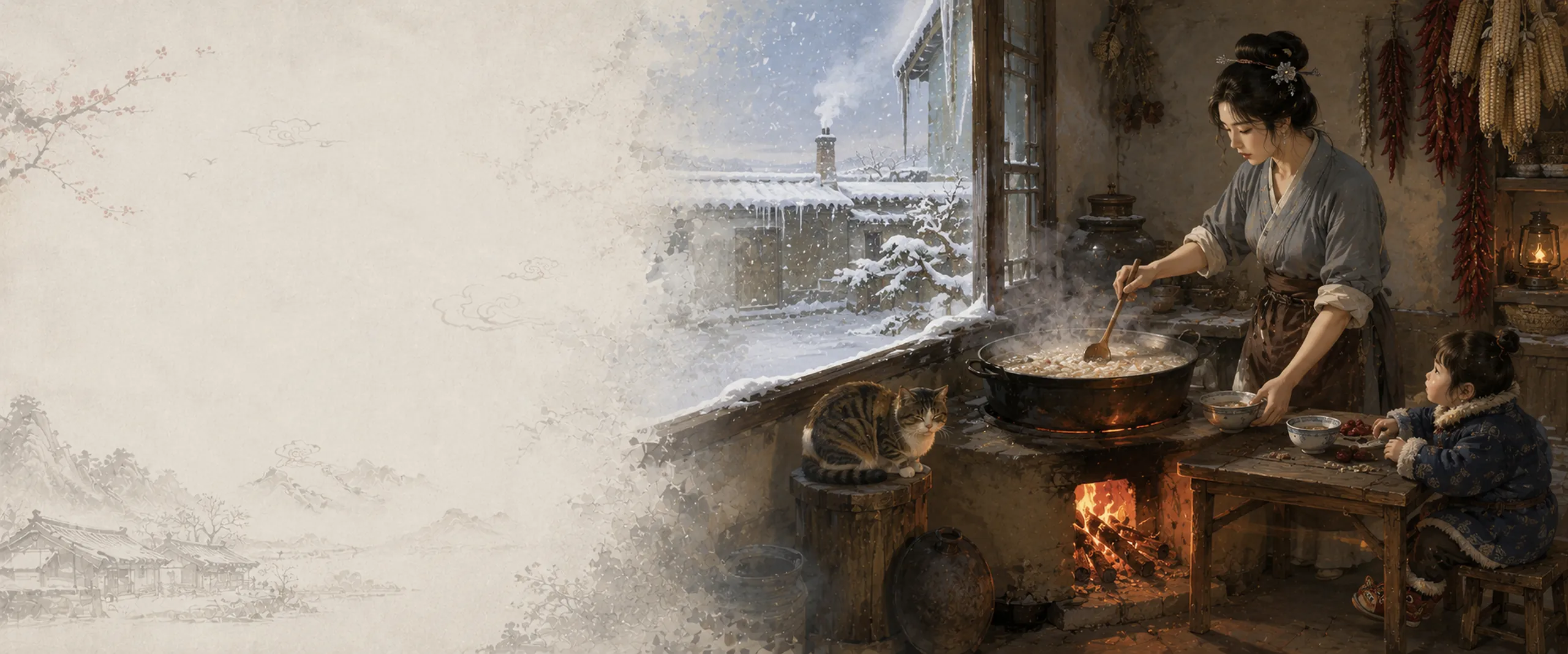
The Laba Festival, commonly known simply as Laba (腊八), falls on the eighth day of the twelfth lunar month. The character la (腊) is traditionally explained in three ways: first, “la means joining,” suggesting the transition between the old and the new; second, “la is akin to hunting,” referring to hunting animals for offerings to ancestors and deities; and third, “la means driving away pestilence and welcoming spring.”
The Laba Festival originated in the ancient La sacrificial rites (腊祭) and later absorbed elements of Buddhist culture, with praying for blessings and welcoming auspiciousness at its core. A popular saying in northern China goes: “Child, child, don’t be greedy; once Laba has passed, the New Year is on its way.”
Customs such as eating Laba porridge, pickling Laba garlic, and offering sacrifices and prayers have been passed down for a thousand years. Every year on the eighth day of the twelfth lunar month, Buddhist temples across China distribute porridge and the fragrance of cooking fills countless households. You can hold a steaming bowl of Laba porridge, savor the warmth and care of a tradition handed down through the centuries, and at the same time welcome the opening chapter of the Spring Festival season.

Event Schedule and Venues
### Core Dates
The Laba Festival falls each year on the eighth day of the twelfth lunar month, generally corresponding to mid- or late January in the Gregorian calendar. Porridge distribution at Buddhist temples and community activities usually begin one to two days before the festival and reach their peak on the official day.
After Laba, people formally enter “New Year mode.” From Laba through the Lantern Festival, the atmosphere of the New Year grows steadily stronger, and markets selling New Year goods become increasingly lively.
The core schedule is as follows:
| Time | Activity | Description |
|---|---|---|
| 1–2 days before the festival, often over the weekend | Laba warm-up activities begin around the country | Chengdu Wenshu Monastery begins porridge distribution early; temples elsewhere begin preparations |
| Eighth day of the twelfth lunar month | Laba Festival Day — eating Laba porridge and pickling Laba garlic | Buddhist temples and communities across China organize celebrations |
| After Laba | Formal entry into “New Year mode” | From Laba to the Lantern Festival, the festive atmosphere grows steadily stronger |
### Traditional Laba Festival Customs
Laba customs are rich and varied, with praying for blessings and welcoming auspiciousness at their heart:
| Custom | Description |
|---|---|
| Eating Laba Porridge | The festival’s most central custom. It is cooked with glutinous rice, red beans, red dates, peanuts, lotus seeds, and many other ingredients, symbolizing harvest and good fortune |
| Pickling Laba Garlic | In northern China, garlic is soaked in vinegar on Laba. By New Year’s Eve, the cloves turn jade green and the vinegar becomes richly fragrant |
| Laba Noodles | In Shaanxi and some other regions, people eat Laba noodles during the festival |
| Curing Preserved Meat | In southern China, Laba marks the beginning of the season for curing preserved meats |
| Sacrifices and Prayers | The festival originated in ancient La sacrificial rites and later incorporated Buddhist culture. Buddhist temples organize porridge offerings and prayer activities |
### Major Recommended Activities by Region
Chengdu, Sichuan — Laba Porridge Distribution at Wenshu Monastery:
The Laba porridge distribution tradition at Wenshu Monastery in Chengdu has been included in the Chengdu municipal intangible cultural heritage list. Every year during the Laba Festival, the monastery distributes 100,000 servings of Laba porridge over three consecutive days to residents and visitors, allowing folk tradition to take on renewed life amid the warmth of everyday community life.
It is one of the foremost destinations for experiencing Laba customs and offers a chance to encounter Chengdu’s deep Buddhist heritage and folk traditions.
Jinan, Shandong — “One Bowl of Laba Porridge Warms an Entire City” Intangible Cultural Heritage New Year Goods Shopping Month:
Jinan’s Intangible Cultural Heritage New Year Goods Shopping Month is held under the theme “One Bowl of Laba Porridge Warms an Entire City.” Drawing on Jinan Railway Station’s dual audience of local residents and travelers in transit, the program closely integrates traditional Laba customs with the preservation and transmission of intangible cultural heritage, creating a public cultural space that combines viewing, participation, and interaction.
The venue includes an intangible cultural heritage market, Laba cultural experiences, and New Year shopping areas.
Beijing — Beixiaguan “Baijiaxin Cultural Journey” First Laba Class:
The Beixiaguan “Baijiaxin Cultural Journey” opens with the Laba Festival. Under the theme “Laba · A First Taste of the New Year,” the activity uses animated short films to introduce the festival’s origin legends and traditional customs.
Community Laba Activities Across China:
Communities throughout the country organize Laba-themed activities. In Fuzhou, Fujian, Qionghe Community in Wenquan Subdistrict holds programs including cultural presentations; Banqiao Village in Chahua Town, Fuyang, Anhui, organizes “Warmth in Banqiao · Celebrating Laba Together,” where villagers share free Laba porridge; and Wujiaxiang Community in Yisuhe Town, Xiangtan, Hunan, holds the themed event “Warm Laba · Warm Neighbors.”
Pre-Trip Preparation
### Visas and Entry
Laba Festival destinations throughout China are subject to the country’s unified visa policies:
* 240-hour visa-free transit for citizens of 54 countries: Travelers may enjoy visa-free transit for up to 240 hours, with permitted areas covering most administrative regions of China.
* Tour groups from ASEAN countries: Organized tour groups may enter visa-free through designated ports.
* Other nationalities: Apply in advance for a tourist visa, or L visa, through the relevant Chinese embassy or consulate, and ensure that your passport remains valid for more than six months.
* Latest Policies: Before departure, consult the official website of China’s National Immigration Administration or the relevant Chinese embassy or consulate.
### Adapting to the Climate
The Laba Festival falls on the eighth day of the twelfth lunar month, corresponding to mid- or late January in the Gregorian calendar. This is the depths of winter across China, with the following regional conditions:
| Region | Temperature Range | Climate Characteristics | Clothing Recommendations |
|---|---|---|---|
| North China (Beijing, Tianjin) | -8°C–3°C | Severely cold and dry, with pronounced wind chill | Down jacket, thermal underwear, scarf, gloves, mask |
| East China (Shanghai, Hangzhou) | 0°C–8°C | Damp cold, with very low perceived temperatures | Down jacket, thermal underwear, waterproof outer layer |
| South China (Guangzhou, Shenzhen) | 8°C–18°C | Mild, with occasional rain | Heavy jacket, sweater, rain gear |
| Southwest China (Chengdu, Chongqing) | 3°C–10°C | Overcast, damp, and cold | Down jacket, thermal underwear, rain gear |
| Northwest China (Xi’an, Lanzhou) | -10°C–5°C | Severely cold and dry | Extreme-cold down jacket and full thermal layers |
| Northeast China (Harbin) | -25°C to -15°C | Extreme cold | Extreme-cold down jacket, snow boots, and full heavy winter protection |
General Advice: Late January is one of the coldest periods of the year across most of China, so keeping warm is the highest priority. Laba falls in deep winter: northern regions are cold and dry and require protection from wind, while southern regions are often damp and cold and require protection from moisture.
Porridge-distribution activities are frequently held outdoors in the early morning, when temperatures are even lower. Layered clothing—lighter inner layers with thicker outer layers—is recommended, and scarves, gloves, and warm hats are essential.
### Travel Insurance
It is strongly recommended to purchase travel insurance covering:
* Accidental injury and medical treatment for acute illness, including outpatient care
* Loss of or damage to personal belongings
* Travel delays or cancellations, as winter ice and snow may cause flight disruptions
### Currency and Payment
* Currency: Renminbi (CNY).
* Cash: Porridge distribution is usually free. If you plan to purchase ingredients for Laba porridge, Laba garlic, or New Year goods, carrying RMB 200–400 in cash is recommended.
* Cards: Visa and MasterCard are accepted at major hotels and shopping centers.
* Mobile Payment: Alipay and WeChat Pay are widely used throughout China.
### Communications and Internet
* Important: Buddhist temples and community event sites can become crowded during the Laba Festival, and 4G/5G networks may become congested. It is strongly recommended to download offline maps in advance. Baidu Maps and AutoNavi are recommended; download maps of your destination city to your phone while connected to Wi-Fi.
How to Get There
### Major Event Destinations
The Laba Festival is celebrated nationwide, with Buddhist porridge distributions and community activities taking different forms across the country. Key recommended destinations include:
| Destination | Featured Activity | Transportation |
|---|---|---|
| Chengdu, Sichuan | Laba porridge distribution at Wenshu Monastery — Chengdu municipal intangible cultural heritage | Chengdu Shuangliu / Tianfu airports; Chengdu East Railway Station |
| Jinan, Shandong | “One Bowl of Laba Porridge Warms an Entire City” Intangible Cultural Heritage New Year Goods Shopping Month | Jinan Yaoqiang Airport; Jinan West Railway Station |
| Beijing | Beixiaguan “Baijiaxin Cultural Journey” first Laba class | Capital / Daxing airports; major Beijing railway stations |
| Fuzhou, Fujian | Qionghe Community Laba-themed event in Wenquan Subdistrict | Fuzhou Changle Airport; Fuzhou Railway Station |
| Fuyang, Anhui | Banqiao Village, Chahua Town, “Warmth in Banqiao · Celebrating Laba Together” free porridge distribution | Fly to Hefei / Fuyang, then transfer by road |
| Xiangtan, Hunan | Wujiaxiang Community, Yisuhe Town, “Warm Laba · Warm Neighbors” themed event | Fly to Changsha, then take high-speed rail to Xiangtan |
### Special Transportation Reminders
In most years, the Laba Festival falls on a working day and is not a statutory public holiday.
Flights / High-Speed Rail:
* If Laba falls on a weekday, travel demand is concentrated mainly over the preceding weekend and on the festival day itself.
* Tickets to popular destinations such as Chengdu and Jinan are best purchased in advance through the Railway 12306 App.
Driving:
* Important: Expressways are not toll-free during the Laba Festival. Toll-free travel applies only during the four national statutory holidays of the Spring Festival, Qingming Festival, Labor Day, and National Day.
Urban Transportation Tips:
* Traffic controls may be implemented around major Buddhist temples and community event sites. Public transportation is recommended.
* Popular porridge-distribution venues such as Wenshu Monastery attract large crowds, so arrive early.
Accommodation Reservations
| Key Point | Recommendation |
|---|---|
| When to Book | Laba falls close to the Spring Festival, and some cities are already entering the Spring Festival travel period. Book hotels 2–3 weeks in advance |
| Chengdu Recommended Areas | Around Wenshu Monastery, the core porridge-distribution area, or central Chengdu for convenient transport |
| Fuzhou Recommended Areas | Around Wenquan Subdistrict or central Fuzhou |
| Jinan Recommended Areas | Around Jinan Railway Station, where the intangible cultural heritage market is concentrated, or central Jinan |
| Price Reference | Budget around RMB 200–400 per night; mid-range RMB 400–800; high-end above RMB 800 |
| Booking Platforms | Major platforms such as Ctrip, Qunar, and Meituan; rooms with free cancellation are preferable |
Pre-Trip Packing Checklist
| Category | Essential Items | Special Notes |
|---|---|---|
| Upper-Body Clothing | Down jacket, thermal underwear, sweater / fleece | January is severely cold across much of China; warmth comes first |
| Lower-Body Clothing | Thermal pants, thick long pants | Porridge distribution often takes place outdoors in the early morning |
| Shoes | Warm, non-slip boots / athletic shoes | Northern roads may be icy or snowy |
| Accessories | Scarf, gloves, warm hat — essential | Outdoor activities may last for long periods; protection from wind and freezing temperatures is important |
| Sun Protection | SPF30+ sunscreen | Snow in northern regions strongly reflects ultraviolet light |
| Rain Gear | Folding umbrella, especially important in southern China | Southern regions often experience rain toward the end of winter |
| Medication | Cold medicine, gastrointestinal medicine, adhesive bandages | Useful for climate and dietary changes |
| Electronics | Power bank, phone, camera | Outdoor activities may last for long periods |
| Storage | Small bag / waist pouch for documents and cash | Keep belongings secure in crowded places |
| Other | Thermos, tissues / wet wipes | Bringing your own utensils or container is recommended for porridge-distribution events |
Cultural Respect
### Etiquette for Porridge Distribution Activities
Eating Laba porridge is the most central custom of the festival. Observe the following:
* Queue in an Orderly Manner: Porridge-distribution venues can be crowded. Queue properly, do not push, and do not cut in line.
* Bring Your Own Container: Some events encourage participants to bring reusable utensils or insulated containers to reduce waste from disposable items.
* Take Only What You Need: Take an appropriate amount of porridge and do not waste food.
* Remain Quiet: Buddhist temple porridge-distribution sites are religious spaces. Maintain a quiet and solemn manner.
* Receive with Gratitude: When receiving Laba porridge, you may take it with both hands and express thanks as a gesture of gratitude.
### Traditional Laba Taboos
The Laba Festival has a number of traditional taboos. Understanding them can help visitors better enter into the festive atmosphere:
* Rise Early: Laba includes the custom of “racing for Laba”—getting up early on the morning of the eighth day of the twelfth lunar month to cook porridge. A folk saying goes: “Golden bowls and silver bowls race for Laba; the family that gets there first receives the most good fortune.”
* Avoid Sleeping Late: Traditionally, sleeping late on Laba is discouraged.
* Avoid Quarreling: Husband-and-wife disputes and family discord are considered inauspicious on Laba.
* Avoid Waste: The ingredients in Laba porridge are valued and should not be wasted.
### Etiquette When Visiting Buddhist Temples
The Laba Festival is closely connected with Buddhist culture. If visiting a Buddhist temple to take part in porridge distribution:
* Dress Appropriately: Wear dignified clothing and avoid exposing shoulders or knees.
* Remain Quiet: Buddhist temples are religious spaces; avoid loud conversation.
* Photography Etiquette: Before photographing monastics, worshippers, or religious ceremonies, smile and ask permission first.
* Respect Belief: Do not touch Buddha images, scriptures, or religious objects.
### Photography Etiquette
* Ask Permission: Before photographing local people in traditional dress, intangible cultural heritage bearers, elderly people, or children, smile and ask first.
* Respect Portrait Rights: Do not use photographs of others for commercial purposes without consent.
* Drone Regulations: Flying drones over crowded areas requires advance notification to local public security authorities.
### General Responsible Participation
* Protect the Environment: Do not litter; keep event venues clean.
* Maintain Order: Queue patiently, do not cut in line, and avoid crowding.
* Waste Sorting: Major Chinese cities have implemented waste-sorting systems; dispose of rubbish according to local regulations.
Practical Emergency Information
| Item | Contact / Notes |
|---|---|
| Emergency Numbers | Police 110, Fire 119, Ambulance 120 |
| Major Hospitals | Municipal and People’s Hospitals; emergency departments remain open 24 hours during the Laba Festival |
| Tourist Police / Lost Property | Event sites generally have permanent police posts. If valuables are lost, report immediately to the nearest police office |
| Tourist Information | Official platforms of local culture and tourism authorities |
| Time Zone | UTC+8, China Standard Time |
| Voltage / Plugs | 220V; plug types A / C / I |
Special Reminders
* Weekday Reminder: In most years, the Laba Festival falls on a working day. It is not a statutory public holiday and does not involve adjusted days off.
* Expressways Are Not Free: Expressways are not toll-free during Laba. Toll-free travel applies only during the Spring Festival, Qingming Festival, Labor Day, and National Day.
* “Once Laba Has Passed, the New Year Is on Its Way”: Laba marks the prelude to the Spring Festival. From Laba through the Lantern Festival, the festive atmosphere grows steadily stronger and New Year markets become increasingly lively.
* Wenshu Monastery in Chengdu Is Especially Recommended: Its Laba porridge distribution tradition is recognized as Chengdu municipal intangible cultural heritage. For those wishing to experience one of the most authentic expressions of Laba folk tradition, Wenshu Monastery is a foremost choice.
* Bring Your Own Container: When attending porridge-distribution activities, bringing an insulated container is recommended. It reduces waste and helps keep the porridge warm.
* Keep Warm: January is severely cold across much of China, and porridge distribution often takes place outdoors in the early morning. Keeping warm is the highest priority.
* Health Precautions: Winter is a season when respiratory illnesses are more common. Wearing a mask in crowded places and washing hands frequently are recommended.
* DIY Laba Garlic: If conditions allow, purchase vinegar and garlic locally and try the traditional custom of pickling Laba garlic (腊八蒜), then taste it on New Year’s Eve.
*May you experience the distinctive charm of Chinese traditional culture amid the warmth and rich fragrance of Laba porridge, and, in the anticipation embodied by the saying “Once Laba has passed, the New Year is on its way,” receive the beautiful blessing of “welcoming blessings and auspiciousness, with everything made complete in a bowl of porridge.”*
—-
Readers’ Comments
Calendar and traditional culture enthusiasts from around the world, sharing the same moon.
Sign in or register to join the conversation. Your comment account is created automatically the first time you use a connected account.
No comments yet
Share your thoughts with readers around the world.