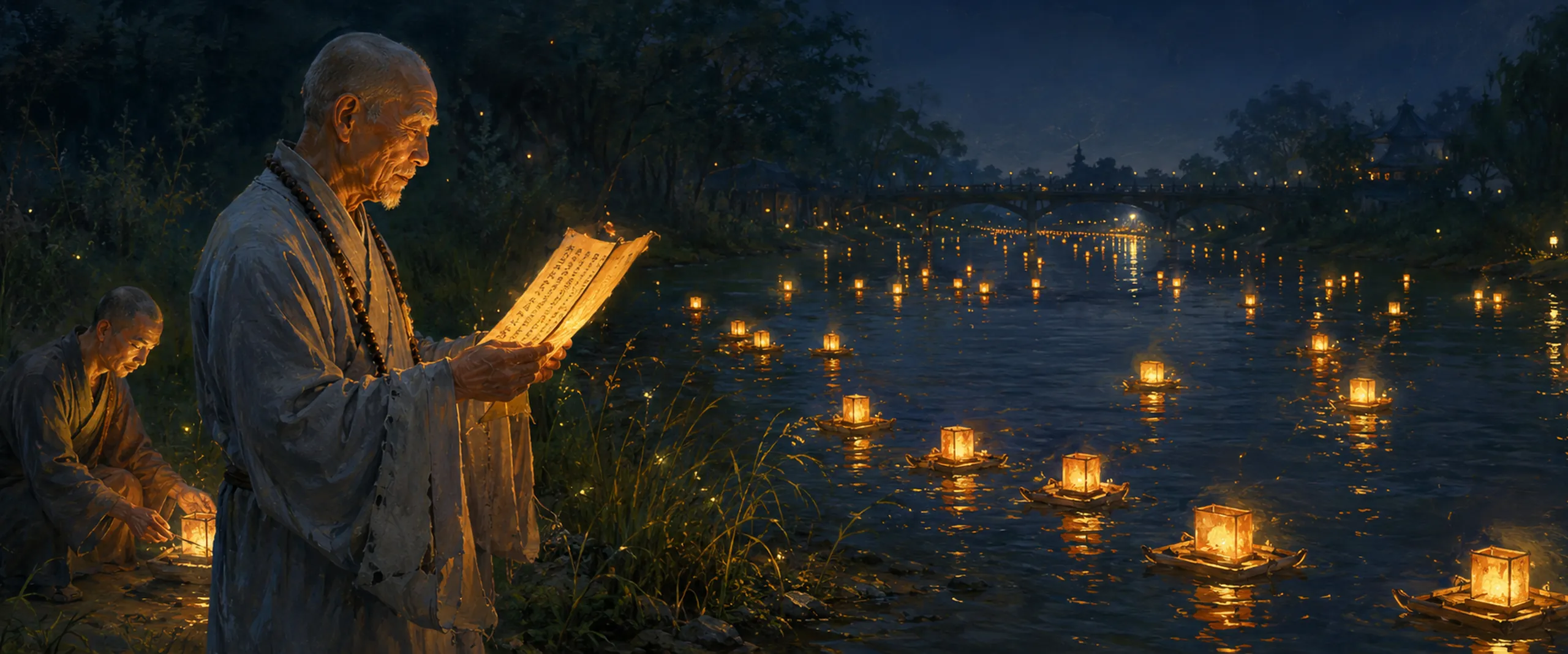
Crimson ceremonial banners sway as though descending from an immortal palace; after paying homage at Shangqing during Zhongyuan, they return. “绛节” refers to banners, dragon canopies, garments, and other ceremonial furnishings displayed during grand Daoist observances on Zhongyuan Day. “上清” is a Daoist celestial realm and here refers to a Daoist temple.
The couplet depicts the lively scene of a Zhongyuan Daoist ceremony, during which the poet encounters a female Daoist priest. The fluttering crimson banners not only convey the solemn magnificence of the rite but also hint at the poet’s own unsettled heart.
Li Ying of the Tang dynasty writes in Zhongyuan Night (《中元夜》): “江南水寺中元夜,金粟栏边见月娥。红烛影回仙态近,翠环光动见人多。香飘彩殿凝兰麝,露绕青衣杂绮罗”, vividly portraying a Zhongyuan night when the temple is ablaze with lights and enveloped in incense. Zhao Ding of the Song dynasty writes in A Drunken Reply to Yanmei’s Quatrain on Zhongyuan Evening (《醉和顔美中元夕绝句》): “年年人月喜团圆,好在诗边又酒边。莫道玄风只渔钓,也随世俗夜无眠”, giving voice to the warmth of hoping for family reunion beneath a full moon at Zhongyuan. Linghu Chu’s Presented to Daoist Master Zhang on Zhongyuan Day (《中元日赠张尊师》) reads: “偶来人世值中元,不献元都未日闲。寂寂焚香在仙观,知师遥礼玉京山”, conveying the solemn devotion of burning incense and making offerings on Zhongyuan Day. Between sacrifice and reunion, Zhongyuan poetry expresses the deep concern Chinese people have long held for both the world of the living and that of the dead.
Historical Development
From Remote Antiquity to the Northern and Southern Dynasties
The oldest source of the Zhongyuan Festival lies in the ancient custom of “秋尝”, the autumn offering to ancestors. Autumn was the season of harvest, and people held rites in which seasonal delicacies were first offered to ancestral spirits and deities before the fruits of labor were enjoyed by the living, while prayers were made for another good harvest in the year to come.
According to historical records, ancestral rites associated with “秋尝” already existed in the pre-Qin period. At first they belonged to the Son of Heaven and the feudal lords, then gradually spread downward into popular society. In the beginning, the date of “秋尝” was not fixed. Over time, it became concentrated around the fifteenth day of the seventh lunar month, generally the first full-moon day after the Beginning of Autumn, when autumn had newly arrived and yin was growing strong.
During this period, the sacrificial customs of the “seventh-month half” had not yet entered the literary vision of poets, but they provided the deepest spiritual foundation for later Zhongyuan poetry.
The Tang Dynasty
The Tang dynasty was the formative period of Zhongyuan poetry. By then, the Daoist name “中元” had already taken shape, while the Buddhist Ullambana assembly had become an important religious ceremony. Tang poets writing about Zhongyuan reveal a cultural landscape in which Confucianism, Buddhism, and Daoism coexisted.
Lu Gong’s Watching a Daoist Rite on Zhongyuan Day (《中元日观法事》) describes a Daoist ritual held during the festival. “四孟逢秋序,三元得气中” identifies Zhongyuan’s place within the annual seasonal order. Yin Yaofan’s Walking in the Void While Watching the Zhongyuan Rite (《中元观法事步虚虚》) opens with “上界秋光净,中元夜气清”, portraying the limpid atmosphere of Zhongyuan night.
Li Ying’s Zhongyuan Night depicts the splendor of a waterside temple in Jiangnan during the festival. Red candles, green ornaments, orchid-and-musk fragrance, and splendid silk garments combine into a vivid picture of a bustling Zhongyuan religious assembly. Li Shangyin’s Written on Zhongyuan (《中元作》), by contrast, uses a Daoist ritual as its background to express an elusive and dreamlike love affair. Wei Zhuang’s Impromptu Poem on the Jiazi Zhongyuan (《即事中元甲子》) places the festival against an age of war and writes of national suffering through “三秦流血已成川”.
Tang Zhongyuan poetry therefore encompasses descriptions of Daoist rites, records of Buddhist Ullambana observances, personal emotion, and reflection on the fate of the country. Its range is broad and its layers richly varied.
The Two Song Dynasties
By the Song dynasty, the subjects of Zhongyuan poetry had become even more diverse. Fan Zhongyan’s Written at Baihuazhou on Zhongyuan Night (《中元夜百花洲作》) departs from the traditional sacrificial themes associated with the festival and instead portrays a bold and unrestrained evening of moon-viewing and drinking.
Zhu Xi’s Presented to Zijin in the Rain on Zhongyuan (《中元雨中呈子晋》) records a leisurely mood while encountering rain during the festival. Zhao Ding’s A Drunken Reply to Yanmei’s Quatrain on Zhongyuan Evening captures the festive warmth of “年年人月喜团圆”.
Song Zhongyuan poetry thus expanded beyond a single religious narrative into personal reflection, leisurely daily life, moon-viewing, drinking, and other dimensions, reflecting the gradual transformation of Zhongyuan from a religious festival into a broader folk celebration.
Yuan, Ming, and Qing
By the Yuan, Ming, and Qing dynasties, Zhongyuan customs had largely taken definitive form. Floating river lanterns, burning paper ingots, and holding Ullambana assemblies became established festival practices.
Wang Kaitai of the Qing dynasty writes in Reflections on the Zhongyuan Festival (《中元节有感》) about Zhongyuan customs in Fujian: “道场普渡妥幽魂,原有盂兰古意存”. Zhao Yi’s Watching Lake Lanterns Released at an Ullambana Assembly While My Boat Was Moored at Fanguang (《舟泊泛光看盂兰会放湖灯》) vividly describes the magnificent spectacle of lanterns released across the lake: “一灯两灯千百灯,满湖荧煌炳繁星”. Pang Kai’s Miscellaneous Verses on Chang’an in the Style of Bamboo-Branch Songs (《长安杂兴效竹枝体》) records children playing with lotus-leaf lanterns on Zhongyuan night.
Qing Zhongyuan poetry ranges from grand narratives of the court to delicate depictions of folk life, and from Daoist ritual to Buddhist Ullambana observances, presenting an increasingly diverse cultural landscape.
Core Imagery
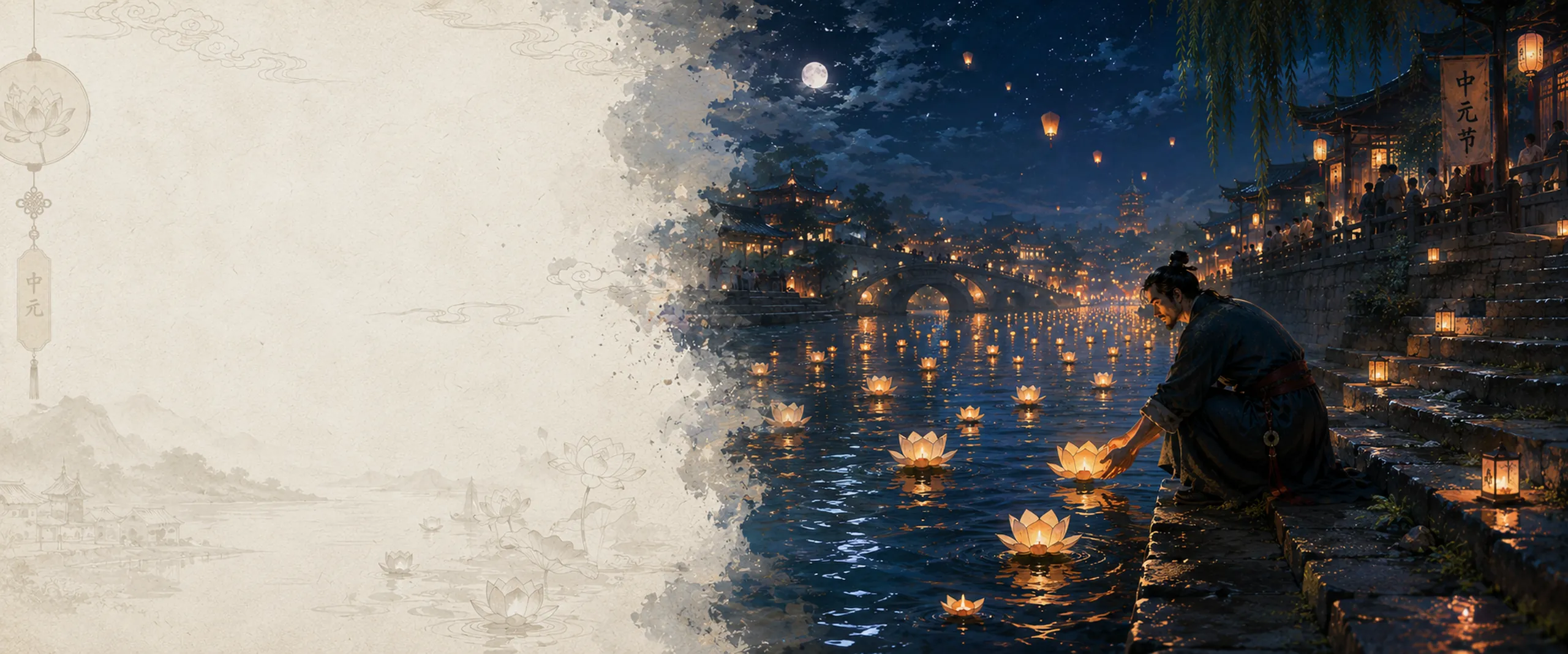
The images that recur throughout Zhongyuan poetry form a distinctive “Zhongyuan image system.” These images are both literary expressions of Zhongyuan customs and vehicles for poetic emotion.
Zhongyuan Daoist Rites
Daoist Zhongyuan observances center on zhai-jiao ritual ceremonies, making ritual scenes one of the most distinctive images in Zhongyuan poetry.
Lu Gong’s “四孟逢秋序,三元得气中” places Zhongyuan within the rhythms of the cosmos. Yin Yaofan’s “上界秋光净,中元夜气清” captures the distinctive clarity of Zhongyuan night.
Images such as “羽衣”, “瑶毂”, “步虚声”, “扫坛”, and “投简” together construct a sacred religious space specific to Zhongyuan.
The ritual becomes a bridge between the human realm and the world of immortals. By writing about such ceremonies, poets complete their reflections on life and death.
Ullambana Assemblies
The Ullambana assembly is the central Buddhist observance associated with Zhongyuan. Zhao Yi’s “一灯两灯千百灯,满湖荧煌炳繁星” uses lake lanterns to portray its magnificence. Li Ying’s “江南水寺中元夜,金粟栏边见月娥” evokes the lively atmosphere of an Ullambana gathering at a waterside temple.
Floating lanterns, food offerings, and scripture chanting together form the full ritual landscape of the Ullambana assembly.
The core idea of this imagery is “普度”, universal deliverance: lanterns serve as guides, food as offerings, and scripture as a bridge, helping the souls of the dead escape suffering.
Lake Lanterns and River Lanterns
River lanterns, or lake lanterns, are among the most visually striking images in Zhongyuan poetry.
Zhao Yi’s “一灯两灯千百灯,满湖荧煌炳繁星” compares the multitude of river lanterns to a sky of brilliant stars. “人灯放入鬼界去,阳火变作阴燐青” describes their transformation as they pass symbolically from the human world into the realm of ghosts.
“一灯一鬼争来擎” directly links each lantern to a departed soul: every light becomes the hope of a spirit awaiting guidance.
The core meaning of the river lantern is “引路”, to illuminate the road home for departed souls and show wandering spirits a direction through the darkness.
Autumn Night and the Moon
Zhongyuan falls in early autumn, making autumn light, night air, cool wind, and the bright moon some of the most common natural images in its poetry.
Yin Yaofan’s “上界秋光净,中元夜气清” uses autumn light and night air to evoke Zhongyuan night. Fan Zhongyan’s “未到中秋先赏月” writes the Zhongyuan moon through comparison with Mid-Autumn. Bian Gong’s “不因逢闰月,今夜是中秋” directly places the moonlight of Zhongyuan beside that of Mid-Autumn.
Images of autumn night and moonlight carry Zhongyuan from religious solemnity into the clarity of nature, and from remembrance of the dead toward contemplation of the cosmos.
Thematic Categories
Daoist Temple Rites
Daoist Zhongyuan observances center on zhai-jiao ritual ceremonies. Lu Gong’s Watching a Daoist Rite on Zhongyuan Day is representative of this theme. “羽衣凌缥缈,瑶毂辗虚空” conveys both the sacredness and ethereal quality of the ceremony.
Yin Yaofan’s “扫坛天地肃,投简鬼神惊” expresses its solemn gravity. Li Shangyin’s Written on Zhongyuan, meanwhile, uses the festival rite to write a personal love affair, intertwining the religious atmosphere of Zhongyuan with the secrecy of private emotion and extending Daoist Zhongyuan ritual from sacred narrative into personal expression.
These poems use Daoist rites as their setting and connect Zhongyuan with the Daoist belief in “地官赦罪”, the Earth Official’s remission of transgressions.
Ullambana Deliverance
The central principle of the Buddhist Ullambana assembly is “救倒悬”, rescuing beings suffering in hell.
Zhao Yi’s Watching Lake Lanterns Released at an Ullambana Assembly While My Boat Was Moored at Fanguang is representative of this theme, using lake lanterns to portray the deliverance of departed souls.
The imagination of “一灯一鬼争来擎” transforms the meaning of universal deliverance into a concrete image. Li Ying’s Zhongyuan Night, by contrast, takes an Ullambana ceremony in a waterside temple in Jiangnan as its background and depicts the bustle and splendor of a Zhongyuan temple assembly.
The imagery of Ullambana expresses the Buddhist spirit of “无缘大慈、同体大悲”, boundless compassion extended without distinction and great compassion born from shared existence.
Autumn Offerings to Ancestors
The oldest source of the Zhongyuan Festival is the ancestral custom of “秋尝”.
In remote antiquity, autumn was the season of harvest. People performed rites for ancestral spirits, first offering seasonal delicacies to them before tasting the food themselves.
Although Zhongyuan poetry contains relatively few direct descriptions of this practice, it remains the deepest spiritual foundation of the tradition.
Poets watching Zhongyuan rites, gazing at lanterns on the water, or looking toward the moon ultimately return to remembrance of the dead and reflection on life.
Moon-Viewing
Zhongyuan poetry also contains a distinctive theme in which the moon leads the festival from sacrifice toward aesthetic experience.
Fan Zhongyan’s Written at Baihuazhou on Zhongyuan Night is representative of Zhongyuan moon-viewing. “未到中秋先赏月” praises the purity of the moon on Zhongyuan night.
Bian Gong’s Seeing the Moon on Zhongyuan places Zhongyuan beside Mid-Autumn through “不因逢闰月,今夜是中秋”.
Such poems free Zhongyuan from the confines of religious ritual and give it an aesthetic dimension: beyond the solemnity of ancestral sacrifice, Zhongyuan can also be a beautiful occasion for admiring the moon.
Closing Reflections
Zhongyuan Festival poetry forms a distinctive and profound landscape within the treasury of Chinese verse. From Lu Gong’s “四孟逢秋序” and the sacred solemnity of Daoist ritual, to Li Ying’s “江南水寺中元夜” and the bustling splendor of Ullambana at a waterside temple; from Li Shangyin’s “绛节飘飖宫国来” and the obscure dreaminess of private love, to Fan Zhongyan’s “南阳太守清狂发” and the bold freedom of moon-viewing and drinking; from Zhao Yi’s “一灯两灯千百灯” and the magnificent spectacle of lake lanterns, to Bian Gong’s “坐爱清光好” and the ingenious juxtaposition of Zhongyuan with Mid-Autumn—Zhongyuan poetry has recorded, across a thousand years, Chinese remembrance of ancestors, compassion for departed souls, reflection on life, and celebration of moonlight.
Within these poems lies the limpid atmosphere of “上界秋光净,中元夜气清”; the brilliant bustle of “红烛影回仙态近,翠环光动见人多”; the compassionate deliverance of “一灯一鬼争来擎,凉燄不愁炙手热”; the bold freedom of “未到中秋先赏月”; and the ingenious association of “不因逢闰月,今夜是中秋”. The meaning of Zhongyuan poetry lies precisely in its ability to carry the light of river lanterns, the fragrance of ritual incense, the beauty of moonlight, and the remembrance of departed souls from a thousand years ago into every new age.
The poetic tradition of Zhongyuan records an evolution in Chinese festival culture from “sacrifice” toward “aesthetic experience”, and from “religion” toward “humanistic feeling.” From the ancient autumn offerings to ancestors, to Daoist rites in the Tang, from moon-viewing and banquets in the Song, to the Qing custom of floating lake lanterns—Zhongyuan poetry has witnessed a thousand-year inheritance of “祭” and “渡”, sacrifice and deliverance. In these lines, Zhongyuan is both the solemnity of “道场普渡妥幽魂” and the pleasure of “未到中秋先赏月”; both the compassion of “一灯两灯千百灯” and the eternity of “皎月当空一轮白”. Zhongyuan poetry is one of the deepest and most enduring declarations Chinese people have made to “祭” and “渡”, a “poetic scroll of the unseen realm” written in ink by generation after generation.
—–
[Language: es]
Selected Poems
Selected Poems
中元作
Tang Dynasty · Li Shangyin
绛节飘飖宫国来,中元朝拜上清回。
羊权须得金条脱,温峤终虚玉镜台。
曾省惊眠闻雨过,不知迷路为花开。
有娀未抵瀛洲远,青雀如何鸩鸟媒。
Background
Among all Zhongyuan poems, Li Shangyin’s Written on Zhongyuan is perhaps the most obscure, dreamlike, and intensely personal. Against the lively background of a temple or Daoist observance, the poem in fact expresses a love that cannot openly be spoken. Li Shangyin conceals his feelings within numerous allusions and intricate images, making the poem resemble the lights of Zhongyuan night—bright, yet veiled in haze. Li Shangyin (c.813–858), courtesy name Yishan and literary name Yuxisheng, was one of the most outstanding poets of the late Tang. His poetry is renowned for imaginative conception and luxuriant beauty, and he was particularly skilled in love poetry and untitled verse.
Written on Zhongyuan is one of the most distinctive Zhongyuan poems. Rather than taking sacrifice or universal deliverance as its theme, it uses a Daoist ritual during Zhongyuan as the setting for a love affair with a female Daoist priest. Li Shangyin experienced several emotional entanglements with female Daoists over the course of his life, and these encounters became a source of inspiration for many of his enigmatic poems.
Line-by-Line Reading
Two allusions concerning love and marriage appear here. “羊权须得金条脱” refers to the Eastern Jin legend in which the immortal woman E Lü Hua descended at night to Yang Quan’s home and presented him with precious objects including golden and jade bracelets. “温峤终虚玉镜台” alludes to the Jin figure Wen Jiao, who used a jade mirror stand as a betrothal gift.
The couplet expresses the poet’s regret that although he and the female Daoist may have met secretly and pledged themselves to one another, they cannot become husband and wife. Yang Quan received the golden bracelet, whereas the poet, like Wen Jiao, is left with an empty jade mirror stand.
The poet draws on two allusions involving love between humans and divine beings. He writes of becoming utterly entranced by the female Daoist’s beauty, intelligence, and affection. Once startled awake from restless sleep, he heard the rain passing; he does not know how he lost his way, only that he was following the trace of blossoms opening.
Both “rain” and “flowers” are symbols of love. To lose one’s way for the sake of flowers expresses a willing surrender to bewilderment in love.
Even the tale of Jian Di, daughter of the Yousong clan, cannot equal the remoteness of Yingzhou; how could a blue magpie ever serve as matchmaker for a poisonous zhen bird?
The poet expresses his wish to remain forever united with the female Daoist, yet at the same time senses how remote and uncertain that hope truly is.
Overall Appreciation
Written on Zhongyuan is one of Li Shangyin’s most obscure and elusive poems. Against the background of a Daoist ceremony during Zhongyuan, he hides an unacknowledgeable love affair within a dense weave of allusions and imagery.
The poem draws on numerous beautiful legends and stories of love, creating an atmosphere at once ethereal, elusive, romantic, and mysterious. The fluttering crimson banners, the gift of the golden bracelet, the unused jade mirror stand, the infatuation of sleeplessness and losing one’s way, and the helpless pairing of blue magpie and zhen bird—all move repeatedly between love and regret.
Although the title names Zhongyuan, the festival ritual is merely the setting. The true theme is love desired but unattainable. Li Shangyin interweaves the religious atmosphere of Zhongyuan with the secrecy of personal emotion, creating a uniquely personal “Zhongyuan love poem.”
中元日观法事
Tang Dynasty · Lu Gong
四孟逢秋序,三元得气中。
云迎碧落步,章奏玉皇宫。
坛滴槐花露,香飘柏子风。
羽衣凌缥缈,瑶毂辗虚空。
久慕餐霞客,常悲集蓼虫。
青囊如可授,从此访鸿蒙。
Background
Among all Zhongyuan poems, Lu Gong’s Watching a Daoist Rite on Zhongyuan Day offers one of the most detailed descriptions of a Daoist Zhongyuan ceremony. Although the poem explicitly portrays a ritual, it creates an imaginative realm of wandering through the great void and contains reflections on the affairs of human life. Lu Gong was a Tang poet whose dates of birth and death are unknown. Born into an eminent family, he lived in reclusion in his early years. In the tenth year of Yuanhe under Emperor Xianzong (815), he served as a secretary in the Palace Library and exchanged poems with Bai Juyi, Yuan Zhen, and others. He later became prefect of Shenzhou.
This poem depicts a Daoist ritual held during Zhongyuan.
Line-by-Line Reading
In the first month of autumn, Zhongyuan among the Three Yuan festivals receives the balanced qi of heaven and earth. “四孟” refers to the first month of each of the four seasons, while “秋序” means the first month of autumn. “三元” refers to the Daoist Shangyuan, Zhongyuan, and Xiayuan festivals, and “得气中” identifies Zhongyuan’s place within the seasonal order.
These two lines take a cosmic perspective and place Zhongyuan within the rhythms of the universe.
White clouds welcome the footsteps of immortals, while memorials rise to the palace of the Jade Emperor. “碧落” is a Daoist term for the heavens; the Palace of the Jade Emperor is his celestial dwelling.
The couplet describes ceremonial acts in which deities are invoked and petitions are presented to heaven.
Dew from sophora blossoms falls upon the altar, while incense drifts through a wind scented with cypress seeds. The couplet records details of the ritual setting. Sophora-blossom dew is autumn dew, and the cypress-seed wind is an autumn breeze. Natural seasonal imagery thus embellishes the ritual and fuses religious ceremony with the signs of the season.
Daoists in feathered robes seem to rise into the misty void, while immortal carriages roll across empty space. The poet has long admired immortals who feed on rosy clouds and drink dew, and often laments living beings struggling amid hardship. If the teachings of the green pouch could be bestowed upon him, he would henceforth seek the primordial realm of Hongmeng.
Overall Appreciation
Taking a Daoist Zhongyuan ceremony as its subject, the poem writes both the sacred solemnity of the rite and the poet’s desire to transcend the mundane world.
From the celestial imagination of “云迎碧落步”, to the concrete detail of “坛滴槐花露”, and finally to the spiritual aspiration in “久慕餐霞客”, the poem moves from outer scene to inner feeling.
“青囊如可授,从此访鸿蒙” is the emotional destination of the entire work. The poet’s observation of a Zhongyuan ritual ultimately becomes a longing to leave the dusty world behind and seek transcendence.
中元夜
Tang Dynasty · Li Ying
江南水寺中元夜,金粟栏边见月娥。
红烛影回仙态近,翠环光动见人多。
香飘彩殿凝兰麝,露绕青衣杂绮罗。
湘水夜空巫峡远,不知归路欲如何。
Background
Among all Zhongyuan poems, Li Ying’s Zhongyuan Night offers one of the most sumptuous and brilliant portrayals of a festival ritual. The eight-line poem begins with “江南水寺中元夜” and ends with “不知归路欲如何”, moving from the splendor and animation of Zhongyuan night toward the bewilderment that emerges once the crowds fall silent. Li Ying, courtesy name Chuwang, was a Tang poet from Chang’an whose dates of birth and death are unknown. He passed the metropolitan examination in the tenth year of Dazhong (856) and later served as Censor-in-Attendance.
This poem portrays an Ullambana ceremony at a waterside temple in Jiangnan on Zhongyuan night.
Line-by-Line Reading
On Zhongyuan night at a waterside temple in Jiangnan, the moon goddess appears beside railings gleaming like golden millet. “金粟” refers to golden ornamentation or lamplight upon the railing. “见月娥” literally writes the rising moon while also evoking the imagination of a lunar immortal descending into the human world on Zhongyuan night.
In the shifting shadows of red candles, immortal figures seem close at hand; where green jade ornaments flash, crowds of participants can be seen moving through the ceremony. The circling candlelight and glimmering green ornaments create a lively picture of brilliant lights and dense human movement.
Incense drifts through the painted hall, thick with the fragrance of orchid and musk; night dew settles around people in blue robes and splendid silk garments. “兰麝” refers to aromatic substances used in incense, while “绮罗” denotes luxurious silks worn by those attending the ceremony.
These two lines convey the splendor of the Zhongyuan assembly through both smell and touch.
Beneath the night sky over the Xiang River, the Wu Gorge lies far away; where is the road home, and what is one to do?
This couplet marks the emotional turn of the poem. The first six lines portray bustle and splendor; the final two reveal uncertainty. After experiencing the brilliance of Zhongyuan night, the poet looks into the distant darkness over the Xiang River and Wu Gorge and suddenly feels the bewilderment of “not knowing the way home.”
Overall Appreciation
The poem first depicts the bustling splendor of a Zhongyuan night at a waterside temple in Jiangnan—golden railings, circling red candlelight, flashing green ornaments, and incense drifting through painted halls—before closing with “不知归路欲如何”.
The first six lines are about seeing; the last two are about thinking. At the end of all the revelry lies uncertainty about the road home.
The poem’s brilliance lies in the fact that it does not stop at description. Instead, it uses scenery to write emotion: no matter how dazzling the lights of Zhongyuan night may be, they cannot illuminate the road through life. This technique of discovering desolation within festivity gives Li Ying’s Zhongyuan Night a singular place in the poetry of the festival.
中元夜百花洲作
Song Dynasty · Fan Zhongyan
南阳太守清狂发,未到中秋先赏月。
百花洲里夜忘归,绿梧无声露光滑。
天学碧海吐明珠,寒辉射宝星斗疏。
西楼下看人间世,莹然都在清玉壶。
从来酷暑不可避,今夕凉生岂天意。
一笛吹销万里云,主人高歌客大醉。
客醉起舞逐我歌,弗歌弗舞如老何。
Background
Among all Zhongyuan poems, Fan Zhongyan’s Written at Baihuazhou on Zhongyuan Night is one of the boldest and most free-spirited. It portrays moon-viewing at Baihuazhou on Zhongyuan night and reveals a spirit at once detached from worldly concerns and exuberantly unrestrained.
Words such as “清狂”, “忘归”, “高歌”, and “大醉” show the poet temporarily casting off the burdens of official life and immersing himself in nature, friendship, and pleasure. Fan Zhongyan (989–1052), courtesy name Xiwen, was an outstanding statesman and writer of the Northern Song. The celebrated line “先天下之忧而忧,后天下之乐而乐” comes from his Record of Yueyang Tower (《岳阳楼记》).
This poem was written on Zhongyuan night in 1046, the sixth year of Qingli under Emperor Renzong. At the time, Fan Zhongyan had been demoted following the failure of the New Policies and was serving as governor of Dengzhou, whose administrative center lay in present-day Nanyang, Henan. He therefore refers to himself as the “Governor of Nanyang”.
While in Dengzhou, he rebuilt Lanxiu Pavilion, constructed Chunfeng Pavilion, developed Baihuazhou, and established Huazhou Academy. On Zhongyuan night, he entertained guests at Baihuazhou, was seized by poetic inspiration, and composed this vigorous and unrestrained poem.
Line-by-Line Reading
I, the Governor of Nanyang, am suddenly seized by a mood of refined wildness; before Mid-Autumn has even arrived, I am already admiring the moon. Lingering at Baihuazhou late into the night, I forget to return, while beneath silent green parasol trees the dew gleams smooth and bright.
The opening immediately establishes the poem’s bold tone. “清狂” is the poet’s own self-definition: he is not merely an ordinary governor, but a man of letters with an unrestrained spirit. “未到中秋先赏月” writes both the brilliance of the moon on Zhongyuan night and the poet’s eagerness to enjoy it.
The sky seems to imitate a blue sea spitting forth a radiant pearl; its cold brilliance shines among the scattered stars. Looking down upon the human world from the western tower, everything appears crystal-clear within a pure jade vessel.
This is the poem’s most exquisite metaphor. The human world becomes a “清玉壶”, a transparent jade flask, luminous and free from dust. Looking down from a height, the poet gains a perspective beyond the mundane.
From a nocturnal outing at Baihuazhou to the vision of the entire world contained within a clear jade vessel, his field of vision continually expands, and his state of mind rises with it.
The oppressive summer heat can never truly be escaped; could tonight’s sudden coolness be heaven’s intention? A single flute scatters clouds across ten thousand miles; the host sings aloud and the guests become deeply drunk. The guests rise and dance in their intoxication, following my song—if we neither sing nor dance, what would it mean to grow old?
The first two lines describe the seasonal sensation of summer heat beginning to recede and autumn coolness emerging on Zhongyuan night. The remaining lines portray the revelry of the banquet. “一笛吹销万里云” magnifies the bold power of the flute, while “主人高歌客大醉” celebrates the pleasure of drinking.
The final rhetorical question, “弗歌弗舞如老何”, drives the joy of Zhongyuan night to its climax.
Overall Appreciation
Fan Zhongyan’s Written at Baihuazhou on Zhongyuan Night turns away from the eerie atmosphere of the “Ghost Festival” and the solemnity of ancestral sacrifice traditionally associated with Zhongyuan, instead writing the freedom and exhilaration of drinking and viewing the moon.
The self-description “南阳太守清狂发” reveals Fan Zhongyan’s broad-minded spirit of “不以物喜,不以己悲”. With the “清玉壶” as its central image, the poem fuses moonlight, cool wind, flute music, loud singing, and drunken dancing into a single whole, expressing a bold spirit that rises above worldly concerns.
Although politically frustrated and demoted to Dengzhou, Fan Zhongyan does not sink into personal sorrow. Instead, on Zhongyuan night, he discovers a form of spiritual freedom. This “清狂” is precisely what makes Fan Zhongyan who he is.
舟泊泛光看盂兰会放湖灯
Qing Dynasty · Zhao Yi
一灯两灯千百灯,满湖荧煌炳繁星。
盂兰盆借佛毫相,放大光明豁沉冥。
人灯放入鬼界去,阳火变作阴燐青。
是时湖天夜昏黑,黑中正显灯光出。
一灯一鬼争来擎,凉燄不愁炙手热。
暗飞忙似万点萤,自照羁魂欣解脱。
漆天墨地枉死城,今夕朗开觉路彻。
夜叉罗刹不敢拦,为有一道红光赫。
鱼龙不知徒惊逃,何暇烧汝头额焦。
甓社有珠恐被掣,老蚌亦复闭口牢。
迷津筏渡有如此,万荷花里欢声嚣。
斯须灯散了无迹,皎月当空一轮白。
Background
Among all Zhongyuan poems, Zhao Yi’s Watching Lake Lanterns Released at an Ullambana Assembly While My Boat Was Moored at Fanguang gives one of the most detailed and vivid descriptions of the custom of floating lanterns on water.
The poem begins with “一灯两灯千百灯” and ends with “皎月当空一轮白”, bringing the magnificent spectacle of an Ullambana lantern release vividly before the reader’s eyes. Zhao Yi (1727–1814), courtesy name Yunsong and literary name Oubei, was a renowned Qing historian and poet. This poem was written in the Guihai year, 1803, when the poet was seventy-six.
It describes his experience of watching lanterns released across a lake during an Ullambana assembly while his boat was moored nearby. The poem is an important historical source for the study of river-lantern customs during the Qing Zhongyuan Festival.
Line-by-Line Reading
One lantern, two lanterns, then hundreds and thousands; the entire lake gleams brilliantly like a sky filled with stars. The Ullambana assembly borrows the radiant light of the Buddha and releases great illumination to open the darkness of the netherworld.
The poem begins with the progressive pattern “一灯两灯千百灯”, showing the lanterns increasing from few to many, from scattered to dense. The effect is intensely visual. “满湖荧煌炳繁星” compares the lanterns to countless stars and captures the grandeur of the scene.
Lamps from the human world are sent into the realm of ghosts; the fire of the living becomes blue phosphorescence in the world of the dead. At that moment the lake and sky are completely dark, and the darkness makes the lantern light shine all the more clearly. It is as though each lamp has a ghost reaching eagerly to hold it, and the cool flame brings no fear of burning the hands.
These lines portray the lantern release from the perspective of ghosts. The lake lanterns are not merely scenery in the world of the living; they become lights in the realm of the dead. The imagination of “一灯一鬼” gives visible form to the ritual meaning of universal deliverance.
Such is the ferry across the lost ford: among ten thousand lotus lanterns rise sounds of joy. In a brief moment the lamps scatter and leave no trace; only one round white moon remains shining high in the sky.
“斯须灯散了无迹” writes the fleeting existence of the lanterns, while “皎月当空一轮白” writes the permanence of moonlight. Moment and eternity, noise and silence, attain a poetic balance in the final contrast.
Overall Appreciation
Zhao Yi’s poem takes the lake lanterns as its thread, moving layer by layer from the grandeur of their release to the emptiness after they vanish, leaving a long aftertaste.
The progressive phrase “一灯两灯千百灯” gives strong motion to the process by which the lanterns multiply across the lake. The imagination of “一灯一鬼争来擎” turns the meaning of universal deliverance into a concrete image.
The poem ends with “皎月当空一轮白”: after the lights disappear, only the moon remains eternal. The poem is therefore not merely a valuable record of Qing Zhongyuan lantern customs, but also a profound reflection on life and death, transience and eternity.
中元见月
Ming Dynasty · Bian Gong
坐爱清光好,更深不下楼。
不因逢闰月,今夜是中秋。
Background
Among all Zhongyuan poems, Bian Gong’s Seeing the Moon on Zhongyuan is one of the shortest, most concentrated, and most subtly ingenious. In only twenty Chinese characters, it establishes an intriguing connection between Zhongyuan and Mid-Autumn: were it not for an intercalary month, the moon of Zhongyuan night would be no different from that of Mid-Autumn. Bian Gong (1476–1532), courtesy name Tingshi and literary name Huaquan, was a Ming poet and one of the “Former Seven Masters”.
The poem was written while admiring the moon on Zhongyuan night. Because that year contained an intercalary month, the moon was exceptionally clear, prompting the poet to think: if there had been no leap month, tonight would already be Mid-Autumn.
Line-by-Line Reading
Sitting upstairs, I delight in the beauty of the clear moonlight; although the night has grown deep, I still do not wish to descend.
The single character “爱” expresses the poet’s fascination with the moonlight, while “更深不下楼” conveys how long and deeply he has remained absorbed in moon-viewing.
If not for the intercalary month this year, tonight would already be Mid-Autumn.
This is the poem’s most ingenious turn. The leap month has delayed Mid-Autumn, and so the moonlight on Zhongyuan night seems to possess the brilliance normally associated with Mid-Autumn.
By linking Zhongyuan and Mid-Autumn, the poet gives the Zhongyuan moon a sense of completeness and reunion usually associated with the Mid-Autumn moon.
Overall Appreciation
Although the poem takes the moon seen on Zhongyuan as its subject, it subtly links Zhongyuan with Mid-Autumn, the fifteenth day of the seventh lunar month with the fifteenth day of the eighth.
Mid-Autumn symbolizes reunion, while Zhongyuan is a festival of ancestral remembrance. Yet beneath moonlight, the two festivals share something in common: the moon shines without distinguishing intimacy from distance, illuminating both reunion and remembrance.
The line “不因逢闰月,今夜是中秋” appears to be about the moon, but is really about feeling. Before moonlight, all festivals can in some way speak to one another.
Readers’ Comments
Calendar and traditional culture enthusiasts from around the world, sharing the same moon.
Sign in or register to join the conversation. Your comment account is created automatically the first time you use a connected account.
No comments yet
Share your thoughts with readers around the world.