Ghost Festival

Ghost FestivalGlobal Spread

「 万树凉生霜气清,中元月上九衢明。 」

The Ghost Festival falls on the 15th day of the seventh lunar month. It is associated with the Daoist “Three Yuan” doctrine — the day when the Earth Official pardons sins — and also merged with the Buddhist Yulanpen Assembly, becoming a festival…

The Zhongyuan Festival spread across Southeast Asia with Chinese migration. In Singapore, Zhongyuan is an important traditional Chinese festival. Throughout the seventh lunar month, large-scale Pudu activities are held across the island; altars are set up and joss paper is burned in public-housing estates and commercial districts, while getai performances take place at night. In Malaysia, Chinese communities hold Yulanpen assemblies (盂兰盆会) and Pudu Dharma ceremonies during Zhongyuan, making offerings to ancestors as well as wandering and unclaimed spirits. Chinese communities in Indonesia likewise maintain Zhongyuan sacrificial traditions, while Thailand, the Philippines, and other places also have similar Chinese Zhongyuan customs.

While preserving inherited traditions, Zhongyuan in Southeast Asia has also incorporated local cultural elements. Forms such as getai performances and temple-fair markets give the festival both religious solemnity and worldly liveliness. By connecting the realms of the living and the dead through compassion, Zhongyuan has become an important cultural bond through which overseas Chinese remember those who came before, honor their origins, and strengthen community cohesion.

Ghost Festival / Global Spread
297 days until Ghost Festival August 16, 2027 · Lunar 七月十五

Celebrated Worldwide

Regional Highlights
01

The Americas

United States

The United States is one of the countries with the largest Chinese immigrant populations in the world. Although Zhongyuan is not as widely known as the Spring Festival or Mid-Autumn Festival, its ritual traditions have continued for more than a century in Chinese-populated cities such as San Francisco, New York, and Los Angeles, and in contemporary times the festival has also been endowed with new cultural meanings.

San Francisco: “Chinatown Hungry Ghost Festival”—from historical trauma to cultural strength. San Francisco’s Zhongyuan Festival is one of the most culturally layered examples in North America. In August 2025, the Chinese Culture Center of San Francisco held its third Chinatown Hungry Ghost Festival, themed “Demons of Our Time”, transforming traditional Zhongyuan observances into a cultural event combining music, art, procession, and ritual.

Curator Leung Hoi-yiu noted that the Ghost Festival occupies an important place in the history of Chinese people in California: between 1860 and 1920, more than 350 Zhongyuan or Yulan ceremonies were documented across the state, providing spiritual solace to early immigrants who endured exclusion and hardship.

The event invited three Hong Kong artists to interpret tradition through contemporary art. Tang Kwok-hin created a mobile sculpture inspired by the lotus flower; Lau Hok-shing created a monumental flame installation centered on the element of fire; and Cheng Yee-man transformed a traditional exorcistic rite into a processional work. A 14-foot-high giant paper effigy of Da Shi Wang (大士王) set out from 667 Grant Avenue and paraded through Chinatown, bidding farewell to wandering spirits and blessing the community with peace.

Chinese Culture Center executive director Jenny Leung stated: “At a time when immigrant communities are repeatedly under attack, art can bring people together.” A senior member of Miu Lin Sin Koon explained that more than a century ago, large numbers of Chinese railroad workers, miners, and gold seekers crossed the ocean, and many died amid hardship and discrimination: “Today, we hope to use the Ghost Festival to pray for them and remember them, while also helping later generations remember what they contributed and sacrificed.”

The Zhongyuan procession in San Francisco Chinatown attracted visitors from around the world. By transforming Zhongyuan from “folk belief” into “cultural action,” the festival has acquired a social significance in the United States that reaches beyond the religious sphere.

Los Angeles: North American Yulanpen Offering-to-the-Sangha Dharma Assembly. On July 20, 2025, Buddha’s Light International Los Angeles Association held the “North American Yulanpen Offering-to-the-Sangha Dharma Assembly” at Fo Guang Shan Hsi Lai Temple. The ceremony was presided over by Venerable Hsin Bao, abbot of Fo Guang Shan, with 90 monastics from across North America and 27 young novice monks participating in short-term monastic practice invited to receive offerings. Around 1,300 devotees gathered at the temple, following Buddhist precepts and practicing filial gratitude through the merit of making offerings to the Sangha.

Zhongyuan observances in Los Angeles center on the Buddhist Yulanpen tradition and emphasize the religious meaning of filial devotion and repaying parental kindness.

Canada

Zhongyuan celebrations in Canada’s Chinese communities carry a distinctive historical dimension: commemorating the thousands of Chinese laborers who died during construction of the transcontinental Canadian railway.

Vancouver: “Spirit of the Square”—an altar for Chinese railroad workers. On September 6, 2025, the day of Zhongyuan, Vancouver Chinatown held the third annual “Spirit of the Square” event to celebrate and commemorate the festival. The event took place at Vancouver Chinatown Memorial Square.

Organizers set up an altar for community members, burned incense, and made offerings in memory of the thousands of Chinese railroad workers who died while building the transcontinental Canadian railway. Activities also included lion dancing, qigong, small-zine making, karaoke, and mahjong.

Vancouver’s Zhongyuan combines an ancient tradition of ritual remembrance with the particular historical memory of Chinese Canadians. Those honored are not only family ancestors, but also the Chinese laborers who gave their lives to the building of Canada and were long forgotten by history.

02

Asia

Asia is the region where Zhongyuan culture has spread most deeply and extensively. The festival is not only widely observed among Chinese communities; Japan, South Korea, Vietnam, and other countries have also developed distinctive Zhongyuan-related traditions.

Southeast Asia

Southeast Asia has the greatest concentration of overseas Chinese communities. Here, Zhongyuan has not only preserved Chinese traditions in relatively complete form, but has also developed distinctive local expressions through interaction with surrounding cultures.

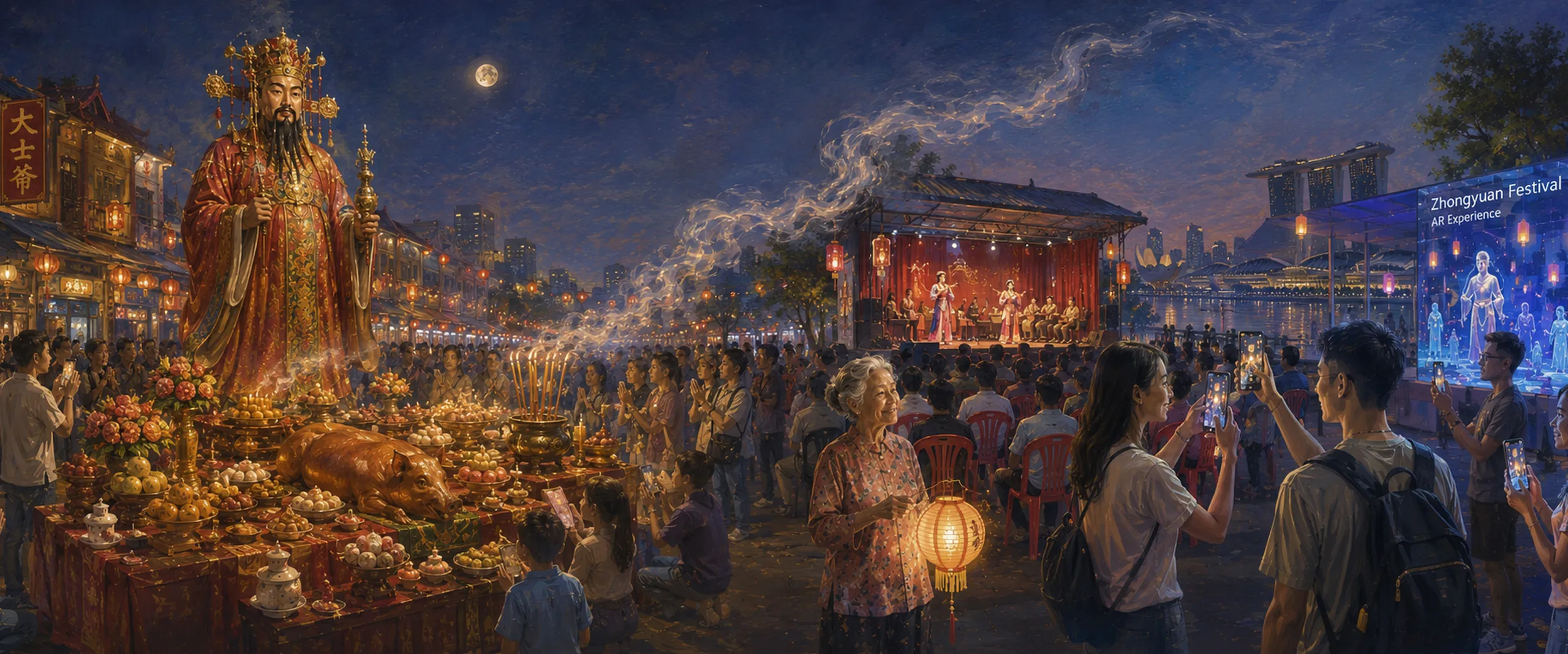
Singapore: getai culture—the public carnival of Zhongyuan. Singapore’s Zhongyuan celebrations can be regarded as one of the world’s most vibrant versions. Zhongyuan takes place during the seventh lunar month, when sacrificial burning and live street performances are common across the island. It is estimated that hundreds of getai stages are set up across Singapore during Zhongyuan every year. Whether beneath public-housing blocks, outside shopping malls, or beside office buildings, red Zhongyuan notices can be seen everywhere, alongside tables filled with offerings, burning candles, and incense.

In 2025, to celebrate the 60th anniversary of Singapore’s founding, a Zhongyuan getai titled “Stars Shine Together · Sixty Years in Shared Radiance” was staged on a grand scale in the Ubi industrial area, bringing together 60 performers from Singapore, Malaysia, mainland China, and Taiwan.

According to observations, crowds streamed in continuously from the evening onward, and by nightfall almost every seat was occupied; over the course of the day, an estimated more than one thousand spectators attended. Performer Hao Hao explained that this major annual Zhongyuan getai symbolizes the traditional seventh-lunar-month rite of welcoming “good brothers” (好兄弟), a euphemistic term for ancestors or spirits, into the human world. Not only the hosts, but all 60 performers had to undergo a jiaobei divination ritual (掷筊杯) before being allowed onto the stage. Marine Parade GRC Member of Parliament Pang Li Yan also took the stage to sing, prompting the host to exclaim that he had “never seen an MP so happy to go onstage.”

Singapore’s temples are equally lively during Zhongyuan. On Zhongyuan Day in 2025, Mahayana Chan Temple estimated that its Hundred-Thousand-Buddha Yulan Pudu Grand Assembly, held from the first through the sixteenth day of the seventh lunar month, would attract 8,000 to 10,000 participants. For the first time, the temple created lotus memorial tablets for pets, allowing monastics to perform purification rites for devotees’ beloved animals and for community cats and dogs.

Lorong Koo Chye Sheng Hong Temple held a Pudu Dharma ceremony lasting about an hour and expected at least 500 worshippers on the fifteenth day of the seventh lunar month alone. The Taoist Federation of Singapore also invited around fifty representatives from Buddhism and Hinduism to visit temples and learn how Taoists celebrate Zhongyuan.

The “bidding for blessed objects” (标福物) activity is organized by Zhongyuan associations and can be regarded as an important means through which Chinese society strengthens cohesion and practices mutual assistance.

Singapore’s Zhongyuan combines solemn ritual worship with exuberant getai entertainment and large-scale Pudu ceremonies, presenting a distinctive cultural form that is both reverent and carnivalesque.

Malaysia: the country’s largest Pudu, attended by 15,000 people. Malaysia’s Zhongyuan celebrations are equally remarkable in scale. In 2025, the Johor Bahru Guan Sheng Gong Association once again organized the country’s largest Zhongyuan Pudu celebration, attracting more than 15,000 participant-visits, the highest attendance on record.

More than sixty food stalls were set up during the event. To highlight interethnic harmony, the organizers specially prepared halal food and invited more than 500 people from other ethnic communities to participate; for the first time, Malay and Indian dance groups were also invited to perform welcoming dances. The assembly prepared 1,500 cases of assorted alcoholic beverages and 60 roast pigs as offerings to the ancestors.

Datuk Shi Yali, chairman of the Guan Sheng Gong Association, stated that Zhongyuan is not only a traditional religious ritual, but also carries the core values of filial piety, gratitude, diligence, and benevolence. He emphasized: “Today, we are not merely holding a banquet or a Pudu ceremony; we are also reminding one another to incorporate these traditional virtues into our everyday lives.”

The “grabbing the offerings for wandering spirits” (抢孤) ritual at the port of Sungai Pinang in Balik Pulau, Penang, is one of Zhongyuan’s most visually striking traditions. The annual “offering to wandering spirits and grabbing the offerings” event is one of only two local celebrations of its kind in Penang. During the 2025 ritual, all the offerings laid out on the ground were cleared away within just five minutes.

Preparations began at 7 a.m., worship began at 10 a.m., and after the rituals concluded, the grabbing began, with surrounding residents rushing forward to take the offerings. The event attracted more than one hundred visitors from outside the area, including tourists from China and Europe.

Zhongyuan activities across Malaysia are highly varied. A celebration in Genting Jaya raised RM150,000; the Bukit Maluri Guanyin Pavilion peace banquet in Kepong raised RM128,000; and a welfare charity organization in Kuching, Sarawak distributed 240 packages of essential supplies to vulnerable groups.

Malaysia’s Zhongyuan thus includes not only the grand spectacle of mass Pudu ceremonies, but also local traditions such as qianggu, together with a strong dimension of charitable assistance and social care.

Indonesia: burning the royal boat and “returning spirits, praying for blessings.” Chinese communities in Indonesia preserve many ancient Zhongyuan traditions.

On September 6, 2025, Zhongyuan Day, several hundred Chinese people from across Indonesia gathered at Fushui Temple in Bojonegoro, East Java, for rites honoring deities, while thousands of local residents participated enthusiastically. Prayers were conducted before dozens of “mountain bundles” (山包) filled with local specialties. After the ceremony, hundreds of people began competing to take the goods contained in the bundles. The event attracted Chinese participants from cities throughout Indonesia, as well as some from overseas.

In Bangka Regency, Bangka Belitung Province, Chinese residents held a “Returning Souls and Praying for Blessings” (归魂祈福) ritual at Luohe Temple. The ceremony opened with participants competing for offerings—fruit, rice, pastries, and other items placed on the altar were eagerly taken away, symbolizing the sharing of blessings.

At midnight, a 13-meter-high sacred effigy and a 12.7-meter-long paper boat model were set alight, symbolizing deities guiding wandering spirits across the river of the underworld. Most Chinese residents of Bangka Regency are descendants of migrants from Fujian and Guangdong who arrived from the Ming and Qing periods onward, and they have preserved traditional Chinese festival customs for centuries.

In West Kalimantan, local Chinese communities conducted the southern Fujian tradition of “burning the royal boat” (烧王船), intended to allow ancestors who had journeyed to Southeast Asia to return to their homeland while also praying for “peace throughout the whole locality” (合坡平安).

Wihara Gunung Timur in Medan also held a major Zhongyuan celebration attended by thousands of ethnic Chinese residents. Guanghui Temple in Jiabu, Central Java, not only conducted Zhongyuan rituals but also distributed 1,300 packages of daily necessities to local residents.

By combining Zhongyuan rituals with charitable relief, Chinese Indonesians have made the festival concern not only the dead, but also the living.

Cambodia: Yulan assemblies of the Teochew and Fujian associations. Zhongyuan celebrations among Cambodia’s Chinese communities are centered primarily on the Teochew and Fujian communities.

On September 20, 2025, the Cambodia Teochew Association held a Zhongyuan Yulan worship ceremony at the Teochew cemetery grounds in Kambol, on the outskirts of Phnom Penh. During the ceremony, vice chairpersons worshipped at the temples of Dafeng Zushi and Bogong, praying for favorable weather and for the people to live and work in peace and contentment.

In previous years, before Zhongyuan, the Teochew Association distributed daily necessities to local residents, and “this good deed has continued to be remembered by local people, who remain grateful for its virtue.”

The Cambodia Fujian Association likewise successfully organized a series of Zhongyuan rituals honoring the “good brothers” and holding Yulan assemblies. Activities took place both at the Fujian Association headquarters and at the new Fujian cemetery grounds, where rice and instant noodles were distributed to poor families in Phnom Penh and Kampong Speu Province.

Through these activities, the Fujian Association promoted the profound meaning of traditional culture while demonstrating a positive commitment to social responsibility and giving back to the local community.

Thailand: preserving Zhongyuan amid economic fluctuations. Zhongyuan celebrations in Thailand are centered mainly on ethnic Chinese communities.

On September 6, 2025, Phong Thep Kong Guang Li Gong in Nong Chang District, Uthai Thani Province, was filled with activity. Local Chinese residents dressed in auspicious red clothing and brought their families to the old Chinese shrine to celebrate Zhongyuan.

People followed the tradition of “family first, community second”: they first set up altars at home to worship their ancestors, then carried offerings to the shrine for a second round of worship. Because of the economic downturn, however, the amount of offerings was smaller than in previous years. Local residents said that even during an important festival, they now had to budget carefully.

Despite this, people’s regard for traditional festivals and the sincerity of their prayers remained undiminished. Teochew Chinese communities in Bangkok also held Yulanpen assemblies, ceremonially welcoming Da Shi Ye, Chenghuang Gong, and other deities, while Buddhist monks conducted the Yujia Yankou (瑜伽焰口) ritual to offer relief to wandering spirits.

Myanmar: Taiwanese businesspeople combine Zhongyuan Pudu with charity. In Myanmar, Taiwanese business communities organize Pudu activities during Zhongyuan. In addition to continuing traditional ritual culture, they also incorporate charitable donations, sending collected supplies to disadvantaged groups and orphanages in different regions.

This practice of combining Zhongyuan ritual observance with charitable relief is widespread among Chinese communities across Southeast Asia.
Japan

The Japanese evolution of Zhongyuan is the most distinctive branch within the wider East Asian lineage. After Zhongyuan entered Japan, it merged with indigenous ancestor worship and developed into Obon (盂兰盆节), becoming Japan’s second-largest festival after New Year.

Japanese Obon is generally observed from August 13 to 16, and many companies and schools take around a week off. Graves are cleaned before the 13th; ancestral spirits are welcomed on the 13th and sent off on the 16th. In folk custom, people gather to perform a dance known as Bon Odori (盆踊).

Unlike China’s “Ghost Festival,” Japan’s Zhongyuan tradition also developed a gift-giving custom: people present gifts to those who have supported or cared for them in everyday life as an expression of gratitude.

Sofukuji Temple in Nagasaki holds an annual “Chinese Bon”, an Obon observance belonging to overseas Chinese communities in Japan. Beginning on the twenty-sixth day of the seventh lunar month, it lasts for three days. Five special pavilions are erected inside the temple, decorated with red lanterns and filled with offerings of fruit, vegetables, and other foods. This four-hundred-year-old tradition is now in urgent need of preservation and transmission.

Japanese Obon has retained the ancestral-worship core of China’s Zhongyuan while transforming it, through nationwide holidays, Bon Odori dancing, and seasonal gift-giving, into a national festival with unmistakably Japanese characteristics.

South Korea

In South Korea, Zhongyuan is known as the “Baekjung Festival” or “Day of the Departed Souls.” Zhongyuan in Korea combines the Daoist belief in the Three Yuan (三元) with indigenous agricultural rituals: the fifteenth day of the seventh lunar month is Zhongyuan, the fifteenth day of the first lunar month is Shangyuan, and the fifteenth day of the tenth lunar month is Xiayuan.

In Korea, Zhongyuan itself carries meanings of celebrating the harvest and thanking the earth, and people make offerings to agricultural deities. Families set up ritual tables at home, place offerings, burn incense, and worship ancestors. Lion dances, dragon dances, and other performances are also held.

Sangju City in South Korea and Keelung City in Taiwan became sister cities through their shared connection to Zhongyuan observances, and Sangju has repeatedly sent delegations to visit Keelung’s Zhongyuan Festival. This form of city diplomacy born from Zhongyuan is a vivid example of festival culture promoting international exchange.

Vietnam

Vietnam’s Zhongyuan tradition has likewise been influenced by Chinese culture. In Vietnam, Zhongyuan is known as the Yulanpen Festival, with particular emphasis on filial devotion and repaying parental kindness.

Vietnamese communities living in Russia have held grand Yulanpen ceremonies of filial gratitude in Moscow, where hundreds of monks, nuns, and devotees reviewed the history and meaning of Yulanpen and revisited Buddhist teachings on filial piety within the family. Vietnamese living abroad cherish and promote this fine tradition and educate younger generations to inherit the beauty of their national culture.

03

Europe

United Kingdom

Although Zhongyuan celebrations in Britain’s Chinese communities are smaller in scale than those of Southeast Asia, they carry a distinctive significance in cross-cultural dialogue.

On language-exchange platforms such as HelloTalk, British users who saw images of Chinese people burning joss paper for Zhongyuan reacted in surprise, asking: “Have Chinese people gone crazy? Aren’t they afraid of fire?” After learning that this was a traditional way of commemorating loved ones, their response shifted from initially being “frightened by the ‘Ghost Festival’” to understanding and respect.

This transformation from “misunderstanding” to “understanding” precisely reflects Zhongyuan’s distinctive value in intercultural communication. British calendars have already marked September 6 as the Zhongyuan Festival.

France

Although France does not have large-scale Chinese Zhongyuan activities, a transnational Pudu ceremony at the Sino-French War Memorial Park in Keelung, Taiwan, is worth noting.

In August 2025, the Zhengsha Community Development Association of Keelung held a Zhongyuan Pudu ceremony titled “Foreign Spirits · Bodhi Compassion” at the Sino-French War Memorial Park, mourning French officers and soldiers who died in the Sino-French War.

Instead of the traditional three sacrificial animals and four fruits, the offerings consisted of French bread and red wine, while a violin was played at the site. By combining Zhongyuan Pudu with French cultural symbols, the ceremony transcended ethnic boundaries and became a peace memorial across national borders.

French calendars have already marked September 6 as Zhongyuan Festival.

Russia

On September 13, 2025, Vietnamese residents in Russia held a grand Yulanpen ceremony of filial gratitude at the Hanoi–Moscow Multifunctional Cultural Complex in Moscow.

A representative of the Moscow Buddhist chanting hall stated that Yulanpen is an important festival for expressing gratitude to parents and remembering ancestors, and that Vietnamese people living overseas should cherish and promote this tradition even more.

This example shows that the influence of Zhongyuan, or Yulanpen, is not limited to Chinese communities. It also possesses deep cultural roots among overseas communities from countries such as Vietnam that have historically been influenced by Chinese culture.

Germany

In Germany, Zhongyuan spreads primarily through intercultural dialogue. German friends compare Zhongyuan with Halloween. Although Halloween involves costumes, trick-or-treating, and ghost stories, both festivals fundamentally revolve around themes of spirits and the supernatural.

German calendars have already marked September 6 as Zhongyuan Festival. This comparison gives German audiences a frame of reference for understanding Zhongyuan: both cultures have traditions concerning the dead, but their forms of cultural expression are entirely different.

04

Oceania

Australia

Zhongyuan celebrations in Australia are concentrated mainly within Chinese communities. Christmas Island in the Indian Ocean is the only part of Australia where Lunar New Year is a public holiday; ethnic Chinese make up half the island’s population, and a large Zhongyuan Festival is held there every year.

In Melbourne, Chinese residents can purchase ritual offerings at Springvale Shopping Centre. In Sydney, overseas youth cultural ambassadors have also brought Taiwan’s Hsinchu Zhongyuan Chenghuang Festival to Australia’s Green Apple Festival for cultural presentation.

Although Zhongyuan is not celebrated on the same scale as the Spring Festival or Mid-Autumn Festival in Australia, Chinese communities continue to maintain the tradition through the purchase of ritual goods, family worship, and other practices.

New Zealand

Dunedin’s Chinese Cultural Festival has already incorporated Zhongyuan into its cultural calendar. The appearance of Zhongyuan on an official cultural calendar in New Zealand marks a degree of cultural recognition for this traditional Chinese festival in Oceania.

Zhongyuan in the Cloud

In-Depth Feature

With the development of digital technology, Zhongyuan has generated entirely new forms of ritual observance among overseas Chinese, allowing those unable to visit ancestral graves in person to express remembrance in the cloud.

Online Dharma assemblies break through geographical limits. During Zhongyuan 2026, after Taiwan’s Qingshuiyan Temple fully opened online registration, its compassionate care expanded beyond geographical limits to overseas participants. Not only did devotees from mainland China take part online, but overseas internet users also prayed for well-known entertainers and performed merit-transfer rites for animals.

Online Dharma assemblies allow Chinese communities scattered around the world to participate in Zhongyuan rituals at the same moment.

“Cloud worship” among overseas Chinese. For overseas Chinese unable to return home, Chinese community centers often organize collective ritual activities. Parents explain the meaning of Zhongyuan to children by telling stories, teaching them to make joss paper, and explaining ritual etiquette.

In the digital age, video calls, online memorial platforms, and other new methods are becoming new vehicles through which overseas Chinese maintain Zhongyuan traditions.

Zhongyuan narratives on social media. On Xiaohongshu and other social platforms, overseas Chinese share their forms of Zhongyuan worship and their understanding of its culture. One blogger described Zhongyuan as a “family group chat across time and space”: “We illuminate memory with firelight, and transmit our concern through taste.”

This poetic expression has given Zhongyuan new vitality among younger generations and within cross-cultural communication.

Mutual Learning Among Civilizations

In-Depth Feature

The Zhongyuan Festival has gradually moved from a traditional festival of the Chinese nation toward the world. Its path differs from those of the Spring Festival, Mid-Autumn Festival, and Dragon Boat Festival: if the Spring Festival takes “reunion” as its emotional core, the Mid-Autumn Festival the “bright moon” as its cultural symbol, and the Dragon Boat Festival “dragon boat racing” as its cultural emblem, then Zhongyuan takes “how we treat the dead” as a universal human question and “filial gratitude” as its emotional core.

Zhongyuan and Halloween: a cultural dialogue between two “ghost festivals.” The most striking cultural phenomenon in Zhongyuan’s overseas transmission is its comparison and dialogue with Western Halloween.

Both occur in autumn and both are related to ghosts, yet their cultural logic is entirely different. Halloween is a carnival of “dressing as ghosts” to drive ghosts away, while Zhongyuan is a form of reverence that “makes offerings to spirits” in order to pacify them. Halloween centers on fear and entertainment, while Zhongyuan is rooted in reverence and gratitude.

As one German friend said: “Zhongyuan feels quite similar to their Halloween. Halloween involves dressing up, asking for candy, and telling ghost stories, but fundamentally both festivals revolve around ‘spirits’ and the ‘supernatural’; it is simply that their cultural forms of expression are completely different.”

This comparison gives Western audiences a point of reference for understanding Zhongyuan while making its values clearer through contrast: it is not horror, but reverence; not entertainment, but gratitude.

Zhongyuan and the Day of the Dead: a cross-cultural dialogue on “life and death.” Zhongyuan and Mexico’s Day of the Dead share an even deeper resonance in their spiritual foundations. Both hold that, at particular times, the living and the dead can communicate; both use food, music, and ritual to receive the departed; and both emphasize that death is not an ending, but another form of existence.

When introducing Zhongyuan, the Singapore Tourism Board deliberately places it alongside Mexico’s Day of the Dead and North American Halloween. This juxtaposition is itself a form of dialogue between civilizations: different cultures address the same human questions in different ways—how should we face death? How should we remain connected with the departed?

Zhongyuan’s answer is to “receive” the dead with reverence, gratitude, and food. As people in Singapore say, Zhongyuan is “a festival for paying respects to departed spirits.”

The universal values of Zhongyuan: filial devotion and gratitude. The fundamental reason Zhongyuan can spread so widely overseas lies in the universal values it carries: gratitude toward ancestors through filial piety, reverence for life through compassion, and concern for the vulnerable through charitable giving.

The abbot of Mahayana Chan Temple in Singapore stated: “The true meaning of Yulanpen is gratitude—not only gratitude toward our parents, but also gratitude toward our teachers.” The chairman of Malaysia’s Guan Sheng Gong Association emphasized that Zhongyuan culture contains the spirit of “filial respect for parents and elders, and mutual care and support.”

As one Indonesian Chinese representative said: “We hope that through rituals like these, our ancestors will know that we have not forgotten them.”

Zhongyuan in the Americas: a turn toward “historical justice.” The spread of Zhongyuan in the Americas carries a distinctive historical dimension. It is not merely family-level ancestor worship, but also a collective affirmation by Chinese-descended communities of their own history.

The Chinese Culture Center of San Francisco has transformed Zhongyuan into cultural action confronting the “demons of our time”—from xenophobia and censorship to historical erasure. At Vancouver Chinatown Memorial Square, altars are erected during Zhongyuan for the thousands of Chinese railroad workers who died building Canada’s transcontinental railway.

As a senior member of San Francisco’s Miu Lin Sin Koon said: “Without them, there would be no Chinese community today taking root and living securely in the Bay Area.”

In North America, Zhongyuan is therefore not only remembrance of family ancestors, but also recognition of and tribute to the collective history of Chinese-descended communities.

Closing Note

Lingering Notes

The global spread of the Zhongyuan Festival traces a long road from China’s ancient autumn harvest offerings and ancestral rites to the world’s five continents. Its inclusion in China’s national list of intangible cultural heritage in 2010 marked Zhongyuan’s transition from a folk festival into the sphere of national protection; its broad spread across dozens of countries and regions demonstrates that the question of “how we treat the dead” can cross languages and national borders.

Unlike the Spring Festival with its reunion, the Mid-Autumn Festival with its bright moon, or the Dragon Boat Festival with its dragon boats, Zhongyuan’s overseas transmission takes “reverence” and “gratitude” as its spiritual core. Wherever people may live, humanity needs a way to give a place to its longing for the departed; whatever the culture, gratitude toward ancestors and reverence for life are shared.

Across Asia, from the all-night revelry of hundreds of getai stages in Singapore to Malaysia’s largest nationwide Pudu attended by 15,000 people; from the blazing 13-meter sacred effigy in Indonesia to Japan’s nine-day nationwide Obon holiday; from the Teochew Association in Cambodia giving offerings and relief to wandering spirits to ethnic Chinese in Thailand maintaining their devotion amid economic hardship, Zhongyuan traditions take distinctive forms across neighboring countries, sharing common roots while following different paths.

Across the Americas, from San Francisco’s Chinatown Hungry Ghost Festival, which uses art to confront historical trauma, to Vancouver’s incense altars for Chinese railroad workers, Zhongyuan has been endowed with a new dimension of “historical justice.”

In Europe, Zhongyuan has found an entry point for intercultural understanding through dialogue with Halloween.

In Oceania, Zhongyuan is entering official cultural calendars.

More moving still is the moment when the voices of Singapore getai performers fill the night sky, when Chinese residents of Bangka in Indonesia ignite a 13-meter sacred effigy at midnight, and when the Chinese Culture Center of San Francisco interprets an ancient Ghost Festival through contemporary art.

At such moments, Zhongyuan is no longer merely “a ghost festival of Chinese people”; it is becoming a cultural space in which humanity collectively reflects on “life and death,” and on “memory and forgetting.”

Like the incense flame that crosses the boundary between yin and yang—it has traveled through a thousand years and remains as solemn as ever; it crosses mountains and seas and remains as warm as before.

The lights of Zhongyuan are illuminating every corner of the world.

—–

Continue exploring Ghost Festival culture

Readers’ Comments

Calendar and traditional culture enthusiasts from around the world, sharing the same moon.

Sign in or register to join the conversation. Your comment account is created automatically the first time you use a connected account.