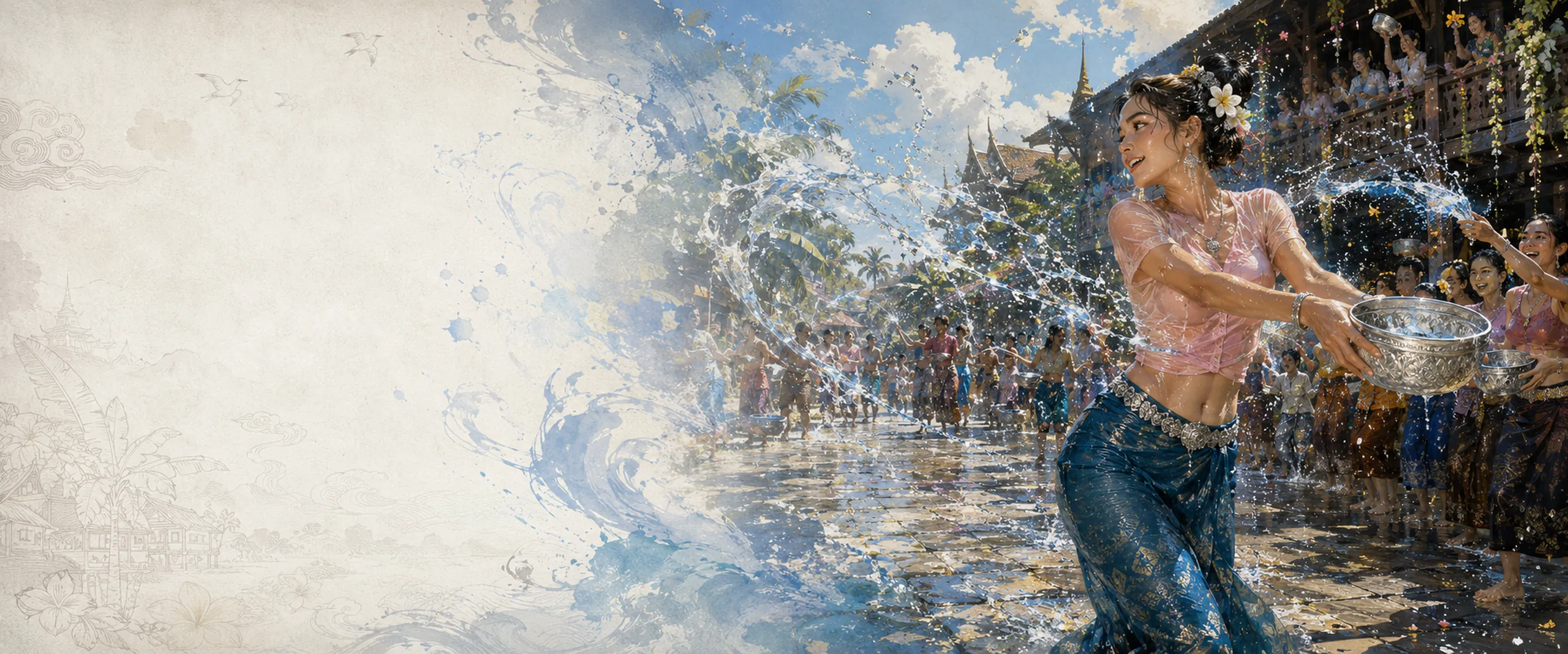
The Water-Splashing Festival is held each year from April 13 to 15 on the Gregorian calendar. On the first day, people clean their homes and courtyards, purchase New Year provisions, and prepare to bid farewell to the old and welcome the new. During the festival, crowds gather at Buddhist temples to bathe the Buddha, carrying clear water to cleanse Buddhist images of dust. Water splashing is the festival’s defining ritual: people use sacred, pure water to dispel misfortune and wish one another peace, happiness, and well-being. Other activities include dragon-boat races, the launching of gaosheng—homemade earthen rockets—and the lighting of Kongming lanterns. Dressed in festive attire, people perform elephant-foot-drum dances and peacock dances. Ganbai (赶摆), meaning going to the fair, is another major feature of the festival. In 2006, the Water-Splashing Festival was inscribed on the First National List of Intangible Cultural Heritage.
Main Customs
Bathing the Buddha
Historical Origins
The Water-Splashing Festival originated in India, where it was once a religious rite of Brahmanism before later being absorbed into Buddhism. Around the late thirteenth to early fourteenth century, it spread through Myanmar into Dai areas of Yunnan. As Theravada Buddhism gained greater influence in Dai communities, the customs of the Water-Splashing Festival also became increasingly widespread. After Buddhism entered Dai society, ancient water culture and Buddhist teachings were woven together into a distinctive system of belief: water was understood as possessing a special power of transmission, serving as a conduit between human beings and the Buddha. For this reason, the Water-Splashing Festival is also known as the “Bathing the Buddha Festival.”
Activities
The bathing-the-Buddha ritual during the festival has two dimensions. The first is the cleaning of dust from Buddhist images and their robes before the festival; the second is the ceremonial bathing of Buddhist images with fragrant water during the festival itself, which is also regarded as one of the origins of the water-splashing custom.
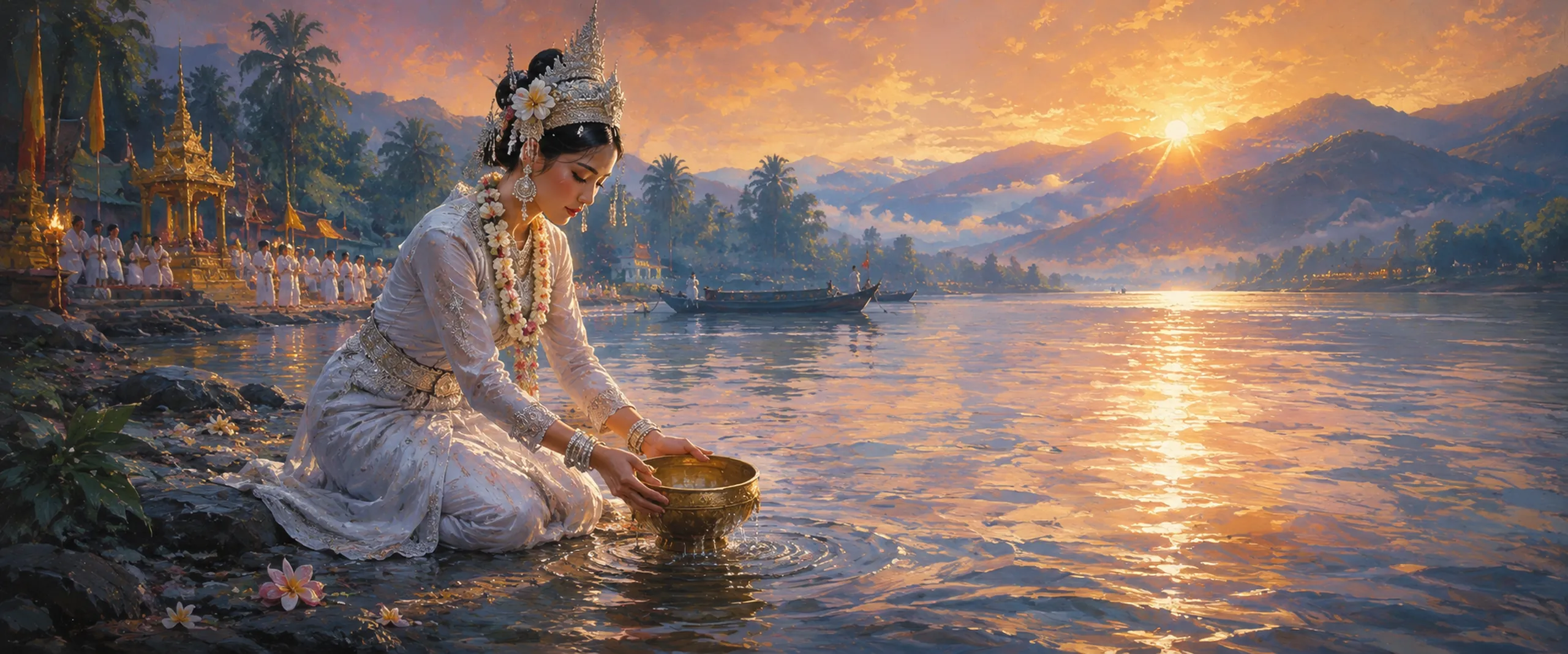
Early in the morning, people bring flowers and green leaves to Buddhist temples as offerings and carry clear water to bathe the Buddha. Dai families draw clean water from wells and place flowers such as champaca in it beforehand so that it becomes fragrant. They then take the water to the temple for 赕佛, making offerings to the Buddha, and use the scented water to cleanse dust from Buddhist images.
During the ritual, worshippers draw water in golden bowls, drip water while chanting scriptures, and express reverence by rinsing Buddhist images with clear water. In some places, people carry empty bamboo tubes and eagerly collect water flowing down from the Buddhist image, either drinking it or using it to wash their faces and hands, believing that this can ward off illness and bring good fortune in the year ahead. Lay worshippers sit around the sand pagodas and listen to monks chant scriptures, praying for health in the New Year. Once bathing the Buddha is complete, collective water splashing begins, and groups of young men and women fill an array of containers with water.
Cultural Significance
Bathing the Buddha is not merely the physical cleansing of a Buddhist image; it is also a form of spiritual purification—washing dust from the image while cleansing impurities from the hearts of the faithful. Dai people believe that bathing the Buddha can bring divine protection, good health, peace, and auspiciousness in the New Year. The ritual brings together Dai water worship and Theravada Buddhist belief with remarkable completeness. Water is both a symbol of creation and purification in Dai culture and a metaphor for compassion and wisdom in Buddhism. As clear water flows over the Buddhist image, worshippers believe that the Buddha’s compassion and wisdom likewise flow into the hearts of all who take part. The Dai Water-Splashing Festival thus preserves, in relatively complete form, the essence of Dai rice-farming civilization and water culture.
How to Participate
The bathing-the-Buddha ritual is open to everyone, and visitors may enter Buddhist temples alongside local worshippers. The Mengle Cultural Tourism Area in Xishuangbanna holds song-and-dance and water-splashing activities every day, and visitors may change into Dai attire and take part themselves. During the festival, Yunnan Ethnic Village organizes welcoming water-sprinkling and pure-water Buddha-bathing ceremonies, allowing visitors to experience firsthand the solemnity and sacred character of this intangible cultural heritage. When entering a Buddhist temple, remain quiet and respectful, dress appropriately, avoid overly revealing clothing, respect local religious beliefs, and participate in an orderly manner according to on-site guidance.
Water Splashing
Historical Origins
Dai folk tradition preserves a vivid legend of seven princesses outwitting a demon king to explain the origin of the Water-Splashing Festival. In remote antiquity, the evil deity Pengma Diandala Zha, also known as Pengma Dian, believed himself all-powerful, ignored the laws of Heaven, acted at will, disrupted wind and rain, reversed heat and cold, and threw the human world into climatic disorder. Immune to swords and spears, the demon king committed every manner of wrongdoing and seized seven princesses as wives.
The seven kind-hearted princesses repeatedly tried to persuade him to stop, but to no avail. To save the human world from disaster, they resolved to destroy their own kin for the greater good. The cleverest and bravest, the seventh princess, took advantage of the demon king’s drunkenness, plucked a hair from his head, looped it around his neck, and severed his head, which rolled to the ground like a ripe melon. Unexpectedly, the moment the head touched the earth, it burst into raging flames. To prevent the fireball from continuing to endanger humanity, the seven princesses decided to take turns holding the demon’s head, each carrying it for one day. At every handover, they washed away dirt and blood with clear water until the head finally decayed.
The flames were extinguished, and the Dai people were saved. From then on, to commemorate the seven women who sacrificed family ties for righteousness and rid the people of harm, Dai communities splashed water on one another and exchanged blessings every New Year. The legend gives a strikingly visual explanation of the custom’s double meaning: water is used both to cleanse the princesses of filth and blood and to extinguish the flames of the demon’s head. Its two functions—purification and extinguishing fire—are brought together perfectly within the story.
Activities
Water splashing is traditionally divided into two styles: “gentle splashing” (文泼) and “vigorous splashing” (武泼). Traditionally, people dip branches into fragrant water scented with acacia leaves and lightly sprinkle one another as a blessing. This gentle form reflects the Dai people’s mild and composed disposition. Yet the festival is also defined by exuberant release: once the celebration reaches its height, people fill basins and buckets with water and splash one another amid laughter, pursuit, and shouted blessings. They carry bronze bowls, washbasins, and buckets into the streets and alleys, chasing one another and splashing anyone they meet. In this vigorous form, age and gender cease to matter; whether splasher or recipient, everyone may be drenched from head to toe and still be delighted.
Water splashing follows the traditional etiquette that elders receive the first respectful sprinkling. A small amount of clear water is first gently sprinkled upon elders as a mark of respect, after which everyone may join the larger-scale celebration.
Cultural Significance
In Dai tradition, water symbolizes washing away the old year and praying for auspiciousness in the new. During the festival, people splash one another with clean, pure water in the hope of washing away the difficulties of the year just past. Folk belief regards this as auspicious water and blessed water, capable of dispelling calamity and illness. Dai people see water as a symbol of holiness, beauty, and light. During the Water-Splashing Festival, water is therefore not merely ordinary water in a physical sense, but sacred water endowed with religious significance—believed to wash away sins, sickness, and misfortune from the previous year and bring auspiciousness, happiness, and health in the year ahead.
People splash one another with water as a blessing and also take part in Buddhist worship, dragon-boat racing, gaosheng launches, and Kongming-lantern lighting. Water splashes bloom through the crowds, forming rainbows beneath the sunlight, while laughter fills the air. People dance as they cry “Water! Water! Water!”, while gongs and drums resound through the sky and blessed water flies in every direction. Dai sayings include “水花放,傣家旺” and “泼湿一身、幸福终身”. In Dai belief, the wetter one becomes, the greater the blessings one receives.
How to Participate
The festival’s central event—the mass public water-splashing celebration—is held on April 15 from 11:00 a.m. to 4:00 p.m., with the main venue at Water-Splashing Square in Jinghong. Major streets throughout the city also become activity areas. The water-fetching ceremony takes place that morning from 9:00 to 10:30 on the southern bank of the Lancang River between the old and new bridges.
It is advisable to reserve accommodation near Water-Splashing Square or Gaozhuang Xishuangjing one to two months in advance. During the festival, traffic restrictions are imposed throughout the city and shared bicycles are suspended, making walking the principal means of getting around. Quick-drying clothing, tube skirts, or padded sports tops are recommended; a set of ethnic-style attire can also be prepared for photographs. Water guns are useful at a distance, while collapsible basins are more efficient at close range. Bring a waterproof phone pouch, sunscreen, goggles, and at least one spare set of clothing. Xishuangbanna is open and welcoming; many guesthouse hosts prepare water guns, face shields, and other equipment for visitors and may guide them into Dai villages to receive ceremonial water blessings.
Splash water courteously and use only clean water. Do not use dirty water, wastewater, or water mixed with stones, glass, or sand. Do not splash police officers on duty, staff members, photographers, elderly or frail people, pregnant women, or infants and young children. High-pressure water guns are strictly prohibited. It is forbidden to use water splashing as a pretext to insult or harass women, to block passing vehicles and surround them with water, or to splash water in narrow road sections prone to congestion. Traffic safety also requires special attention, as accidents occur more frequently during the festival.
Ganbai
Activities
Ganbai (赶摆) is one of the principal events of the Water-Splashing Festival and among the most important collective activities of Dai festive life. The term comes from the Dai language and is often translated as “going to the market” or “temple fair,” yet its meaning extends far beyond that of an ordinary marketplace.
Ganbai grounds are usually established on broad riverbanks or in open fields. Bamboo and timber are used to construct shaded shelters where people can rest. One or two tall frames for launching gaosheng are erected beside the grounds, with separate areas for fireworks and flying fire lanterns. People of many ethnic groups arrive from every direction in festive dress, filling the grounds as elephant-foot drums and mang gongs resound. Both are distinctive Dai musical instruments.
The ganbai ground becomes one of the liveliest places during the festival. People enthusiastically watch folk performers present peacock dances, white-elephant dances, sword dances, and martial dances, move with the rhythm of the drums, and immerse themselves in the festive atmosphere of song and dance. Dragon boats race on the river, gaosheng rockets rise into the air, and young men and women gather to toss embroidered bags as a way of conveying affection.
Dai people also go to ganbai dressed in beautiful clothing to sell or purchase traditional foods. At night, song and dance continue amid gaosheng rockets, fireworks, and flying fire lanterns. Villages remain awake through the night with Dai opera, Gayang dancing, and Kongming lanterns.
Cultural Significance
Ganbai is not merely a place of entertainment, but also an important setting for the exchange of goods and the circulation of social ties. People can taste a wide range of traditional Dai foods, buy handicrafts, and watch folk-art performances. It is the part of the Water-Splashing Festival most filled with the warmth and vitality of everyday life, ensuring that the festival is not only religious in character but also a carnival shared by the entire community.
Although ganbai is often translated simply as “going to market,” its significance reaches far beyond commercial exchange. It is a collective spiritual and emotional gathering of the Dai community. On the ganbai grounds, boundaries between villages and between ethnic groups are softened as people celebrate together without distinction. The Water-Splashing Festival has become a shared festival for all ethnic communities of Xishuangbanna. Ganbai expresses the festive spirit of universal participation and shared joy within Dai society.
How to Participate
Ganbai grounds are generally found around Water-Splashing Square in Jinghong, along the Lancang River, and in public open spaces within major Dai villages. Visitors may enter freely, browse markets, taste Dai specialties such as lemongrass grilled fish, pineapple rice, and roast chicken, and watch folk song-and-dance performances. Bringing some cash is advisable, as certain stalls may not support mobile payment. Wear comfortable, lightweight clothing and allow plenty of time to explore at an unhurried pace. Ganbai is an open public activity that requires neither reservation nor admission ticket.
Dragon-Boat Racing
Historical Origins
The legend of dragon-boat racing is associated with the Dai hero Yan Hongwo. Every year, villages entering dragon boats into the competition perform sacrificial rites both when the boats are made and when they are launched. These ceremonies serve three purposes: to thank the Dai hero Yan Hongwo and the Dragon King, to pray for favorable weather in the coming year, and to wish the village’s dragon boat success in the race. Dragon-boat racing thus expresses both the Dai people’s reverence for heroes and their aspiration toward a better life.
Activities
Dragon-boat racing is the festival’s most visually spectacular water activity and is usually held on the first or third day.
Competing wooden boats are fitted with dragon heads and tails, while their hulls are painted with dragon-scale patterns and decorated as dragons, peacocks, large fish, and other forms. More than thirty rowers sit on both sides and propel the boats with short paddles. The decoration is exceptionally elaborate: dragon heads are carved at the bow, dragon tails mounted at the stern, and dragon scales painted along the hull, glittering beneath the sun. On the broad Lancang River, dozens of young men and women row with all their strength. Dragon-boat racing is not merely a contest of physical power but also an aesthetic spectacle—every dragon boat is a moving work of art.
At the sound of the starting gun, the boats surge forward together like arrows toward the opposite bank. Spectators on both shores erupt in thunderous cheers as gongs, drums, and voices fill the air. After the race, the winners approach the ceremonial platform to receive their prizes and drink celebratory wine.
Cultural Significance
Dragon-boat racing brings together competition on water, dragon-totem worship, and prayers for harvest. For Dai communities living along the Lancang and Nujiang river basins, the dragon boat is not merely festival entertainment, but also an expression of reverence for the water deity and remembrance of ancestors.
How to Participate
Dragon-boat races are held on the Jinghong section of the Lancang River, and the best viewing points are designated areas on both banks. Arrive early to secure a good position, and prepare sun protection and drinking water. Some viewing areas may become crowded, so follow on-site order and staff instructions. Races are usually held on the afternoon of the festival’s first day, though exact times depend on local official announcements. Viewing is free and does not require a ticket.
Launching Gaosheng and Kongming Lanterns
Historical Origins
The custom of launching gaosheng grew out of Dai reverence for the sky and prayers for harvest. The higher the rocket flies, the smoother and more auspicious the coming year is believed to be. The thunderous roar of the earthen rocket is also like a proclamation to the heavens—the New Year has arrived.
Activities
Gaosheng are homemade Dai earthen rockets. A bamboo pole several zhang long is packed at its base with gunpowder and other materials and placed upon a tall launching frame made of bamboo. The frames are erected before the festival, and when the time comes, the rockets are ignited and sent whistling into the blue sky.
Once the fuse is lit, the powder burns and the bamboo shoots into the clouds like a rocket, releasing brilliant fireworks in the air like clusters of flowers and glittering stars. The night sky becomes radiant. The highest-flying gaosheng receives admiration and a prize; the farther and higher a village’s rocket travels, the greater the honor and auspiciousness people associate with it.
Releasing Kongming lanterns and floating water lanterns is among the festival’s most romantic nighttime activities. People release lit Kongming lanterns into the night sky, where they rise slowly like scattered stars. They carry wishes for favorable weather, abundant harvests, and family well-being in the coming year. Yingjiang County preserves this tradition, and the sight of thousands of lanterns rising together has become one of the festival’s signature spectacles. In Xishuangbanna, tens of thousands of people release Kongming lanterns and water lanterns together, making the night sky and river seem like a galaxy spilling down to earth.
Floating water lanterns are placed upon the water and allowed to drift with the current. One kind of light travels across the river, the other ascends into the sky; one below and one above, together forming one of the festival’s most moving nocturnal scenes. The resulting “water, land, and sky” feast of lights is breathtaking.
Cultural Significance
Gaosheng rockets and lanterns form complementary images in the festival night: one shoots straight into the heavens, the other rises slowly; one roars, the other drifts away in silence. Together they create one of the Water-Splashing Festival’s most complete symbolic scenes—people announce the arrival of the New Year to the sky while entrusting their wishes to flowing water. These customs extend the festival from the exuberance of daytime into the romance of night, carrying festive joy upward from the earth into the heavens.
How to Participate
Gaosheng are generally launched from tall frames near ganbai grounds, and visitors should watch from a safe distance. Kongming lanterns and water lanterns are public activities: Kongming lanterns may be purchased at night markets or festival venues and released in designated areas, while water lanterns can be bought or made and then placed in the river. Mass Kongming-lantern releases in Xishuangbanna usually take place on the second or third festival night. Arrive early along the Lancang River or in Gaozhuang Xishuangjing to secure a good vantage point.
When releasing Kongming lanterns, avoid power lines and buildings, follow staff instructions, do not release them in restricted airspace, and observe fire-safety rules. Water lanterns should preferably be made from biodegradable and environmentally responsible materials in order to protect the ecology of the Lancang River.
Tossing Embroidered Bags
Activities
Tossing embroidered bags is a game especially associated with unmarried young people, in which the bag serves as a token of affection. Young men and women convey feelings by throwing embroidered bags, and women may express affection through the act of tossing them. The game is usually held at ganbai grounds or specially arranged sites, where young men and women divide into two groups and throw embroidered bags back and forth.
The game tests not strength, but skill, responsiveness, and mutual understanding. The embroidered bag traces a graceful arc through the air and lands in the hands of someone one admires, carrying not merely an object but a feeling. It is both a game and a form of courtship—through tossing the bag, young people come to understand one another’s skill, reactions, and intentions.
Cultural Significance
The custom brings together the Water-Splashing Festival’s exuberance and the romantic lives of young people, making the festival not only a religious celebration and a harvest festival, but also a festival of youth and love. It is an important form of social interaction for young Dai men and women and reflects Dai society’s openness toward and respect for freely chosen love. As one element within the festival’s rich variety of activities, embroidered-bag tossing reveals the deep human warmth of Dai culture.
How to Participate
Bag-tossing activities are held at ganbai grounds or village squares. Single visitors may join and interact with local young people. It is advisable to watch first and understand the rules and etiquette, then participate after receiving an invitation. Respect local customs and the wishes of others. It can be an excellent opportunity to make friends, but boundaries and consent should always be observed.
Festive Dress and Artistic Performances
Festive Attire
During the Water-Splashing Festival, Dai men, women, children, and elders all dress in festive attire, presenting the refinement and richness of Dai clothing culture.
Dai women’s festival dress is especially elaborate. They wear fitted short jackets, tube skirts, and silver belts around the waist. Colors and patterns vary according to age and occasion: young women tend to favor brighter colors, while married women prefer a more restrained elegance. Silver jewelry is one of the most important elements of Dai dress, including silver crowns, neck rings, bracelets, and belts, creating a shimmer from head to toe. Young Dai women and men appear in festival dress, beat elephant-foot drums, and perform the Gaguang dance. The Water-Splashing Festival is one of the most concentrated occasions for displaying Dai clothing, silverwork, and other forms of material culture.
Peacock Dance and Elephant-Foot-Drum Dance
The peacock dance is the most representative Dai dance and one of the most important artistic performances during the Water-Splashing Festival. It imitates the gestures and postures of the peacock—spreading its wings, shaking its feathers, drinking water, and strolling—with elegance and grace, expressing the Dai people’s affection for the peacock and admiration for the beauty of nature. Traditional performances such as peacock-frame dance and elephant-foot-drum dance are highlights of intangible-cultural-heritage exhibition areas during the festival.
The elephant-foot-drum dance is one of the best-loved traditional dances among Dai men. The elephant-foot drum is a distinctive Dai instrument with a long, slender body resembling an elephant’s leg and a deep, resonant sound. Dancers carry the drum on the shoulder, beating it while moving with vigorous force. During the three festival days, everyone from people in their seventies and eighties to children of seven or eight years old dresses in festive clothing and gathers in village squares. Men and women, old and young, form circles and dance to the rhythms of mang gongs and elephant-foot drums. Some perform the peacock dance, others Yulahe, while still others improvise as they sing and dance. During the festival, Dai communities also form processions, striking mang gongs and beating elephant-foot drums while collectively performing the Yilahe dance from household to household as part of New Year visits. At moments of peak excitement, crowds may burst into cries of “Water! Water! Water!” or conclude with the sung refrain “玉腊呵、玉腊呵.”
Zhangha Singing and Folk Arts
Zhangha singing is a traditional Dai narrative singing art and an important form of performance during the festival. Its repertoire includes historical legends, love stories, and reflections on life, making it an important vehicle of Dai cultural memory. Zhangha, white-elephant dance, and other performances help audiences understand Dai cultural characteristics such as attentiveness to nature, love of water, reverence for Buddhism, and a gentle, composed temperament. Other festival arts include red-deer dance, butterfly dance, and traditional Dai martial-arts performances.
How to Participate
Costume displays and artistic performances take place throughout the various festival venues. Visitors can watch performances at Water-Splashing Square, ganbai grounds, Dai villages, Gaozhuang Xishuangjing, and other locations. Many scenic areas and villages offer Dai costume rental, allowing visitors to dress in festival attire and take commemorative photographs while entering more fully into the festive atmosphere. Dance performances are generally open to the public, with designated safe viewing areas. Some highly participatory dances, such as the Gaguang dance, welcome visitors to join; following the steps of local dancers is usually enough to take part.
Sand Piling and Water Lanterns
Activities
Sand piling is one of the important Buddhist activities of the Water-Splashing Festival. On the first day of the New Year, before dawn has broken, villagers carry water and bamboo baskets to Buddhist temples. The baskets are filled with carefully selected clean sand from rivers and used to build offerings for the Buddha. People shape the sand into pagodas in temple courtyards and sit around them while listening to monks chant scriptures. In Xishuangbanna, participants may also shape elephants from sand, expressing affection for the animal.
Releasing water lanterns is another important Buddhist activity during the festival. People craft delicate lanterns, place candles inside, and set them afloat on rivers. The lights drift with the current and flicker in the darkness, symbolizing blessings and prayers being carried into the distance. 赕佛, making offerings to the Buddha, is a religious practice that runs throughout the festival. People offer flowers, food, and pure water at Buddhist temples, listen to monks chant scriptures, and pray for the Buddha’s protection. Some regions also preserve traditions of sacrificing at dragon pavilions.
Cultural Significance
Piling sand as an offering to the Buddha expresses reverence while also symbolizing the accumulation of merit and prayers for peace. The elephant occupies a sacred place in Dai culture, and shaping elephants from sand expresses veneration for the auspicious elephant. These Buddhist activities closely bind the festival’s exuberant celebrations to religious faith, making the Water-Splashing Festival not only a secular carnival but also a solemn religious observance.
How to Participate
Sand-piling activities take place in major Buddhist temples. Visitors may go early in the morning to observe. Maintain silence, do not disturb religious practices, and do not touch Buddhist images or ritual objects without permission. Water lanterns can be purchased near the river and released in designated areas. Environmentally friendly materials are recommended in order to protect the river ecosystem. Visitors may observe 赕佛 activities, but should respect religious beliefs and maintain an appropriate distance.
Regional Variations
Xishuangbanna Dai Autonomous Prefecture
The Dai people of Xishuangbanna belong to the Dai Lü branch and use the Zula calendar. Here, the Water-Splashing Festival is the Dai New Year, known as “Sangkan Bimai”, with the beginning of the year falling in the sixth month of the Dai calendar, corresponding to April in the Gregorian calendar. In 2006, the Xishuangbanna Dai Water-Splashing Festival was included in the First National List of Intangible Cultural Heritage. In addition to water splashing, activities include ganbai, dragon-boat racing, bathing the Buddha, scripture chanting, Zhangha singing, peacock dance, and white-elephant dance performances. Many customs are also associated with the elephant: people beat elephant-foot drums and dance to welcome the arrival of the New Year. The festival also features the launching of gaosheng rockets and the lighting of Kongming lanterns. Early in the morning, Dai men and women first build floral pavilions from freshly gathered flowers, then carry clear water and pour it over Buddhist images to bathe them, after which people of all ages splash water on one another.
Dehong Dai and Jingpo Autonomous Prefecture
The Dai people of Dehong belong to the Dai Na branch and use the Great Dai Calendar. Their New Year is “Jing Bimai”, around November each year; the Water-Splashing Festival held in April is therefore not a New Year celebration, but a grand traditional festival shared by the Dai, De’ang, and Achang peoples. In Dehong Dai, the festival is called “Bai Shuang Nan”; in De’ang, “Gong Pai”; and among the Achang, “Flower-Watering Festival”. In earlier times, the festival in Dehong was primarily attended by young Dai men and women, but it gradually developed into a large-scale celebration for the entire population. Traditionally, Dehong has the saying “大泼三天,小泼七天”. Major activities include flower gathering, Buddhist offerings, sprinkling water for blessings, embroidered-bag tossing, and song-and-dance performances. The flower-gathering ritual marks the opening of the festival, when people of different ethnic groups enter the mountains to collect yellow champaca, Caesalpinia pulcherrima, and other flowers used in ritual offerings. The temple bathing-the-Buddha ceremony includes drawing water in golden bowls, dripping water, and chanting scriptures. Mangshi and other places preserve the tradition of sacrificing at dragon pavilions. At Jiegao Port in Ruili, more than twenty water-splashing sub-venues are established. Longchuan County holds embroidered-bag tossing games for unmarried young people, with women expressing affection by throwing embroidered bags. Yingjiang County retains the custom of releasing Kongming lanterns.
Pu’er City
Simaogang Town in Simao District holds a water-fetching ceremony on the banks of the Lancang River, an important opening ritual whose tradition has continued for a thousand years. Other activities include village-to-village blessing visits and the launching of gaosheng rockets. In Jinggu Dai and Yi Autonomous County, the Water-Splashing Festival lasts for two months, ending with the “Minle Sand-Piling Water-Splashing Festival.” During that celebration, Dai participants circle a bodhi tree, golden pagoda, and small elephant figures in prayer, placing flowers into sand mounds and praying for favorable weather in the coming year. Ximeng Wa Autonomous County holds a four-day series of celebrations including ethnic cultural parades, New Year greeting ceremonies, water-splashing festivities, and a mass fish-catching event.
Lincang City
The Water-Splashing Festival in Gengma Dai and Wa Autonomous County is known for combining “water splashing + electronic music + intangible cultural heritage.” Locally created festival dance tracks such as Gengma Party and UP Gengma integrate Dai opera, puppetry, red-deer dance, kinnara dance, elephant-foot drums, and traditional Dai melodies into electronic rhythms. Activities also include sand-piling and flower-inserting rituals, elephant-foot-drum dance, Gayang dance, water-lantern prayers, and float parades. Shuangjiang Lahu, Wa, Blang and Dai Autonomous County holds an Iceland Tea Gathering and Water-Splashing Festival, featuring collective New Year greetings, mass water splashing, the Iceland Music Festival, and traditional ganbai fairs, continuing until April 28.
Honghe Hani and Yi Autonomous Prefecture
Jinping County hosts the China–Vietnam (Jinping) Cross-Border Water-Splashing Festival and Longevity Water Culture Festival, using water as a medium through which people of different ethnic groups from China and Vietnam celebrate together. Activities include water-fetching and blessing rituals, ethnic parade formations, mass water-splashing celebrations, and artistic performances. Besides traditional embroidered-bag tossing and swinging, there are ethnic-unity dances, Dai electronic-music carnival nights, and Bull King competitions. Folk activities include beating elephant-foot drums, dancing, tossing colored bags, launching gaosheng rockets, cockfighting, horse racing, and damuli games.
Yuxi City
Xinping Yi and Dai Autonomous County is known for the Huayao Dai bathing festival. After Yamo scripture chanting and blessing rituals, young Huayao Dai women sprinkle auspicious water drawn from the Ailao Mountains. They use fresh bamboo branches to sprinkle visitors with blessed water. The festival is divided into three rituals: sending off the deities, opening the village prohibition, and closing the village prohibition. Activities also include flower gathering, sheep slaughter, preparing festival foods, cultural performances, tug-of-war, and recreational fish-catching competitions. Additional programs include intangible-heritage village parades, farming activities, melon-king searches, folk-culture experiences, and Dai food tastings.
Baoshan City
Lujiang Town in Longyang District holds the Water-Splashing Festival under the theme “幸福吉祥水 富美潞江坝”, with three activity sites at the Bidun Coffee Cultural Industrial Park, the White Pagoda in Mangdan Village, and Nanhu in Moka Village. In addition to the water-splashing carnival, there are music festivals, evening galas, investment-promotion events, and Most Beautiful Peacock Princess competitions. Visitors can also watch Dai song and dance, elephant-foot-drum competitions, spinning-top contests, and crossbow contests, take part in mass flower gathering, beer carnivals, and bonfire parties, and taste specialties such as Dai long-table banquets, pounded rice noodles, and Water-Splashing Festival rice cakes.
Thailand — Songkran
Thailand’s Water-Splashing Festival is known as Songkran and is the traditional Thai New Year, held each year from April 13 to 15. In 2023, it was inscribed by UNESCO on the Representative List of the Intangible Cultural Heritage of Humanity. During the festival, people splash water on one another to convey New Year blessings. Before the festival, every household thoroughly cleans the home and refreshes its surroundings. Grand celebrations are held in Bangkok, Chiang Mai, Phuket, Ayutthaya, and other tourist cities. Chiang Mai also preserves traditional rituals. Activities include elephant water play, water-gun battles, and float parades.
Myanmar
In Burmese, the festival is called Thingyan and celebrates the traditional New Year over five days. It is also a time for performing good deeds and accumulating merit: people visit temples and meditation centers, practice meditation, observe precepts, worship the Buddha, and chant scriptures. Traditionally, people hold tree branches, dip them into silver bowls of water, and sprinkle water on others as a blessing; young men and women use small basins to splash one another as an expression of affection. With the exception of monks, pregnant women, and elderly people, everyone may splash water on others, symbolizing washing away the old and welcoming the new. Communities also organize song-and-dance performances, while households place ceramic jars filled with flowers and leaves representing the seven days of the week before their doors to welcome the New Year.
Laos
In Laos, the festival is also called Songkran or the “Fifth-Month Festival” and marks the Buddhist-calendar New Year, held around April 13 to 15, usually with celebrations lasting one week. During the festival, people visit temples to worship and bathe the Buddha, splash water, tie blessing strings, make offerings, pile sand, and release animals. Lao people bathe Buddhist images with flower-scented clear water and splash one another to wash away the previous year’s misfortune and bring good luck. The distinctively Lao wrist-tying blessing ritual is another important part of the festival. In Laos, younger people may pour water directly over the heads of elders. People ride in pickup trucks, singing and dancing as they splash water, eat, and drink.
Cambodia
In Cambodia, the festival is known as Cambodian New Year. During the celebrations, people splash water to bid farewell to the old and welcome the new, in ways broadly similar to celebrations in Thailand and Laos.
Pre-Festival Preparations
Preparations begin several days before the festival. Dai households are busy slaughtering pigs and chickens, brewing alcohol, and making large quantities of haonuosuo (毫诺索)—New Year cakes—as well as various sticky-rice cakes for the holiday. Every household cleans the home, purchases New Year provisions, and prepares to bid farewell to the old and welcome the new. Women ready their festive attire—tube skirts, silver ornaments, and floral crowns—with meticulous care.
Dai families draw clean water from wells and place fresh flowers such as champaca in it beforehand, allowing the water to take on their fragrance, then carry it to Buddhist temples for “赕佛”, making offerings to the Buddha. This flower-scented water serves not only as pure water for bathing Buddhist images, but also as the “fragrant water” used to sprinkle and splash one another during the festival—every drop steeped in floral fragrance and auspicious wishes. In earlier times, households would also build sand pagodas in their courtyards before the festival as an expression of devotion.
Day One: Mai Day — Wanduo Shanghan
The first day is known as “Mai Day”, comparable to Lunar New Year’s Eve, and in Dai is called “Wanduo Shanghan”, meaning sending off the old. People clean and put their homes in order, prepare the New Year meal, and make ready for dragon-boat racing, gaosheng launches, cultural performances, and other festival activities.
Early in the morning, people gather flowers and green leaves and carry them to Buddhist temples as offerings. They bring clear water to “bathe the Buddha”, cleansing Buddhist images of dust. Bathing the Buddha first refers to cleaning the image and its robes before the festival. People also build four or five sand pagodas in temple courtyards and sit around them while listening to monks chant scriptures. When the rite is complete, the Buddhist image is carried into the courtyard, and women from the entire village bring limpid water to wash away its dust.
After the temple rites conclude, young men and women withdraw and begin splashing one another in play, marking the beginning of the collective water-splashing celebration. People fill bronze bowls, washbasins, and even buckets with water, pour into streets and alleys, chase one another in delight, and splash everyone they encounter.
The central purpose of this day is to “send off the old”—to cast away the frustrations and misfortunes of the passing year and receive the New Year with cleansed bodies and renewed spirits.
Day Two: Nao Day — Wannao
The second day is called “Nao Day”, with “nao” meaning “empty.” Traditionally, this day belongs neither to the previous year nor to the year ahead and is therefore known as the “empty day.” In Dai conceptions of time, there exists between old and new a period that belongs to neither—a temporal interval suspended between two years. This idea reflects a distinctive philosophy of time: once the old year has passed but the new one has not yet arrived, the world enters a state of chaos and renewal, and people prepare for what is to come through water splashing and collective revelry.
Dai folk belief holds that this is the day on which the head of the evil deity decays, and water splashing is therefore the principal activity. Grand celebrations are usually held to commemorate the celestial maidens who rid the people of harm, using sacred water to ward off calamity and exchanging wishes for peace and happiness.
Day Three: Mai Paya Wanma — Wan Paya Wanma
The third day is New Year’s Day, known as “Mai Paya Wanma.” People traditionally regard it as the arrival of the “King of Days.” It is said to be the day when the spirit of Mai Paya Wanma returns to the human world carrying the new calendar. Activities include piling sand, bathing the Buddha, dripping blessed water, launching gaosheng rockets, exchanging New Year greetings, and splashing water, with New Year visits and exuberant water celebrations at the center.
Day Four: Bawangma
The fourth day is the New Year proper, known as “Bawangma”, revered as the beginning of the year. People regard it as the most beautiful and auspicious of days. Early in the morning, Dai men and women, young and old, dress in festive attire and carry clear water first to the Buddhist temple to bathe the Buddha. They then begin splashing one another, exchanging wishes for auspiciousness, happiness, and good health. People dance as they cry “Water! Water! Water!” Gongs and drums thunder into the sky, while blessed water flies in all directions in a scene of extraordinary exuberance.
This three-day structure—four days in some regions—of bidding farewell to the old, passing through the empty day, and welcoming the new forms a complete ritual of temporal transition. Such a structure is exceptionally rare among calendrical New Year ceremonies around the world and reveals a distinctive Dai understanding of time.
Xishuangbanna
Xishuangbanna is the festival’s core region and the place where it enjoys the highest level of recognition. Major activities include water-fetching ceremonies, mass water-splashing celebrations, large folk-cultural parades, dragon-boat races, and the mass release of Kongming lanterns and water lanterns. On April 13, 1961, Premier Zhou Enlai also took part in the Water-Splashing Festival in Xishuangbanna. The annual water-fetching ceremony continues a long-established Dai custom.
How to participate: fly to Xishuangbanna Gasa International Airport or take high-speed rail to Xishuangbanna Station. Accommodation becomes scarce during the festival, so booking one to two months in advance is recommended. Most major events are concentrated in central Jinghong and can be reached on foot or by special festival bus routes.
Dehong
The Water-Splashing Festival in Dehong is equally grand. It is a shared traditional festival of the Dai, De’ang, and Achang peoples, shaped through nearly a thousand years of historical transmission. Major customs include flower gathering, Buddhist offerings, sprinkling water for blessings, embroidered-bag tossing, and song-and-dance performances. The mass water-splashing celebration has developed into a distinctive cultural phenomenon involving the entire population. Dehong extends the official festival holiday into mid-April and also organizes intangible-cultural-heritage performances and ethnic-costume exhibitions.
How to participate: fly to Dehong Mangshi Airport or take a long-distance bus to Mangshi. The festival atmosphere is equally vibrant but generally attracts fewer tourists, offering a more locally rooted experience. Accommodation should still be reserved in advance, and waterproofing and sun protection remain essential.
Menglian
The Water-Splashing Festival in Menglian is not only a Dai festival but a shared celebration for all ethnic communities in the county. Activities under themes such as “宾弄赛嗨”, a Dai expression meaning “friends as close as relatives,” promote ethnic unity. In 2026, the festival continued until April 17 and received more than 150,000 visitors across the county.
Contemporary Transmission
### Intangible Cultural Heritage Recognition
Because of its distinctive social and cultural value, the Water-Splashing Festival was included in the First National List of Intangible Cultural Heritage in 2006. The Dehong Water-Splashing Festival was included in the Second National List of Intangible Cultural Heritage Extension Projects in 2008. The festival functions as a comprehensive stage for displaying traditional Dai culture, including water culture, music and dance, foodways, clothing, and folk beliefs. It preserves in relatively complete form the essence of Dai rice-farming civilization and water culture and carries broad cultural and social functions.
### Premier Zhou Enlai and the Festival’s Internationalization
On April 13, 1961, Premier Zhou Enlai traveled to Xishuangbanna to meet the Prime Minister of Myanmar and joined people of different ethnic groups in splashing water together. This historical event greatly increased the festival’s visibility. Visitors from China and abroad began arriving in ever larger numbers, and the scale of the celebration expanded year after year. The Water-Splashing Festival thus came to be known as the “Carnival of the East.” Zhou’s participation elevated the festival from a local ethnic celebration into a cultural symbol of international renown.
### Contemporary Scale
Far from declining in modern society, the Water-Splashing Festival has continued to expand. During the 2025 festival, Xishuangbanna held celebrations for the Dai-calendar year 1387, bringing together visitors from every direction. The 2025 mass water-splashing festivities were held throughout urban Jinghong. At Jiegao Port in Ruili, more than twenty sub-venues were established; in 2024, single-day participation at Mangshi Square exceeded 80,000 people.
The festival’s influence now extends from Xishuangbanna and Dehong to Laos, Thailand, Cambodia, Myanmar, and the six northeastern states of India. It has become an important cultural bond linking ethnic minorities of southwest China with Southeast Asian countries. It is not only a major force of unity among all ethnic groups in Xishuangbanna, but also contributes positively to friendly cooperation and exchange between Xishuangbanna and Southeast Asia and to the region’s social, economic, and cultural development.
### A Cultural Phenomenon That Has “Broken Out of Its Circle”
Why has the Water-Splashing Festival “broken out of its circle” and become so popular with visitors from China and abroad? On the one hand, it preserves traditional religious rituals such as flower gathering, 赕佛, and bathing the Buddha, maintaining the authenticity of its cultural foundations. On the other hand, the festival continually absorbs elements of contemporary life, adding song-and-dance entertainment, commodity exchange, and large-scale ethnic cultural parades. Its sense of spectacle lies precisely in this meeting of tradition and modernity: Dai Zhangha performances, traditional dragon-boat races, and folk cockfighting appear alongside contemporary cultural-tourism experiences such as mass Kongming-lantern and water-lantern releases. Today, the Water-Splashing Festival has become a large-scale gathering that comprehensively showcases Dai water culture, song and dance, clothing, religious belief, and other traditions, with an ever-expanding sphere of influence.
Readers’ Comments
Calendar and traditional culture enthusiasts from around the world, sharing the same moon.
Sign in or register to join the conversation. Your comment account is created automatically the first time you use a connected account.
No comments yet
Share your thoughts with readers around the world.