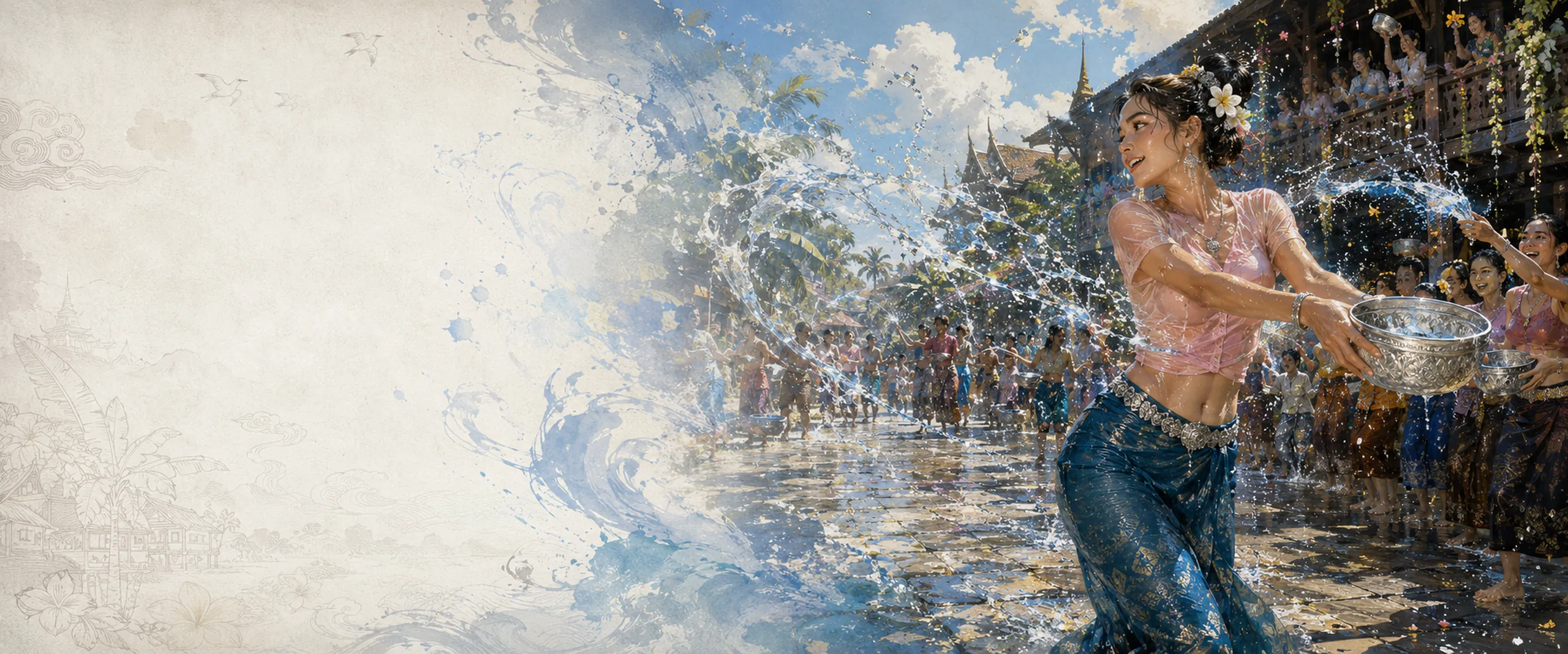
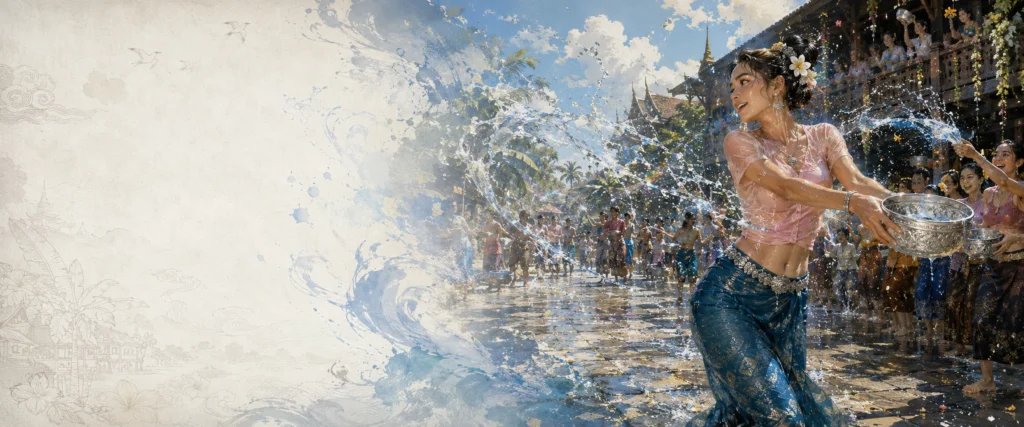
Water-Splashing Festival

Water-Splashing FestivalGlobal Spread

「 欢快时节圣水扬,污秽随清泼洒净。 」

The Water‑Splashing Festival is held in mid‑April (the first month of the Dai calendar) each year and is the grandest traditional festival of the Dai ethnic group. During the festival, people splash pure water on one another, symbolising the…

The Water-Splashing Festival is not only a traditional festival of China’s Dai people; it also shares common origins with Songkran celebrations in several Southeast Asian countries. Thailand, Laos, Cambodia, Myanmar, and other countries all hold similar New Year water-splashing celebrations every April. The Xishuangbanna Water-Splashing Festival has become an internationally recognized cultural-event brand, drawing visitors from around the world each year.

During the festival, people splash water on one another as a blessing, race dragon boats, launch gaosheng (高升), traditional festival rockets, attend ganbai (赶摆), festive market gatherings, and enjoy song-and-dance performances, creating scenes of extraordinary scale and exuberance. In 2006, the Water-Splashing Festival was included in the first group of China’s national intangible cultural heritage list.

As cultural exchange under the Belt and Road Initiative has deepened, the Water-Splashing Festival is becoming a cultural bridge linking the hearts of people in China and Southeast Asian countries, using sacred water to convey the universal values of auspiciousness, purity, and blessing.

Water-Splashing Festival / Global Spread

Celebrated Worldwide

Regional Highlights
01

The Americas

United States

The United States is one of the countries with the largest Thai and Southeast Asian immigrant populations in the world. Although the Water-Splashing Festival is not a federal public holiday, in Thai-populated areas such as New York, Minnesota, Chicago, Massachusetts, and Los Angeles, Songkran has become one of the most important annual cultural events.

New York State: an official resolution formally recognizes Songkran. On April 7, 2025, the New York State Legislature passed a resolution formally recognizing Songkran—the traditional Thai New Year, observed from April 13 to 15—as an important cultural celebration for New York State’s Asian American communities.

On April 9, the New York State Legislature held a Songkran celebration at the Legislative Office Building in Albany, attended by Thai Consul General in New York Somjai Taphaopong. Activities included the traditional Thai water-pouring rite, classical Thai dance, and musical performances.

The resolution emphasized that Songkran is “an enduring cultural heritage celebrated by Thai communities in New York and across the United States—a festival that preserves and transmits the essence of Thai identity while proudly reflecting the contribution of the Thai diaspora to the rich cultural diversity of American society.”

Minnesota: Songkran in front of the State Capitol. On May 10–11, 2025, Minnesota Songkran was held at the Minnesota State Capitol in Saint Paul. Thai Ambassador to the United States Dr. Suriya Chindawongse and Thai Consul General in Chicago Katanawadee Kalayanamit attended the opening ceremony.

Minnesota Commissioner of Public Safety Bob Jacobson attended on behalf of the governor and formally presented a proclamation to the Thai Cultural Council recognizing Minnesota Songkran 2025. The event officially opened with a ribbon-cutting and water-pouring ceremony.

Chicago: Songkran at Wat Dhammaram. On April 12, 2025, the Thai Consul General in Chicago attended a Songkran celebration held at Wat Dhammaram. The event was jointly organized by the Sunday Buddhist School, Thai Music Academy, Thai Classical Dance School, and other groups.

Massachusetts: a multiethnic Songkran celebration. On April 26–27, 2025, Wat Nawamintararachutis held Songkran celebrations, with the Thai Consul General in New York attending the opening ceremony.

The event embodied a spirit of cultural exchange, with communities from Thailand, Laos, Cambodia, and Vietnam jointly participating in traditional performances. Activities included Buddhist merit-making rites, almsgiving, bathing the Buddha, pouring water over elders’ hands to offer blessings, a food market, a Miss Songkran beauty pageant, and cultural performances by students from the Sunday Buddhist School.

Los Angeles: the 16th annual Thai New Year Songkran Festival. East Hollywood in Los Angeles hosts a Thai New Year Songkran Festival every year, reaching its 16th edition in 2025. Activities included live music, Muay Thai demonstrations, religious ceremonies, Thai cuisine, and the Miss Songkran USA pageant.

Following a vehicle attack in Vancouver, Los Angeles police increased patrols around the event.

Collective participation by Thai diplomatic missions in the United States. During Songkran 2025, officials and staff from the Royal Thai Embassy in Washington, the Thai Consulate General in Chicago, and “Team Thailand Chicago” collectively took part in preserving and celebrating Water-Splashing Festival traditions.

This official participation by diplomatic institutions has given Songkran a form of recognition in the United States that extends beyond ethnic communities.

Canada

Canada also has large Southeast Asian communities. Water-Splashing Festival celebrations are centered on Vancouver and extend to major cities such as Toronto and Montreal. Unlike the United States, where Thai communities play the dominant role, in Canada the festival is more often presented through the framework of a “Chinese Traditional Culture Festival,” jointly promoted by Chinese and Southeast Asian immigrants.

Vancouver: Chinese Traditional Culture Festival and Water-Splashing Festival. On July 27, 2025, the Chinese Canadian Federation hosted the 2025 Chinese Traditional Culture Festival and 17th Vancouver Water-Splashing Festival at Swangard Stadium in Burnaby.

Chinese Consul General in Vancouver Yang Shu, British Columbia legislators Zhou Jionghua and Chen Hansheng, Burnaby Mayor Hou Maihao, and others attended, together with more than a thousand members of the public.

Consul General Yang Shu stated that the Chinese Traditional Culture Festival “provides a platform for cultural exchange and mutual learning, allowing overseas Chinese to revisit the feelings of their homeland and enabling local communities to experience the charm of traditional Chinese culture.”

The event featured six themed zones: traditional intangible cultural heritage, stage performances, interactive water splashing, a food market, charity booths, and cultural workshops. More than 60 community groups took part in the opening ceremony.

Most performers were ordinary community residents, retired seniors, current students, and everyday immigrants.

In 2025, the event achieved a historic breakthrough: for the first time, it moved beyond Vancouver, arriving in Toronto on August 3 and Montreal on August 10. From the West Coast to the East Coast, the “splash” of the Water-Splashing Festival is spreading across Canada.

Vancouver also connects the Water-Splashing Festival with the official calendar of the Royal Thai Consulate General in Vancouver, which lists Songkran as an important annual diplomatic and cultural event.

02

Europe

United Kingdom

The United Kingdom is one of the European countries where Water-Splashing Festival culture is most actively promoted. In April 2025, London hosted “the UK’s largest Thai Water Festival.” The event took place at a Buddhist center affiliated with the Royal Thai Embassy and included a series of Thai cultural activities.

In Thai, Songkran means “movement” or “change,” marking the beginning of the Thai New Year.

Swindon also held its first “Authentic Street Food Festival” on April 20, 2025, featuring authentic Thai cuisine, traditional dance, Thai bands, and kathoey performances.

British blogger Lee also traveled specially to Xishuangbanna in Yunnan, China, to experience the Water-Splashing Festival and used video to show British audiences the festival’s “proper way to experience it.”

Belgium

On the European continent, Wat Thai Dhammaram in Brussels, Belgium, held Songkran celebrations in April 2025.

Activities included traditional Songkran rites—pouring water over Buddha images, monks, and elders—along with sales of Thai food and products, Thai cultural performances, and chanting ceremonies to pray for the deceased.

As Belgium is home to the headquarters of the European Union, its Songkran celebrations attracted participants and spectators from countries across Europe.

France and Germany

In France and Germany, the Water-Splashing Festival spreads mainly through tourism and social media.

French and German tourists are important international visitor groups during Thailand’s Songkran period. Because spring holidays in Europe overlap with Songkran, large numbers of European travelers go to Thailand at this time to participate personally in the water-splashing festivities.

German bloggers and cultural travelers also bring their Songkran experiences back to Europe, spreading them across German-speaking regions through social media.

European bloggers have additionally traveled to the Dai Ethnic Garden in Xishuangbanna, Yunnan, China, to experience the Water-Splashing Festival firsthand and share the lively scenes of the celebrations with European audiences through video.

03

Asia

Asia is the region where Water-Splashing Festival culture has spread most deeply and extensively. The festival is not only celebrated on a grand scale in China’s Dai areas, but is also a traditional New Year festival shared by Thailand, Laos, Cambodia, Myanmar, and other countries.

Thailand

Thailand is a cultural heartland of the Water-Splashing Festival, or Songkran. In 2025, Thailand renewed the celebration under the name “Maha Songkran World Water Festival,” with more than 100 activities held across the country’s five major regions.

On the evening of April 12, the “2025 World Water Festival” opened at Sanam Luang in Bangkok, drawing tens of thousands of Thai residents and international visitors.

Prime Minister Paetongtarn attended with members of her cabinet. She stated that the World Water Festival was “based on existing Thai culture while integrating technology, modern elements, and creativity; it can not only add economic value to tradition, but also effectively stimulate the economy of Bangkok and the country as a whole.”

During Songkran, from Sanam Luang in Bangkok to the ancient city walls of Chiang Mai, from the Isan atmosphere of Nakhon Ratchasima to the seaside celebrations of Phuket, every location is filled with its own distinctive combination of tradition and vitality.

Alongside street water-splashing celebrations, traditional rites continue in many places, including bathing Buddha images, sprinkling scented water over elders to offer blessings, and making donations at temples.

Modern forms such as the S2O Songkran Music Festival have also injected new vitality into the ancient festival.

The Tourism Authority of Thailand estimated that the three-day celebration of the 2025 Songkran World Water Festival at Sanam Luang alone generated 1.7 billion baht in tourism revenue, attracting 523,456 Thai participants and 34,559 foreign visitors.

Songkran remains one of Thailand’s most important annual cultural-tourism festivals.

Myanmar

Myanmar’s Water-Splashing Festival is the country’s grandest festival of the year. The 2025 celebration was the first held after Myanmar’s traditional Water-Splashing Festival was inscribed on UNESCO’s Representative List of the Intangible Cultural Heritage of Humanity.

Naypyidaw specially organized a Water-Splashing Festival walking event. Traditional Myanmar snacks were served, and according to Myanmar custom, people used sacred tamarind branches to sprinkle clear water and offer blessings, washed elders’ hair, and trimmed their fingernails and toenails.

Myanmar’s Ministry of Foreign Affairs also holds a Water-Splashing Festival event every year specifically for diplomatic missions. Ambassadors and their spouses are taken by bus to the City Hall square, where they first watch folk dances from different ethnic groups and are also invited onto the stage to perform and celebrate together.

Among Chinese-funded enterprises, the Letpadaung mining project department, Kyaukpyu Power Company, and others organize Water-Splashing Festival social activities for Chinese and Myanmar employees, strengthening mutual understanding and friendship through folk interaction and cultural exchange.

Border cities in Yunnan, China, such as Ruili, also celebrate the festival together with Myanmar. On the afternoon of April 13, the 2025 Ruili Water-Splashing Carnival opened on a grand scale. People of different ethnic groups wore brilliant traditional clothing, struck golden gongs, beat elephant-foot drums, and danced the joyful Gayang dance.

Laos

The traditional Lao New Year falls from April 14 to 16 and is also known as the Water-Splashing Festival or Songkran.

During the festival, Luang Prabang holds a “Miss Songkran” procession, while people celebrate the traditional New Year by splashing water on one another to exchange blessings.

At Chinese-funded enterprises such as Laos Cement Company, Chinese and Lao employees gather together for a wide range of celebrations, splashing water on one another for blessings and joining in festive gatherings.

The Consulate General of Laos in Changsha has also organized Songkran promotional events in China, introducing Lao New Year culture to Chinese audiences.

Cambodia

Cambodia’s counterpart to Songkran is the Khmer New Year. Around April 13–16 each year, the country generally observes three days of public holiday to celebrate the Buddhist-calendar New Year.

In April 2025, large-scale street water-splashing activities were held in Phnom Penh, attracting large numbers of young people and tourists. Water fights, scented powder, singing, and dancing filled the streets with splashing water and resounding cheers.

In addition to temple blessings, bathing Buddha images, and ceremonies honoring elders, large water-splashing celebrations have also been held on city streets in Phnom Penh and elsewhere in recent years.

On the morning of April 14, 2025, under the leadership of Cambodian Prime Minister Hun Manet, the Angkor Water Festival was held in the Angkor area of Siem Reap Province, bringing together young people and members of the public from different places to celebrate Cambodia’s traditional New Year and carry forward and develop national culture.

Malaysia

Although Malaysia does not list Songkran as a nationwide public holiday, the tradition has long continued in Thai-populated areas such as Kedah, Perlis, and Penang, as well as in multicultural cities such as Kuala Lumpur.

Lively water-splashing celebrations are likewise staged on the streets of Kuala Lumpur.

Japan

In Tokyo, Japan, a Myanmar New Year celebration—the Water-Splashing Festival—was held on April 12–13, 2025, at the Sun Plaza in Shiokaze Park.

Japan also has its own local “Water-Splashing Festival”: the Fukagawa Hachiman Festival, one of Edo’s three great festivals, is also known by this nickname because spectators splash water over those carrying the portable shrines, creating an exuberant and festive scene.

A major Fukagawa Hachiman Festival is held once every three years, when around 50 mikoshi gather and parade through the streets.

The year 2025 marked the once-every-three-years “Honmatsuri”, when 53 parish-neighborhood mikoshi, together with the principal sacred palanquin known as the Horen, joined in a procession covering approximately eight kilometers.

04

Oceania

Australia

Australia has active Thai and Southeast Asian communities, and Water-Splashing Festival celebrations are held in multiple cities.

Canberra: a religious ceremony attended by the ambassador. On April 13, 2025, Thai Ambassador to Australia Arjaree Sriratanaban led officials and staff from “Team Thailand Canberra” to attend Thai New Year and Songkran religious ceremonies at Wat Dhammadharo in Lyneham.

Perth: a Water-Splashing Festival close to home. Songkran in Perth marks the beginning of the Buddhist New Year. Activities include bathing Buddha images and young people pouring water over the hands of monks and elders as a sign of respect.

Darwin: Thai Cultural Festival. The Thai Association of the Northern Territory held a “Thai Festival” at Civic Park, offering activities for all age groups throughout the day. The 2025 theme was “Lanna Maha Songkran,” showcasing the culture of northern Thailand.

Brisbane: international students celebrate Songkran at the University of Queensland. The University of Queensland held a Songkran Water Festival where international students splashed one another using water guns and basins.

Tasmania: Songkran in the Thai community. The Thai community in Penguin, Tasmania, held Songkran celebrations featuring Thai street food, blessings by Thai Buddhist monks through water sprinkling, traditional Thai dance and singing, and Muay Thai demonstrations.

New Zealand

On April 12, 2025, Auckland University of Technology’s city campus held a Thai New Year, or Songkran, celebration.

Mutual Learning Among Civilizations

In-Depth Feature

The Water-Splashing Festival has gradually moved from being a traditional festival of China’s Dai people and Southeast Asian countries toward the world.

Its inscription on UNESCO’s Representative List of the Intangible Cultural Heritage of Humanity in December 2024 marked the festival’s elevation from a regionally shared traditional celebration to a cultural heritage shared by all humanity.

This path differs from those of the Spring Festival, Mid-Autumn Festival, and Dragon Boat Festival. If the Spring Festival takes “reunion” as its emotional core, the Mid-Autumn Festival the “bright moon” as its cultural symbol, and the Dragon Boat Festival “dragon boat racing” as its cultural emblem, then the Water-Splashing Festival takes “water” as its purest cultural symbol and “blessing” as its most universal emotional connection.

Water: a cultural language that needs no translation. Water is the most central cultural symbol of the Water-Splashing Festival. Clear water symbolizes purity and blessing, while splashing water signifies washing away the misfortune of the old year and welcoming the auspiciousness of the new.

Water needs no translation. Wherever people may be, a basin of clear water splashed outward carries a blessing; whatever the culture, the desire to “wash away the old year and welcome new life” is shared.

This is the deeper reason the Water-Splashing Festival has been able to spread rapidly across the Americas, Europe, and Oceania: it requires no complicated cultural explanation—only a handful of clear water and a heart that wishes others well.

The dual cultural identity of the Water-Splashing Festival: religious rite and public carnival. In its overseas spread, the Water-Splashing Festival presents two faces.

On the religious level, it is a solemn Buddhist New Year ceremony: bathing Buddha images, making offerings, sprinkling water over elders to offer blessings, and chanting scriptures in temples.

On the secular level, it is a public water-splashing carnival: street water fights, music festivals, and food markets.

This dual identity enables the festival to be passed down in temples in the solemn form of a “religious rite”, while also spreading through streets and parks in the joyful form of a “water-splashing carnival.”

It is precisely this quality of “solemnity and carnival existing side by side” that allows the Water-Splashing Festival to attract both devout believers and tourists seeking joy.

From temples to state capitols: the Water-Splashing Festival’s path “beyond its original circle.” The festival’s overseas transmission reveals a clear trajectory of breaking beyond its original cultural circle.

At first, Songkran celebrations were held mainly in Thai temples, or wat, by monks and Thai communities. Later, they expanded into community parks and city squares. Eventually, the Water-Splashing Festival entered the Minnesota State Capitol and the New York State Legislature, where a governor’s representative issued an official proclamation and the legislature passed a resolution formally recognizing Songkran.

From temples to state capitols, the festival’s journey beyond its original circle is a microcosm of Southeast Asian culture entering mainstream global society with water as its medium and blessing as its bridge.

The Water-Splashing Festival as a bridge for dialogue among civilizations. The global spread of the Water-Splashing Festival is, in essence, a dialogue of water between different civilizations.

At the Songkran celebration in Massachusetts, communities from Thailand, Laos, Cambodia, and Vietnam participated together. The Water-Splashing Festival crossed the boundaries of a single nation and became an important bond linking Southeast Asia’s diverse cultures.

In Vancouver, Canada, the festival was incorporated into a “Chinese Traditional Culture Festival,” attended together by the Chinese Consul General, Canadian provincial legislators, and a city mayor. The festival crossed ethnic boundaries and became a platform for China–Canada cultural exchange.

In Australia, the Thai ambassador attended religious ceremonies while Thai communities across different states held celebrations. The festival crossed national borders and became a cultural witness to friendly relations between Thailand and Australia.

Closing Note

Lingering Notes

The global spread of the Water-Splashing Festival traces a refreshing path from the rivers and streets of Southeast Asia to the world’s five continents. Its inscription on UNESCO’s Representative List of the Intangible Cultural Heritage of Humanity in December 2024 marked its elevation from a regionally shared traditional festival to a cultural heritage shared by all humanity.

Unlike the reunion of the Spring Festival, the bright moon of Mid-Autumn, or the dragon boats of Duanwu, the overseas spread of the Water-Splashing Festival takes “water” as its purest cultural symbol and “blessing” as its most universal emotional connection—water needs no translation, and blessing needs no explanation.

Wherever people may be, a basin of clear water carries the most beautiful wishes for the New Year. Whatever the culture, the desire to “wash away the old year and welcome new life” is shared.

Across the Americas, from the New York State Legislature formally passing a resolution recognizing Songkran to the water-splashing celebrations in front of the Minnesota State Capitol; from Buddhist ceremonies at Wat Dhammaram in Chicago to Los Angeles’s 16th annual Songkran Festival; from Vancouver’s 17th Water-Splashing Festival to its first arrivals in Toronto and Montreal—the splashes of the Water-Splashing Festival are spreading across the North American continent.

Across Europe, from “the UK’s largest Thai Water Festival” in London to the traditional ceremonies at Wat Thai Dhammaram in Brussels, the refreshing spirit of the Water-Splashing Festival is sweeping across Europe.

Across Asia, from Bangkok’s “Maha Songkran World Water Festival” at Sanam Luang to Myanmar’s first Water-Splashing Festival after its intangible-cultural-heritage inscription; from Luang Prabang’s “Miss Songkran” procession in Laos to the street celebrations of Phnom Penh in Cambodia; from the water-splashing revelry of Xishuangbanna in Yunnan, China, to the Myanmar New Year celebration in Tokyo, Water-Splashing Festival traditions flourish in distinctive forms across Asian countries, sharing common origins while following different paths.

Across Oceania, from religious ceremonies in Canberra attended by the Thai ambassador to celebrations in Perth, Darwin, Brisbane, and Tasmania, the cool splashes of the festival are spreading across the Southern Hemisphere.

More moving still is the moment when the Thai Ambassador to the United States cuts the ribbon for the Water-Splashing Festival at the Minnesota State Capitol, when the New York State Legislature passes a resolution recognizing Songkran as an important cultural heritage of Asian communities, and when the Chinese Consul General in Vancouver and a Canadian mayor deliver remarks together at the Water-Splashing Festival.

At such moments, the Water-Splashing Festival is no longer merely a festival of Southeast Asia; it is becoming a cultural celebration shared by the world.

Like that basin of clear water crossing mountains and seas—it has traveled through a thousand years and remains as refreshing as ever; it crosses national borders and carries the same blessings as before.

The splashes of the Water-Splashing Festival are reaching every corner of the world.

—-

Continue exploring Water-Splashing Festival culture

Readers’ Comments

Calendar and traditional culture enthusiasts from around the world, sharing the same moon.

Sign in or register to join the conversation. Your comment account is created automatically the first time you use a connected account.