Raosanling

RaosanlingCuisine of Raosanling

「 酸辣鱼鲜,乳扇香。 」

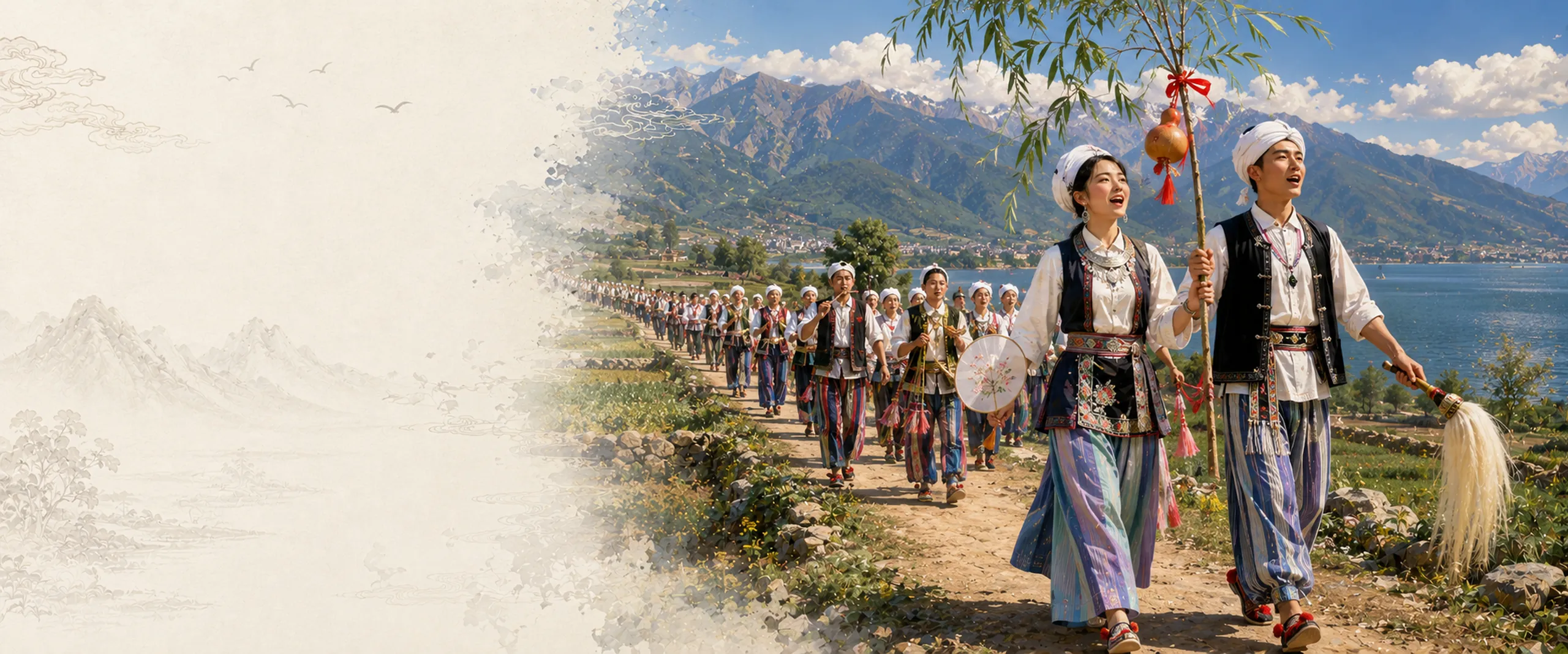
Rao San Ling is a traditional festival of the Bai people, celebrated in the Bai‑populated areas of Dali, Yunnan, generally held in the latter half of the fourth lunar month. The “Three Spirits” (San Ling) refer to three important temples in the…

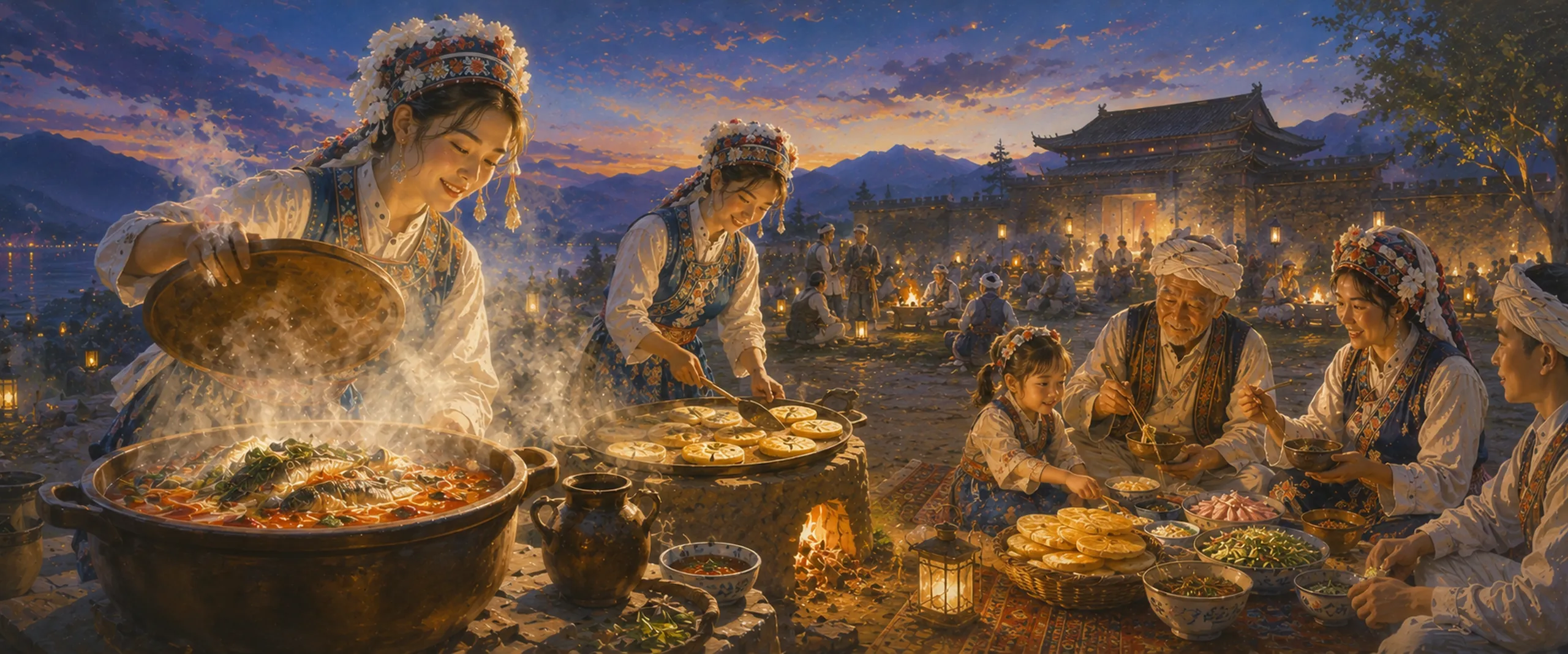
Raosanling is one of the Bai people’s grand traditional festivals, and food forms an essential part of the celebration. Hot-and-sour fish is among the most representative dishes of Bai cuisine. Made primarily with fresh fish from Erhai Lake and cooked with sour papaya, chili peppers, and other seasonings, it is vividly sour and spicy, with a deep freshness and aroma. Shengpi is another distinctive Bai specialty: pork skin and meat are singed over fire, sliced thinly, and served with a specially prepared dipping sauce, creating a flavor all its own. Rushan is one of the Bai people’s most characteristic dairy products. Cow’s milk is made into thin sheets that may be grilled or fried; once grilled, they become sweet, aromatic, and crisp. The Bai attach great importance to festive food, and “almost every festival has one or several foods suited to the occasion.” During Raosanling, people savor these authentic local dishes while singing, dancing, and praying for a favorable year, experiencing the distinctive character of Bai culture through taste.

Raosanling / Cuisine of Raosanling

Festival Food Gallery

Seasonal Menu

Food in Detail

Seeking the True Flavor

Hot-and-Sour Fish

Soups, Broths & Congee

Basic Information

  • Category: Soup / stew
  • Popular Areas: Bai-inhabited areas of Dali, especially around Erhai Lake
  • Main Ingredients: Wild crucian carp from Erhai Lake, sour papaya, dried chili powder, fermented chili, tofu, potatoes
  • Also Known As: Dali hot-and-sour fish, Bai hot-and-sour fish, “live fish cooked in living water”

Historical Origins

Hot-and-sour fish is one of the most representative dishes of Bai Raosanling and lies at the heart of Bai culinary culture in Dali. Tasting authentic Bai foods such as hot-and-sour fish, shengpi, and rushan is an “indispensable pleasure for the palate” when experiencing the festival. The history of the dish is closely tied to the fishing and hunting life of Bai ancestors in the Erhai Lake basin. For generations, the Bai have lived along the shores of Erhai Lake, whose waters abound in wild crucian carp, once one of their most important sources of protein. Over time, Bai ancestors discovered that the natural fruit acidity of local sour papaya, combined with the heat of chili peppers, could temper the fishy aroma while heightening freshness and flavor. From that discovery came this classic dish, defined by the meeting of sourness, heat, freshness, and fragrance.

One of the defining features of Dali hot-and-sour fish is the old principle of “cooking live fish in living water.” Traditionally, once the fresh fish has been cleaned, it is placed directly into boiling water without first being fried, preserving the tenderness of the flesh and its natural flavor as fully as possible. It is said that only truly fresh fish and the sweet spring water of Cangshan can produce the most authentic Dali hot-and-sour fish—one reason the dish is so difficult to reproduce perfectly elsewhere.

Cultural Meaning

Hot-and-sour fish is prepared primarily with wild crucian carp from Erhai Lake, Cangshan spring water, local sour papaya, dried chili powder, and fermented chili. Its acidity comes from the natural fruit fragrance and tartness of the papaya, while the heat is built through the combination of the two chilies. To prepare the dish, the gills and internal organs are removed from the live fish, which is then cleaned and fried in hot oil until golden on both sides. Cold water is added and brought to a vigorous boil, followed by slices of sour papaya or stewed plums, dried chili powder, scallions, ginger, salt, Sichuan peppercorns, and garlic. The fish is then simmered gently over low heat. Just before serving, a handful of cilantro and chopped scallions is scattered over the top. Tofu, potatoes, and other ingredients may also be stewed together with the fish, giving the broth greater body. The finished dish unfolds in distinct layers: sourness, heat, freshness, and aroma rise one after another around tender fish and a deeply flavored broth, giving hot-and-sour fish the kind of appeal that never seems to tire the palate.

Hot-and-sour fish carries several layers of meaning within Bai food culture. First, “living from the waters at one’s side.” Wild crucian carp from Erhai Lake was one of the most important food sources for Bai ancestors, and the dish is a culinary record of the Bai people’s long dependence on and coexistence with the lake. Second, “the balance of sour and spicy.” The tartness of sour papaya and the heat of chili meet on the palate without overwhelming one another, symbolizing the Bai character of “combining firmness with gentleness.” Third, “the flavor of celebration.” Hot-and-sour fish is one of the central dishes at Raosanling’s thousand-person long-street banquet and one of the flavors most deeply embedded in Bai festival memory.

Simple Preparation

  • Ingredients: 2–3 wild crucian carp from Erhai Lake (or carp), sour papaya slices, dried chili powder, fermented chili, tofu, potatoes, ginger, garlic, scallions, cilantro, salt, Sichuan peppercorns
  • Steps:
  1. Scale the fish and remove the gills and internal organs. Wash thoroughly and make several cuts along the body so the seasonings can penetrate.
  2. Heat a wok and oil, then fry the fish until golden on both sides.
  3. Add cold water and bring to a vigorous boil. Add sour papaya slices, dried chili powder, fermented chili, ginger, garlic, salt, and Sichuan peppercorns.
  4. Add tofu and potato pieces and simmer over medium heat for about 15–20 minutes.
  5. Sprinkle with chopped scallions and cilantro just before serving.

Tip: Hot-and-sour fish places great emphasis on the principle of “cooking live fish in living water.” Only fresh Erhai fish and sweet spring water can produce the most authentic flavor. Sour papaya is the soul of the dish’s acidity and should not be replaced with vinegar.

Shengpi (生皮)

Others

Basic Information

  • Category: Cold dish / raw food
  • Popular Areas: Bai-inhabited areas of Dali
  • Main Ingredients: Fire-singed pork (lower belly and hind-leg meat), plum vinegar, stewed plums, chili, scallions, garlic, cilantro
  • Also Known As: Fire-singed pork shengpi, Bai shengpi, heige (黑格, in the Bai language)

Historical Origins

Shengpi is one of the most challenging yet distinctive traditional foods of the Bai people of Dali. Known in the Bai language as “herl ge rd,” this traditional dish is distinguished by the practice of eating raw pork after the animal has been singed over fire. The custom can be traced back to the Nanzhao period and represents a distinctive food tradition shaped by Bai ancestors through centuries of production and everyday life. For more than a thousand years, it has remained one of the most beloved folk dishes among local Bai communities. Tasting authentic specialties such as hot-and-sour fish, shengpi, and rushan is also considered an “indispensable pleasure for the palate” when experiencing Raosanling.

What sets shengpi apart above all is the way it is prepared. The Bai have their own method of handling a freshly slaughtered pig, known as the “fire-singed pig.” Straw is lit to burn away the bristles, and while the meat is still at its freshest, it is sliced very thinly or cut into fine strips and served with a specially prepared dipping sauce regarded as the “soul” of the dish. Once scraped and washed, the entire pig takes on an enticing golden color. Three things matter most: “straw fire, knife work, and dipping sauce.” The straw fire gives the skin its golden hue and distinctive toasted aroma; the knife determines the thinness and evenness of every slice; and the dipping sauce brings the flavors to their final expression.

Cultural Meaning

The preparation begins with the “fire-singed pig.” After slaughter, several people gather enough straw and set it alight to burn away the bristles. Once the pig has been singed twice on all sides, hot water is poured over the body and the remaining hair is scraped away with a knife. The whole animal seems coated in black gold, with an alluring golden sheen beneath it. Cuts from the parts described as “never seeing the sky,” such as the lower belly and hind leg, are selected and sliced, while the skin itself turns golden under the fire. The dipping sauce is made with plum vinegar, stewed plums, chili, scallions, garlic, cilantro, and other seasonings. Shengpi may also be tossed cold with pickled vegetables. The meat remains fresh and tender, and once dipped in the sauce, each slice carries sour, spicy, fresh, and aromatic notes.

Shengpi carries deep meaning within Bai culinary culture. First, “food for the brave.” Eating raw pork requires courage and complete confidence in the freshness and quality of the ingredient, making it a culinary expression of the Bai character described as “vigorous and unadorned.” Second, “the wisdom of straw fire.” The use of burning straw to remove the bristles reflects the ancestral principle of “taking from nature”: straw is a gift of the earth, and using it in the preparation of the pig is also understood as a gesture of gratitude toward the natural world. Third, “memory of home.” In Dali, wherever Bai communities are found, there will always be people who eat shengpi. For the Bai, it is one of the most immediate and recognizable tastes of homesickness and belonging.

Simple Preparation

  • Ingredients: An appropriate amount of fire-singed lower pork belly (or hind-leg meat), plum vinegar, stewed plums, chili powder, chopped scallions, minced garlic, cilantro, soy sauce
  • Steps:
  1. Singe the pig over a straw fire to remove the bristles, then scrape and wash it until the skin is golden.
  2. Select cuts from the parts “that do not see the sky”—the lower belly or hind leg—and slice them thinly or into fine strips.
  3. Mix plum vinegar, stewed plums, chili powder, chopped scallions, minced garlic, cilantro, and soy sauce into a dipping sauce.
  4. Dip the shengpi slices into the sauce before eating, or toss them cold with pickled vegetables.

Tip: Shengpi requires exceptionally fresh pork and must be made from a pig slaughtered and singed the same day. The dipping sauce is the “soul” of the dish, and the acidity of plum vinegar and stewed plums provides the finishing touch.

Three-Course Tea

Drinks & Fine Wines

Basic Information

  • Category: Tea beverage / tea ritual
  • Popular Areas: Bai-inhabited areas of Dali
  • Main Ingredients: Pu’er tea (or tuocha), brown sugar, walnut kernels, rushan, honey, Sichuan peppercorns, ginger, cinnamon
  • Also Known As: Bai Three-Course Tea, Thunder Tea

Historical Origins

Three-Course Tea is one of the most culturally profound expressions of Bai food and drink. It forms part of traditional Bai wedding ceremonies, festivals, and rituals of hospitality. In 2014, Three-Course Tea was included in the fourth batch of China’s national intangible cultural heritage list. During Raosanling, tasting Bai “Three-Course Tea” and immersing oneself in the distinctive appeal of this intangible cultural heritage tradition is one of the festival’s essential experiences. Its preparation follows exacting rules, described as “three courses,” “six principles,” and “eighteen sequences.” At the heart of the ritual are the three courses themselves: three teas of markedly different flavors corresponding to the philosophy of “first bitter, second sweet, third lingering in reflection.” This sequence is also the source of its name.

The origins of Three-Course Tea are closely bound to the ancient tea traditions of Bai ancestors. Tea has been produced in Bai regions since early times and has long been indispensable in everyday life. Through generations of practice, the simple act of drinking tea gradually took on a ritual dimension, becoming a ceremony infused with reflection on the course of human life.

Cultural Meaning

Each of the three courses has its own method of preparation and its own flavor profile.

The first course, “bitter tea”—also known as “Thunder Tea” or “baidou banjiu tea.” Tea leaves are placed in a tea vessel and roasted over the fire while the vessel is shaken continuously so that the leaves heat evenly. Once the leaves turn slightly yellow and release a toasted fragrance, boiling water is poured in. A deep rumbling sound rises from the vessel like thunder, giving the tea its name. Bitter yet fragrant, this first course symbolizes the hardships and trials of life.

The second course, “sweet tea”—brown sugar, walnut kernels, rushan, and other ingredients are added to the bitter tea. The sweetness of the sugar, the fragrance of the walnuts, the richness of the rushan, and the bitterness of the tea intertwine to form a sweet, full-bodied flavor. This second course symbolizes life’s sweetness and the rewards that follow effort.

The third course, “lingering tea”—honey, Sichuan peppercorns, ginger, cinnamon, and other seasonings are added. The result is deliberately complex: sweetness carries a slight tingling sensation; the tingling opens into fragrance; and within the fragrance lies a trace of heat. Its aftertaste lingers long on the palate. This final course symbolizes reflection, insight, and the wisdom that comes after one has lived through experience.

Three-Course Tea is among the highest philosophical expressions of Bai culinary culture. First, “one bitterness.” The bitter first tea represents life’s hardships and trials, recalling the idea of “enduring the bitterest of hardships.” Second, “two sweetness.” The second course symbolizes life’s sweetness and rewards, as well as the hope that “sweetness follows bitterness.” Third, “three lingering reflections.” The final tea represents the understanding and wisdom gained over time: “looking back on the past and savoring life.” This philosophy bears a striking resemblance to Wang Guowei’s reflection in Renjian Cihua (《人间词话》): “古今成大事业大学问者必经过三种之境界”. In the midst of Raosanling—a festival of thousand-person revelry and songs answered by multitudes—Three-Course Tea creates a moment of quiet contemplation. Even amid exuberant singing and dancing, there remains space to savor the meaning of “first bitter, second sweet, third lingering in reflection.”

Rushan (乳扇)

Drinks & Fine Wines

Basic Information

  • Category: Dairy product / fried food
  • Popular Areas: Bai-inhabited areas of Dali, especially Dengchuan in Eryuan County
  • Main Ingredients: Fresh cow’s milk, sour water
  • Also Known As: Dali rushan, Dengchuan rushan

Historical Origins

Rushan is the Bai people’s most representative traditional dairy product. Its principal area of production lies around Dengchuan in Eryuan County, and its name comes from the fan-like shape of its thin sheets. In 2022, the craft of making rushan was included on Yunnan Province’s list of representative provincial intangible cultural heritage projects. During Raosanling, visiting intangible cultural heritage markets and tasting specialties such as rushan and diaomei is regarded as one of the festival’s “must-do experiences.”

Its origins are closely tied to the pastoral traditions of Bai ancestors. Since ancient times, the Dengchuan area has been rich in water and pasture and has long served as an important livestock-raising region for the Bai. Fresh cow’s milk was abundant, yet difficult to preserve. To make it last, Bai ancestors developed a method of curdling the milk with sour water, stretching the curds into thin sheets, and drying them. In this way, fresh milk could be transformed into a dairy product suited to long-term storage. Every 10 kilograms of fresh milk yields approximately 1 kilogram of rushan.

Cultural Meaning

Making rushan demands great precision. Fresh cow’s milk is first combined with sour water to make it curdle. The curds are then stretched into thin sheets and hung over bamboo poles to dry. Careful control of heat and acidity is crucial throughout the process: too much sour water makes the rushan hard, while too little makes it difficult to shape. Once dried, rushan is milky white, thin as paper, and shaped like a fan, from which its name derives. In 2020, the craft was included on Dali Prefecture’s intangible cultural heritage list, and in 2022 it was added to Yunnan Province’s provincial list. Fifty-five-year-old Li Peihe is a provincial representative inheritor of this intangible cultural heritage tradition. Having made rushan for more than thirty years, he has brought the craft to consummate mastery.

Rushan carries several layers of cultural meaning. First, “the memory of milk fragrance.” It is a culinary record of the pastoral traditions of Bai ancestors, and every bite preserves something of the highland’s milky aroma. Second, “the art of skillful hands.” Its making requires exact control of heat and practiced movements acquired through experience, a craft passed down through generations of Bai women. Third, “a treasure of intangible cultural heritage.” The rushan-making tradition has been included on the provincial intangible cultural heritage list and stands as one of the most recognizable symbols of Bai food culture.

Simple Preparation

  • Ingredients: Fresh cow’s milk, sour water (lemon juice or white vinegar may be substituted)
  • Steps:
  1. Heat the fresh milk to about 80°C, add the sour water, and stir gently until the milk curdles.
  2. Remove the curds and, while they are still hot, stretch them into thin sheets.
  3. Hang the sheets over bamboo poles to dry for approximately 1–2 days.
  4. When ready to eat, the rushan may be deep-fried, grilled, or eaten directly.
  5. When frying rushan, heat the oil until it is about sixty percent hot, then fry until golden and crisp.

Tip: The key to making rushan lies in controlling both the amount of sour water and the temperature. It may be fried, grilled, or rolled, offering many ways to enjoy it. Fried rushan served with rose-petal jam is the most classic preparation.

Xizhou Baba (Posu Baba)

Grains & Staples

Basic Information

  • Category: Grain staple / baked flatbread
  • Popular Areas: Xizhou Town in Dali and surrounding areas
  • Main Ingredients: Wheat flour, lard, chopped scallions, Sichuan peppercorns for the savory version; or brown sugar and rose jam for the sweet version
  • Also Known As: Xizhou posu baba, posu, “Eastern pizza”

Historical Origins

Xizhou baba is one of the most representative traditional wheat-based foods of the Bai people of Xizhou, Dali. Also known as posu baba, it is a wheat flatbread prized for the harmony of its color, aroma, and flavor. As one of the culinary signatures of Xizhou Ancient Town, Xizhou posu baba has even been jokingly called “Eastern pizza” by visitors. In November 2011, it was included in the third batch of Dali Prefecture’s intangible cultural heritage list. During Raosanling, it is one of the snacks that invariably appears on the “food radar.”

Its method of preparation reveals the skill Bai ancestors developed in working with dough. Wheat flour forms the basis of Xizhou baba, but preparing the fermented dough requires particular care: the right amount of alkali must be added, the dough kneaded thoroughly, and layers created with oil. It is this laminated structure that produces the crisp, flaky texture after cooking and gives “posu” its name.

Cultural Meaning

Xizhou baba comes in both sweet and savory versions. The savory filling combines fresh minced meat, lard, chopped scallions, and seasoned salt with pepper; the sweet version uses brown sugar, rose jam, and sweet bean paste. After the dough has fermented, it is kneaded and rolled out into a sheet on a board. Fine salt or white sugar is scattered over the surface, lard is spread across it, and the dough is rolled into a long strip before being divided into portions. Each portion is rolled into a round cake and cooked in a flat pan. Freshly made Xizhou baba has a golden surface, is rich without being greasy, and can be enjoyed hot or cold. Its layers are crisp, while the interior remains soft and fragrant. The molten brown-sugar version is the most popular of all.

Xizhou baba embodies the quiet, unadorned beauty of Bai food culture. First, “the taste of the farmhouse.” It was originally an everyday food of Bai farming families in Xizhou and reflects the wisdom of turning humble staples into carefully crafted fare. Second, “equally at home with savory and sweet.” Its two forms express the inclusiveness of Bai cuisine: it does not insist on one taste alone; sweetness has its own richness, and savoriness its own character. Third, “a treasure of intangible cultural heritage.” Xizhou baba has been included on Dali Prefecture’s intangible cultural heritage list and is one of the most representative symbols of Bai wheat-based food traditions.

Simple Preparation

  • Ingredients: 300 g wheat flour, an appropriate amount of lard, savory filling (fresh minced meat + chopped scallions + seasoned salt and pepper) or sweet filling (brown sugar + rose jam + sweet bean paste)
  • Steps:
  1. Add an appropriate amount of alkali to the flour and knead into a smooth dough. Leave to ferment until doubled in size.
  2. Roll the dough into a thin sheet, spread with lard, add the filling—savory or sweet—and roll into a long strip.
  3. Divide into portions and roll each into a round cake.
  4. Brush a flat pan with oil, add the cakes, and cook over low heat until golden on both sides and crisp in distinct layers.

Tip: The key to the “posu” flakiness of Xizhou baba lies in creating layers with fat and repeatedly folding the dough. The molten brown-sugar version is the most popular and is best enjoyed hot.

Diaomei Wine (雕梅酒)

Drinks & Fine Wines

Basic Information

  • Category: Fermented alcoholic beverage
  • Popular Areas: Eryuan County, Dali, and surrounding areas
  • Main Ingredients: Diaomei (green plums carved with decorative patterns), farmhouse small-pot rice liquor
  • Also Known As: Green plum wine, diaomei brew

Historical Origins

Diaomei wine is one of the Bai people’s most distinctive traditional alcoholic drinks and is produced in Eryuan County, Dali. It is a sweet, low-alcohol wine made from the local specialty known as diaomei (雕梅). At the thousand-person long-street banquet held before Shendu during Raosanling, hot-and-sour fish paired with diaomei wine becomes “an intangible cultural heritage feast for the palate.”

Making diaomei has traditionally been an essential skill for Bai girls. A small knife is used to carve continuous, winding patterns into the flesh of a green plum; the pit is pressed out through an opening, and the fruit is gently flattened into the shape of a chrysanthemum. It is then preserved in white sugar for more than a month. Diaomei is said to have served as a way of judging whether a Bai girl possessed deft and skillful hands. To make the wine, these carved plums are soaked in farmhouse small-pot rice liquor of around 45 degrees for approximately six months, until the liquid takes on a luminous golden-amber hue.

Cultural Meaning

Diaomei wine is made with carved plums and farmhouse small-pot rice liquor of around 45 degrees. The plums are steeped at a ratio of approximately one plum to one cup of liquor for about six months, until the wine turns golden amber. The finished plum wine is sweet and pleasant, with a slightly viscous texture. It may be drunk directly, served chilled, or diluted with an appropriate amount of water, and is used to cut through the heaviness of rich foods. Its sweetness makes it especially suitable for those who do not enjoy strong liquor, and it has become a popular drink on dining tables in many places.

Diaomei wine condenses two essential ideas in Bai food culture: “craftsmanship” and “time.” First, “proof of skillful hands.” Diaomei itself demonstrates the dexterity of Bai girls, and diaomei wine extends that skill into another form. Second, “brewed by time.” It requires six months of patient waiting, expressing the wisdom of “exchanging time for flavor.” Third, “the flavor of celebration.” At the Raosanling long-street banquet, diaomei wine and hot-and-sour fish form one of the festival’s most characteristic pairings.

Simple Preparation

  • Ingredients: 500 g fresh green plums, 500 ml baijiu (around 45 degrees), 200 g rock sugar
  • Steps:
  1. Wash the green plums and allow them to dry. Use a knife to carve patterns into the flesh and remove the pits.
  2. Place the carved plums in a clean glass jar and add the rock sugar.
  3. Pour in the baijiu, making sure the plums are completely submerged.
  4. Seal the jar and leave it in a cool place to steep for more than six months.
  5. The wine is ready to drink once it has turned a golden amber color.

Tip: Carving the patterns is one of the key techniques in making diaomei wine. The finer the carving, the more fully the plum aroma can be released. The longer the steeping time, the rounder and richer the wine becomes.

Diaomei (雕梅)

Fruits & Nuts

Basic Information

  • Category: Preserved fruit / pickled food
  • Popular Areas: Eryuan County, Dali, and surrounding areas
  • Main Ingredients: Green plums, white granulated sugar
  • Also Known As: Diaomei, chrysanthemum plum

Historical Origins

Diaomei is one of the Bai people’s most artistic traditional foods and was also one of the traditional ways of judging a Bai girl’s skill with her hands. This Bai intangible cultural heritage specialty is made by carving the surface of a green plum with a knife, allowing the fruit both to absorb flavor more readily and to take on a delicate decorative form. Diaomei may be used to prepare diaomei pork ribs or steeped to make green plum wine.

The craft reveals both the manual skill and the aesthetic sensibility of Bai women. In their hands, an ordinary green plum is transformed: continuous winding patterns are carved into its flesh, the pit is removed, and the fruit is gently pressed into the shape of a chrysanthemum. Diaomei thus becomes more than food. It is also a piece of edible craftsmanship—something so delicate that one can almost hesitate to eat it.

Cultural Meaning

Making diaomei requires great care. Fresh green plums are selected and continuous winding patterns are carved into the flesh with a small knife. The pit is pressed out through an opening, and the fruit is gently shaped into a chrysanthemum. It is then preserved in white granulated sugar for more than a month. Once ready, diaomei has a pleasantly sweet-and-sour flavor and may be eaten directly, used in cooked dishes such as diaomei pork ribs, or steeped in liquor to make diaomei wine.

Diaomei carries especially deep meaning within Bai women’s culture. First, “proof of skillful hands.” Traditionally, knowing how to carve diaomei demonstrated a Bai girl’s dexterity and was a skill women were expected to master before marriage. Second, “the beauty of craftsmanship.” Transforming an ordinary green plum into a chrysanthemum through carving embodies the artistry of “turning the ordinary into the extraordinary.” Third, “a treasure of intangible cultural heritage.” Diaomei is a Bai intangible cultural heritage food and one of the most artistic expressions of Bai culinary culture.

Simple Preparation

  • Ingredients: 500 g fresh green plums, 300 g white granulated sugar
  • Steps:
  1. Wash the green plums and allow them to dry. Use a small carving knife to cut continuous winding patterns into the flesh.
  2. Press the pit out through an opening and gently shape the fruit into a chrysanthemum.
  3. Place the diaomei in a clean glass jar, alternating one layer of fruit with one layer of white sugar.
  4. Seal the jar and preserve for more than one month before eating.

Tip: The knife work should be fine and precise; the more intricate the pattern, the more readily the flavor penetrates the fruit. The longer the preservation time, the deeper and mellower the flavor of the diaomei.

Long-Street Banquet (Thousand-Person Long-Street Banquet)

Others

Basic Information

  • Category: Communal banquet
  • Popular Areas: In front of Shendu, Qingdong Village, Xizhou Town, Dali
  • Main Ingredients: Hot-and-sour fish, shengpi, rushan, Xizhou baba, diaomei wine, and others
  • Also Known As: Thousand-Person Long-Street Banquet, Shendu Long-Street Banquet, Thousand-Person Long-Table Banquet

Historical Origins

The thousand-person long-street banquet is perhaps the most visually striking form of dining during Raosanling and one of the strongest expressions of communal cohesion. Before Shendu, hot-and-sour fish and diaomei wine meet at the table to create “an intangible cultural heritage feast for the palate.” During the festival, Qingdong Village “instantly transforms into an open-air theater,” and the long tables laid out before Shendu carry the revelry of Raosanling to one of its great climaxes.

The origins of the banquet are closely tied to the Bai tradition of “sharing and eating together.” In traditional Bai society, bonds between villages, festival celebrations, and gratitude for the harvest were all expressed through communal feasting. During Raosanling, Bai people from hundreds of villages scattered between Cangshan Mountain and Erhai Lake converge on Shendu. The long-street banquet becomes a place not only to share food, but also to renew emotional and communal ties.

Cultural Meaning

At the banquet, Bai niangniang (嬢嬢) wear “Wind, Flower, Snow, and Moon” headdresses, while the silver ornaments at their waists chime with every step of the dance. Long tables stretch out before Shendu, and traditional dishes arrive one after another: hot-and-sour fish, shengpi, rushan, Xizhou baba, diaomei wine, and other Bai specialties. Food is never separated from celebration. As everyone eats heartily, Bawangbian dance, octagonal drums, and Bai melodies rise and fall around the tables. During Raosanling, participants make no distinctions of social status, wealth, or ethnicity. Men and women, young and old alike adorn themselves with flowers, apply elaborate makeup, and attend in festive dress. The long-street banquet gives especially vivid form to this spirit of “making no distinctions among one another and sharing food together.”

The thousand-person long-street banquet brings together some of the deepest values of Bai culinary culture. First, “gathering and sharing.” A thousand people seated together at one extended table represent the fullest expression of the Bai ideal of “bringing all things together and sharing the harvest.” Second, “community cohesion.” Bai people dispersed across different villages meet again through the banquet, and the act of sharing food strengthens the bonds between them. Third, “a feast of revelry.” The banquet is one of the climactic moments of Raosanling: before Shendu, food, song, dance, and laughter merge into a single scene of celebration.

The Raosanling Way of Eating: Maiguo Zaofan (埋锅造饭)

Others

Basic Information

  • Category: Dining practice
  • Popular Areas: Along the Raosanling procession route
  • Main Ingredients: Ingredients and cooking utensils brought by the participants themselves
  • Also Known As: Outdoor cooking, cooking in the open air

Historical Origins

One of the most distinctive ways of eating during Raosanling is known as maiguo zaofan (埋锅造饭), literally setting up cooking pots and preparing meals in the open. Participants “carry ritual implements, simple luggage, food, cooking utensils, and other necessities, arriving from every direction to attend the gathering.” Around Shendu, they “set up cooking pots and prepare meals,” and when night falls, they sleep in Qingdong’s temples or among the surrounding fields and woods. Eating while moving, singing, and dancing makes this practice the clearest culinary expression of Raosanling’s itinerant spirit.

The custom is inseparable from the nature of the procession itself. Over three days, participants walk more than forty kilometers, making it impossible to organize meals at a single fixed location. Cooking in the open solves a practical need, but it also draws food naturally into the surrounding landscape. Through maiguo zaofan, Bai cuisine leaves the table and travels with the people between Cangshan and Erhai. At the foot of the mountains or beside the lake, ingredients are gathered or unpacked, simple stoves are built, and meals are cooked on the spot. Food becomes part of the road and part of the celebration itself.

Cultural Meaning

Maiguo zaofan brings together the twin meanings of “wildness” and “journeying.” First, “returning to nature.” Cooking in the open looks back to the migratory life of Bai ancestors and pays tribute to it. Second, “eating as one travels.” Food moves with the procession, turning the “journey” of Raosanling into not only a visual celebration but also a journey through taste. Third, “eating together as a community.” Participants from different villages gather to set up pots, cook, and share food in the open air—few images express communal cohesion more simply or directly.

During Raosanling, participants bring their own ingredients and cooking utensils and prepare meals around Shendu or at outdoor locations along the procession route. They may build makeshift stoves for cooking or prepare grilled foods. Ingredients are generally traditional Bai foods that are easy to carry and cook, including fish from Erhai Lake, pork, rice noodles, vegetables, and others.

Food Culture

Foodways

Viewed as a whole, the food traditions of Bai Raosanling reveal several cultural ideas that run through them from beginning to end:

I. “Wildness” as the soul. Raosanling is a celebration shaped by the “wild.” People walk forty kilometers through the open countryside, set up cooking pots among fields, mountains, and forests, and spend the night outdoors around Shendu. This “wildness” in Bai food appears in three ways. First, in the ingredients: wild crucian carp from Erhai Lake, spring water from Cangshan Mountain, and wild mountain vegetables. Second, in the cooking: shengpi is made by singeing the pig skin over a straw fire before the meat is eaten raw. And third, in the way meals are taken: people set up pots around Shendu and build makeshift stoves in the open air. This “wildness” is not roughness or crudity. Rather, it expresses a culinary philosophy formed through the Bai ancestors’ long coexistence with the natural world: “taking from nature, while honoring nature.”

II. “Transformation” as wisdom. Diaomei wine requires carved plums to steep for more than half a year; Three-Course Tea unfolds through successive stages of roasting, boiling, and blending; rushan is made by curdling milk with sour water, stretching the curds into thin sheets, and drying them. Each of these forms of “transformation” embodies the same ancestral wisdom: in times of material scarcity, the Bai learned how to “exchange time for flavor.” Diaomei was once a measure of whether a Bai girl was deft and skillful; Three-Course Tea carries the philosophy of “first bitter, second sweet, third lingering in reflection”; and the craft of making rushan has been included on the provincial intangible cultural heritage list. Here, transformation is more than technique. It is also an expression of the Bai people’s patience with life and their affection for it.

III. “Journeying” as the form. The most distinctive way of eating during Raosanling is the “traveling feast.” Over the course of the three-day procession, people eat as they walk and sing and dance as they go. Participants “carry ritual implements, simple luggage, food, cooking utensils, and other necessities, arriving from every direction to attend the gathering,” and around Shendu they “set up cooking pots and prepare meals.” In this way, Bai cuisine leaves the fixed dining table and moves into a living landscape of mountains, paths, and water. Eating is no longer a pause in the journey; it becomes part of the journey itself, part of the movement and part of the revelry.

IV. “Gathering” as the core. Raosanling is not only a religious procession but also a great act of communal gathering. During the festival, people “travel in groups organized by village, ranging from several dozen to more than a hundred participants.” The thousand-person long-street banquet before Shendu brings together Bai people from villages scattered throughout the region. There, they sit together, share the same dishes, and pair hot-and-sour fish with diaomei wine; the intangible cultural heritage feast finds its fullest meaning in the act of sharing. The logic of “gathering” in Raosanling food culture lies precisely here: food draws scattered individuals into a community, and the shared table renews a common sense of belonging.

Regional Distribution

Foodways
Region Distinctive Raosanling Foods
Dali (core area) Hot-and-sour fish, shengpi, rushan, posu baba, cold chicken rice noodles, Three-Course Tea, diaomei wine
Xizhou Ancient Town Posu baba, cold chicken rice noodles
Yunnan Ethnic Village (Kunming) Fried rushan, rice liangxia, papaya water, pea jelly

Note: At events held in Yunnan Ethnic Village, visitors can enjoy not only Bai foods but also distinctive specialties from other ethnic groups in Yunnan, including Miao Huashan chicken, Lahu grilled chicken wings with chaotian chili peppers, and Tibetan butter tea.

Closing Reflections

Foodways

After circling the sacred grounds of three deities, the Bai people, between Cangshan Mountain and Erhai Lake, bring their most devout expression of gratitude to Heaven and Earth to completion through three days and three nights of song and dance and a great long-street banquet. Every year, from the twenty-third to the twenty-fifth day of the fourth lunar month, Bai villagers from around Erhai Lake set out from the City God Temple in Dali Ancient City carrying willow branches used to pray for rain. They strike money sticks and octagonal drums symbolizing the twenty-four solar terms and advance while singing Dabenqu. When the procession finally settles before Shengyuan Temple in “Shendu,” an intangible cultural heritage feast begins to unfold along the long street outside the temple gate.

Hot-and-sour fish is the soul of the Raosanling table. Made with fish freshly caught from Erhai Lake, local sour papaya, and chili, it gathers the flavors of Cangshan and Erhai into the vivid encounter between sourness and heat—a landscape the Bai people have learned to preserve not only in memory, but also on the palate. No less unforgettable is shengpi, a kind of fire-singed pork sashimi for those bold enough to try it; here, an extreme freshness and wildness meet the Bai dipping sauce and become a frank expression of confidence in the ingredient’s original flavor. Rushan, meanwhile, is one of the most recognizable tastes of the streets of Dali: thin, fan-shaped sheets of milk, richly fragrant, grilled or fried until crisp and sweet. Spread with rose-petal jam and torn into pieces while walking, they offer one of the most authentic ways to eat one’s way through the city. Posu baba is one of Xizhou’s most celebrated culinary memories; in its molten brown-sugar version, the griddle forms a crisp, toasted shell that breaks open at the first bite to release a rush of piping-hot sweetness. During the rituals of Raosanling, rushan and baba are also solemnly offered beneath Qianxun Pagoda, becoming tokens through which human beings enter into dialogue with the divine.

First bitter, second sweet, third lingering in reflection—Bai Three-Course Tea is an inseparable cultural note within Raosanling. The bitter tea recalls the first trials of life; the sweet tea evokes love and reward; and the final tea invites one to linger over the memory of years gone by. When a thousand people sit together along a single long street, and the freshness of hot-and-sour fish, the crispness of posu baba, and the sweet-and-sour notes of diaomei wine meet upon the palate, Raosanling ceases to be merely a festival. It becomes a living memory of intangible cultural heritage, passed from one generation of Bai people to the next through taste.

—-

Continue exploring Raosanling culture

Readers’ Comments

Calendar and traditional culture enthusiasts from around the world, sharing the same moon.

Sign in or register to join the conversation. Your comment account is created automatically the first time you use a connected account.