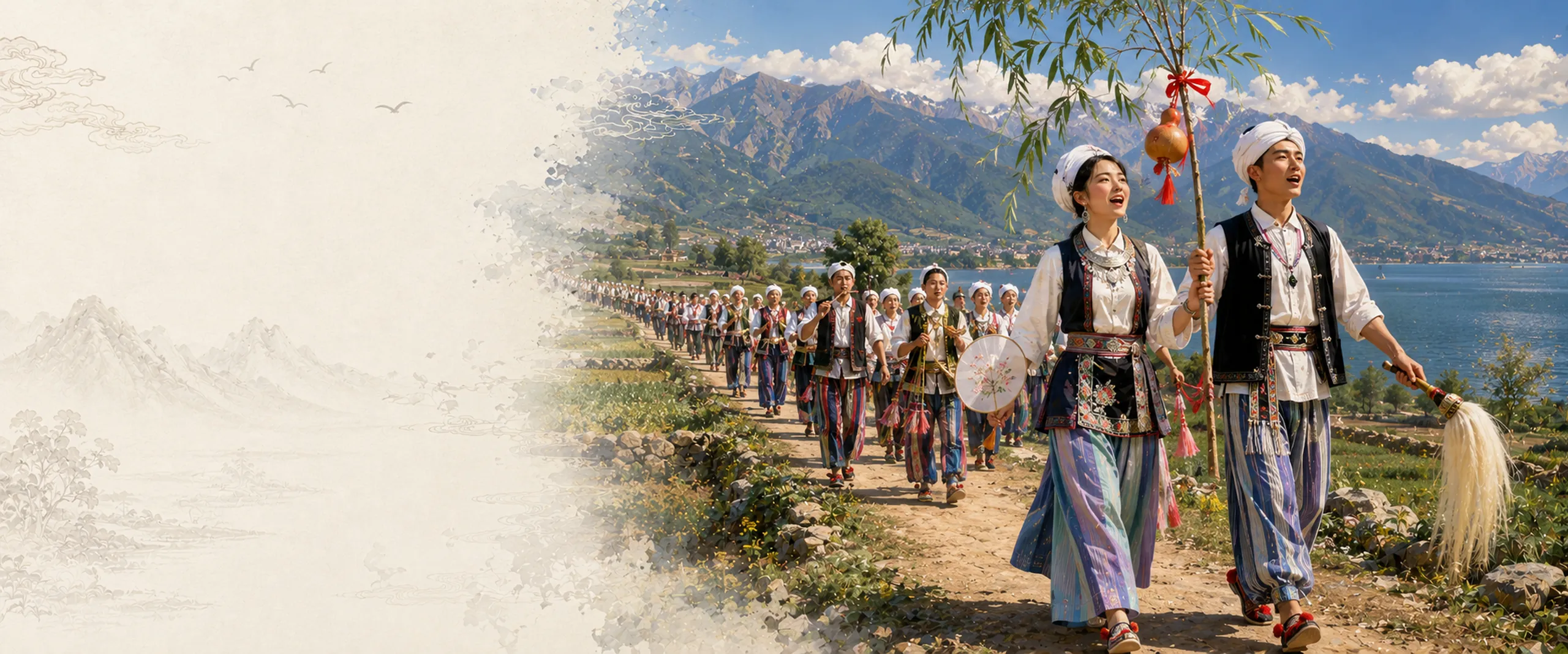
Raosanling is one of the most distinctive traditional festivals of the Bai region of Dali and is held each year from the twenty-third to the twenty-fifth day of the fourth lunar month. During the festival, Bai people dress in ceremonial attire and travel along the foothills of the Cangshan Mountains to circle three temples: Fodu, the “Buddhist Capital” (Chongsheng Temple); Shendu, the “Divine Capital” (Shengyuan Temple); and Xiandu, the “Immortal Capital” (the Erhe Deity Shrine). Through song and dance they pray for a good year, while antiphonal singing becomes a medium for expressing affection. Raosanling was included in the first batch of China’s national intangible cultural heritage list in 2006. Through its distinctive combination of religious worship and folk song and dance, Raosanling has become an important subject of anthropological and folkloric research. Every year during the festival, large numbers of visitors and scholars from China and abroad travel to Dali to experience this ancient yet vibrant form of folk culture firsthand. By bringing song, dance, and faith into a single cultural expression, Raosanling presents to the world the Bai people’s devout hopes for harvest and harmony.
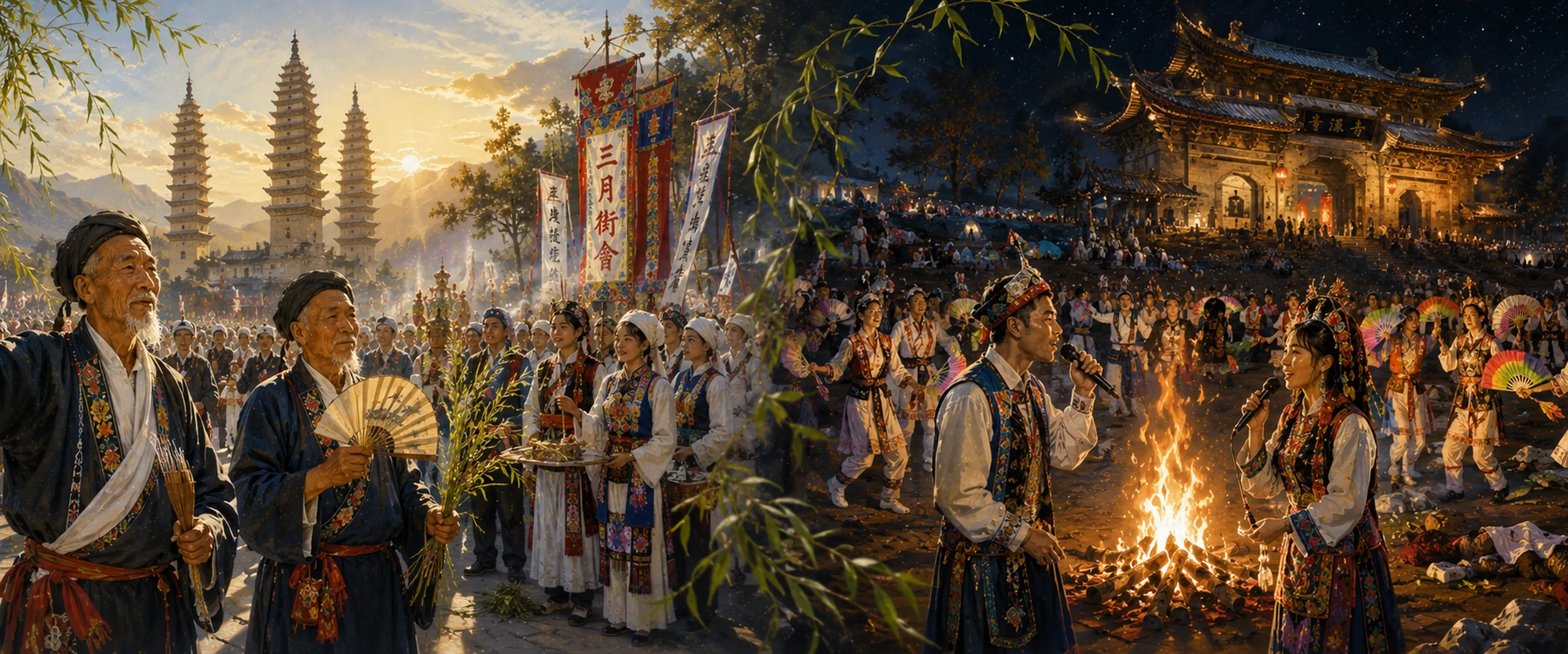
Celebrated Worldwide
UNESCO:
The most important channel through which Raosanling has entered the international stage has been the intangible cultural heritage system of the United Nations Educational, Scientific and Cultural Organization.
In 2009, “Bai Raosanling” was listed among the projects recommended by China for nomination to UNESCO’s Representative List of the Intangible Cultural Heritage of Humanity. In 2011, the nomination materials for Raosanling were formally submitted to UNESCO’s Intergovernmental Committee for the Safeguarding of the Intangible Cultural Heritage. UNESCO’s official nomination file described Raosanling as “an annual three-day festival of the Bai people whose name refers to a syncretic system of religion and belief combining Buddhism, Taoism, and the local Benzhu faith.”
During the evaluation process, UNESCO gave strong recognition to the value of Raosanling. The assessment concluded that Raosanling satisfied a number of criteria from R.1 to R.4: it is a ritual and festive event transmitted from generation to generation, integrating multiple forms of cultural expression and bringing together Bai communities; inscription on the List would help raise awareness of intangible cultural heritage and promote intercultural dialogue; communities and government authorities had jointly adopted effective safeguarding measures; and the nomination had received the full participation and consent of the communities concerned.
Although Raosanling was ultimately not inscribed because of issues relating to criterion R.5—concerning supplementary information on the inventorying of intangible cultural heritage—the nomination process itself produced far-reaching effects. UNESCO’s website still retains the nomination record for Raosanling. Owing also to its cultural relationship with the Cangshan Mountains and Erhai Lake, Raosanling has become one of the cultural calling cards of Dali Cangshan UNESCO Global Geopark, where it is likewise introduced as an important form of intangible cultural heritage.
UNESCO’s attention brought Raosanling from the status of a local ethnic festival into the global field of intangible cultural heritage safeguarding. As some scholars have noted, the fact that Raosanling attained national intangible cultural heritage status and was nominated to UNESCO for recognition as world intangible cultural heritage was made possible by strong support and active organization from the local government, and even more fundamentally by the profound and distinctive cultural value of the festival itself.
International Visitors:
The most direct form of Raosanling’s global dissemination is to “invite” the world into the landscape between Cangshan and Erhai in Dali, allowing international visitors to participate personally in this thousand-year-old carnival.
Every year from the twenty-third to the twenty-fifth day of the fourth lunar month, the Dali plain erupts into the exuberance of Raosanling—tens of thousands of Bai people dress in ceremonial attire, strike the bawangbian (霸王鞭), a traditional rhythmic bamboo-clapper prop used in Bai song-and-dance performance, and sing and dance all the way from Chongsheng Temple to Heyi City Village beside Erhai Lake. Visitors from around the world immerse themselves in the celebration and witness this extraordinary cultural spectacle firsthand. The scene is more authentic than any staged performance at a scenic attraction, and far wilder and livelier than one might imagine.
Dali has long been a popular destination for foreign travelers. The old “Foreigner Street” in the ancient city was itself one of the clearest signs of this. During Raosanling, large numbers of visitors become part of the festival itself. The performers show no shyness before cameras; instead, they often sing with even greater enthusiasm.
Yunnan Nationalities Village serves as a concentrated showcase of Raosanling culture and holds Bai Raosanling folk activities every year during the May Day holiday, allowing visitors from China and abroad to experience authentic Bai customs within the park. Visitors can not only enjoy performances involving the bawangbian, Dabenqu (大本曲), a traditional Bai narrative song form accompanied by instrumental performance, and suona music, but can also join interactive activities under the guidance of “Jinhua” and “Apeng,” traditional Bai terms used for young women and men, fully immersing themselves in the authentic atmosphere of Bai culture.
International travel guides have also taken note of Raosanling. Frommer’s travel guide lists it among Dali’s important festival events. A report on the Mekong Tourism website describes Raosanling as “an occasion when local Bai people walk through rural areas to worship at three temples one after another, and an opportunity for travelers to witness firsthand both the region’s religious diversity and its uninhibited secular celebration.” Travel platforms such as Trip.com also recommend Raosanling dancing to international visitors as an important experience at bonfire evenings in Dali Ancient City. After participating personally in Raosanling, these international visitors and travelers spread its cultural appeal around the world through travel writing, photographs, and videos. They are not merely spectators, but voluntary transmitters of Raosanling culture.
International Scholars:
Raosanling has also attracted attention from the international academic community. A number of overseas scholars have conducted fieldwork and academic research on the festival.
A research team from the University of Oregon once carried out field investigations in Beijing, Kunming, and Dali, with particular attention to the Raosanling festival and the Bai people. They visited Lijiang Ancient City and several villages around the Erhai Lake basin, documenting ritual activities held during Raosanling at Shengyuan Temple, the Erhe Shrine, and Huguo Temple. Their research showed that Raosanling is not merely a festival celebration, but also a ritual closely connected with the reproduction and continuation of life. Some studies have pointed out that the bawangbian dance is “deeply embedded in the spiritual practices of the Bai people” and, in rituals such as Raosanling, “invokes the presence of ancestors and sacred powers.” Other research has focused on the “liminal” qualities of the Raosanling pilgrimage—the pilgrimage process displays the characteristics of the liminal stage found in rites of passage, temporarily breaking through the hierarchical boundaries between humans and deities and the norms governing marriage and romantic relationships established in everyday Bai society. Through these academic findings, Raosanling has been introduced to the international scholarly community as a representative case of Bai culture.
In addition, the Chinese Festival Image Chronicle Project has produced audiovisual documentation of Raosanling. The project “Dali Bai ‘Raosanling’” was undertaken by researcher Bao Bo of Dali University, and the resulting film documented the contemporary condition of this traditional Bai festival in Dali. This form of audiovisual documentation has allowed Raosanling to enter broader channels of international communication.
Media Dissemination:
Media coverage is an important channel through which Raosanling has reached the world. International Online and other media directed toward overseas audiences have reported on the festival. China Youth Network, China News Service, and other outlets have used photojournalism to communicate the grandeur of Raosanling to international audiences. Hong Kong China News Agency has also reported on the festival. These reports have been translated into multiple languages and disseminated around the world.
Raosanling is also beginning to attract attention on overseas social media. Ma Xiaoyu of Egypt has previously experienced intangible cultural heritage in China. As Dali is a popular destination among international travelers, folk activities such as Raosanling are becoming known to growing numbers of people through visitors’ social-media sharing. As Dali becomes increasingly internationalized, transport hubs such as airports and railway stations have been equipped with English signage, while tools such as WeChat translation have made travel more convenient for foreign visitors. Improvements in this infrastructure have also created better conditions for the international dissemination of Raosanling.
Mutual Learning Among Civilizations
Cultural Dialogue
Raosanling has been called the “Bai Carnival.” The term itself creates a dialogue with carnival cultures around the world. Brazil’s Rio Carnival is renowned for samba and float parades; Spain’s Running of the Bulls is known for speed and courage; Italy’s Venice Carnival is distinguished by masks and magnificent dress—while Raosanling creates a unique “Bai-style carnival” through pilgrimage processions, the resonant rhythms of the bawangbian, and the flowing melodies of Dabenqu.
Raosanling shares certain deeper cultural logics with carnivals around the world. Anthropologists have summarized one of the defining characteristics of carnival as “liminality”—a specific time and space in which ordinary social order is temporarily suspended, allowing people to move beyond everyday norms and release their emotions freely. Raosanling historically operated in much the same way: among Bai people living under arranged-marriage customs, the three days of Raosanling were the only time when individuals could temporarily escape such constraints, reunite with former lovers, or seek new partners. Beside the nighttime bonfires, singing and dancing continued until dawn. This “carnival” was therefore not merely entertainment, but a ritual renewal of social order.
Yet the differences between Raosanling and global carnival traditions are equally striking. Raosanling is not simply a carnival of entertainment, but a “ritualized cultural space” centered on pilgrimage to three temples. As scholars have pointed out, the core of Raosanling is “pilgrimage”—through year-after-year practices of festive recreation and prayer to deities, Bai people establish a series of pilgrimage rituals that in turn affirm identity within the ethnic community. This dual structure of “pilgrimage + carnival” gives Raosanling a distinctive place among the festivals of the world.
Cultural Distinctiveness
The reason Raosanling cannot easily be reproduced overseas lies fundamentally in its deep connection with the Bai system of Benzhu worship (本主崇拜). Benzhu worship is a religious belief system distinctive to the Bai people—each Bai village has its own Benzhu, a local tutelary deity, while Raosanling is a collective pilgrimage extending across villages and regions. As one scholar has stated, Raosanling is “a communal ritual unique to the Bai people.” The three sacred realms represented by the “Three Spirits” of Raosanling—Buddha, deity, and immortal—comprise the Buddhist divinities of Chongsheng Temple, Duan Zongbang, Emperor Jing who loved the people, worshipped at the Qingdong Benzhu Temple, and the hero Duan Chicheng of the Erhe Shrine. Together, they embody in concentrated form the Bai culture’s capacity for inclusion and absorption.
For the Bai people, Raosanling is not only a carnival but also a spiritual source of hope for family “prosperity” and “purity, auspiciousness, and peace.” What ordinary people care about most is the well-being that the festival is believed to bring to their families. This profound layer of faith makes Raosanling impossible to transplant simply overseas—it is not a “cultural performance” that can be staged at any time, but an annual “practice of faith” deeply bound to the land and its deities.
International Value
UNESCO defines Raosanling as a “ritualized cultural space.” The concept itself carries significant international value. “Cultural space” is one of the core concepts within UNESCO’s system for safeguarding intangible cultural heritage and refers to a place or period of time in which folk and traditional cultural activities are concentrated. The value of Raosanling as a “ritualized cultural space” lies in the fact that it is not merely a three-day festival, but a concentrated enactment of Bai culture within a specific time and space—the procession route forms the spatial dimension; the twenty-third to twenty-fifth days of the fourth lunar month form the temporal dimension; song and dance, worship, and social interaction constitute the activities; and Benzhu worship provides the core of belief.
This approach to safeguarding a “ritualized cultural space” offers useful reference for countries around the world seeking to protect similarly complex forms of cultural heritage. Although Raosanling ultimately was not inscribed on UNESCO’s Representative List of the Intangible Cultural Heritage of Humanity, the nomination process itself demonstrated China’s efforts and international perspective in safeguarding intangible cultural heritage.
Contemporary Value
One of the original functions of Raosanling was to pray for rain. Today, large-scale pumping and irrigation systems have been built around Erhai Lake, and rain prayers are no longer an immediate necessity, yet Raosanling as a folk festival has grown more lively with every passing year. This transformation itself carries important significance for mutual learning among civilizations—when the original function of a festival is replaced by modern technology, the festival does not necessarily disappear; instead, it can acquire new vitality through richer cultural meanings. This demonstrates the capacity of traditional culture to adapt during the process of modernization.
Today, Raosanling has seen its “religious character gradually diminish while the content of its cultural activities has become increasingly rich and diverse, and it has become a festival of spring outings and social interaction for the Bai people.” This transformation from “entertaining the deities” to “entertaining people” is precisely a form of cultural change experienced by many world-class intangible cultural heritage traditions. Raosanling carries a thousand years of Bai cultural memory and constitutes a cultural root for the Bai people. It “embodies the Bai people’s love of life and reverence for nature.” This love of life and reverence for nature are values shared by humanity and form the spiritual foundation that enables Raosanling to cross cultural boundaries and enter into dialogue with the world.
Raosanling and the Lancang River
Dali in Yunnan, where Raosanling is held, lies in the upper reaches of the Lancang–Mekong River basin. Since ancient times, this region has been a corridor where multiple ethnic groups and cultures meet. The Benzhu worship embodied in Raosanling shares deep cultural similarities with village guardian-deity traditions in Southeast Asian countries. The village guardian-spirit traditions of Thailand, Myanmar, Laos, and other countries are highly similar in function to Bai Benzhu worship—they are all protectors of villages, all occupy a central place in local belief, and all sustain community cohesion through annual rites. The safeguarding concept of Raosanling as a “ritualized cultural space” therefore also provides a reference for protecting other similar cultural spaces throughout the Lancang–Mekong River basin.
Closing Note
The global dissemination of Raosanling traces a distinctive path from the landscape between the Cangshan Mountains and Erhai Lake to the international stage of intangible cultural heritage. Its inclusion on the national intangible cultural heritage list in 2006, followed in 2009 by its selection as one of China’s recommended projects for nomination to UNESCO’s Representative List of the Intangible Cultural Heritage of Humanity—these two milestones clearly outline the trajectory by which Raosanling moved from an ethnic festival of southwest China into international view.
Among the many ethnic festivals of the world, Raosanling has followed a path of its own. Its core cultural elements are deeply bound to the geographical space of Cangshan and Erhai and cannot simply be “packaged” and taken overseas. For this reason, its global dissemination is expressed more through “inviting people in”—through its UNESCO intangible cultural heritage nomination, firsthand participation by international visitors, academic research by overseas scholars, and coverage by international media, the world is invited into the landscape between Cangshan and Erhai to experience the festival’s distinctive charm firsthand.
On the UNESCO stage, Raosanling gained international attention as a “ritualized cultural space.” Between Cangshan and Erhai in Dali, every year from the twenty-third to the twenty-fifth day of the fourth lunar month, tens of thousands of Bai people and Chinese and foreign visitors together witness this thousand-year-old carnival. In academic research, Raosanling has become a representative case for understanding Bai culture, Benzhu worship, and the theory of “liminality.” Through travel guides and social-media dissemination, Raosanling is becoming known to a growing number of international travelers.
More moving still is the fact that, as Raosanling enters the world’s view, it continues to maintain its profound connection with Cangshan and Erhai. The Raosanling procession still sets out to the morning bells of Chongsheng Temple; the rhythm of the bawangbian still sounds along the field paths of Qingdong Village; the melodies of Dabenqu still echo beneath the willows beside Erhai Lake. Raosanling has not diluted the richness of its culture merely in order to “go out into the world.” Instead, through “inviting people in,” it allows the world to encounter its most authentic form amid Cangshan and Erhai. Like the bawangbian handed down across a thousand years—it has survived the rise and fall of dynasties, yet its rhythm remains as resonant as ever; it crosses cultural boundaries and still stands apart in its own distinctive way. The songs and dances of Raosanling continue without end between Cangshan and Erhai—and within the world’s field of vision.
—-
Readers’ Comments
Calendar and traditional culture enthusiasts from around the world, sharing the same moon.
Sign in or register to join the conversation. Your comment account is created automatically the first time you use a connected account.
No comments yet
Share your thoughts with readers around the world.