Munao Zongge

Munao ZonggeOrigins of the Munao Zongge Festival

「 <p>太阳之舞,鸟雀传世,木代祭祀,景颇圣节。</p> 」

The Manau Zongge Festival is a traditional festival of the Jingpo people, generally held in the first month of the lunar calendar. “Manau Zongge” is a Jingpo term meaning “everyone dance together,” and it is the most important festival celebration…

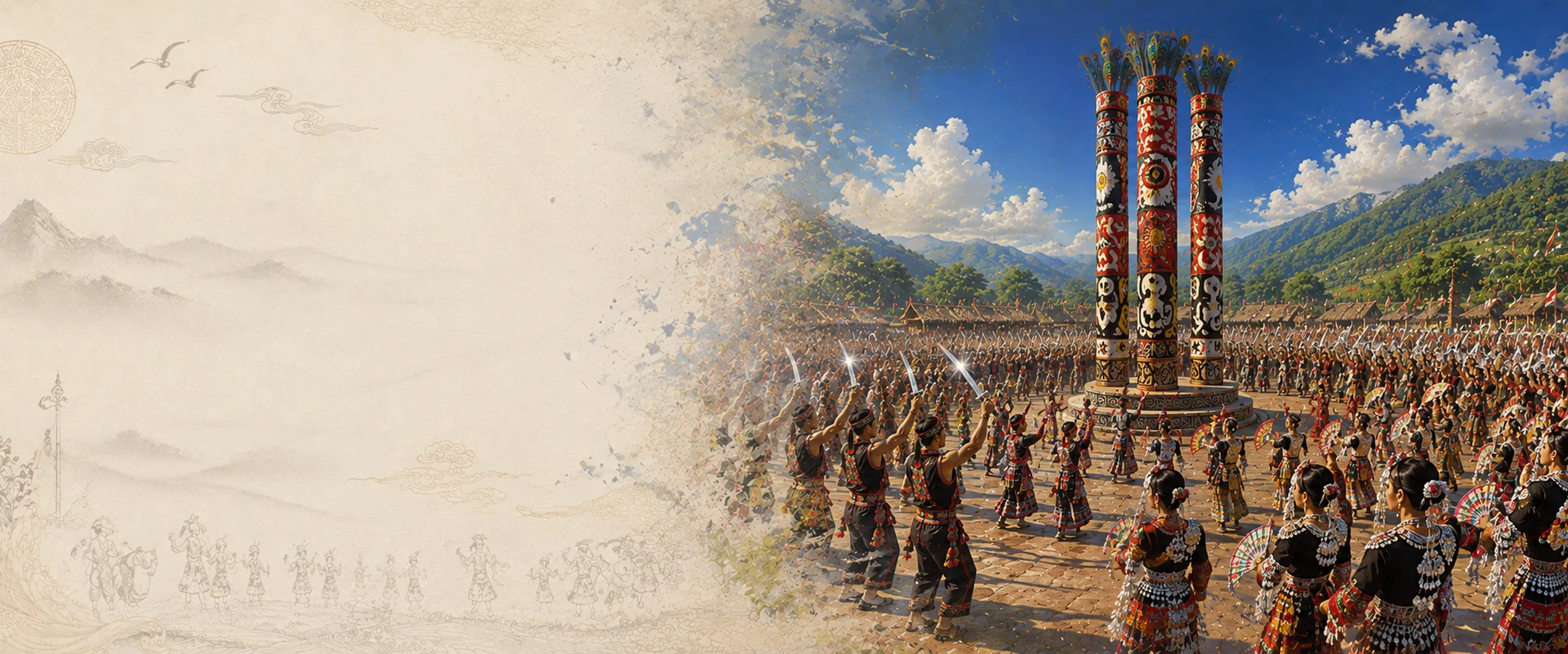
The Munao Zongge can be traced back to primitive society. In the Jingpo language, “Munao Zongge” means “joyous gathering for singing and dancing.” It was originally a primitive religious sacrificial ritual to worship the sun god “Mudai.” According to the creation epic *Munao Zhaiwa*, the Munao Zongge was originally only performed by the sun’s children in the Sun Palace. The Sun God invited all beings in heaven and earth to a grand gathering; the beings on earth sent birds to attend; the birds learned the dance and brought it back to the human world. The main activity of the Munao Zongge is the Munao dance. Before the official event, people erect four wooden pillars (Munao Shidong, 目瑙示栋) in the centre of the dance ground to worship the sun god and indicate the dance routes. Traditional Munao Zongge has various types, including Su Munao (招财庆丰收, praying for wealth and celebrating the harvest).

Munao Zongge / Origins of the Munao Zongge Festival

The Origin of the Festival Name

Origins & Anecdotes · Tracing the Past

Dual Naming in Jingpo and Zaiwa

The name “Munao Zongge” itself embodies the cultural integration among different subgroups of the Jingpo people. The Jingpo people have multiple subgroups, of which the Jingpo branch and the Zaiwa branch are the two largest. “Munao” is in the Jingpo language, while “Zongge” is in the Zaiwa language. Together, they mean “everyone come and dance together.”

In the Jingpo branch, “Mu” refers to the celestial god “Mudai,” and “Nao” refers to the movements of sacrificial dance. “Munao” literally means “dance of offering sacrifice to heaven,” a religious dance activity centred on worshipping the celestial god. In the Zaiwa branch, “Zongge” means “everyone dance together,” emphasising collective participation and mass revelry.

In recent decades, the two branch names have been combined into the unified term “Munao Zongge.” This dual naming is a vivid reflection of cultural integration within the Jingpo people. From the Jingpo branch’s “heaven‑sacrificing dance” to the Zaiwa branch’s “everyone dance together,” the naming history of Munao Zongge is itself a cultural history of the Jingpo people.

Three Levels and Over Ten Types

The Jingpo people’s Munao has extremely rich levels and types. From the perspective of its development history, Munao can be divided into three levels: “Zhang Munao” (章目瑙, Sun Palace Munao), “Wu Munao” (乌目瑙, Bird Munao), and “Shenjing Munao” (神京目瑙, Human Munao).

“Zhang Munao” is the most primitive form. In Jingpo, “Zhang” means sun, referring to the dance that only the Sun God and his children could perform. “Wu Munao” is the dance that birds performed on the ground after learning it from the Sun Palace; “Wu” in Jingpo means bird. “Shenjing Munao” is the Munao that the Jingpo ancestors learned from the birds and then performed in the human world.

Beyond these three levels, there are more than ten different types of Munao, each with its specific function and purpose. For example, among the Jingpo branch, there was “Pianbudang Munao” performed before war, and “Gongran Munao” performed when a hill chief’s family divided its estates. Among the Zaiwa branch, there was “Bugunge” performed at funerals, and “Longleige” used to expel evil spirits. There is also “Su Munao” (praying for wealth and celebrating the harvest), “Badang Munao” (celebrating victory), “Dingshuan Munao” (celebrating the completion of a new house), and “Jieru Munao” (rallying troops before an expedition). In Jingpo history, expeditions, victories, bountiful harvests, weddings and funerals, and welcoming honoured guests were all occasions for holding a “Munao Zongge.”

This rich typology shows that Munao Zongge is not merely a festival but a complete system of cultural rituals. It runs through every aspect of Jingpo social life—from war to peace, from life to death, from harvest to calamity—Munao has always been the core way for the Jingpo people to express emotions, communicate with spirits, and unite the community.

Munao Zongge Festival and Munao Zongge Grand Gathering

In contemporary times, there is a subtle difference between the “Munao Zongge Festival” and the “Munao Zongge Grand Gathering.” The “Munao Zongge Festival” specifically refers to the festival activities held during the statutory festival period (the 15th day of the first lunar month). The “Munao Zongge Grand Gathering” or “Munao Zongge activities” refers more broadly to Munao Zongge events held outside the statutory festival period, which can be held as needed for cultural tourism development. Though subtle, this distinction reflects the transformation of Munao Zongge from religious ritual to cultural performance in contemporary society.

Festival Origins

Origins & Anecdotes · Tracing the Past

Sun Worship

The oldest source of Munao Zongge can be traced back to the Jingpo ancestors’ primitive worship of the sun. This is the deepest and most essential cultural gene of Munao Zongge.

In the primitive religious beliefs of the Jingpo people, the sun god “Mudai” is the supreme deity. Munao Zongge was originally a grand sacrificial ritual held to worship the sun god “Mudai.” The Jingpo people are a cross‑border ethnic group whose ancestors have ethnic affinity with the Di‑Qiang (氐羌) nomadic groups of the northwest. In the cold environment of the Gansu‑Qinghai Plateau, the sun not only brought light to humanity but also warmth; therefore, the Jingpo ancestors held the sun god in special reverence.

In Jingpo creation myths and heroic epics, the sun god occupies a central position. It is said that the Jingpo people originated from the Gansu‑Qinghai Plateau, where snow covered the ground all year round and the land was frozen and bitterly cold. In this extremely cold environment, the sun was the fundamental guarantee of life. The Jingpo ancestors integrated their gratitude and reverence for the sun into religious rituals, forming the tradition of Munao Zongge centred on worshipping the sun god.

The very name “Munao Zongge” contains the worship of the sun—“Mu” refers to the celestial god “Mudai,” the sun god. Munao Zongge is essentially a grand ceremony paying tribute to the sun god.

Birds Bringing the Dance

Among the many origin legends of the Jingpo people, the story of “birds learning the dance from the Sun Palace and bringing it to the human world” is the most widely spread and influential. This legend infuses Munao Zongge with its most moving cultural narrative.

#### The Sun King’s Invitation and the Mission of the Hundred Birds

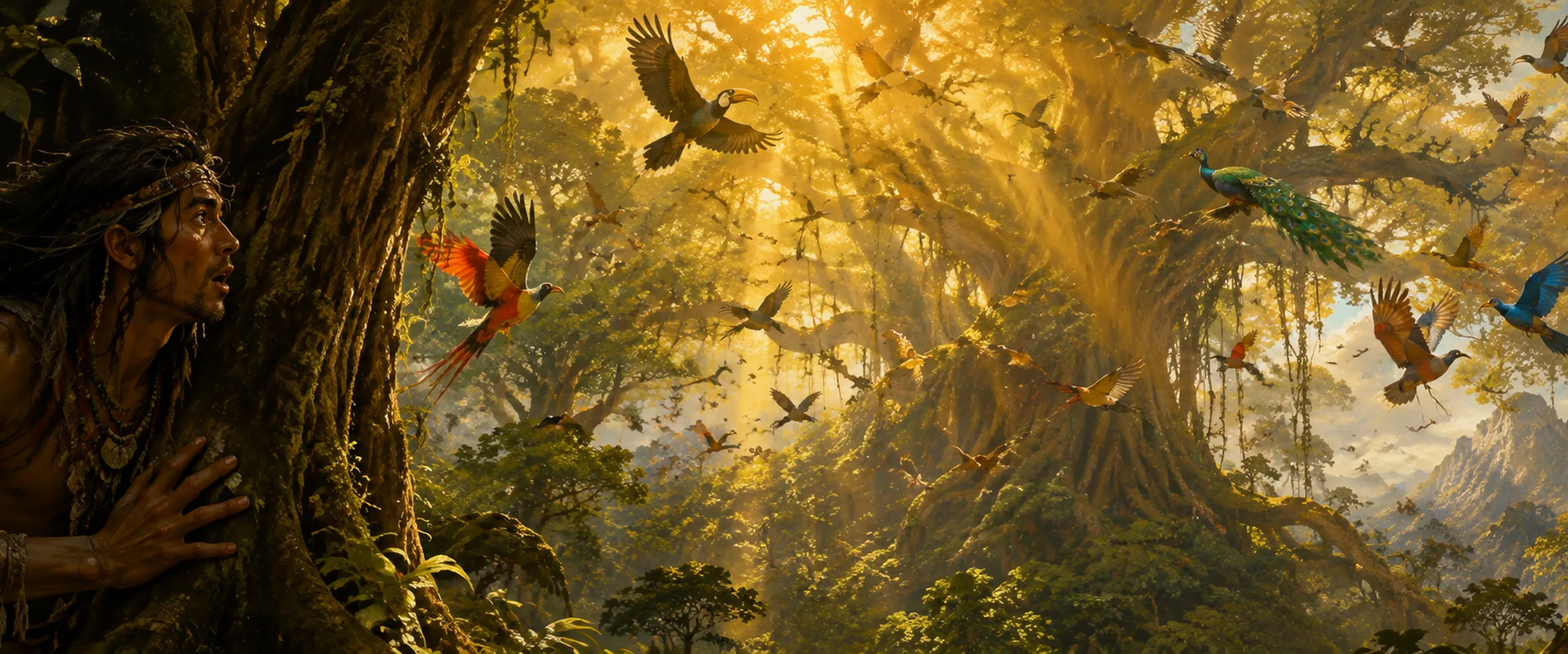
Legend has it that in ancient times, only the children of the sun in the Sun Palace could perform the Munao Zongge. Once, the Sun God invited all beings in heaven and earth to a Munao Zongge grand gathering he was hosting, and the beings on earth sent all the birds to attend.

The birds, bearing this important mission, flew out of the forests and wilderness, crossed mountains and rivers, and flew over the Muzhai Shengya slopes, finally reaching the Sun Palace, where they sang and danced with the sun’s children. They were awestruck by the magnificent dance and enchanting music of the Sun Palace, and threw themselves wholeheartedly into this sacred revelry.

Another version of the legend is more specific: the nine sun brothers, who should have appeared one each day, all appeared in the sky at once and did not go back at night. All living beings on earth were scorched and could not survive. So the animals and humans jointly elected the “Kongrang” (hornbill) and “Wudong” (peacock) as envoys to plead with the Sun King. Upon arriving at the Sun Palace, they happened to catch the Sun King holding a “Zhan Munao” and were invited to participate. Their dashing bearing and melodious voices won the Sun King’s favour.

#### Bird Munao and the Three‑Level Evolution

After learning the Munao dance in the Sun Palace, the birds returned to the ground. Deeply moved by the beauty of the Munao, they decided to hold a Munao on the ground as well—this is the “Wu Munao” (Bird Munao). According to legend, the Munao held by the birds on the ground was witnessed by the Jingpo ancestor Ningguanwa (宁贯娃, also known as Ningguanwa). The Jingpo ancestors were enchanted by the birds’ melodious voices and graceful dances, and were deeply inspired, so they created the Jingpo people’s own Munao. Thus, human Munao was born.

This legend not only explains the origin of the Munao Zongge but also reveals a core concept of Jingpo culture: human culture is not created out of nothing, but is learned from nature and obtained from the gods. Birds, as messengers connecting heaven and earth, transmitted the culture of the sun god to humanity. This concept of “culture descending from heaven” endows Munao Zongge with sacredness.

The Jingpo legends about the origin of Munao form a clear three‑stage evolutionary chain: “Zhang Munao” (Sun Palace Munao) → “Wu Munao” (Bird Munao) → “Shenjing Munao” (Human Munao). “Zhang Munao” is the sacred source—the dance that only the sun god’s children could perform. “Wu Munao” is the bridge of transmission—the dance that birds brought from the Sun Palace and performed on the ground. “Shenjing Munao” is the human creation—the dance that the Jingpo ancestors learned from the birds and further developed according to their own needs.

This three‑stage structure not only explains the origin of Munao but also reveals the developmental logic of Jingpo culture: culture originates from the divine (the sun god), is transmitted through nature (birds), and is ultimately mastered and developed by humanity. Through this narrative, the Jingpo people place their own culture within the cosmic order—Munao Zongge is not only a human dance but also a divine gift and a natural offering.

#### The Hornbill and the Peacock

The influence of the bird‑transmission legend is still profoundly evident in the ritual details of Munao Zongge. During the Munao Zongge dance, the “Naoshang” (瑙双, lead dancers) all wear hats made of peacock feathers and hornbill skulls as a mark of commemoration. This is not just decoration but also a tribute to the birds that transmitted the dance.

The hornbill has special significance for the Jingpo people. In the legend, the hornbill (“Kongrang”) was chosen as the envoy to the Sun Palace. The peacock (“Wudong”) was another important bird envoy. These two birds became the most important animal totems of Munao Zongge; their images appear not only on the headdresses of the lead dancers but also in the carvings on the Munao Shidong.

Heroic Legends

Beyond the beautiful myth of birds transmitting the dance, the Jingpo people also have several origin legends of Munao Zongge associated with heroic figures. These legends infuse Munao Zongge with the spiritual connotations of struggle, courage, and national dignity.

In the Jingpo creation epic, Ningguanwa (宁贯娃, also known as Ningguanwa) is one of the most important heroic figures. He is the creator hero who separated heaven and earth, and also the son‑in‑law of the sun god. According to legend, Munao Zongge was a dance performed by the attendant birds of the goddess of fertility in the distant Sun Palace, and was later brought back to the human world by the Jingpo ancestor Ningguanwa. The sun god’s bird is thus revered as the god of dance, and the Jingpo people use dance to commemorate their ancestors’ great migration. As the son‑in‑law of the sun god, Ningguanwa had a special status as a bridge between heaven and earth. He could enter the Sun Palace, witness the sacred “Zhang Munao,” and bring it back to the human world. This narrative model of “the hero retrieves culture from the divine realm” is common in myths around the world—Prometheus bringing fire from heaven, Ningguanwa bringing dance from the Sun Palace—both are humanity’s collective imagination of cultural origins.

Another widely circulated legend links the origin of Munao Zongge to the story of the Jingpo hero Leipan (雷盼) defeating a demon king. According to legend, the Jingpo people once lived a happy life in peace. Later, a demon king appeared who survived by eating children. The Jingpo hero Leipan bravely stepped forward and fought a desperate battle with the demon king. The sun god, moved by Leipan’s courage, gave him a precious sword forged from flames. With this divine sword, Leipan ultimately defeated the demon king that devoured children. The Jingpo people held songs and dances to commemorate their ancestors’ victory—this is the origin of Munao Zongge. In this legend, Munao Zongge is not only a religious ritual to worship the sun god but also a grand celebration of victory and a commemoration of heroes. The demon king symbolises evil and disaster; the hero’s victory symbolises the power of justice and light. Thus, Munao Zongge acquired the spiritual connotation of “defeating evil and defending the homeland.”

Although the legends of Ningguanwa and Leipan have different protagonists, they share the same narrative pattern: the hero saves his people from adversity, and Munao Zongge is a commemoration and celebration of that victory. Whether Ningguanwa retrieving the dance from the Sun Palace or Leipan defeating the demon king with a divine sword, Munao Zongge is always closely linked to the narrative chain of “hero—salvation—victory—commemoration.” These two legends are not mutually exclusive but explain the cultural significance of Munao Zongge from different perspectives. The Ningguanwa legend emphasises the origin of culture (from heaven to the human world), while the Leipan legend emphasises the function of culture (exorcism and celebration). Together, the two legends constitute a complete cultural narrative of Munao Zongge—it is both sacred (from the sun god) and secular (celebrating human victory); both religious (worshipping celestial gods) and social (uniting the community).
Core Rituals

Origins & Anecdotes · Tracing the Past

Munao Shidong (目瑙示栋, Munao Ritual Pillars)

The Munao Shidong is the most important material carrier of Munao Zongge. The Shidong stands in the centre of the Munao dance ground and is the most sacred and revered totem in the hearts of the Jingpo people. The Shidong generally consists of six thick rectangular wooden plaques—four vertical and two horizontal—mounted on a base, painted with irregular spiral geometric patterns in red, black, and white. The two central vertical plaques are slightly taller; the left one (male) bears the sun pattern, and the right one (female) bears the moon pattern. The sun pattern is at the very top, with rays radiating in all directions, representing the Jingpo people’s migration from the Sun‑Moon Mountains of the Qinghai‑Tibet Plateau, while also symbolising the pairing of yin and yang and humanity’s dependence on the sun and moon.

Every detail of the Shidong contains rich cultural information. The spiral dance pattern below represents the migration routes of the Jingpo ancestors. Further below are the legendary patterns of the hornbill and peacock leading the dance. The two slightly shorter plaques at the sides are the ancestral male and female pillars, with the ancestral birthplace “Muzhe Shenglabeng” (木折省腊崩) painted at the top. The upper horizontal plaque bears a field pattern, and the lower one bears patterns of livestock and grains. The male and female pillars are connected by crossed knives and arrows. Beside the Shidong, a special seat for the sun god is set up, called “Zhangkenri” (章肯日) in Jingpo. The entire design of the Munao Shidong is centred on the sun—the sun at the very top, with its light shining over all. This is not just a visual design but also an expression of cosmology: the sun is the source of all things and the origin of all power.

The Munao Shidong is an encyclopaedia of the Jingpo people carved in wood—the sun, moon, migration routes, legendary animals, ancestral birthplace, fields and grains, knives and arrows—all condensed onto these six wooden plaques.

The Erecting of the Shidong Ceremony

Historically, before erecting the Munao Shidong, the entire village’s Dongsa (董萨, ordinary shamans) would chant to appease the village spirits, creating a sacrificial climax. Only after three consecutive days of sacrifice could the Munao Shidong be erected. At that moment, the entire square would burst with cheers and joy.

The ceremony of erecting the Shidong is extremely solemn. First, people offer sacrifices to the spirits to request permission to erect the Shidong; then they chant scriptures tracing the ancestors’ history; finally, amid the gaze of tens of thousands, the Shidong is erected. Once erected, it marks the official start of Munao Zongge. Knives and spears are placed beside the pillars, symbolising the people’s strong and resolute character. According to the legend that the Munao dance originated from bird dances, wooden carvings of hornbills and peacocks are placed at both ends of the pillar frame. Tall living bamboo poles are erected in front of the pillars, symbolising the ever‑green vitality of life. Above hangs a horizontal plaque painted with the Jingpo legendary place of origin, the Himalayas.

Naoshang and Naoba

In the Munao Zongge dance, there must be specialised lead dancers, the “Naoshang” (瑙双) and “Naoba” (瑙巴), leading the way, with large drum troupes and bands providing accompaniment. The Jingpo Munao Zongge dance troupe consists of the Naoshang group, the Naoba group, and the mass participants.

The Naoshang and Naoba are generally required to have good appearance, good character, and a thorough knowledge of history and traditions. Traditionally, they were strictly selected by divination, because Munao Zongge was a sacred sacrificial activity to the sun god. They have distinct origins, strict division of labour, each performing their own duties, with none dispensable. The Naoshang are the chief ritual officiants, with extremely strict requirements for the ritual dance movements. They wear hornbill headdresses, serving as the “eyes” and “soul” of the entire group, leading tens of thousands of people dancing to the same drumbeat. The Naoba assist the Naoshang, responsible for maintaining the group’s order and rhythm.

Mass Dance of Ten Thousand

The main activity of Munao Zongge is the Munao dance. When Munao Zongge is held, tens of thousands of people from within a radius of a hundred li participate, all dancing together in a grand and passionate atmosphere. Tens of thousands of people stepping to the same drumbeat creates a spectacular and profoundly powerful scene. Munao Zongge is one of the largest and most magnificent collective dances in the world.

The dance troupe is arranged in formation, with bold and orderly dance steps, and a spirited, lively rhythm. Though the dance movements are not numerous, the distinctive rhythm of the stamping step and shoulder swing is unique, making it the representative movement of Jingpo dance. Dancers are dressed in festival attire; silver ornaments sparkle like stars, and long knives wave like the wind. The dance scene of Munao Zongge has been described as a “dance of paradise.”

Instruments and Music

The music of Munao Zongge is provided by a large drum troupe and band. The drumbeat is the soul of Munao Zongge—tens of thousands of people step to the same beat; the drum is the conductor of the mass movement. In addition to drums, instruments such as gongs, cymbals, and suona horns also participate in the accompaniment. The music has a spirited and lively rhythm with strong emotional appeal. Guided by the drumbeat, the dancers form a unified rhythm and step, and the entire dance ground becomes a huge living organism, pulsating to the musical beat.

Historical Evolution

Historical Development
Primitive Society Period
The Munao Zongge can be traced back to primitive society. The Jingpo ancestors were a branch of the ancient Di‑Qiang ethnic group, originally inhabiting the Qinghai‑Tibet Plateau as part of the Di‑Qiang peoples. In the ancient days of slash‑and‑burn farming and tribal migrations, the Jingpo people used song and dance as a medium to communicate with heaven and earth, to appreciate nature, and to commemorate their ancestors. The earliest Munao Zongge was a grand ritual of the Jingpo people to worship the celestial god “Mudai,” belonging to an exclusive sacrificial ceremony—a solemn rite for communicating between humans and gods and praying for the well‑being of the land.
Tang to Ming Dynasties
According to historical legends and Chinese historical records, the Jingpo people began their long journey from the Qinghai‑Tibet Plateau southward along the Hengduan Mountains around the Tang dynasty. In the Tang dynasty, the Jingpo were known as “Xunchuan Man” (寻传蛮) and “Gaoligong People” (高黎贡人). For over a thousand years, the Jingpo people have kept their ethnic origins and migration history firmly in mind, as reflected in the annual traditional festival of “Munao Zongge.”
Qing Dynasty to the Republic of China
The Qing dynasty to the Republic of China period was the heyday and monopolisation period of Munao Zongge under the hill chief system. In traditional Jingpo society, Munao Zongge was usually organised by the hill chief. The hill chief was the political leader of traditional Jingpo society, holding supreme authority. Before the abolition of the hill chief system, Munao Zongge had strong religious and hierarchical overtones. At that time, only hill chief families that enshrined the “Mudai” god were qualified to hold the Munao Zongge sacrificial ceremony. Although holding Munao Zongge required considerable wealth in terms of frequency and scale, it could enhance the hill chief’s social status and prestige. If ordinary wealthy families wanted to hold a Munao Zongge ceremony to raise their social standing, they had to borrow the Mudai god by giving cattle to the hill chief’s family that enshrined it.
1950s to 1970s
In the 1950s, with the founding of the People’s Republic of China and the social system reforms in Jingpo areas, the hill chief system was abolished. The traditional mechanism for holding Munao Zongge also underwent fundamental changes. However, by the 1970s, Munao Zongge was completely prohibited, and this ancient festival tradition fell into silence for over two decades. Munao Zongge’s transmission faced an unprecedented crisis.
Revival after Reform and Opening‑up
After reform and opening‑up, through the continuous efforts of the Jingpo people and the restoration and implementation of ethnic policies, Munao Zongge activities were approved by the government for restoration. In 1980, with approval from the Central United Front Work Department and the consent of the prefecture and Longchuan County Party Committee, Munao Zongge was grandly held at the Longchuan County Middle School sports ground. Longchuan County, for the first time with the entire county’s effort, hosted the “Zhurong Wenbang Tongken Munao Zongge” event, attracting more than 60,000 participants. The festival’s content and form underwent many new changes, abandoning the original content and procedures of invoking spirits and performing exorcisms, and adding many new elements. Subsequently, Munao Zongge was soon restored and popularised throughout the province and prefecture wherever Jingpo compatriots lived.
21st Century: Intangible Heritage Protection and Cultural‑Tourism Integration
On 20 May 2006, with approval from the State Council, “Jingpo Munao Zongge” (No. 459Ⅹ‑11) was inscribed on the first batch of China’s National Intangible Cultural Heritage Representative Project List. The project was declared by Longchuan County, Dehong Dai and Jingpo Autonomous Prefecture, Yunnan Province, as the core heritage site. That same year, the Yunnan Provincial Government officially conferred upon Longchuan County the title “Hometown of Munao Zongge.” Munao Zongge also has several nationally recognised representative inheritors of intangible cultural heritage, including Zhao Baozhong (赵保忠) and Yue Matong (岳麻通).

Primitive Society Period

The Munao Zongge can be traced back to primitive society. The Jingpo ancestors were a branch of the ancient Di‑Qiang ethnic group, originally inhabiting the Qinghai‑Tibet Plateau as part of the Di‑Qiang peoples. In the ancient days of slash‑and‑burn farming and tribal migrations, the Jingpo people used song and dance as a medium to communicate with heaven and earth, to appreciate nature, and to commemorate their ancestors. The earliest Munao Zongge was a grand ritual of the Jingpo people to worship the celestial god “Mudai,” belonging to an exclusive sacrificial ceremony—a solemn rite for communicating between humans and gods and praying for the well‑being of the land.

According to the creation epic *Munao Zhaiwa*, Munao Zongge originated in the realm of the sun god and was brought to the human world by a hundred birds carrying the art. Its emergence can be traced back to the period of primitive society. The development of the Munao ceremony roughly went through multiple stages—the first stage was from after the 7th century BC to before the 11th century AD, when the Jingpo ancestor Di‑Qiang tribes began migrating south from the Mongolia region, passing through Shanxi and Shaanxi to Qinghai and Tibet, where the Jingpo differentiated from the Di‑Qiang, and thereafter Jingpo culture gradually formed its own system. In prehistoric civilisation, “dance steps were history books”—the winding and meandering totemic patterns on the Munao Shidong replicated the migration routes of the ethnic group’s southward movement; the continuous circular dance formations symbolised the unbroken lineage of the ethnic group’s reproduction.

Tang to Ming Dynasties

According to historical legends and Chinese historical records, the Jingpo people began their long journey from the Qinghai‑Tibet Plateau southward along the Hengduan Mountains around the Tang dynasty. In the Tang dynasty, the Jingpo were known as “Xunchuan Man” (寻传蛮) and “Gaoligong People” (高黎贡人). For over a thousand years, the Jingpo people have kept their ethnic origins and migration history firmly in mind, as reflected in the annual traditional festival of “Munao Zongge.”

Along the long migration road, Munao Zongge continued to grow. In ancient times, the Jingpo people danced the Munao Zongge countless times on their journey from the north to Yunnan. The names of Munao Zongge also varied according to the needs of the time, such as “Gongran Munao”—the Munao danced before the tribe separated and dispersed for migration. At that time, Munao Zongge was led by hill chiefs, and various ritual types emerged: dances before battle to rally warriors and build morale, dances at harvest time to give thanks to nature, and dances when moving to a new settlement to pray for peace and prosperity. In Jingpo history, expeditions, victories, bountiful harvests, weddings and funerals, and welcoming honoured guests were all occasions for holding “Munao Zongge.”

Qing Dynasty to the Republic of China

The Qing dynasty to the Republic of China period was the heyday and monopolisation period of Munao Zongge under the hill chief system. In traditional Jingpo society, Munao Zongge was usually organised by the hill chief. The hill chief was the political leader of traditional Jingpo society, holding supreme authority. Before the abolition of the hill chief system, Munao Zongge had strong religious and hierarchical overtones. At that time, only hill chief families that enshrined the “Mudai” god were qualified to hold the Munao Zongge sacrificial ceremony. Although holding Munao Zongge required considerable wealth in terms of frequency and scale, it could enhance the hill chief’s social status and prestige. If ordinary wealthy families wanted to hold a Munao Zongge ceremony to raise their social standing, they had to borrow the Mudai god by giving cattle to the hill chief’s family that enshrined it.

In the past, hill chief families generally held Munao every four or five years, as a symbol of the hill chief’s power and authority. Because of the enormous cost, a hill chief’s jurisdiction generally held it only every few years or decades. During this period, the Munao for worshipping “Mudai” was a symbol of the hill chief’s prestige and power. Before the late 1950s, Munao Zongge ceremonies of various sizes and types continued to be held sporadically in Jingpo areas. In the old society, the Jingpo people’s social development level was low, with backward economy, social production, and cultural life; moreover, there were many hill chiefs without unification, so Munao Zongge was basically controlled and monopolised by the hill chiefs.

1950s to 1970s

In the 1950s, with the founding of the People’s Republic of China and the social system reforms in Jingpo areas, the hill chief system was abolished. The traditional mechanism for holding Munao Zongge also underwent fundamental changes. However, by the 1970s, Munao Zongge was completely prohibited, and this ancient festival tradition fell into silence for over two decades. Munao Zongge’s transmission faced an unprecedented crisis.

Revival after Reform and Opening‑up

After reform and opening‑up, through the continuous efforts of the Jingpo people and the restoration and implementation of ethnic policies, Munao Zongge activities were approved by the government for restoration. In 1980, with approval from the Central United Front Work Department and the consent of the prefecture and Longchuan County Party Committee, Munao Zongge was grandly held at the Longchuan County Middle School sports ground. Longchuan County, for the first time with the entire county’s effort, hosted the “Zhurong Wenbang Tongken Munao Zongge” event, attracting more than 60,000 participants. The festival’s content and form underwent many new changes, abandoning the original content and procedures of invoking spirits and performing exorcisms, and adding many new elements. Subsequently, Munao Zongge was soon restored and popularised throughout the province and prefecture wherever Jingpo compatriots lived.

In April 1983, Munao Zongge was approved by the Standing Committee of the Dehong Dai and Jingpo Autonomous Prefecture People’s Congress and established as the statutory ethnic festival of the Jingpo people. The festival dates are the 15th and 16th days of the first lunar month each year. From a symbol of hill chief power to a statutory ethnic festival, Munao Zongge completed its institutional transformation from tradition to modernity, evolving from a traditional aristocratic sacrificial ritual to a public cultural celebration shared by all ethnic groups and mass participation.

21st Century: Intangible Heritage Protection and Cultural‑Tourism Integration

On 20 May 2006, with approval from the State Council, “Jingpo Munao Zongge” (No. 459Ⅹ‑11) was inscribed on the first batch of China’s National Intangible Cultural Heritage Representative Project List. The project was declared by Longchuan County, Dehong Dai and Jingpo Autonomous Prefecture, Yunnan Province, as the core heritage site. That same year, the Yunnan Provincial Government officially conferred upon Longchuan County the title “Hometown of Munao Zongge.” Munao Zongge also has several nationally recognised representative inheritors of intangible cultural heritage, including Zhao Baozhong (赵保忠) and Yue Matong (岳麻通).

On 6 February 2012, 18,604 people participated in the Munao Zongge held at Mangshi Square in Dehong, setting the world record for the “Largest Jingpo Munao Zongge Dance.” During the 2023 Munao Zongge Festival, on‑site participation exceeded 100,000, setting a new historical high. Longchuan County’s Jinghan Pengsheng permanent venue has hosted the Pengsheng Tongken Munao Zongge Festival for more than 40 consecutive sessions, making it the region with the most large‑scale Munao Zongge events, the longest continuous holding period, and the most complete transmission system in the country.

To make this thousand‑year intangible heritage transcend “festival‑only” status and truly integrate into the daily lives of all ethnic groups, Longchuan County launched the “Daily Munao Zongge” cultural benefit activity from 17 May 2019, held every evening at the Munao Zongge Square in Longchuan County town. In 2024, “Daily Munao Zongge” became a provincial‑level demonstration site for the “Encounter Yunnan” evening ethnic square dance programme.

From late 2025 to early 2026, Munao Zongge received widespread attention on short‑video platforms, and in 2025 it was selected as an innovative case of Chinese mass culture brands. In 2026, Munao Zongge was performed at the Yunnan‑Tibet Super League and showcased at the Cultural Tourism and Sports Hall of the 10th China‑South Asia Expo. In July of the same year, Dehong Munao Zongge was featured on CCTV‑3’s *National Free Dance* programme. Munao Zongge has become a grand event for showcasing ethnic cultural charm, promoting economic development, and strengthening ethnic unity, growing from a local festival to a cultural brand with international influence.

Cultural Spirit

Cultural Core
Munao Zongge carries the Chinese people’s longing for a better life and their devotion to family, embodying the cultural spirit of reunion, harmony, gratitude and blessing — it is one of the most enduring traditional festivals in Chinese culture.
Sun Worship
Gratitude to Nature
Unity and Striving
Remembering History

Sun Worship

The most core cultural spirit of Munao Zongge is sun worship. From the name (with “Mu” referring to the sun god “Mudai”) to the sun motif on the Munao Shidong, from the legend of “Zhang Munao” (the dance only the sun god’s children could dance) to the ritual function of worshipping the sun god “Mudai”—the sun runs through all of Munao Zongge.

The Jingpo ancestors’ worship of the sun originated from their deep dependence on light and warmth in the cold environment of the Gansu‑Qinghai Plateau. The sun is not only a gift of nature but also the source of life. Munao Zongge is a collective tribute to the sun—people thank the sun for light and warmth through dance, and pray that it will continue to protect their people.

Gratitude to Nature

The Jingpo people believe in animism. In the Jingpo worldview, there are many spirits in heaven and earth—the sun god, water god, wind god, and god of wisdom. Munao Zongge is dedicated to worshipping these deities. It embodies the Jingpo people’s gratitude to nature—thanks to the sun for light, thanks to water for life, thanks to the wind for strength. This gratitude is not an abstract idea but is expressed through concrete rituals—sacrifice, dance, and song.

The ecological wisdom of Munao Zongge still holds important lessons today. At a time when humanity faces climate and ecological crises, the Jingpo traditional concept of “revering and giving thanks to nature” offers an alternative way of relating to nature.

Unity and Striving

The most immediate cultural spirit of Munao Zongge is “unity.” Tens of thousands of people dancing to the same drumbeat—this collective, synchronised, large‑scale dance is itself a symbol of unity. Munao Zongge means “everyone come and dance together.” The name itself emphasises the spirit of “collective participation” and “mass revelry.”

Munao Zongge has a strong practical effect in strengthening cultural identity and ethnic cohesion. In Munao Zongge, people regardless of age, gender, or wealth participate, dance, and revel together. This collective ritual experience strengthens emotional bonds and cultural identity among community members. Munao Zongge has become a grand gathering of ethnic unity for the interaction, exchange, and integration of all ethnic groups, and a main front for consolidating the sense of community for the Chinese nation.

Remembering History

Munao Zongge is a living transmission of Jingpo migration history. From the migration‑route patterns on the Shidong, to the north‑south route followed by the “Mudai” descent, to the dance path of Munao Zongge following the migration route—every detail of Munao Zongge tells the story of the Jingpo people’s journey from north to south.

Before holding Munao Zongge, the highest priest “Zhaiwa” (斋瓦) would invite the celestial god “Mudai” to the Munao ground. The route taken by “Mudai” as it descended to earth from north to south was exactly the route of the Jingpo ancestors’ migration. In the “soul‑escorting” ceremony at funerals, the direction was reversed—the route went from south to north, safely escorting the deceased’s soul to the north.

Munao Zongge not only commemorates the ancestors’ migration but also transforms this commemoration into a ritual practice passed down through generations. The annual holding of the Munao Zongge Festival is a collective remembrance of the Jingpo people’s migration history. In the dance, people feel the hardships of their ancestors; in the songs, they pass down their ethnic memory.

Conclusion

Afterglow

The formation of the Munao Zongge Festival is the result of thousands of years of cultural accumulation by the Jingpo people, continuously infused with the spirit of the times. It originated from the Jingpo ancestors’ primitive worship of the sun—the sun as light, warmth, and the source of life—and acquired the religious framework of deities like “Mudai” within the animistic polytheistic belief system. It gained the cultural narrative of “from heaven to the human world” through the beautiful myth of birds transmitting the dance, the spiritual connotation of “defeating evil and defending the homeland” through heroic legends, the historical memory of “from north to south” through the migration epic, the institutional guarantee of social organisation through the hill chief system, and the cultural rebirth through contemporary intangible heritage protection.

From “Zhang Munao” to “Wu Munao” to “Shenjing Munao,” from the sacred dance in the Sun Palace to the cultural bridge transmitted by birds to the mass revelry of humanity; from ancient sun worship to the migration epic of the Jingpo ancestors, from hill chief‑led religious sacrifice to the statutory festival with mass participation—Munao Zongge has undergone a long evolution from the divine realm to the human world, from religion to secularity, from hill chiefs to the masses, from local celebration to national intangible heritage. It carries both the Jingpo ancestors’ reverence for and gratitude to the sun, and the Jingpo people’s simplest and most sincere aspirations for unity, abundance, and a better life.

In 2006, the Jingpo Munao Zongge was inscribed on the first batch of the National Intangible Cultural Heritage list, No. 459Ⅹ‑11. In 2012, 18,604 people danced together, setting a world record. In 2023, on‑site participation at the Munao Zongge Festival exceeded 100,000. From ancient sun worship to contemporary “Daily Munao Zongge,” Munao Zongge has traversed thousands of years and continues to flourish with its unique cultural charm on the land of Yunnan.

Munao Zongge, as its name suggests— “everyone come and dance together.” Tens of thousands of people, stepping to the same beat, shouting the same slogan, feel the pulse of the same culture in the same rhythm. This is not just a dance; it is an epic written by a people with their bodies. The Jingpo people believe that as long as the Munao Zongge is still danced, the ancestors’ spirits will not depart, and the nation’s memory will not disappear. Like the thunderous drumbeats and the orderly dance steps—they are not only the melody of the festival but also the cultural heartbeat of the Jingpo people, who have endured a thousand years of trials and still thrive with vitality.

—

[es]

Continue exploring Munao Zongge culture

Readers’ Comments

Calendar and traditional culture enthusiasts from around the world, sharing the same moon.

Sign in or register to join the conversation. Your comment account is created automatically the first time you use a connected account.