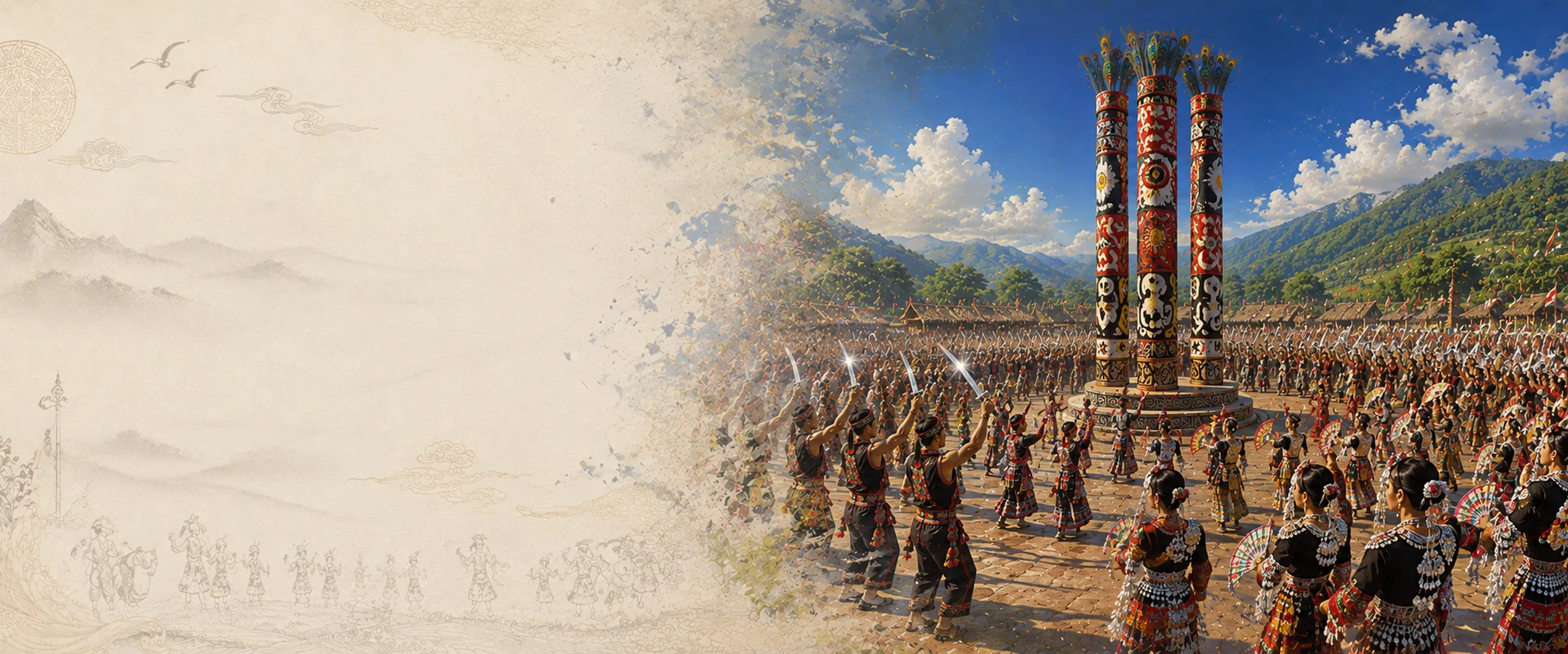
The Munao Zongge Festival is generally held on an even-numbered day selected within the nine days following the fifteenth day of the first lunar month, and usually lasts three to five days. Before the formal festivities begin, four wooden pillars known as Munao Shidong are erected at the center of the dancing ground. They serve both as objects of worship for the Sun God and as guides marking the routes of the dance. Swords and spears are placed beside the pillars, symbolizing the strength, resilience, and determination of the Jingpo people. Wooden carvings of a hornbill and a peacock are placed at the tops, while a tall living bamboo pole is erected in front to symbolize evergreen life. Historically, the Munao dance was performed on major occasions such as years of abundant harvest, departures for war, victorious returns, marriages, and ceremonies honoring spirits and deities. Today, the Munao Zongge Festival has developed into a major celebration integrating song, dance, painting, carving, and other forms of artistic expression.
Main Customs
Types and Names of Munao Zongge
Twelve Types of Munao: A Complete Ritual System from Worship to Everyday Life
Munao Zongge is not a single fixed form, but a ritual system comprising twelve different types and covering virtually every major moment in traditional Jingpo society. As folklorists have noted, traditional Munao forms include Su Munao, performed to attract prosperity and celebrate harvests; Badang Munao, celebrating victory; Dingshuan Munao, marking the completion of a new house; Deru Munao, held before a military expedition; Tingretu Munao, associated with choosing a site and laying foundations; Naosai Munao, performed for entertainment; Kenran Munao, for marriages; Tingran Munao, for forming friendships or sworn bonds; Kelong Munao, for welcoming guests; Gongran Munao, associated with separation or parting; and Zhu Munao, a funerary sacrificial dance, among twelve traditional forms.
Together, these forms preserve material concerning Jingpo warfare, production, daily life, migration, religious beliefs, and ceremonial procedures. They constitute a comprehensive ritual map of Jingpo society—from birth to death, from war to peace, and from the individual to the collective.
From Zhang Munao to Shenjing Munao: The Three-Level Origin of Munao
From the perspective of its legendary development, Munao is divided into three levels: Zhang Munao, or Munao of the Palace of the Sun; Wu Munao, or Munao of the Birds; and Shenjing Munao, or Munao of Humankind.
Zhang Munao is regarded as the most primordial form. In the Jingpo language, zhang means “sun,” and it refers to a dance that could originally be performed only by the Sun God and the children of the Sun.
Wu Munao refers to the dance performed on earth after birds learned it in the Palace of the Sun; wu means “bird” in Jingpo.
Shenjing Munao is the human form of the dance, learned by Jingpo ancestors from the birds and subsequently performed in the human world.
This three-level origin narrative places Munao Zongge within a complete cosmological framework extending from Heaven to Earth and from the sacred to the human realm.
Preparations Before the Festival: From Selecting the Dongsar to the Buffalo Sacrifice
Although Munao Zongge is primarily held around the fifteenth day of the first lunar month, preparations traditionally begin several months in advance, and every stage carries a strong sense of ritual solemnity.
Selecting the Dongsar: Mediator Between Humans and the Sacred
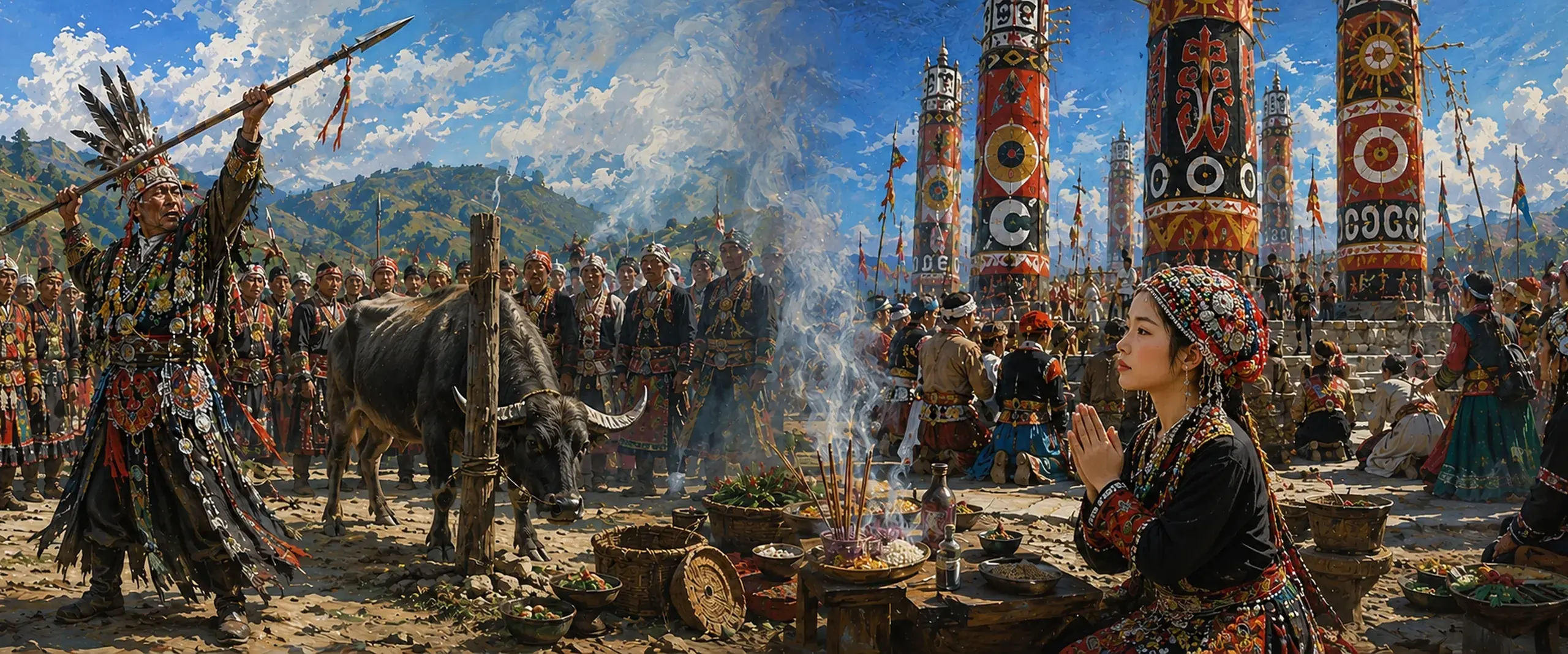
Before a Munao Zongge can be held, a Dongsar must be invited. The Dongsar functions as a ritual specialist or priest. Before the festival, he performs ceremonies for Heaven and Earth and prays for peace and protection for everyone who will attend.
The selection of a Dongsar follows strict traditional procedures. The dates for divination are carefully chosen, and the Dongsar selects an auspicious time according to customary practice in order to conduct the necessary rites and determine who will serve as the ritual specialist responsible for blessings at that year’s Tongken Munao Zongge Festival.
The Jingpo people traditionally revere nature and have long venerated Heaven, Earth, and the myriad beings of the natural world. The first divination therefore determines what offerings are required for the deities. The second identifies the Dongsar who will recite the blessing prayers. The third selects the honorary presiding figure of the festival. The selection of the Dongsar is thus the first confirmation of the festival’s sacred legitimacy: without his prayers and ritual mediation, Munao Zongge cannot properly receive divine protection.
In traditional celebrations, the Dongsar also presides over and organizes ceremonies, chants the Jingpo creation epic, and conducts sacrifices involving cattle and chickens for spirits. The Dongsar is therefore not merely a priest, but a mediator between the human and spiritual worlds and a guardian of Jingpo historical memory and cultural tradition.
Buffalo Sacrifice: The Most Solemn Form of Indigenous Ritual Worship
The buffalo sacrifice is one of the preparatory rites of the Munao Zongge Festival. It is among the most solemn and ancient forms of religious ritual and one of the sacrificial song-and-dance practices most distinctive of Jingpo culture.
Through the ceremony, Jingpo communities express their reverence for cattle and pray for heavenly protection, wishing peace and good fortune for the Jingpo people living on their homeland, safety for both humans and livestock, and abundant harvests. The rite is usually held before the formal beginning of Munao Zongge.
In traditional forms of the festival, the celebration began with cattle sacrifice. Several ritual specialists entered the ground wearing hats decorated with wild-goose feathers and boar tusks and red robes embroidered with dragons, carrying long knives stained with sacrificial blood. After circling the ground in dance, two to four highly respected lead dancers entered with a group of warriors carrying hunting guns and long knives. Shots were fired into the air to drive away evil influences, after which drums and gongs sounded together and men and women in full ceremonial dress formed successive large circles.
The buffalo sacrifice brings together Jingpo reverence for cattle, awe toward the sacred, and hopes for an abundant harvest. It serves as one of the most solemn preludes to the festival.
Erecting the Munao Shidong: Creating Sacred Space
Before the formal activities begin, four wooden pillars known as the Munao Shidong are erected in the center of the dance ground. They are used to honor the Sun and to indicate the routes of the dance. The Shidong are the most important material symbols of Munao Zongge and may be regarded as the “eyes” and “soul” of the festival.
A Shidong structure generally consists of four vertical and two horizontal thick rectangular wooden panels mounted on a base and may rise to approximately twenty meters. The two central vertical panels are slightly taller. The left is the male panel and bears a solar image; the right is the female panel and bears an image of the Moon. The radiant Sun at the top symbolizes the Jingpo people’s ancestral migration from the Riyue Mountain region of the Qinghai-Tibet Plateau.
Below it, spiral dance designs symbolize the migration routes followed by Jingpo ancestors. Lower still are legendary images associated with the hornbill and peacock as leaders of the dance. The two slightly shorter panels represent ancestral male and female pillars, with the ancestral place of origin, Muzhe Shenglabeng, depicted at their tops. Of the horizontal panels, the upper one contains agricultural field motifs, while the lower one depicts livestock, poultry, and the five grains. Crossed swords and blades at the center symbolize the enduring vitality, courage, and decisiveness of the Jingpo people.
A living bamboo pole is placed in front to symbolize evergreen life. Above hangs a horizontal plaque depicting the Himalayas, identified in Jingpo tradition as a place of origin.
The Munao Shidong may be understood as a Jingpo encyclopedia carved in wood. The Sun and Moon, migration routes, legendary animals, ancestral homeland, fields and grain, weapons and tools—all are condensed into the design of these four sacred pillars. Swords and spears are placed beside them to symbolize strength and determination. In accordance with the legend that Munao originated from the dances of birds, wooden carvings of a hornbill and a peacock are placed at the ends of the structure.
Historically, before the Shidong could be erected, all the Dongsar of a village had to chant rituals addressed to village spirits, bringing the ceremonies to a climax. Only after three consecutive days of worship could the Shidong be raised. When they finally stood upright, the entire square erupted in cheers.
The raising of the pillars itself was deeply solemn. People first offered worship and requested divine permission to erect them, then chanted texts recounting ancestral history, and finally raised the Shidong before the assembled crowd. Once the pillars stood, Munao Zongge had officially begun.
Arrangement of the Festival Ground
To the left of the Munao pillars stands a square raised platform for suona players and other musicians. In front of the pillars hang a large hide drum approximately two meters long and one or more large mang gongs more than a meter in diameter.
Around the square, bamboo fencing with two designated entrances is traditionally erected to prevent “wild spirits” and livestock from entering and disturbing the rites. This spatial arrangement is not merely practical. It carries a deeper religious meaning: the Munao ground is a sanctified space separated from the ordinary world, and entry is permitted only through specific symbolic “gates.”
Day One: Worship of the Sun God and Erection of the Munao Shidong
The Munao Zongge Festival generally lasts three days. The first day centers on worship of the Sun God and the erection of the Munao Shidong.
Worship of the Sun God: The Sacred Foundation of Munao Zongge
Munao Zongge originated in worship of the Sun God. In traditional Jingpo religious belief, the solar deity Madai occupies an exceptionally high position. Munao Zongge was originally a grand sacrificial ceremony held specifically to honor Madai. In Jingpo heroic epics, the world-creating culture hero Ningguanwa is described as the son-in-law of the Sun God.
In ancient times, Munao was a ritual offered to deities. The beings worshipped included the Sun God Madai, deities of wisdom, water, wind, and other sacred forces. Traditional Munao Zongge ceremonies were presided over by hereditary chiefs and wealthy sponsors and were held for worship, celebration of agricultural abundance, and military occasions. Through these ceremonies, people expressed gratitude to the Sun God and prayed that divine protection would continue to safeguard the Jingpo people.
The Ritual Procedure
The rituals are presided over by the Dongsar. Offerings are arranged, prayers are made, and the creation epic is chanted. Cattle and chickens may traditionally be sacrificed to spirits.
Every component follows prescribed rules: the kinds of offerings, the order of worship, and the texts to be recited are all carefully regulated. After the rites conclude, participants begin entering the central area of the Munao ground in preparation for the mass dancing of the following day.
Cultural Meaning of the First Day
The central theme of the first day is reverence—reverence for the Sun God, the ancestors, Heaven, and Earth. Through solemn ritual, the Jingpo people establish a spiritual connection with sacred powers and confirm their place within a larger cosmic order.
The first day therefore gives sacred meaning to the exuberant celebration of the next two days. Munao Zongge is not merely a dance; it is also a ritual act of homage to the sacred.
Day Two: Tens of Thousands Dancing Together — The Climax of Munao Zongge
The second day is the climax of the festival and its most spectacular and visually powerful moment: tens of thousands of people perform the same dance, moving to a single drumbeat and tracing routes associated with ancestral migration.
Naoshuang and Naoba: The Sacred Responsibility of the Lead Dancers
The Munao Zongge dance cannot begin without specialized lead dancers known as Naoshuang and Naoba. Jingpo tradition places great importance on their role, and a performance without Naoshuang leadership is considered incomplete.
The Naoshuang are the principal ritual leaders, and the movements required of them follow highly strict conventions. Traditionally there may be four or eight male leaders wearing elaborate bird crowns incorporating hornbill skulls, with boar tusks attached to the sides, three ritual tubes fixed to the front, and feathers of hornbills, paradise flycatchers, peacocks, pheasants, and other birds rising from the crown.
They wear red and green silk ceremonial robes associated with the Sun and Moon and carry auspicious ceremonial swords. A corresponding number of Jingpo women wearing silver ornaments and carrying fans accompany them.
Because legend holds that Munao originated from a bird dance brought down from the Palace of the Sun, the crowns of the Naoshuang incorporate peacock feathers and hornbill elements as a form of commemoration.
The Naoshuang stand in two rows. In the front are figures dressed in ceremonial robes representing messengers of the Sun and Moon; behind them stand women in silver-decorated costumes known as Wushuang. Their techniques, formations, and participant numbers follow fixed traditional patterns.
During the dance, the Naoshuang must know precisely when the two lines should move in parallel and when they should separate. They must also know where and when bows are performed and how many times. They move freely through the formation, producing constantly changing patterns while maintaining the traditional sequence of Munao steps.
The Naoba are lead dancers for the larger public formation. They must also master the traditional patterns, understand when the two lines should converge or divide, know the timing and location of ritual bows, and guide thousands or tens of thousands of dancers into different patterns. Their dance steps and physical presence must maintain participants’ enthusiasm while keeping the enormous formation orderly, lively, and distinctive.
Naoshuang and Naoba are traditionally expected to possess good appearance, strong character, and deep knowledge of historical origins. In older practice, they were selected through divination because Munao Zongge was understood as a sacred ceremony honoring the Sun God. Each position has a distinct origin and function, and all are considered necessary.
Tens of Thousands Dancing Together: One of the World’s Most Spectacular Collective Dances
As the music begins, the Naoshuang and Naoba enter the dance ground first. People of different ethnic groups in ceremonial dress then join, forming circular and serpentine formations that follow fern-like patterns.
Munao Zongge movements are relatively simple to learn but possess a strong sense of rhythm. The basic movement combines measured stamping with shoulder swaying, producing a distinctive and recognizable cadence. The tradition has largely been transmitted through elders teaching younger generations by demonstration and observation.
The dancing formation resembles two enormous dragons winding and shifting across the ground, continuously transforming while maintaining order. Jingpo men wave long swords and spears, displaying powerful and expansive movements. Jingpo women dance in silver-decorated garments, producing bright metallic sounds as they move. The brilliance of traditional clothing creates a constantly changing field of color.
The scale and collective force of the event are extraordinary, creating an atmosphere of peace, celebration, social unity, and communal cohesion. For this reason, Munao Zongge is often praised as the “Dance of Ten Thousand People.”
When Munao Zongge is held, more than ten thousand people may gather from an area extending dozens of kilometers around. Everyone dances together in the same space, creating a grand and intensely collective atmosphere.
On the festival ground, tens of thousands of participants enter in orderly formation to the rhythm of wooden drums, mang gongs, dongba horns, flutes, and other instruments. The flowing crowd winds through the ground like a gigantic dragon. The spectacular sight of “ten thousand people dancing together” has often been described as one of the world’s largest collective song-and-dance ritual performances.
The Dance Route: A Migration Epic Written with the Body
The routes followed in Munao Zongge are not arbitrary. Dancers move according to patterns marked on the Munao Shidong. The spiral motifs carved and painted on the pillars symbolize the migration routes followed by Jingpo ancestors.
By dancing according to these predetermined patterns under the guidance of the Shidong, participants effectively reenact ancestral migration with their own bodies.
After two circuits, the formation divides in two. One section continues along the prescribed pattern under the lead dancers, while another group, guided by experienced dancers, performs relatively freer movements.
Munao Zongge is therefore not merely a dance but a living enactment of Jingpo history. Every step follows ancestral traces, and every turn reaffirms collective memory. The dancing route itself forms a migration epic written through bodily movement.
The Sound of the Dongba: An Ancient Call Across Time
The dongba is a distinctive Jingpo wind instrument made from a cattle horn, a hollow wooden tube, and a reed fashioned from insect-nest material. Its sound is bright yet deep and is considered indispensable during Munao Zongge.
During the festival, as wooden drums and large mang gongs establish the rhythm, the ancient sound of the dongba circles above the dance ground. Its distinctive melody is often described as a resonance across time, as though the living were dancing together with their ancestors. The sound inspires participants, helping sustain the dance and expressing celebration of harvest, good fortune, and blessings for relatives and friends.
The wooden drum is another ancient Jingpo percussion instrument and is traditionally traced to the legendary sacrificial ceremony known as Zhang Munao. It is an essential accompaniment to the dance.
On the Munao ground, thousands upon thousands of dancers enter under the leadership of the Naoshuang and Naoba, moving in disciplined formations to the sounds of wooden drums, mang gongs, dongba, flutes, and other instruments.
Nighttime Celebration on the Second Day
After the mass dancing of the day, celebration continues into the night. People sing ancient songs and dance hand in hand. Voices, drums, and laughter blend together until the entire Munao ground becomes a sea of celebration.
Young men and women meet and form relationships through song and dance, while older participants revisit memories of their youth through the same traditions.
Day Three: Farewell and Completion
The third day centers on farewell and the completion of the festival cycle.
The Peak of Celebration
As the third day approaches its end, dancers hold bouquets while continuing to dance. Those responsible for cooking join the formation carrying spatulas, while those serving alcohol enter holding containers of drink. Everyone becomes part of the dance.
Participants toast one another, exchange gifts, and continue dancing with great enthusiasm. At this point, the joyful and festive atmosphere reaches its climax.
Farewell Ceremony
At the conclusion of the event, Munao Zongge ends with a formal ceremonial closing. People reluctantly leave the dancing ground and promise to gather again the following year.
Munao Zongge is therefore not merely a dance, but also a reunion of the community, an act of cultural transmission, and a process of collective spiritual renewal.
The Completion of Munao Zongge
The three-day sequence—worship, collective dance, and farewell—forms a complete ritual cycle. It is at once an act of homage to the Sun God and remembrance of the ancestors; a celebration of harvest and an affirmation of life.
Through Munao Zongge, Jingpo communities communicate with sacred powers, engage symbolically with their ancestors, and renew their bonds with one another.
Clothing and Silver Ornaments: Ethnic History Worn on the Body
The Munao Zongge Festival is one of the most important occasions for the concentrated display of Jingpo clothing traditions. Every ceremonial costume requires meticulous weaving and embodies the skill, intelligence, and labor of Jingpo women, making traditional dress one of the finest expressions of Jingpo handicraft.
Jingpo Women’s Ceremonial Dress
The silver-decorated clothing worn by Jingpo women is especially striking. Jackets are densely ornamented around the collar with silver bubbles, chains, and plaques. Women wear tubular skirts woven with geometric patterns, belts, vine ornaments, bamboo waist hoops, tall red headwraps, silver necklaces and rings around the neck, and woven leggings.
The silver ornaments are said to symbolize the industrious and courageous character of Jingpo women and are often described as an “ethnic history book worn on the body.”
Young women’s skirts are covered in intricate patterns, while silver ornaments densely line the garments and ring as they walk. Their metallic sound responds directly to the rhythm of the dance and creates one of Munao Zongge’s most distinctive soundscapes.
According to local clothing shops, a fully handwoven half-skirt may cost around three to four thousand yuan, while a custom ceremonial jacket decorated with pure silver ornaments can cost more than ten thousand yuan. A complete ceremonial costume is therefore not merely clothing, but also family wealth and a form of cultural inheritance.
Jingpo Men’s Ceremonial Dress
Jingpo men’s festival clothing is equally distinctive. Men wear carefully wrapped headcloths and finely woven shoulder bags ornamented with silver.
Ceremonial headwraps may be decorated with red tassels and peacock feathers. Black short jackets can also be fitted with bright silver ornaments, while a long sword is worn at the waist. Their firm steps and strong bearing evoke the image of a mountain tiger.
The long sword is not merely a weapon but also a symbol of masculinity and courage. On the Munao ground, the flashing movement of blades in men’s hands becomes part of the visual power of the dance.
Jingpo Brocade: Living Transmission of Intangible Heritage
Jingpo brocade is highly diverse in meaning, form, and color, with distinctive patterns and designs. Every piece is woven thread by thread with great care.
Traditional weaving continues to use an ancient backstrap-loom technique. Designs commonly employ squares, triangles, angular patterns, polygons, diamonds, and other geometric arrangements. Proportions are carefully balanced, and corresponding motifs may be interconnected into larger compositions.
Each woven textile is unique and embodies the labor, skill, and creative intelligence of its maker.
Food Customs of Munao Zongge
Traditional Jingpo Foods
During the festival, Jingpo communities prepare a wide range of traditional foods. Rice is the principal staple, accompanied by meat and wild vegetables. Representative dishes include Jingpo Ghost Chicken, pounded dishes, chicken cooked with sour bamboo shoots, and bamboo-tube rice.
Jingpo Ghost Chicken is one of the best-known Jingpo dishes. Cooked chicken is shredded and mixed cold with chili, coriander, lemon, and other seasonings, producing a sour and spicy flavor that stimulates the appetite.
Pounded dishes are prepared by placing wild vegetables, meat, and other ingredients into a stone mortar and pounding them together with chili, garlic, and seasonings, giving the dish a distinctive texture.
Bamboo-tube rice is prepared by cooking glutinous rice inside sections of bamboo, allowing the rice to absorb the fragrance of the bamboo.
Food During the Festival
During Munao Zongge, participants bring food from their own villages, sell it from stalls around the dance ground, or share it with relatives and friends. At communal long-table banquets, people sit together, eat traditional foods, and share in the festive atmosphere.
The Jingpo people are renowned for hospitality. During the festival, whether or not one is personally acquainted with the hosts, entering their tent traditionally means being treated as an honored guest.
Legends of Munao Zongge: From the Palace of the Sun to the Human World
Munao Zongge is surrounded by a rich body of mythology that gives the festival much of its cultural meaning.
Birds Bring the Dance: Munao Descends from Heaven to Earth
According to an ancient Jingpo legend, Munao Zongge was originally a dance of the heavenly Palace of the Sun. On one occasion, the Sun King Madai invited living beings from Earth to attend a Munao celebration in the solar palace, and birds were sent as representatives.
When they arrived, the Sun King was holding a Zhang Munao and invited them to participate. Their graceful bearing and beautiful voices pleased the Sun King.
After returning to Earth, the birds held a Wu Munao, “Bird Munao.” Jingpo ancestors saw the birds’ elegant singing and dancing, were deeply inspired, and created the human form of Munao.
Because humans learned the dance from birds, the Naoshuang still wear headdresses incorporating peacock feathers and hornbill skull elements in commemoration of this origin.
Leipan Battles the Demon King: Heroism and Sacrifice
Another Jingpo legend explains the origin of Munao Zongge through the story of a hero named Leipan.
Long ago, the Jingpo people lived peaceful and prosperous lives. Then a demon king appeared who survived by eating children. When no child was offered to him, he summoned wind and rain and flooded the fields.
A man named Leipan led the people southward to rebuild their homes along the Mali Hka and N’Mai Hka rivers. The demon followed them and devoured Leipan’s son. Leipan then resolved to lead his people into battle against the demon.
Moved by his courage, the Sun God forged a precious sword for him. The demon was finally killed, and the people celebrated their victory through song and dance. Later, in remembrance of their ancestors’ heroic achievement in defeating evil, Jingpo communities performed Munao Zongge whenever major celebrations took place.
Munao Zongge and Jingpo Migration Memory
According to memories transmitted by elders, the earliest ancestral homeland of the Jingpo people lay in a distant place called Muzhai Shenglabeng.
Before Munao Zongge begins, the highest ritual specialist, known as the Zhaiwa, invites the heavenly deity Madai to descend to the festival ground. The route Madai follows from north to south after descending to Earth is interpreted as the migration route of Jingpo ancestors.
The message is clear: Munao Zongge originated in the north, and the Jingpo are descendants of people from the north. The tradition reminds each generation not to forget the dawn when their ancestors began their great migration.
In funerary soul-sending rites, the direction is reversed. The soul is guided from south to north, returning the dead safely to the ancestral homeland, where they may “fall like leaves back to their roots” and rest beneath the soil of the old country.
The beliefs of the living and the souls of the dead thus travel repeatedly across mountains and rivers between the northern homeland and the Jingpo mountains.
Munao Zongge is therefore a “living ethnic history” of the Jingpo people. It preserves not only migration routes but also the spiritual identity of the community.
Regional Variations
Longchuan County
Longchuan currently has one of the largest Jingpo populations in China and preserves some of the most complete and standardized forms of Munao Zongge. The People’s Government of Yunnan Province has officially designated Longchuan as the “Home of Munao Zongge.”
The permanent festival grounds at Jinghan Pengsheng in Longchuan have hosted numerous editions of the Pengsheng Tongken Munao Zongge Festival. The area is among the regions in China with the greatest number of large-scale Munao Zongge events, the longest continuity of celebration, and one of the most complete systems of cultural transmission.
Mangshi
Munao Zongge in Mangshi is likewise celebrated on a grand scale. The 2026 Mangshi Munao Zongge Festival attracted large numbers of visitors.
Yingjiang County
The Munao Zongge Festival in Yingjiang County has become an important platform for presenting the cultural vitality of local ethnic communities.
The Jingpo are a cross-border people. Nearly one million related Jingpo communities live in northern Myanmar and northern India, and Munao Zongge is celebrated both inside and outside China. The festival has therefore become an important cultural bond connecting Jingpo communities across national borders.
Contemporary Transmission
### Recognition as National Intangible Cultural Heritage
On May 20, 2006, Jingpo Munao Zongge, project number 459 Ⅹ-11, was included in the first batch of China’s National Intangible Cultural Heritage representative projects. The project was submitted by Longchuan County, Dehong Dai and Jingpo Autonomous Prefecture, Yunnan Province, which remains one of its core areas of transmission.
Representative inheritors of Munao Zongge include national-level intangible cultural heritage bearers such as Zhao Baozhong and Yue Matong. Through their work, they continue to safeguard the core cultural memory of the festival and help maintain its vitality in contemporary society.
### Establishment as an Official Ethnic Festival
In 1983, following deliberation and approval by the Standing Committee of the People’s Congress of Dehong Dai and Jingpo Autonomous Prefecture, Munao Zongge was formally established as an official ethnic festival of Dehong Prefecture.
The celebration was designated to begin on the fifteenth and sixteenth days of the first lunar month; subsequent arrangements established a festival period beginning on the fifteenth day and lasting four days. Through this official recognition, an ancient traditional festival was given new forms and functions suited to contemporary society.
### Contemporary Scale and Influence of Munao Zongge
Far from declining, Munao Zongge has continued to expand in contemporary society. It has a broad popular foundation in Longchuan County, especially in Jingpo villages, where men and women of all ages gather on the Munao ground during festival periods to participate in the celebration.
Around the fifteenth day of the first lunar month each year, Jingpo communities across Dehong in Yunnan hold Munao Zongge festivals. Tens of thousands of people wear full ceremonial dress and move to powerful drumbeats, stamping and swaying their shoulders along spiral routes. Silver ornaments glitter like a flowing galaxy, creating a visually overwhelming scene.
From late 2025 into early 2026, Munao Zongge received widespread attention on short-video platforms. In 2026, the dance was performed during the Yunnan Super League and at the Culture, Tourism and Sports Pavilion of the 10th China–South Asia Expo. In July of the same year, a Dehong Munao Zongge performance troupe traveled to Beijing to record an episode of CCTV-3’s Everybody Dance.
The influence of Munao Zongge is thus expanding from the borderlands to the national stage and from traditional ritual life into contemporary media and cultural presentation.
### The Value of Munao Zongge
Munao Zongge brings together many dimensions of Jingpo culture and touches virtually every aspect of social production and daily life. It offers a concentrated presentation of Jingpo traditions and is therefore of major value for the study of Jingpo history and culture.
Because of its enormous scale, long history, and rich ethnic character, Munao Zongge possesses strong cultural appeal and a powerful capacity to reinforce communal cohesion.
Closing Note
The folk traditions of the Munao Zongge Festival form a vast cultural narrative about “ritual” and “dance.” From the solemn selection of the Dongsar to the ancient buffalo sacrifice, from the sacred space created by erecting the Munao Shidong to the breathtaking sight of tens of thousands dancing together, from the precise leadership of the Naoshuang and Naoba to the ancient resonance of the dongba and wooden drums, and from the glittering brilliance of silver ceremonial dress to the flashing movement of long swords, the customs of Munao Zongge unite the Jingpo people’s reverence for the Sun God, remembrance of their ancestors, celebration of harvest, and love of life.
The core of Munao Zongge is the union of ritual and dance. Munao Zongge is a sacrifice to the Sun God, and its origins can be traced in tradition back to the period of early human society. In ancient times, Munao was a ceremony dedicated to deities. The beings honored included the Sun God Madai, the God of Wisdom, the Water God, the Wind God, and other sacred powers. Munao Zongge is also an act of ancestral remembrance: the routes traced by the dance correspond to the migration routes of Jingpo ancestors, and participants reenact those journeys through their own movements.
Munao Zongge is equally a festival of dance. Tens of thousands of people moving to the same drumbeat create one of the most spectacular forms of collective dance in the world. Its movements are comparatively simple to learn but powerfully rhythmic, centered on the distinctive basic action of measured stamping and shoulder swaying. Yet Munao Zongge is more than a dance. It is a concentrated expression of Jingpo culture, integrating song, choreography, painting, carving, dress, architectural craftsmanship, religious rites, and folk customs within a single cultural event.
In 2006, Jingpo Munao Zongge was included in the first batch of China’s National Intangible Cultural Heritage. From ancient Sun worship to contemporary national heritage protection, from the legendary dance brought down by birds from the Palace of the Sun to the modern spectacle known as the “Dance of Ten Thousand People,” Munao Zongge has crossed centuries while continuing to flourish across the lands of Yunnan.
Like the thunderous drums and the unified rhythm of countless footsteps, Munao Zongge is not merely the melody of a festival. It is the cultural heartbeat of the Jingpo people—a heartbeat that has endured through centuries of migration, hardship, and change, and continues to pulse with extraordinary vitality.
—
Readers’ Comments
Calendar and traditional culture enthusiasts from around the world, sharing the same moon.
Sign in or register to join the conversation. Your comment account is created automatically the first time you use a connected account.
No comments yet
Share your thoughts with readers around the world.