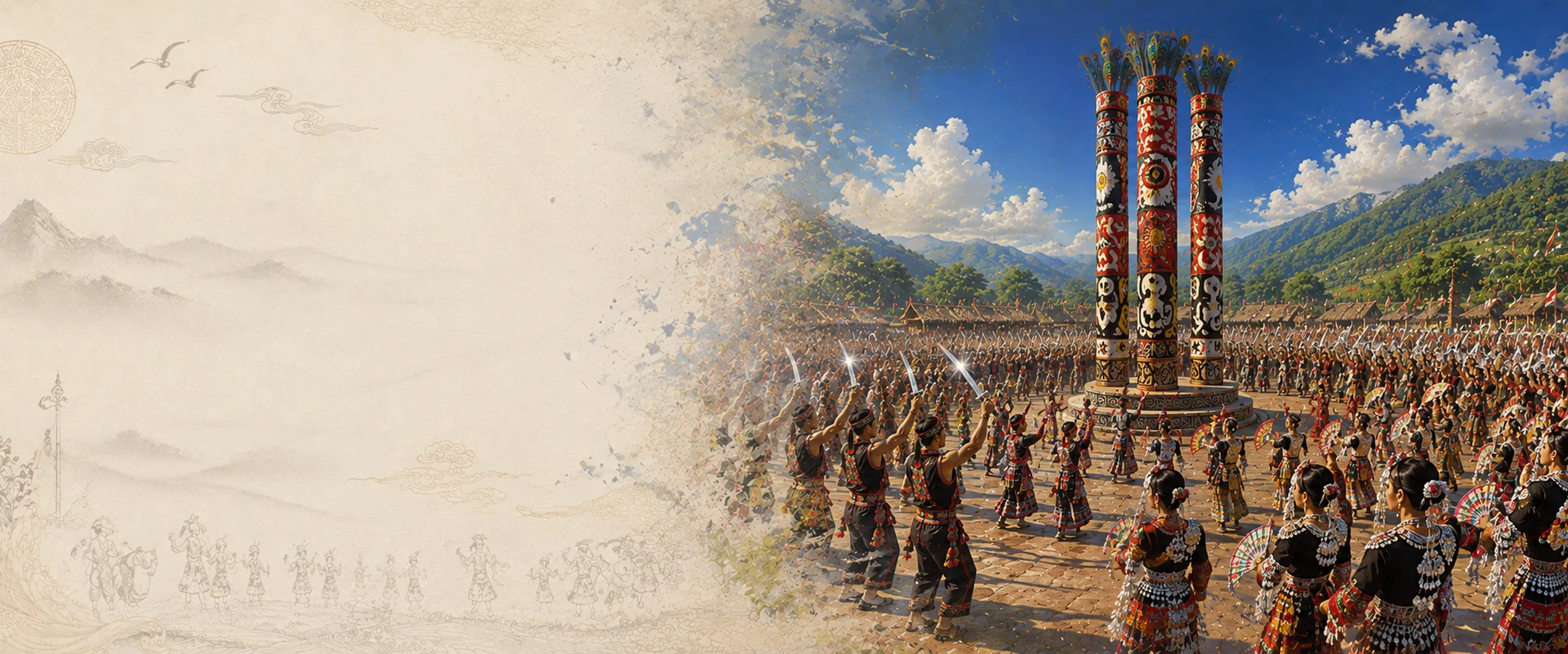
The Munao Zongge Festival is the most solemn traditional festival of the Jingpo people. In the Jingpo language, its name means “everyone dancing together.” During the festival, tens of thousands of Jingpo people follow the guidance of the Munao Shidong (目瑙示栋), ceremonial wooden pillars that serve as the symbolic center of the dance ground, moving to the same drumbeat in vast yet orderly formations. Munao Zongge was included in the first batch of China’s national intangible cultural heritage list in 2006. In recent years, the festival has become an important cultural-tourism brand of the Dehong Dai and Jingpo Autonomous Prefecture in Yunnan, drawing large numbers of domestic and international visitors each year to watch and participate in the celebration, creating a truly spectacular scene. Through the grandeur of tens of thousands dancing together, the Munao Zongge Festival presents to the world the Jingpo people’s spirit of solidarity and striving forward, together with their rich and diverse cultural traditions.
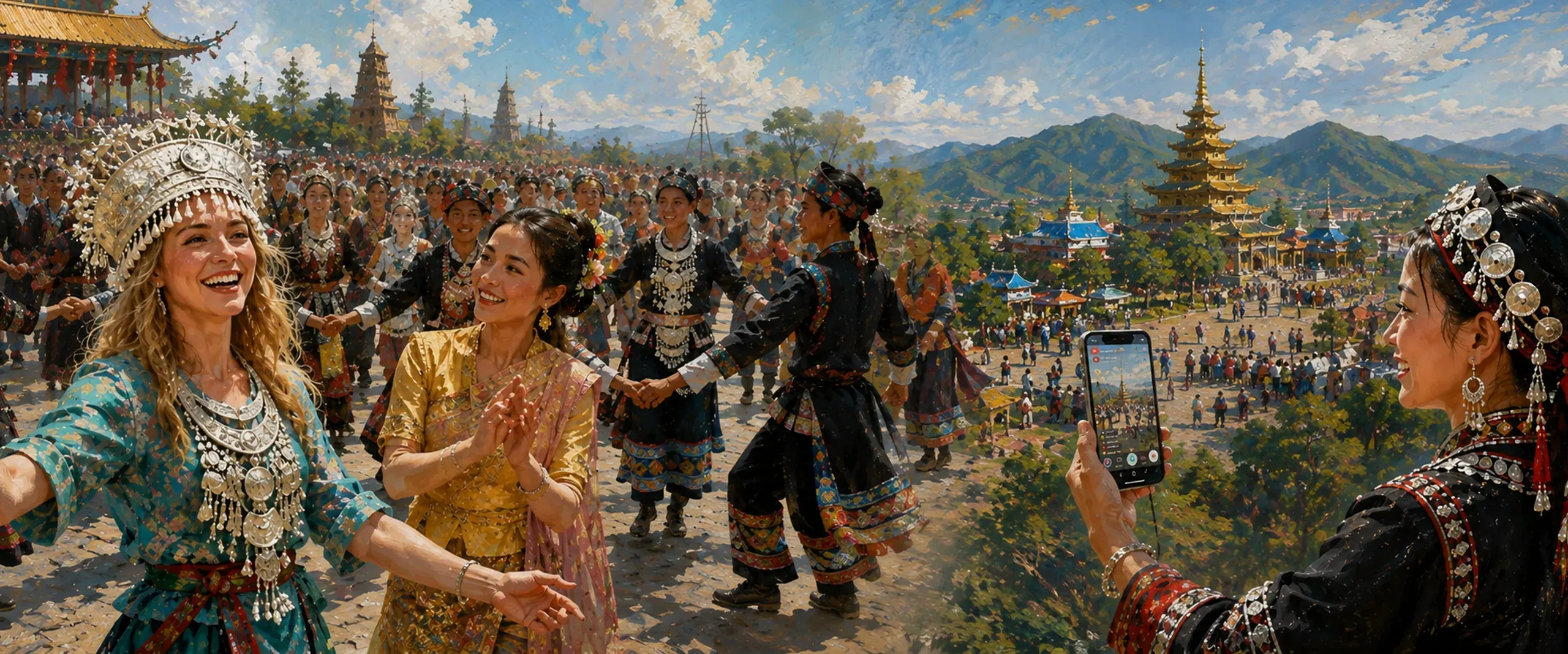
Celebrated Worldwide
A Cross-Border People
The global spread of the Munao Zongge Festival begins with a distinctive geographical and ethnic reality—the Jingpo are a cross-border people.
In China, the Jingpo are concentrated primarily in the Dehong Dai and Jingpo Autonomous Prefecture of Yunnan. In Myanmar, the Jingpo are known as the Kachin, and live mainly in Kachin State and Shan State. The two countries are connected by the same mountains and rivers; the people share common origins and closely related cultures. Munao Zongge, known in Kachin as Manau, is the grandest traditional song-and-dance festival of the Kachin people. Both the government of Dehong Prefecture in China and the government of Kachin State in Myanmar have designated the Munao Zongge Festival as an official public holiday.
This natural cross-border distribution has given the Munao Zongge Festival an intercultural character from the very beginning. Its cross-border transmission is reflected not only in the simultaneous celebration of the festival, but also in everyday cultural exchange. Academic research has noted that Munao Zongge is a traditional festival shared by Jingpo communities along the China–Myanmar border and is highly representative of cross-border ethnic communication practices. The pathways through which Munao Zongge has developed across the border include cross-border conferences, festival activities, think-tank forums, marriages, study, training, and other forms of exchange. The melodies of Munao Zongge had already spread from Dehong into Jingpo/Kachin communities in Myanmar at an early stage.
Cross-border celebration in Ruili. Ruili, situated directly on the China–Myanmar border, is a representative setting for the cross-border dissemination of the Munao Zongge Festival. In 2025, Ruili held a grand celebration of the festival. Among the participants were special guests from Myanmar, who wore traditional attire and joined the lead dancers, together creating a spectacular cross-border cultural celebration. As one observer remarked, the Munao Zongge Festival is “not only a festival within the Jingpo community, but increasingly an international event, because more and more tourists are taking part.” What remains unchanged is the Jingpo people’s aspiration for a happy life.
Border trade in Manghai. In Manghai Township, Dehong, the Munao Zongge gathering ingeniously combines the presentation of ethnic culture with rural tourism and border trade. Around the festival grounds, a distinctive “China–Myanmar Border Specialty Street” brings together characteristic goods from both countries. Traditional Jingpo foods such as “ghost chicken” (鬼鸡), a distinctive Jingpo-style chicken dish, attract border residents and travelers from both sides. Here, Munao Zongge is not only a cultural feast but also an important platform for economic and cultural exchange between border communities in China and Myanmar.
South and Southeast Asia
In June 2026, the first South and Southeast Asia Influencer Creators Conference was held in Kunming, Yunnan. Around 200 guests gathered in the “Spring City,” including leading influencers from 11 countries, well-known domestic creators, platform representatives, and media journalists. During the performance showcase, Yingjiang County represented Dehong with a presentation of Munao Zongge.
This national-level intangible cultural heritage performance, deeply rooted in Jingpo culture, became one of the most closely watched cultural highlights of the conference through its distinctive folk appeal. At the performance venue, Jingpo dancers dressed in exquisite traditional clothing entered in formation under the leadership of the Naoshuang Naoba (瑙双瑙巴), the festival’s lead dancers, their silver ornaments swaying as their steps remained perfectly synchronized, fully displaying both the power and agility of Munao Zongge. Influencer creators from countries across South and Southeast Asia watched attentively throughout, immersing themselves in the distinctive character of Yunnan’s ethnic minority culture.
By drawing on the platforms of the South and Southeast Asia Expo and the first South and Southeast Asia Influencer Creators Conference, Munao Zongge was presented comprehensively and disseminated from multiple perspectives, allowing friends from South and Southeast Asia to experience directly the appeal of China’s ethnic minority cultures and effectively helping ethnic culture move beyond the borderlands and onto the international stage. With song and dance as a bond and culture as a bridge, this cultural performance further narrowed the distance between China and the countries of South and Southeast Asia and deepened regional cultural exchange and emotional connection.
Africa
One of the most striking chapters in the Munao Zongge Festival’s journey into the world has unfolded on the African continent.
According to China News Service, the Nigeria Huaxing Arts Troupe has obtained performance authorization for “Munao Zongge.” This African arts group has brought Jingpo music from Dehong in Yunnan, China, onto African stages. Performance authorization means that Munao Zongge is no longer simply a cultural tradition belonging only to the Jingpo people, but has become a cultural resource actively embraced, learned, and transmitted by people of other countries and ethnic groups.
Mainstream global media have also witnessed the spread of Munao Zongge in Africa. The Global Times reported that the music of Munao Zongge had “crossed continents, captivating audiences in African countries including Nigeria and Rwanda, where local performers are developing their own interpretations of it.” The phrase “local performers are developing their own interpretations of it” is particularly significant. In Africa, Munao Zongge is no longer merely “being displayed”; it is being “re-created.” When African performers interpret Munao Zongge in their own way, this ethnic culture from China’s southwestern frontier has already undergone its first process of localization on the African continent.
As local media in Dehong observed: “When the powerful melody of ‘O Ran, O Ran’ crosses mountains and seas and sparks a wave of public imitation across the African continent, and when the Jingpo intangible cultural heritage music ‘Munao Zongge,’ originating in Dehong, Yunnan, China, sweeps global social-media platforms with more than 3.7 billion plays across the internet, a miracle of traditional ethnic culture breaking out of its original circle in the digital age is unfolding.” This hit song, rearranged and empowered by AI, has “moved from the firesides of the southwestern frontier to the center of the world stage, demonstrating through the most vivid practice the profound truth that ‘what is ethnic belongs to the world.’”
International Visitors
The Munao Zongge Festival attracts tens of thousands of participants every year, including not only local residents but also visitors from around the world.
On March 3, 2026, coinciding with the Lantern Festival on the fifteenth day of the first lunar month, the opening ceremony of the 2026 Mangshi Munao Zongge Festival was held at the Dehong Jingpo International Munao Zongge Cultural Park. People of different ethnic groups from within and beyond the prefecture, together with visitors from China and overseas, gathered to celebrate amid powerful drumbeats and flowing dance steps. On the morning of February 24, 2024 alone, around 40,000 people took part in the Munao Zongge gathering. Participants included not only residents of surrounding counties, cities, townships, and villages, but also visitors who had traveled from Jilin, Sichuan, Chongqing, and other parts of Yunnan.
Foreign visitors are likewise important participants in the Munao Zongge Festival. At the 2024 celebration, a tour group of overseas visitors with an average age of over 65 joined in the festivities. Israeli tour guide Glaubman Yonatan, who has maintained ties with China for nearly 30 years, said: “After coming to Yunnan, I was drawn to its original ethnic traditions and landscapes.” Liu Li, a visitor from Chongqing, said after experiencing Munao Zongge: “This is my first time in Dehong experiencing Munao Zongge. The atmosphere is wonderful. I became completely immersed in it and was deeply affected by the energy. I’m very happy.”
For visitors from afar, Munao Zongge offers a distinctive cultural experience. Its dance steps are simple and easy to learn, requiring no dance background whatsoever—this is precisely one of the major reasons it can attract so many visitors to participate personally. As one observer noted, the dance steps “have to be simple,” because this is a gathering of strangers—“whether or not one has learned the dance is not a barrier to participation; once the body enters the space, it naturally merges into the collective rhythm.” This open and inclusive mode of participation gives the Munao Zongge Festival a natural accessibility and warmth for international visitors.
International Academic Attention
The Munao Zongge Festival has also attracted attention from the international academic community. A number of scholars have conducted fieldwork and academic research on Munao Zongge.
Some studies have explored the cross-border dissemination of Munao Zongge in the China–Myanmar border region. The research argues that “cross-border ethnic groups can participate in strengthening international communication capacity through cultural exchange,” and uses Munao Zongge as a case study to analyze how Jingpo communities on both sides of the China–Myanmar border engage in communicative interaction through the festival. These findings provide a reference for constructing communication models in which multiple actors participate collaboratively.
Scholars in Taiwan have also researched Munao Zongge. He Cuiping presented a paper entitled “‘History’ and ‘Culture’ in Cultural Industries: Beginning with the Munao Zongge of China’s Jingpo People” at the Academic Symposium on the Cultural Transmission and Innovative Development of Jingpo Culture and the 120th Anniversary of the Creation of Jingpo Writing. Other researchers have studied festival dances among Yunnan–Myanmar communities in Taiwan, deepening understanding of Munao Zongge and its cultural context.
These academic studies have introduced Munao Zongge to the international scholarly community as a representative case of cross-border ethnic culture and have provided important academic perspectives for understanding the transnational transmission of ethnic traditions.
Munao Zongge in the Cloud:
In 2026, the international dissemination of the Munao Zongge Festival reached an unprecedented peak—a digital breakthrough driven by music.
More than 3 billion plays worldwide. According to a May 2026 report by the People’s Daily Overseas Edition, videos under the “Munao Zongge” topic on Douyin had accumulated more than 3 billion plays, while related content on Kuaishou exceeded 20,000 posts. The Global Times reported that the song had received more than 3 billion plays across major platforms. Local-media figures were even more striking, placing total internet-wide plays at nearly 4 billion. From the first short video posted in March by a member of Yingjiang self-media account “Bian Xiao V,” which surpassed 3.2 million plays within just three hours, to dissemination on a scale of several billion views, Munao Zongge took less than three months.
Attention from mainstream international media. The Global Times published an extensive report titled Jingpo festival song carries ethnic heritage to world. The Manila Times republished the report. China Daily also covered the cultural influence of the Munao Zongge Festival under the headline Timeless ethnic ideas feed fashion needs today. CCTV reported on the festival’s inclusion in China’s national intangible cultural heritage list in 2006.
Organic content growth, without celebrities or major promotion. Particularly noteworthy is that Munao Zongge became popular “without top-tier celebrities or massive promotional campaigns throughout the entire process, relying entirely on organic content growth.” As China Art News commented: “A traditional dance simply broke out of its original circle on its own.” The popularity of Munao Zongge “is not an isolated case, but a microcosm of the way traditional ethnic culture is taking on new forms today.” Traditional songs and dances of ethnic minorities in Yunnan and other provinces are now spreading across China and even internationally through a path of “old melodies + new technology + viral short-video circulation.”
Mutual Learning Among Civilizations
Dialogue with Global “Collective Dance”
Munao Zongge has been praised as the “world’s largest collective song-and-dance ritual.” The description itself creates a dialogue with collective dance cultures around the world.
Collective dancing has deep historical traditions across the world. Greece’s Sirtaki is known for people joining hands in circular formations; Israel’s Hora is celebrated for its circle dancing and joyful rhythm; and collective dances across the Pacific Islands attract participants through synchronized movement and powerful rhythms. What distinguishes Munao Zongge is its “scale” and “structure”—tens of thousands of people moving to the same beat, following spiral patterns, and dancing for days at a time. Such a scale is exceptionally rare anywhere in the world.
Munao Zongge shares a deeper cultural logic with collective dances worldwide: collective dance is one of humanity’s oldest forms of social cohesion. Through dance, individuals merge into the group, strangers become companions, and differences dissolve into rhythm. As China Art News observed: “The strangers who encounter the video on their screens and the strangers dancing shoulder to shoulder in the festival ground are all invited participants.” The steps of Munao Zongge “have to be simple,” because “whether one has studied dance does not constitute a threshold for participation.” This is precisely the shared secret of successful collective dance everywhere: the lower the threshold, the broader the participation, and the stronger the cohesion.
Dialogue with Global “New Year / Harvest Festivals”
The Munao Zongge Festival is held around the fifteenth day of the first lunar month, a time that resonates in interesting ways with New Year and harvest festivals among many peoples around the world.
China’s Lantern Festival, Japan’s Koshōgatsu (“Little New Year”), and Korea’s Daeboreum are all celebrated around the fifteenth day of the first lunar month. Although their forms differ, they share the themes of “bidding farewell to the old, welcoming the new, and praying for a good harvest.” Munao Zongge is also held a second time during the season for tasting the new rice, around October, echoing autumn harvest thanksgiving festivals around the world—Thanksgiving in the United States, Germany’s Erntedankfest, and India’s Pongal—all of which express gratitude after the harvest and celebrate abundance.
The distinctive feature of Munao Zongge is that it brings together the dual themes of “New Year” and “harvest.” The Munao Zongge around the fifteenth day of the first lunar month prays for favorable weather and a prosperous new year, while the October celebration gives thanks for a year of abundant grain. This festive structure of “praying for blessings at the beginning of the year and giving thanks at its end” is a shared logic of agricultural civilizations and a profound reason why Munao Zongge can cross cultural boundaries and generate resonance.
The AI Era
The most noteworthy aspect of the Munao Zongge Festival’s global dissemination is not merely the continuation of tradition, but “how tradition enters into dialogue with new technology.”
In early 2026, Zhen Zhen, a Beijing musician born in the 1980s, happened to see a striking video of tens of thousands dancing together at the Munao Zongge Festival. Deeply moved by the energy of the ethnic tradition, he decided to create a new arrangement. In only three weeks, he wrote lyrics based on the Munao Zongge March, incorporated electronic variations, and used AI tools to synthesize male and female vocal lines, giving the traditional ethnic melody a dramatic new transformation. Zhen Zhen discarded his approach three times before arriving at the final version—“from the idea of a love song to the idea of sports music, only then did I finally find the balance.”
The intervention of AI technology not only greatly shortened the creative cycle and lowered the threshold for dissemination, but also ingeniously addressed some of the central difficulties in spreading ethnic music. In the past, ethnic music often struggled to cross geographical and cultural barriers because of less widely spoken languages, traditional forms, and relatively uniform rhythms. With AI, on the one hand, algorithmic optimization of arrangements makes it possible for the original rhythms of Jingpo wooden drums and mang gongs (铓锣) to coexist in balance with electronic beats; on the other hand, AI-synthesized multilingual vocals allow vocables such as “O Ran, O Ran”, which require no translation, to be readily embraced by listeners around the world.
Yet technological intervention has also prompted reflection on cultural accuracy. Zhen Zhen recognized that AI is a double-edged sword: “Because of information contamination, AI often confuses elements of De’ang and Dai culture with Jingpo elements. If one is not careful, this can cause cultural offense.” This awareness of cultural accuracy is precisely the principle that traditional cultures most need to guard and uphold when entering the world in the digital age.
A Global Journey
From the firesides of Dehong in Yunnan to stages on the African continent, Munao Zongge has traveled an astonishing cultural journey.
Stage One — Songs beside the fire. For centuries, Munao Zongge was passed down from generation to generation in Jingpo villages, through elders teaching by word and example and younger people absorbing the tradition through everyday life.
Stage Two — The formalization of the festival. In 2006, Munao Zongge was included in China’s national intangible cultural heritage list, taking the festival from the village into a broader public arena.
Stage Three — The distillation of the music. In 1991, Shilegan composed the Munao Zongge March, transforming oral tradition into a melody that could be recorded.
Stage Four — The digital breakthrough. In 2026, an AI-adapted version of Munao Zongge swept global social-media platforms with billions of plays.
Stage Five — Cross-cultural re-creation. The Nigeria Huaxing Arts Troupe obtained performance authorization, and African performers began interpreting Munao Zongge in their own ways.
From the fireside to the African continent, Munao Zongge has completed a full trajectory of “oral tradition → written recording → digital dissemination → cross-cultural re-creation.” As local Dehong media observed: “From songs passed down beside the fire to performances at major festivals, from an ethnic custom in a remote border region to an important component of the cultural treasury of the Chinese nation, what Munao Zongge carries is not only the historical memory and spiritual beliefs of the Jingpo people, but also a vivid embodiment of the pluralistic unity of outstanding traditional Chinese culture, in which each culture appreciates the beauty of the others and shares in that beauty together.”
Closing Note
The global dissemination of the Munao Zongge Festival traces a distinctive path from Jingpo villages in Dehong, Yunnan, to the five continents of the world. Its inclusion on the national intangible cultural heritage list in 2006 marked the transition of Munao Zongge from a folk festival into a tradition under national protection; its sweeping success across global social-media platforms with billions of plays in 2026, meanwhile, marked an extraordinary cultural breakthrough for Munao Zongge in the digital age.
Unlike Raosanling, whose international path centers on “inviting the world in,” the Water-Splashing Festival with its symbol of “water,” or the Torch Festival with its totem of “fire,” the global dissemination of the Munao Zongge Festival has followed a distinctive dual-track path of “cross-border sharing alongside digital breakthrough.” Its identity as the festival of a cross-border people—the Jingpo of China and the Kachin of Myanmar sharing common roots and origins—gave it an international dimension from the very beginning; empowered by AI in the digital age, its music has made another leap, from the borderlands to the world.
At the cross-border level, the Munao Zongge Festival is one of the most vivid cultural bonds between China and Myanmar—the governments on both sides have designated it as an official public holiday, border residents from both countries celebrate together in places such as Ruili and Manghai, and characteristic goods from both countries meet in festival markets. At the regional level, through platforms such as the South and Southeast Asia Influencer Creators Conference, Munao Zongge is becoming known and appreciated by growing numbers of regional partners. At the global level, its music has crossed Asia and Africa—the Nigeria Huaxing Arts Troupe has obtained performance authorization, while local performers are now interpreting this melody from southwestern China in their own ways.
More moving still is the fact that, throughout its journey into the world, Munao Zongge has maintained its profound connection with the fireside culture of the Jingpo people. As Shilegan has said, it is precisely “the deep connection with my homeland that allows my music to resonate with the Jingpo people.” Munao Zongge has not diluted the richness of its culture merely in order to “go out into the world.” Its melodies still carry the warmth of the fireside, the howl of mountain winds, and the resonant clang of the mang gong. Like that drumbeat resounding across a thousand years—it has passed through dynastic change and remains as powerful as ever; it has crossed national borders and continents and still moves the heart. The melody of “O Ran, O Ran” is now echoing in every corner of the world. The dance steps of Munao Zongge continue without end beyond Cangshan and across distant oceans.
—-
Readers’ Comments
Calendar and traditional culture enthusiasts from around the world, sharing the same moon.
Sign in or register to join the conversation. Your comment account is created automatically the first time you use a connected account.
No comments yet
Share your thoughts with readers around the world.