Naadam

NaadamOrigins of Naadam

「 <p>成吉思汗,大聚部落,男儿三艺,草原盛会。</p> 」

Naadam is a traditional festival with a long history among the Mongolian people. “Naadam” is a Mongolian transliteration meaning “entertainment” or “games,” generally held in summer and autumn when the grass and water are plentiful. The most…

“Nadam” is the Mongolian word for “entertainment” and “games.” According to the *Genghis Khan Stone Inscription* carved on a cliff, the Nadam originated in the early period of the Mongol Empire. As early as 1206, when Genghis Khan was proclaimed the Great Khan of the Mongols, a grand Nadam was held. In 1225, to celebrate the victory of the Mongol army’s western expedition, another grand Nadam was held. In 1260, when Kublai Khan ascended the throne in Shangdu, a Nadam was also held. To inspect his troops, maintain unity, and allocate pastures, Genghis Khan held a “Great Khuriltai” (大忽力革台, great assembly) every July–August, summoning the leaders of various tribes. To demonstrate solidarity and friendship and to pray for a bountiful harvest, a Nadam was always held, initially only with archery competitions. The earliest historical record of the Mongols, *The Secret History of the Mongols*, already describes the grand occasion of people singing, dancing, and holding “Nadam” gatherings.

# Nadam Fair

The Nadam is the most representative traditional festival of the Mongolian people, integrating competitions, entertainment, sacrifice, and trade. It is hailed as the “Carnival of the Grasslands.” This article will begin by interpreting the name “Nadam” and its semantic connotations and diverse types; then trace its two major origins—the religious foundation of shamanism and Ovoo (敖包, stone mound) sacrifices, and the institutional establishment of Genghis Khan’s “Great Khuriltai”; then outline its evolution through the Yuan, Ming, and Qing dynasties; then focus on the core competitions of the “Three Manly Arts” (男儿三艺) and their cultural spirit; and finally present regional transmission and contemporary renewal, showcasing the vibrant vitality of this thousand‑year‑old festival in the new era.

Naadam / Origins of Naadam

The Origin of the Festival Name

Origins & Anecdotes · Tracing the Past

Semantics: Entertainment, Games, and Celebration

The word “Nadam” comes from the Mongolian language, with its root “naad-” meaning “to play,” “to entertain,” or “to game” in Mongolian. Thus, “Nadam” most directly means “a gathering for entertainment” or “a festival of games.” This seemingly simple term captures the essence of the festival—it is a grassland celebration that centres on “play” and “joy,” integrating strength, skill, speed, and laughter.

In the context of Nadam, “entertainment” is not mere pastime but is closely connected to the production, military training, religious beliefs, and social cohesion of the Mongolian people. For a nomadic people who moved with water and grass, survival in the harsh natural environment required a strong physique, superb equestrian and archery skills, and a spirit of solidarity and cooperation. Nadam was the best stage to display these qualities, test the group’s strength, and consolidate community identity.

“Nair” and “Nadam”: The Change of Name

Historically, Nadam was also commonly referred to in Mongolian as “Nair” (奈日), meaning “gathering,” “feast,” or “festival.” “Nair” emphasised the atmosphere of assembly and celebration, while “Nadam” highlighted the competitive and recreational content. In different historical periods and regions, the two terms were often used interchangeably or together.

With the passage of time, especially after the founding of the Inner Mongolia Autonomous Region in 1947, “Nadam” gradually became the general term for this traditional festival. This change of name also reflects the historical shift of Nadam from a broad tribal gathering to a sports competition centred on the “Three Manly Arts.”

Diverse Types

Nadam is not a single, fixed festival but has a rich variety of types and levels. According to scale, purpose, and scope of participants, Nadam can be divided into multiple types:

By scale: There are small‑scale Nadams held at the gacha (village) or sumu (township) level, and large‑scale Nadams at the banner, league, or even the entire autonomous region level.

By purpose: There are “Harvest Nadams” to celebrate a good harvest; “Commemorative Nadams” to honour historical events or heroes; “Ovoo Nadams” held for Ovoo sacrifices; and modern “Tourism Nadams” held to develop tourism and boost the economy. Traditionally, major events such as celebrating military achievements, offering sacrifices to battle flags, mustering troops, league and banner gatherings, and Ovoo sacrifices all called for the holding of Nadam.

This rich typology shows that Nadam is not merely a festival but a complete system of social and cultural rituals, pervading every aspect of Mongolian social life.

Festival Origins

Origins & Anecdotes · Tracing the Past

Shamanism and Ovoo Sacrifice

The oldest origins of Nadam can be traced back to the primitive religious beliefs of the Mongolian ancestors—Shamanism—and the closely related “Ovoo” sacrifices. This is the deepest cultural gene of Nadam.

An Ovoo (敖包), meaning “pile” in Mongolian, is a solid, cone‑shaped tower made of stones, earth, or willow branches. Originally, Ovoos were functional markers used to indicate roads, boundaries, or borders on the grassland. On the vast, boundless steppe, Ovoos were like lighthouses in the sea, guiding the nomadic herders. However, in the animistic Shamanist belief system, these stone piles standing between heaven and earth gradually acquired sacred meaning. The Mongols believed that natural objects such as mountains, forests, and water sources possessed spirits, and that Ovoos became the places where these spirits dwelled or manifested. People began to offer sacrifices at these Ovoos, praying for divine protection for favourable weather, abundant livestock, and human safety. Thus, the Ovoo completed its transformation from a functional landmark to a sacred altar, becoming a spiritual link connecting heaven, earth, and humanity.

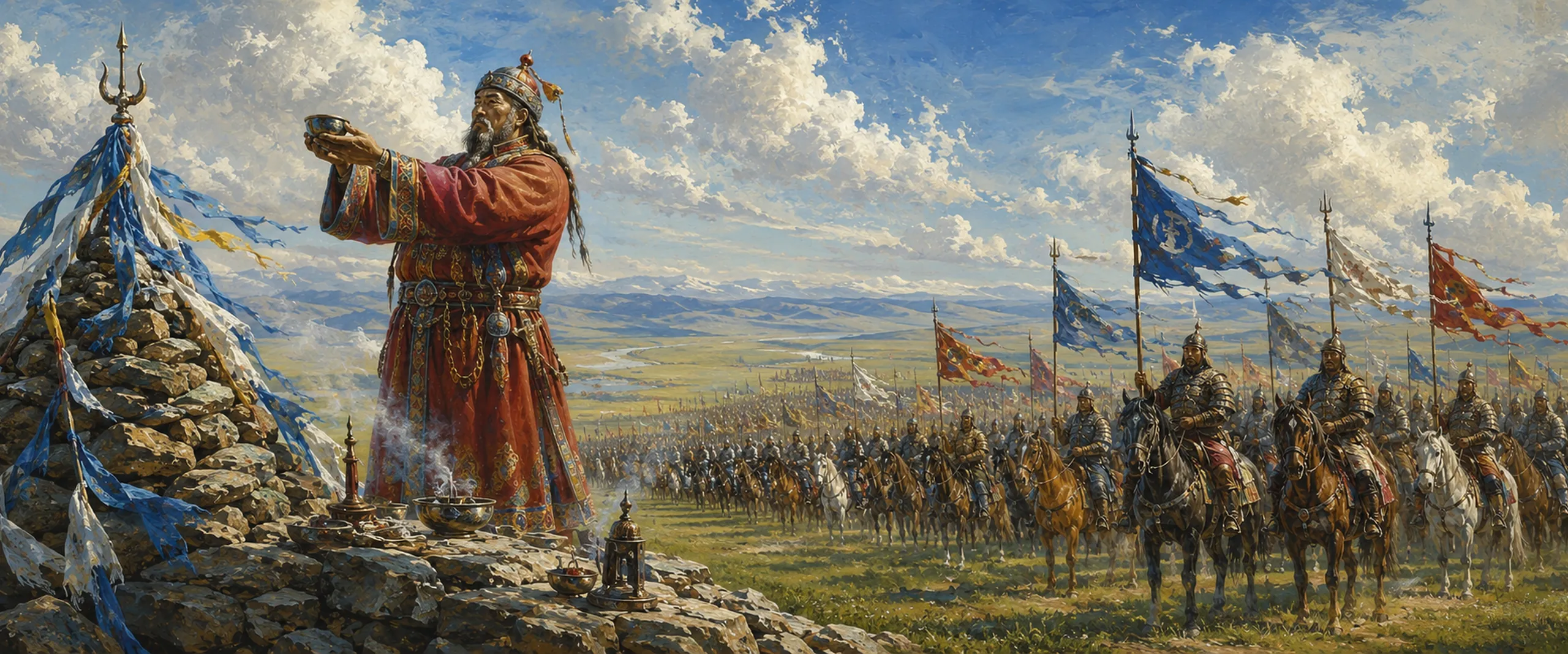
Ovoo worship is one of the most important traditional sacrificial ceremonies of the Mongolian people. Every year when the grass and water were at their best (usually from late May to August in the lunar calendar), tribes or clans would select an auspicious day to hold a solemn ceremony at the Ovoo. On the day of the sacrifice, herders, dressed in their finest, would come from all directions bearing offerings such as hada (ceremonial scarves), cooked mutton and beef, milk wine, and dairy products. At the Ovoo, they would present offerings, and lamas or elders would chant prayers for favourable weather and the well‑being of people and livestock. The highlight of the ritual was “circling the Ovoo”—all participants walked clockwise around the Ovoo three times, sprinkling milk wine and dairy products toward it. This ritual symbolised communication with the spirits, conveying people’s prayers to heaven.

From “entertaining the gods” to “entertaining the people”: The religious ceremony of “Ovoo sacrifice” was, in a sense, a performance to “entertain the gods.” However, after the solemn rituals ended, the herders did not immediately disperse. In their long productive and daily life, the Mongolian ancestors gradually added various recreational and competitive activities after the sacrifices to “entertain the people.” People began to hold traditional horse racing, archery, and wrestling events. These activities may have initially been related to sacrificing to the gods, displaying strength, and selecting warriors, but over time they gradually became independent from religious rituals, evolving into folk activities with broad popular participation and entertainment value. The predecessor of Nadam was precisely the Mongolian “Ovoo sacrifice.” It can be said that Nadam is the flower of carnival that bloomed from the solemn religious altar. It preserves the reverence and gratitude toward nature and ancestors found in Ovoo sacrifice, but transforms this reverence and gratitude into a celebration and praise of life, strength, and unity. It is worth noting that after the sacrificial activities, young men and women who took a liking to each other could steal away quietly—this is the origin of the song “Meeting at the Ovoo” (《敖包相会》). This well‑known folk song is a vivid footnote to Nadam’s journey from sacred ritual to romantic life.

Genghis Khan and the “Great Khuriltai”

If Ovoo sacrifice was the “soul” of Nadam, then Genghis Khan and the Mongol Empire he established gave Nadam its “form,” elevating it from a loose, regional post‑sacrificial entertainment to an institutionalised, national celebration for all.

The *Genghis Khan Stone Inscription* and the Nadam of 1225: The earliest precise record of Nadam comes from the *Genghis Khan Stone Inscription* (also known as the *Genghis Khan Stele*), carved in Uighur‑Mongolian script on a cliff in 1225. This inscription records that Genghis Khan, to celebrate his victory over the Khwarezmian Empire, held a grand Nadam at Bukha Suqihai, where an archery competition was held. This was the first appearance of Nadam in historical records, marking its entry from folk tradition into the grand narrative of national history.

The “Great Khuriltai”: Deliberation and Celebration of the Mongol Empire: In 1206, Genghis Khan unified the tribes of the Mongolian Plateau and established the Great Mongol Empire. To consolidate the new regime, strengthen cohesion among the tribes, inspect his troops, and maintain and allocate pastures, Genghis Khan held a “Great Khuriltai” (great assembly) every July–August. At these gatherings, tribal leaders were summoned together. This “Great Khuriltai” was not only a political occasion for discussing state affairs, enacting laws, appointing and removing officials, and meting out rewards and punishments, but also a grand celebration. During the gatherings, to show solidarity and friendship and to pray for a good harvest, Nadam activities were always held. Initially, the competitions may have been relatively simple, featuring only one event—archery, horse racing, or wrestling. However, by the Yuan and Ming dynasties, these three events were combined to form the fixed form of “Nadam,” with the “Three Manly Arts” as its main content.

The “Three Manly Arts”: From Survival Skills to Cultural Totems: Genghis Khan placed great value on cultivating courage, resourcefulness, and tenacity. He collectively called horse riding, archery, and wrestling the “Three Manly Arts,” making them important content for training soldiers and the populace. In the expansion and rule of the Mongol Empire, equestrianism, archery, and wrestling were not only survival skills of the nomadic people but also the core of their military might. Thus, the “Three Manly Arts” were endowed with a status surpassing mere sports, becoming the fundamental standard for measuring whether a Mongolian man was capable of venturing far and achieving greatness. Competitions in the “Three Manly Arts” were also seen as sacred ceremonies displaying the national spirit and transmitting the essence of culture. At every Nadam, the competitors, hearing inspiring eulogies, were filled with fighting spirit and achieved excellent results. A Nadam blessing says: “The skilful sound of the horse‑head fiddle is melodious; the pure white hada scarf gleams; the traditional competitions of the Three Manly Arts continue in succession, and the Mongolian wrestlers take the field in formation.” This cultural tradition of elevating sports to the level of spiritual belief is the fundamental reason why Nadam has endured through centuries of change.

Core Competitions

Origins & Anecdotes · Tracing the Past

The “Three Manly Arts”—wrestling (搏克, Bökh), horse racing, and archery—are the soul of Nadam and the essence of traditional Mongolian sports culture. These three skills originated from the nomadic, hunting, and military life of the Mongolian ancestors. After thousands of years of transmission, they have been elevated to the spiritual totems and cultural symbols of the Mongolian people.

Bökh (Wrestling)

Mongolian wrestling, known as “Bökh” (搏克) in Mongolian, is the most eye‑catching and ritual‑rich event at the Nadam. Unlike Olympic Greco‑Roman or freestyle wrestling, Bökh has its own unique rules, methods, and cultural connotations.

Rules and Features: The competition rules of Bökh are relatively free. There are no weight classes (no age or weight divisions), and no limit on the number of participants, but the total must be an even number—2, 4, 6, 8, etc. The competition uses a single‑elimination format, with one fall deciding the winner. After the referee’s signal, the opponents shake hands and then begin. There is no time limit, and wrestlers may use various methods and techniques such as hooking, pulling, kicking, tripping, pushing, lifting, and holding, but they may not attack the legs, kick indiscriminately, or pull the opponent’s trousers. The match is lost when any part of the body above the knee touches the ground.

Attire and Ceremony: The attire of Bökh wrestlers is highly distinctive. They wear a tight, sleeveless vest made of cowhide or canvas called a “Jodag” (昭德格), loose wrestling trousers, Mongolian boots, and a colourful cloth neck ring called a “Jingga” (景嘎). The number of coloured ribbons on the “Jingga” represents the victories the wrestler has won and is a mark of honour.

Before the match begins, both sides have people singing challenge songs to boost morale. When entering and exiting the arena, wrestlers imitate the movements of an eagle, swinging their arms up and down like an eagle spreading its wings, leaping forward in a majestic and awe‑inspiring manner. This eagle‑imitating ceremony symbolises strength, freedom, and victory, endowing Bökh with a sacred quality beyond mere sports.

Bökh is not only a contest of strength and skill but also a test of will and honour. The winners are hailed by the crowd as “warriors of solid bronze and wrought iron” and enjoy great respect.

Horse Racing

The Mongols are known as the “people on horseback,” and horse racing holds an extremely important place in Nadam. Mongolian horse racing is generally divided into two types: trotting races and galloping races.

Trotting Races: These require the horse to trot with a pace gait (i.e., the front and hind legs on each side move together), competing in speed, endurance, steadiness, and grace. The horses used are usually adult horses over five years old, and the riders are also mostly adults. The race demands that riders possess superb riding skills to control the horse so that it moves fast, steadily, and gracefully without breaking into a gallop.

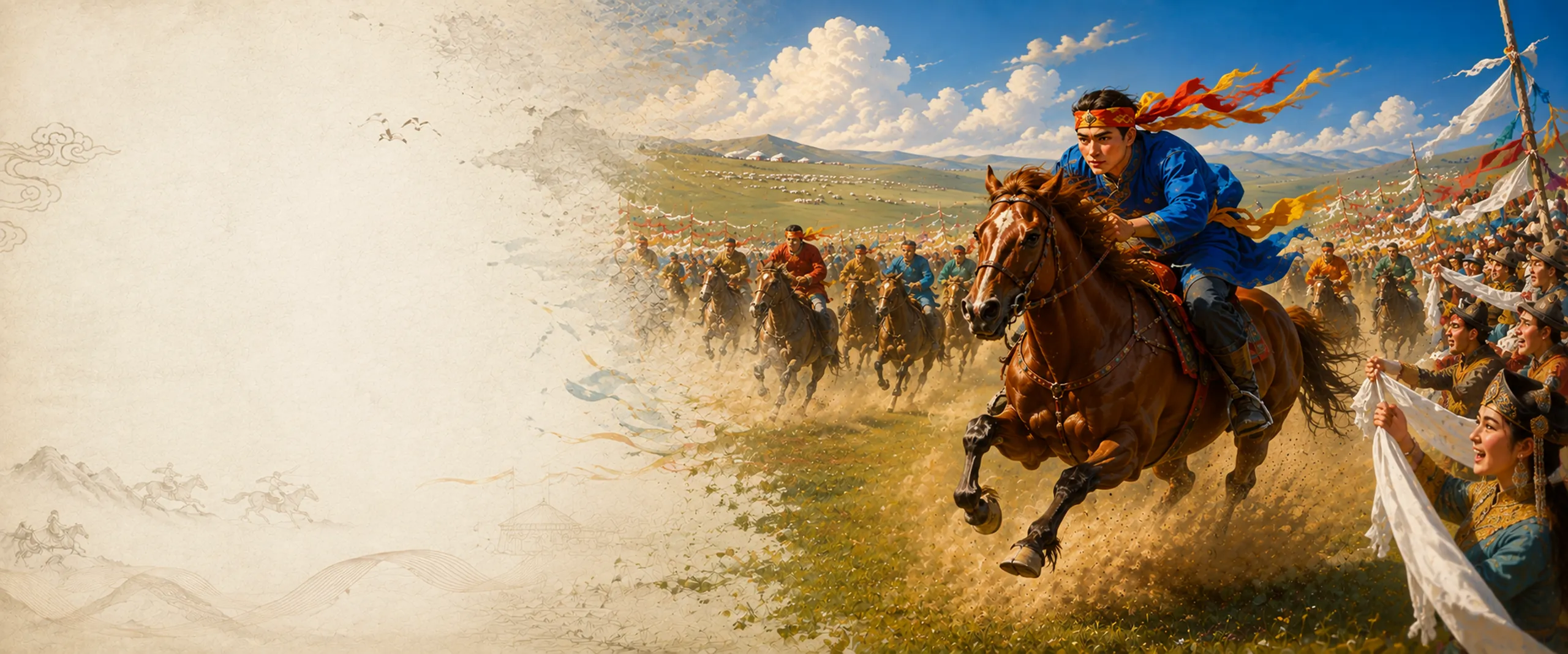
Galloping Races: These test the horse’s speed and endurance, with the first to reach the finish line declared the winner. The participants are mostly men, especially boys around twelve or thirteen, because of their light weight and agility. To reduce the horse’s load and ensure the rider’s safety, galloping horses are ridden bareback or with lightweight saddles. The riders wear colourful shirts and have red and green ribbons tied to their heads, looking heroic and spirited. The race course is generally 25 to 35 kilometres long, with as few as a dozen to as many as over a hundred participants. At the start, riders quickly mount and whip their horses, while the spectators cheer and shout with excitement.

According to Mongolian custom, after the horse races, a grand horse‑praising ceremony is held. The winning horses are lined up in front of the reviewing stand, and a respected elder recites praise poems, lauding the steeds’ grace and speed, as well as the riders’ courage and skill. Horse racing is not only a display of harmony between horse and rider but also the grassland people’s endless longing for speed and freedom.

Archery

Archery was one of the most important hunting and combat skills of the Mongolian ancestors. At the Nadam, archery is also an indispensable event, testing the competitor’s precision, composure, and psychological resilience.

Traditional Mongolian archery uses horn bows and feathered arrows. During competitions, participants, dressed in their finest ethnic attire, shoot arrows at targets (usually bullseyes or leather pouches) from a set distance. There are various competition formats, including standing shooting and mounted shooting. Accompanied by melodious archery eulogies, the archers focus their minds, draw their bows to full crescent shape, and when they hit the mark, the crowd bursts into enthusiastic applause. At the Nadam, archery is not only a sport but also a tribute to the spirit of the ancient warrior.

Regional Transmission

Origins & Anecdotes · Tracing the Past

Intangible Cultural Heritage Status

In 2006, Nadam was inscribed on the first batch of China’s National Intangible Cultural Heritage list. This recognition marked the highest official affirmation of Nadam’s cultural value at the national level. As a national intangible cultural heritage, the protection and transmission of Nadam received more systematic policy support and social attention.

Nadam covers an extremely wide area, and in different Mongolian settlements, it displays rich regional characteristics and transmission forms. The Nadam of Xilin Gol League is particularly representative; in 2008, the Nadam declared by Hejing County in the Xinjiang Uygur Autonomous Region was included in the national intangible cultural heritage list as an extension item.

Xilin Gol League

The Xilin Gol grassland is one of the areas where traditional Mongolian culture is best preserved and is also regarded as the most representative venue for Nadam. The permanent venue for the Inner Mongolia Autonomous Region’s Nadam is located in Xilin Gol League. Here, Nadam not only preserves the most traditional competitions such as the “Three Manly Arts” but has also developed into a comprehensive event integrating folk sports, artistic performances, and cultural tourism exchange. In July 2026, the 36th Tourism Nadam of the Inner Mongolia Autonomous Region opened in Xilin Gol League, attracting over 100,000 visitors and local residents on the opening day alone.

Haixi Mongolian Nadam

The Nadam of the Haixi Mongols in Qinghai Province has a unique historical origin. It originates from the “Sea Sacrifice” (祭海) sacrificial activity of the twenty‑nine banners of the Qinghai Lake Mongols. This sacrificial activity began in the tenth year of the Tianbao era of the Tang dynasty (751 AD), when the emperor conferred the title of “Vast Duke” upon the god of Qinghai Lake and sent envoys to conduct rituals. The traditional Haixi Mongolian Nadam expresses the local people’s joy in celebrating the harvest. The various forms of activity it contains are a microcosm of the Haixi Mongols’ production methods, religious beliefs, and folk customs over several centuries. Today, the Haixi Mongolian Nadam is held in rotation in Delingha City, Golmud City, and other areas.

Xinjiang Mongolian Nadam

The Xinjiang Mongolian Nadam is a traditional festival of the local Mongolians, mainly popular in Hejing County, Bohu County, and other areas of the Bayingolin Mongol Autonomous Prefecture. The Xinjiang Mongolian Nadam is held on 23 June in the Gregorian calendar each year, lasting one to three days. Compared with the Nadam in Inner Mongolia, the Xinjiang Nadam places greater emphasis on its unique cultural elements, such as *Jangar* (《江格尔》) epic recitation, folk dance performances, and Mongolian long‑song singing. With social development, the Xinjiang Nadam has added activities such as goat grabbing, ethnic costume shows, bonfire parties, artistic performances, and handicraft exhibitions to the traditional “Three Manly Arts.”

Subei Mongolian Nadam

The Subei Mongolian Nadam in Gansu Province is the fruit of wisdom passed down through generations of Subei Mongols over centuries. The Subei Mongols are a branch of the Qinghai Mongols who have settled in Subei for over three hundred years. In addition to the three male competitions, the Subei Mongolian Nadam has added track and field events, ball games, and performances by the Ulan Muqir (乌兰牧骑, art troupe), while also holding trade fairs and honouring advanced individuals. During the Nadam, tents are set up everywhere, extensive trade fairs are organised to promote production, and various evening cultural activities are held.

Contemporary Renewal

Origins & Anecdotes · Tracing the Past

From the Grasslands to the World

In the 21st century, Nadam has ushered in unprecedented prosperity and development. It is no longer merely a pastime for grassland herders but has become a super IP for cultural tourism in Inner Mongolia and even nationwide. According to statistics, since 2024, Nadam activities in the Inner Mongolia Autonomous Region alone have received a cumulative total of over 6 million visitors, generating tourism revenue exceeding 4.1 billion yuan.

Nadam has become a phenomenon‑level cultural tourism activity, continuously leading the emergence of new business forms and expanding consumption scenarios. From the traditional arena of the “Three Manly Arts” to a comprehensive celebration integrating more than 20 core activities—folk sports, artistic performances, intangible cultural heritage workshops, grassland music festivals, automobile Nadam, mass self‑driving tours, costume photo shoots, and more—Nadam has completed a magnificent transformation from traditional folklore to a modern cultural tourism brand. Many tourists camp on the grassland several days in advance just to witness the Nadam experience.

Innovative Models

To make this intangible heritage transcend “festival‑only” status and truly integrate into the daily lives of all ethnic groups, various places in Inner Mongolia have innovatively launched the “Daily Nadam” model. Based on local customs, features, and resource endowments, they have created year‑round Nadam events, forming a “Daily Nadam” cultural tourism development matrix. Since 2024, “Daily Nadam” has flourished everywhere. This innovative model allows visitors to experience the warmth and charm of Nadam whenever they come to the grasslands, and also enables the living transmission of Nadam culture across a broader time and space.

The Blending of Tradition and Modernity

Contemporary Nadam, while adhering to its traditional cultural core, actively embraces modern elements. The event venues are planned with five functional zones: catering consumption, specialty product exhibitions, “Three Manly Arts” competitions, intangible cultural heritage workshops, and folk interaction. Visitors can watch traditional events such as Bökh, horse racing, and archery, and can also participate in special activities like Shagai (髀石, ankle bone) games, cheese exhibitions, and grassland hotpot. Nadam has developed into a comprehensive cultural tourism brand integrating folk sports, artistic performances, and cultural tourism exchange.

Nadam promotes the symbiotic co‑prosperity of “intangible heritage + agriculture + tourism,” achieving a two‑way synergy between cultural transmission and economic benefits.

Historical Evolution

Historical Development
Mongol Empire Period
The predecessor of Nadam can be traced back to the Ovoo sacrifice and shamanist beliefs of the Mongolian ancestors. Before the establishment of the Mongol Empire, the nomadic tribes scattered across the grasslands, whenever the grass and water were lush, held sacrificial ceremonies at the Ovoos. After the sacrifices, people held horse racing, archery, wrestling, and other competitive activities to display strength, select warriors, and unite the tribe. This tradition of “Ovoo sacrifice” was the oldest source of Nadam—the carnival flower blooming from the solemn religious altar.
Yuan Dynasty
In 1271, Kublai Khan established the Yuan dynasty, with its capital at Dadu (modern‑day Beijing). As the Mongol rulers entered the Central Plains, Nadam also expanded from the grasslands to a broader stage. In 1260, when Kublai Khan ascended the throne in Shangdu (in present‑day Zhenglan Banner, Inner Mongolia), a grand Nadam was also held. During the Yuan dynasty, Nadam was not only a gathering of the Mongols but also an important occasion to display imperial prestige and connect with leaders of various ethnic groups.
Ming Dynasty
After the fall of the Yuan dynasty, the Mongol ruling group retreated to the northern grasslands, a period known in history as the “Northern Yuan.” During this period, although they had lost their political centre in the Central Plains, the Mongols still maintained their traditional nomadic lifestyle and social organisation on the grasslands. Nadam, as an important carrier of Mongolian culture, continued to be transmitted and developed on the grasslands.
Qing Dynasty
The Qing dynasty was an important period for the development of Nadam. To strengthen its rule over the Mongol regions, the Qing government implemented the league‑banner system. With the establishment of this system, Nadam gradually transformed from a spontaneous, loose tribal activity into a regularly held, organised, and purposeful recreational activity organised by official authorities.
Contemporary Era
In the 20th century, Nadam entered a new period of development. After the founding of the Inner Mongolia Autonomous Region in 1947, “Nadam” gradually became the general term for this traditional celebration, replacing historical names such as “Nair.” This change of name reflects the historical shift of Nadam from a broad tribal gathering to a sports competition centred on the “Three Manly Arts.”

Mongol Empire Period

The predecessor of Nadam can be traced back to the Ovoo sacrifice and shamanist beliefs of the Mongolian ancestors. Before the establishment of the Mongol Empire, the nomadic tribes scattered across the grasslands, whenever the grass and water were lush, held sacrificial ceremonies at the Ovoos. After the sacrifices, people held horse racing, archery, wrestling, and other competitive activities to display strength, select warriors, and unite the tribe. This tradition of “Ovoo sacrifice” was the oldest source of Nadam—the carnival flower blooming from the solemn religious altar.

In 1206, Genghis Khan unified the tribes of the Mongolian Plateau and established the Great Mongol Empire. To consolidate the new regime, strengthen cohesion among the tribes, inspect his troops, and maintain and allocate pastures, Genghis Khan held a “Great Khuriltai” (great assembly) every July–August. This “Great Khuriltai” was not only a political occasion for discussing state affairs, enacting laws, appointing and removing officials, and meting out rewards and punishments, but also a grand celebration. During the gatherings, to show solidarity and friendship and to pray for a good harvest, Nadam activities were always held.

The earliest precise record of Nadam comes from the *Genghis Khan Stone Inscription* (also known as the *Genghis Khan Stele*), carved in Uighur‑Mongolian script on a cliff in 1225. This inscription records that Genghis Khan, to celebrate his victory over the Khwarezmian Empire, held a grand Nadam at Bukha Suqihai, where an archery competition was held. This was the first appearance of Nadam in historical records, marking its entry from folk tradition into the grand narrative of national history.

Genghis Khan placed great value on cultivating courage, resourcefulness, and tenacity. He collectively called horse riding, archery, and wrestling the “Three Manly Arts,” making them important content for training soldiers and the populace. Initially, the competitions may have been relatively simple, featuring only one event—archery, horse racing, or wrestling. However, by the Mongol Empire period, these three skills had already been endowed with a status surpassing mere sports, becoming the fundamental standard for measuring whether a Mongolian man was capable of venturing far and achieving greatness.

Yuan Dynasty

In 1271, Kublai Khan established the Yuan dynasty, with its capital at Dadu (modern‑day Beijing). As the Mongol rulers entered the Central Plains, Nadam also expanded from the grasslands to a broader stage. In 1260, when Kublai Khan ascended the throne in Shangdu (in present‑day Zhenglan Banner, Inner Mongolia), a grand Nadam was also held. During the Yuan dynasty, Nadam was not only a gathering of the Mongols but also an important occasion to display imperial prestige and connect with leaders of various ethnic groups.

Yuan‑dynasty Nadam, building on the traditions of the Mongol Empire, became further institutionalised and standardised. The Yuan rulers regarded the “Three Manly Arts” as a national custom and actively promoted them in the court and the military. On every major festival or state occasion, Nadam was an indispensable component. However, as the Yuan rulers penetrated deep into the Central Plains, the space for Nadam activities expanded from the grasslands to the cities, and its function grew from purely tribal cohesion to include the political significance of displaying imperial majesty and connecting with leaders of various ethnic groups.

It is worth noting that during the Yuan dynasty, the three events of archery, horse racing, and wrestling were gradually combined to form the fixed form of “Nadam,” with the “Three Manly Arts” as its main content. This process of standardisation laid the foundation for the classic form of Nadam that would follow.

Ming Dynasty

After the fall of the Yuan dynasty, the Mongol ruling group retreated to the northern grasslands, a period known in history as the “Northern Yuan.” During this period, although they had lost their political centre in the Central Plains, the Mongols still maintained their traditional nomadic lifestyle and social organisation on the grasslands. Nadam, as an important carrier of Mongolian culture, continued to be transmitted and developed on the grasslands.

In the Ming dynasty, the various Mongol tribes still held Nadam activities on major festivals, league and banner gatherings, or Ovoo sacrifices. It was precisely during this period that archery, horse racing, and wrestling were formally combined to form the fixed form centred on the “Three Manly Arts,” which has continued to the present day. Although Ming‑dynasty Nadam was not as grand or influential as the imperial court Nadam of the Yuan dynasty, it maintained vigorous vitality among the grassland populace. Nadam gatherings between tribes became an important way to maintain the social order of the steppe and promote inter‑tribal communication.

The Nadam in the Ming‑dynasty Mongol region also displayed new characteristics in its organisational form. With the constant divisions and reunifications among the Mongol tribes, the holding of Nadam no longer depended solely on a unified khan’s court but was increasingly organised autonomously by tribal chiefs. This trend towards decentralisation gave Nadam different local characteristics in various places, while preserving its core “Three Manly Arts” content.

Qing Dynasty

The Qing dynasty was an important period for the development of Nadam. To strengthen its rule over the Mongol regions, the Qing government implemented the league‑banner system. With the establishment of this system, Nadam gradually transformed from a spontaneous, loose tribal activity into a regularly held, organised, and purposeful recreational activity organised by official authorities.

During this period, Nadam was generally held once every half‑year, one or two years, or at the league, banner, or sumu level. On the basis of standardised competition rules, the three events—wrestling, archery, and horse racing—were formally designated as the fixed, mandatory competitions for every Nadam. Called the “Three Manly Arts” by the Mongols, they became the main content of Nadam culture and have continued to the present day. Competition rules, attire, and awards all became more standardised.

During the Qing dynasty, the entertainment and trade functions of Nadam were also strengthened. At that time, merchants and vendors from near and far also set up stalls, selling daily necessities and purchasing livestock products. Nadam gradually evolved from a purely sacrificial and competitive activity into a comprehensive gathering integrating competition, trade, and social interaction. The Qing government’s institutionalised management of Nadam, to some extent, weakened its spontaneity, but it also allowed this tradition to be preserved and continued within a more regulated framework.

Contemporary Era

In the 20th century, Nadam entered a new period of development. After the founding of the Inner Mongolia Autonomous Region in 1947, “Nadam” gradually became the general term for this traditional celebration, replacing historical names such as “Nair.” This change of name reflects the historical shift of Nadam from a broad tribal gathering to a sports competition centred on the “Three Manly Arts.”

In 2006, Nadam was inscribed on the first batch of China’s National Intangible Cultural Heritage list. This recognition marked the highest official affirmation of Nadam’s cultural value at the national level. As a national intangible cultural heritage, the protection and transmission of Nadam received more systematic policy support and social attention. Nadam covers an extremely wide area, and in different Mongolian settlements, it displays rich regional characteristics and transmission forms. The Nadam of Xilin Gol League is particularly representative; in 2008, the Nadam declared by Hejing County in the Xinjiang Uygur Autonomous Region was included in the national intangible cultural heritage list as an extension item.

In the 21st century, Nadam has ushered in unprecedented prosperity and development. It is no longer merely a pastime for grassland herders but has become a super IP for cultural tourism in Inner Mongolia and even nationwide. According to statistics, since 2024, Nadam activities in the Inner Mongolia Autonomous Region alone have received a cumulative total of over 6 million visitors, generating tourism revenue exceeding 4.1 billion yuan. Nadam has become a phenomenon‑level cultural tourism activity, continuously leading the emergence of new business forms and expanding consumption scenarios.

To make this intangible heritage transcend “festival‑only” status and truly integrate into the daily lives of all ethnic groups, various places in Inner Mongolia have innovatively launched the “Daily Nadam” model. Based on local customs, features, and resource endowments, they have created year‑round Nadam events, forming a “Daily Nadam” cultural tourism development matrix. Since 2024, “Daily Nadam” has flourished everywhere. This innovative model allows visitors to experience the warmth and charm of Nadam whenever they come to the grasslands, and also enables the living transmission of Nadam culture across a broader time and space.

Contemporary Nadam, while adhering to its traditional cultural core, actively embraces modern elements. From the traditional arena of the “Three Manly Arts” to a comprehensive celebration integrating more than 20 core activities—folk sports, artistic performances, intangible cultural heritage workshops, grassland music festivals, automobile Nadam, mass self‑driving tours, costume photo shoots, and more—Nadam has completed a magnificent transformation from traditional folklore to a modern cultural tourism brand.
Cultural Spirit

Cultural Core
Naadam carries the Chinese people’s longing for a better life and their devotion to family, embodying the cultural spirit of reunion, harmony, gratitude and blessing — it is one of the most enduring traditional festivals in Chinese culture.
The Grassland Philosophy of Reverence for Strength, Skill, and Wisdom
The “Unity of Heaven and Humanity” Concept and Nomadic Culture
Unity, Friendship, and Community Identity
From “Sacrifice” to “Celebration”: The Integration of Religion and Secularity

The Grassland Philosophy of Reverence for Strength, Skill, and Wisdom

The core cultural spirit of Nadam is the reverence for “strength” and “skill.” Surviving and thriving in the harsh grassland environment required a strong physique, superb equestrian and archery skills, and outstanding intelligence—the very foundations for individuals and communities to gain a foothold. The “Three Manly Arts” perfectly embody these three qualities: wrestling displays strength and technique, horse racing displays speed and endurance, and archery displays precision and composure. Nadam pushes these three skills to their limits, making them important criteria for measuring personal worth and gaining social respect. Under this cultural influence, Mongolian children have often been trained from a young age in horse riding, wrestling, archery, and other skills.

The “Unity of Heaven and Humanity” Concept and Nomadic Culture

The timing of Nadam (the lush season of July–August) and its location (the vast grasslands) deeply reflect the Mongolian nomadic cultural concept of “unity of heaven and humanity.” Nadam is a response to nature’s generous gifts, an expression of gratitude and a prayer for “favourable weather and the well‑being of people and livestock.” On the Nadam arena, the relationships between humans and horses, humans and bows, and humans and the earth are artistically presented. Horse racing celebrates the horse, archery transmits the hunting skills of ancestors, and wrestling emulates the power of the earth. The cultural space of Nadam is the vast grassland, and its rhythm vibrates in harmony with the seasonal cycles of the steppe.

Unity, Friendship, and Community Identity

Nadam is also an important bond for strengthening ethnic cohesion and promoting tribal unity. Genghis Khan held Nadam through the “Great Khuriltai” to unite the tribes and display his power. Over the long course of history, herders scattered across the grasslands were brought together through Nadam to exchange feelings, share information, and strengthen ties. Nadam is also an important vehicle for displaying ethnic culture and reinforcing national identity. Today, Nadam has become a grand spiritual and cultural gathering for all ethnic groups to strive together and develop together. It allows participants, amidst shared cheers and competitions, to feel the sense of belonging and pride as “children of the grasslands.”

From “Sacrifice” to “Celebration”: The Integration of Religion and Secularity

The history of Nadam’s evolution is also a history of cultural transformation from “entertaining the gods” to “entertaining the people.” It originated from sacrifices and worship of mountain, river, and ancestral spirits. But over time, the sacred colour of religion gradually merged with the joyful atmosphere of secular celebration. Today’s Nadam, while retaining reverence for nature in some traditional ceremonies, is largely a mass celebration. This evolution from “sacrifice” to “celebration” reflects the remarkable vitality of Mongolian culture in adhering to tradition while continuously absorbing new elements and adapting to new eras.

Conclusion

Afterglow

The formation of Nadam is the result of the Mongolian people’s cultural accumulation over thousands of years of nomadic life, continuously infused with the spirit of the times. It originated from ancient shamanist beliefs and Ovoo sacrifices—reverence and gratitude toward heaven, earth, mountains, rivers, and ancestors—and received its institutional framework through Genghis Khan’s “Great Khuriltai” that unified the Mongolian Plateau; it was elevated to a national spiritual totem through the refinement of the “Three Manly Arts”; it was continuously standardised and enriched through transmission during the Yuan, Ming, and Qing dynasties; and it has radiated unprecedented vitality in contemporary intangible cultural heritage protection and cultural tourism integration.

From the ancient legends of the Erguna River to the thunder of ten thousand horses on the Xilin Gol grasslands; from the devout prayers of shamans before the Ovoos to the roaring cheers of 100,000 people at the Nadam arena; from Genghis Khan’s “Great Khuriltai” deliberations and celebrations to the contemporary “Daily Nadam” tourism innovation—Nadam has undergone a long evolution from sacrifice to sport, from tribe to nation, from grassland to the world, and from tradition to modernity. It carries both the Mongolian ancestors’ reverence for natural forces and their prayers for a better life, while also demonstrating the Mongolian people’s national spirit of revering strength, pursuing freedom, striving for unity, and forging ahead.

In 2006, Nadam was inscribed on the first batch of the National Intangible Cultural Heritage list. In 2026, the opening day of the 36th Tourism Nadam of the Inner Mongolia Autonomous Region attracted over 100,000 visitors. From the first record on the *Genghis Khan Stone Inscription* in 1225 to the innovative practice of “Daily Nadam” in the 21st century, Nadam has traversed 800 years and continues to thrive on the vast grasslands with its unique cultural charm.

Nadam, as its name suggests—”games” and “celebration.” It is the display of strength and beauty on the grasslands, the contest of physical fitness and wisdom, and the competition of speed and endurance. It is not only an important carrier of Mongolian cultural traditions but also a brilliant pearl in the pluralistic and unified pattern of the Chinese nation. Like the melodious long‑song and passionate horse‑head fiddle music at the Nadam arena—they are not only the melody of the festival but also the bold and unrestrained cultural heartbeat of the Mongolian people, who have endured a thousand years of trials and still stride forward with vigour.

—

[es]

Continue exploring Naadam culture

Readers’ Comments

Calendar and traditional culture enthusiasts from around the world, sharing the same moon.

Sign in or register to join the conversation. Your comment account is created automatically the first time you use a connected account.