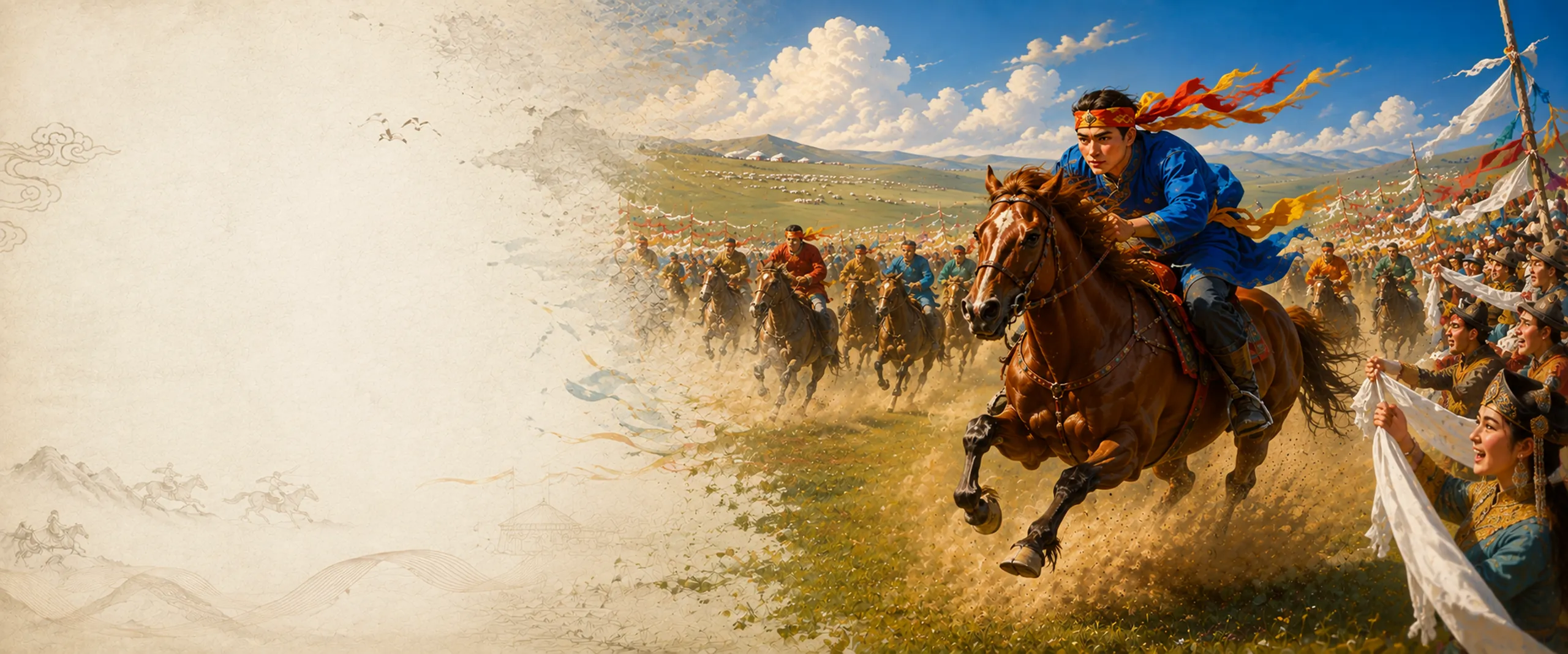
Naadam is the most important traditional festival of the Mongolian people. In Mongolian, its name means “entertainment” or “games.” Bökh (搏克), Mongolian wrestling, horse racing, and archery are known as the Mongolian “Three Manly Skills,” embodying the grassland people’s admiration for courage, wisdom, and resilience. Naadam has been included in China’s national intangible cultural heritage list. Today, it has developed into a major grassland celebration combining traditional athletic competitions, song-and-dance performances, and economic and trade exchange. Held successively across Inner Mongolia each summer, it attracts large numbers of visitors from China and abroad. Naadam not only displays the appeal of traditional Mongolian sports, but also promotes the development of grassland cultural tourism, becoming an important window through which the world can understand Mongolian culture.
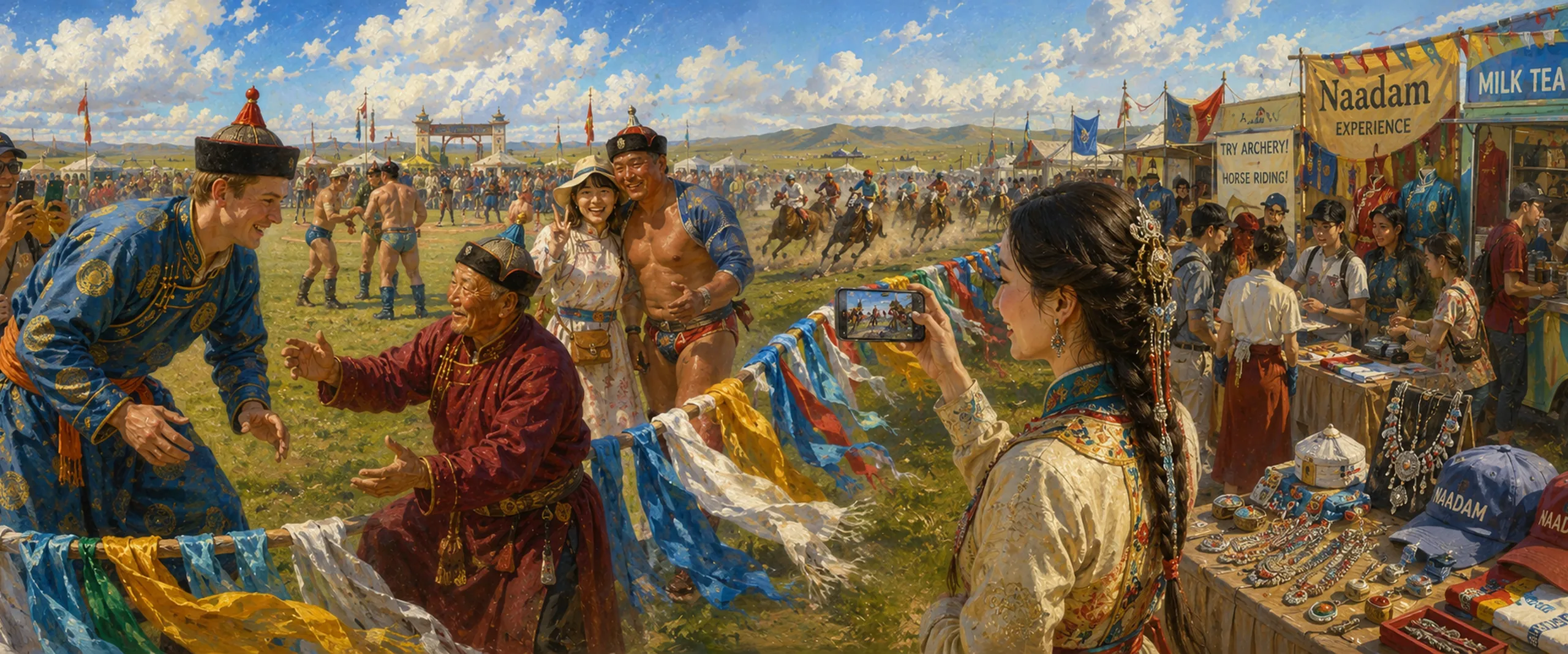
Celebrated Worldwide
Mongolia
Mongolia is the most central stage in Naadam’s global presence. Every year from July 11 to 13, people across the country celebrate Naadam together—it is both a traditional festival and Mongolia’s national holiday.
“Eternal Mongolia” — Naadam’s International Upgrade in 2026
On July 11, 2026, the opening ceremony of Naadam, themed “Eternal Mongolia,” was held in grand fashion at the Central Stadium in Ulaanbaatar. Mongolian President Ukhnaagiin Khürelsükh delivered the opening address. In the distinguished guests’ section, alongside Mongolia’s three highest-ranking state leaders, were South Korean President Lee Jae-myung and his wife, who were then on a state visit to Mongolia.
This year’s opening ceremony marked a historic international upgrade for Naadam—for the first time, real-time commentary was simultaneously provided in five foreign languages: English, Japanese, Korean, Chinese, and Russian. The event was broadcast globally through MNB World, YouTube, FM radio, and other media platforms. To make viewing more convenient for international audiences, the YouTube livestream also offered simultaneous translation in English, Russian, Chinese, Korean, and Japanese. At the same time, large electronic screens in Ulaanbaatar’s nine districts and in the central squares of all 21 provincial capitals broadcast the opening ceremony live. For the first time, the National Naadam Organizing Committee also installed a large outdoor screen in Sükhbaatar Square and created an artificial-turf leisure area, providing residents and visitors with a public space from which to watch the festivities.
To implement the principle of “making it convenient and comfortable for every citizen to participate in the National Naadam,” the organizing committee also introduced a series of accessibility services. Service tents were set up outside the Central Stadium for people with disabilities, pregnant women, and breastfeeding mothers, while a rest area capable of accommodating 100 people was built outside the stadium. This year’s opening ceremony also distributed 104 free admission tickets to people with disabilities. These measures made Naadam not only a traditional celebration, but also a public cultural event shaped by modern human-centered care.
8,500 Foreign Visitors — Naadam’s Global Appeal
According to Mongolian media, during Naadam in 2025 alone, approximately 8,500 foreign visitors traveled specifically to Mongolia to experience the festival. In recent years, growing numbers of travelers from around the world have journeyed vast distances to Mongolia for the opportunity to witness this unique ethnic celebration firsthand.
At the Naadam opening ceremony, visitors from around the world shared their impressions. American visitor Anna Rebecca, an English teacher working in Mongolia as a volunteer teacher, said: “Seeing smiles on everyone’s faces and watching people immerse themselves in the joyful atmosphere of the festival left me with a wonderful impression.” American visitors Marco Benagas and Nat Ratboun, from Maine, were attending the National Naadam opening ceremony for the first time: “It is definitely one of the most spectacular performances I have ever seen. Watching thousands upon thousands of people work together to create something so powerful was genuinely moving.”
Australian visitor Dennis Pipich was visiting Mongolia for the first time, mainly to see his wife’s family. The Mongolian robe he wore that day had been given to him by his mother-in-law. He said: “The entire performance fully expressed the pride and vibrant energy of the Mongolian people. I especially enjoyed the horseback performances, the music, and the dancing.” American visitor Lucy Tennett came to Mongolia for the first time with five family members to visit her younger brother, who was working there as an English teacher: “Mongolian culture is astonishing. Every performance fully expressed the traditions and national pride of the Mongolian people.” South Korean visitor Ryu Ju-yoon said: “South Korea does not have a nationwide traditional celebration on the same grand scale as Mongolia’s Naadam, so watching the Naadam opening ceremony felt very fresh and distinctive to me.”
Inner Mongolia, China
In China, the global dissemination of Naadam centers on the Inner Mongolia Autonomous Region. Through the innovative model of “Tourism Naadam,” the traditional festival has been transformed into a major cultural-tourism IP capable of attracting international visitors.
The 36th Tourism Naadam — 100,000 Visitors and 30 Million Livestream Viewers
From July 18 to 20, 2026, the 36th Inner Mongolia Tourism Naadam, themed “Travel through Inner Mongolia · Encounter Naadam,” opened in grand fashion in Xilinhot, Xilingol League. More than 100,000 visitors from across China and local residents attended on the opening day. According to statistics, around 100,000 Chinese and international visitors entered the opening ceremony venue, while nearly 30 million people watched the ceremony via livestream.
Naadam has become a major cultural-tourism IP for Inner Mongolia. He Mingjian, deputy commander of this year’s Naadam, stated that “visitor numbers are expected to surpass 600,000 this year.” The three-day festival brought together the charm of folk customs, the spirit of competition, and the energy of consumption, while a broader series of activities continued through the end of August.
One of the most striking international initiatives at this year’s festival was organized by China Youth Daily, which invited nearly 100 online influencers and 100 international visitors to form a joint parade contingent. Using their cameras to document sporting competitions and folk traditions, they extended to the world an invitation to “meet at Naadam.” A contingent of international visitors also appeared in the opening ceremony. Representatives of China’s 56 ethnic groups entered in festive dress, followed successively by contingents from Inner Mongolia’s 12 leagues and cities.
A Tunisian Woman’s Naadam Encounter
At the 2026 Inner Mongolia Naadam, one of the most eye-catching international figures was Asma, a reporter and presenter with China Arab TV in Dubai, originally from Tunisia. Wearing a red Mongolian robe, she sang the Chinese song Great China in fluent Mandarin and became one of the most striking figures in the media group. Walking across the green grasslands, Asma recorded the sweeping scenery with her camera while enthusiastically responding to greetings from those around her, completely immersed in the lively and harmonious atmosphere. She said that Naadam is a long-established cultural and sporting gathering of the grasslands with deep roots among ordinary people. This Tunisian woman’s Naadam encounter reached audiences around the world through international media coverage.
A “Two-Way Journey” of China–Mongolia Intangible Cultural Heritage
Naadam is not only a platform for presenting the culture of China’s Mongolian people; it is also becoming a bridge for cultural exchange between China and Mongolia. In July 2026, at Naadam in Ulaanbaatar, Mongolia, an intangible cultural heritage performance team from Otog Front Banner in Inner Mongolia was invited to present the traditional Ordos Wedding. During the performance, inheritors dressed in traditional Ordos ceremonial attire recreated in a realistic setting the solemn rites of the nationally listed intangible cultural heritage item “Ordos Wedding.” The team won first prize in the costume presentation category and also received two special honors for “wedding sister-in-law attire” and “marriage audience attire.” Through intangible cultural heritage as a bridge and clothing as a medium, this transnational performance wrote a vivid chapter of ethnic unity and cultural integration through mutual learning between the grassland civilizations of China and Mongolia.
Naadam’s Many Contemporary Forms
Contemporary Naadam has evolved beyond the traditional “Three Manly Skills” into multiple forms. Alongside official Naadam celebrations, there are now folk Naadam, tourism Naadam, international Naadam, school Naadam, symbolic Naadam, and other varieties. This year’s Inner Mongolia Naadam introduced more than 20 participatory experiences, including intangible cultural heritage workshops, folk games, and costume-change travel photography. The traditional “Three Manly Skills”—bökh wrestling, horse racing, and archery—were held simultaneously, while interactive events such as a four-event visitor competition, family Naadam, and youth Naadam allowed visitors themselves to enter the competitive arena. Nearly 20 experience-oriented activities were arranged at the main venue. In the evening, Beizimiao Square hosted a special intangible cultural heritage performance and a bonfire celebration for tens of thousands of people. The local area also launched 13 distinctive tourism routes, linking grassland landscapes with folk-cultural experiences.
The festival also launched the “Fine Intangible Heritage Goods · Craftsmanship in Transmission” Inner Mongolia Intangible Cultural Heritage Shopping Month, bringing together intangible cultural heritage practitioners from all 12 leagues and cities of the autonomous region. Inside the heritage workshops, visitors could personally make leather carvings and felt embroidery, experiencing distinctive cultural traditions at close range under the careful guidance of heritage inheritors.
Naadam has thus developed from a regional ethnic festival into a cultural-tourism brand open to the world.
United States
Naadam’s global spread is visible not only in its principal settings in Mongolia and Inner Mongolia, China, but also in the spontaneous transmission of tradition among Mongolian communities overseas.
On July 11, 2026, Mongolian nationals studying, working, and living in the Washington, D.C. area held a traditional Mongolian Naadam celebration in Arlington, Virginia. Mongolian Ambassador to the United States Ö. Battbayar declared the event open. Maria Sand, acting deputy director of the U.S. State Department’s Office of Japanese, Korean, and Mongolian Affairs, attended by invitation and delivered remarks.
During the Naadam gathering, 32 outstanding wrestlers holding national-, provincial-, and county-level titles took part in Mongolian wrestling competitions. Other sporting and cultural activities combining Mongolian tradition with modern elements included shagai shooting, archery, children’s races, and shagai horse racing.
With support from Mongolia’s Ministry of Foreign Affairs, this year’s Naadam was jointly organized by the Embassy of Mongolia in the United States, the Mongolian Association of the Washington, D.C. area, and other nongovernmental organizations. According to the Mongolian Embassy, the celebration attracted more than 2,000 participants from Mongolia and other countries.
Mongolian Americans in communities such as Chicago also regularly hold Naadam celebrations. The President of Mongolia has previously stated that Naadam, as part of the nation’s cultural heritage, was held abroad for the first time under presidential patronage. Such Naadam gatherings spontaneously organized by overseas Mongolian communities vividly embody a culture “carried with them”—wherever Mongolian people migrate in the world, they gather each July and use wrestling, horse racing, and archery to reaffirm their cultural identity.
Naadam in the Cloud
Naadam’s global dissemination has been inseparable from international media and livestreaming technologies.
Mongolia’s five-language Naadam livestream. In 2026, the opening ceremony of Mongolia’s Naadam offered, for the first time, simultaneous real-time commentary in English, Japanese, Korean, Chinese, and Russian. The YouTube livestream likewise provided simultaneous translation in five languages. This multilingual broadcasting service enabled international audiences to understand Mongolia’s history, culture, and National Naadam more directly.
Inner Mongolia Naadam’s overseas dissemination. In 2025, reports related to the opening ceremony of Inner Mongolia’s Naadam reached overseas audiences effectively through multiple channels. International viewers were able to transcend geographical distance and experience the distinctive character of Inner Mongolia’s grassland culture. Some reports described the spectacular performances at the opening ceremony in detail, while others introduced the historical origins, cultural significance, and traditional Mongolian customs associated with Naadam, opening a window through which overseas audiences could understand Inner Mongolia. Through this wave of international communication, Inner Mongolia’s grassland culture once again reached the world, further enhancing the region’s international cultural influence.
Discussion on overseas social media. Videos of the 2026 Inner Mongolia Naadam sparked lively discussion abroad. One foreign viewer exclaimed: “My God, this looks almost like a massive military parade!” China Daily foreign presenter Robert Kadhim, reporting on the Inner Mongolia Naadam for the first time, was stunned by the sight of a thousand riders carrying national flags during the opening ceremony: “This is absolutely one of the most breathtaking scenes I have ever witnessed!”
Canada Illuminates the Light of Naadam. To celebrate Mongolia’s National Naadam Festival, the iconic “OTTAWA” sign in the Canadian capital and the world-famous natural landmark Niagara Falls were illuminated on July 11, 2026, in the red, blue, and red colors of the Mongolian national flag, extending festive congratulations to Mongolia. This form of lighting international landmarks across national borders is a vivid symbol of a national festival gaining recognition from the international community.
Mutual Learning Among Civilizations
Dialogue with Global “Competitive Festivals”
Naadam is often called the “Olympics of the Grasslands.” The phrase itself creates a dialogue with sporting festival traditions around the world.
The ancient Greek Olympic Games centered on athletic competition. Held every four years, they brought together competitors from different city-states in Olympia. Naadam likewise centers on the “Three Manly Skills”—wrestling, horse racing, and archery—and is held each summer on the grasslands. Both originated in forms of military training, both embody admiration for strength, speed, and skill, and both use competition to bring communities together and display culture.
The greatest difference between Naadam and the Olympic Games lies in Naadam’s “participation by all” and “cultural comprehensiveness.” UNESCO has specifically noted that Naadam “encourages everyone to participate.” It is not a stage reserved exclusively for elite athletes, but a collective celebration in which all members of the community can take part. At the same time, Naadam is not merely athletic competition. It also brings together long-song singing, khöömei (呼麦), Mongolian throat singing, the morin khuur (马头琴), the traditional horse-head fiddle, ethnic dance, traditional foods, handicrafts, and diverse forms of cultural expression. As UNESCO has described it, Naadam is “a complex cultural heritage of nomadic civilization and a unique expression of culture.”
Dialogue with Global “Horse-Culture” Festivals
One of Naadam’s central symbols is the horse. Horse racing is the most visually striking of the “Three Manly Skills.” Around the world, there is no shortage of cultural festivals centered on horses or human–animal relationships. Spain’s Running of the Bulls, although centered on bulls rather than horses, likewise places interaction between people and animals at its core; Turkey’s “Kyrgyz Horse Racing Festival” is known for equestrian competition; and Mongolia itself holds a dedicated Winter Naadam of Horse Culture.
What most distinguishes Naadam horse racing from these festivals is its “grassland scale.” Races extend for dozens of kilometers across vast open grasslands rather than taking place on enclosed tracks. The riders are often children—light in weight and raised alongside horses—which itself vividly reflects the nomadic ideal of “human and horse as one.” As UNESCO has pointed out, the three sporting competitions of Naadam are “directly related to the Mongolian way of life and living conditions.”
In February 2026, Mongolia’s Winter Naadam of Horse Culture was held in Erdene District of Töv Province. Herdsmen from 13 Mongolian provinces and three districts under Ulaanbaatar competed on horseback. Traditional skills such as horse catching, horse breaking, and whip handling unfolded one after another, creating a vivid panorama of Mongolian horse culture across the snow-covered steppe.
Dialogue with Global “Nomadic Civilizations”
Naadam is one of the most concentrated cultural expressions of nomadic civilization. UNESCO has noted that Naadam is “inseparable from the nomadic civilization of the Mongolian people, who have long practiced animal husbandry across the vast grasslands of Central Asia.”
Historically, nomadic civilizations were distributed widely across the world—from the steppes of Central Asia to the deserts of North Africa, from the tundra of Northern Europe to the semi-arid regions of the Middle East. Nomadic peoples commonly developed competitive traditions centered on “strength, speed, and precision”—Arab horse racing and falconry, Kazakh kures wrestling, and Kyrgyz goat-snatching on horseback all share a strong spiritual affinity with Naadam’s “Three Manly Skills.”
Naadam’s distinctive quality lies in the way it unites the “Three Skills” as a whole—wrestling represents strength, horse racing represents speed, and archery represents precision. Together, these three capacities are precisely the core skills required for survival and development in nomadic life on the grasslands. Naadam is therefore not only a competition, but also an annual ritual through which nomadic civilization affirms itself.
Cultural Sharing
Naadam is one of the clearest examples of a cross-border ethnic festival. Mongolian people live across China, Mongolia, Russia, and other countries, and Naadam is a cultural heritage shared by Mongolian communities as a whole. China has included Naadam in its national intangible cultural heritage list, while Mongolia nominated Naadam for UNESCO’s Representative List of the Intangible Cultural Heritage of Humanity—demonstrating that the same cultural tradition can be valued and protected simultaneously by different countries.
At the Naadam in Xilinhot, Inner Mongolia, representatives of China’s 56 ethnic groups enter the venue in festive dress. At Naadam in Ulaanbaatar, intangible cultural heritage performance groups from Inner Mongolia, China, appear on the international stage. In Washington, D.C., Mongolian expatriates spontaneously organize their own Naadam. This form of cultural sharing across national borders is one of Naadam’s most distinctive and precious cultural values.
“Tourism Naadam”
One of the most noteworthy contemporary changes in Naadam is the rise of “Tourism Naadam.” Traditional Naadam was a spontaneous gathering of Mongolian herders; Tourism Naadam is a public cultural event open to the entire world.
This transformation has prompted discussion about “commercialization” and “authenticity.” Yet viewed from another perspective, Tourism Naadam has enabled the festival to move from the grasslands onto the global stage. International visitor contingents appear at Naadam; 100 international visitors form a joint parade group; 8,500 foreign visitors travel specifically to Mongolia to attend the festival. Behind these numbers lies the reality that Naadam culture is increasingly being seen and experienced by the world.
As some scholars have pointed out, Naadam is like a living “museum of Mongolian culture.” Through its distinctive dynamic form and diverse varieties, it plays an important role in protecting and transmitting ethnic traditional culture, while also enabling interaction, integration, and wider promotion. Naadam has not lost its cultural core because of its transformation into a tourism event—it has simply found a new way to enter into dialogue with the contemporary world.
Closing Note
The global dissemination of Naadam traces a distinctive journey from the deep grasslands of the Mongolian Plateau to the five continents of the world. Its inclusion in China’s national intangible cultural heritage list in 2006, followed by its inclusion on UNESCO’s Representative List of the Intangible Cultural Heritage of Humanity in 2010, clearly outlines Naadam’s trajectory from an ethnic festival to a cultural heritage shared by humanity.
Unlike Raosanling and its model of “inviting the world in,” the Water-Splashing Festival and its symbol of “water,” or Munao Zongge and its digital breakthrough, Naadam has followed a distinctive global path of “cross-border sharing alongside multiple forms of development.” Its character as the tradition of a cross-border people gives it an inherently international dimension; its “Three Manly Skills” can be understood worldwide without translation; and the innovation of “Tourism Naadam” allows it to embrace the world with an open attitude.
In Mongolia, Naadam is the centerpiece of the national holiday—five-language broadcasts, the attendance of international political leaders, and 8,500 foreign visitors traveling specifically for the festival are making Naadam the country’s most important window for presenting its national culture to the world. In Inner Mongolia, China, Naadam is a major cultural-tourism IP—100,000 visitors, 30 million livestream viewers, and an international visitor contingent at the opening ceremony are turning it into one of the most brilliant calling cards through which Chinese grassland culture reaches the world. In Washington, D.C., Mongolian expatriates organize Naadam themselves—more than 2,000 participants and nationally ranked wrestlers competing have made it a spiritual anchor through which overseas Mongolian communities reaffirm their cultural identity.
More moving still is the fact that, throughout its journey into the world, Naadam has always maintained its profound connection with the grasslands. Wrestlers enter with “eagle steps,” racehorses thunder across the vast steppe, and archers take aim at the center of the target—these scenes have remained unchanged for centuries. As UNESCO has pointed out, Naadam “emphasizes respect for nature and the environment.” Naadam has not diluted the richness of its culture in order to “go out into the world”—it has simply allowed the winds of the grasslands to blow farther.
As one foreign visitor at a Naadam opening ceremony put it: “Watching thousands upon thousands of people work together to create something so powerful was genuinely moving.” What Naadam carries is not only the historical memory and spiritual beliefs of the Mongolian people, but also humanity’s shared aspiration toward strength, speed, precision, and unity. The drumbeats of Naadam are resounding across the grasslands and beside the ears of the world. The hoofbeats of Naadam are crossing the steppe—and crossing national borders.
—-
Readers’ Comments
Calendar and traditional culture enthusiasts from around the world, sharing the same moon.
Sign in or register to join the conversation. Your comment account is created automatically the first time you use a connected account.
No comments yet
Share your thoughts with readers around the world.