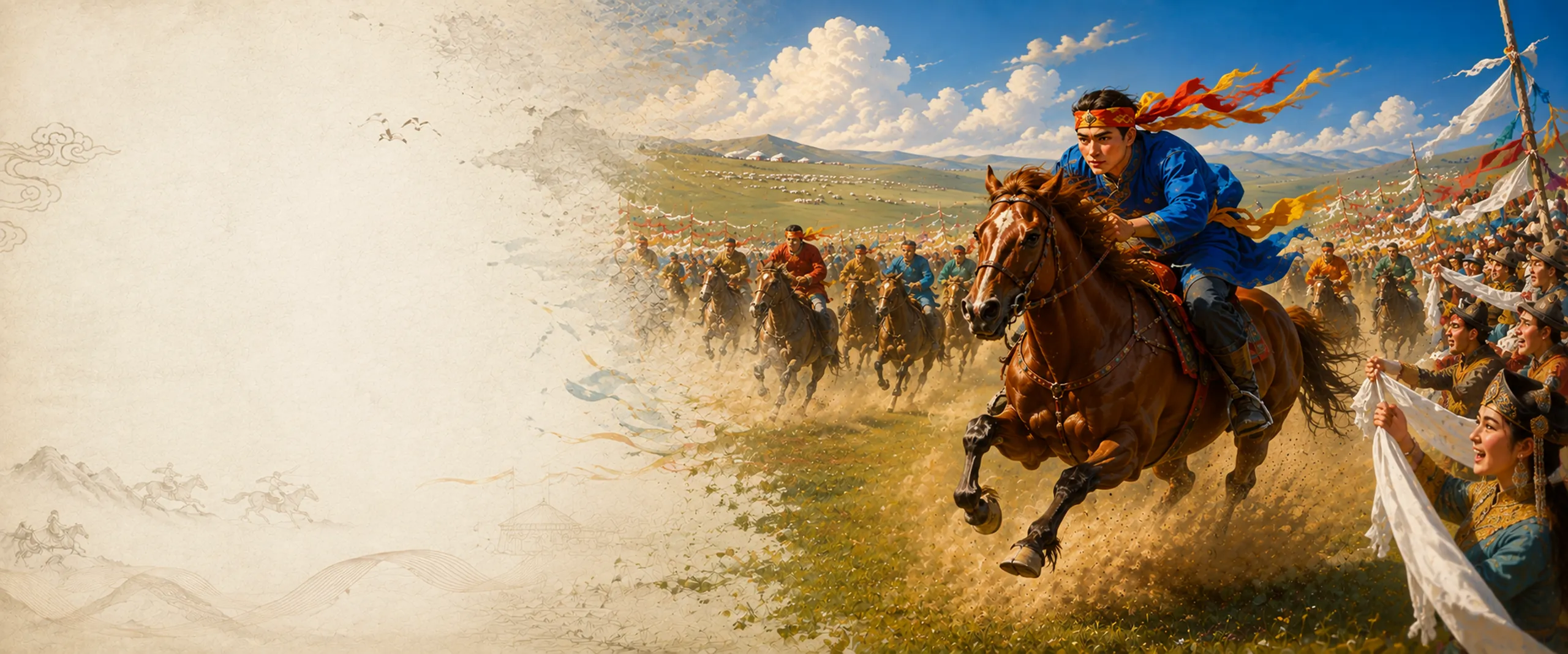
Bökh wrestling, horse racing, and archery are collectively known as the Mongolian “Three Manly Skills.” Bökh tests strength and technique, horse racing tests speed and endurance, and archery tests precision and composure, together embodying the grassland people’s admiration for courage, intelligence, and perseverance. Over time, Naadam also incorporated camel racing, Mongolian chess, shagai competitions using sheep anklebones, and other events. Naadam grew out of traditional nomadic culture and early shamanic beliefs. During the festival, the normally tranquil grasslands are transformed by fluttering banners, crowds moving in every direction, the calls of cattle and sheep, and the neighing of horses, creating a vivid scene of prosperity and celebration.
Main Customs
Types and Names of Naadam
The Meaning of “Naadam”: Entertainment, Games, and the Joy of Harvest
The word “Naadam” comes from Mongolian, with the root naad- meaning “to play,” “to have fun,” or “to engage in games.” Its most direct meaning is therefore “a gathering for entertainment” or “a festival of games,” and it can also convey the joy of a successful harvest. This seemingly simple word captures the essence of the festival with remarkable precision: Naadam is a grassland celebration centered on play and enjoyment, bringing together strength, skill, speed, competition, and communal laughter.
Within the cultural context of Naadam, “entertainment” is not merely leisure. It is closely connected with Mongolian production and daily life, military training, religious belief, and community cohesion. For a nomadic people who traditionally moved with water and pasture, survival in a demanding natural environment required physical strength, excellent riding and archery skills, and a strong spirit of cooperation. Naadam became an ideal arena in which these qualities could be displayed, tested, and celebrated, while also reinforcing collective identity.
The Diverse Forms of Naadam
Naadam is not a single, fixed festival but a broad cultural institution with many forms and levels. Depending on its scale, purpose, and range of participants, Naadam can be divided into several categories.
By scale: Naadam may range from small gatherings organized by a gacha (village-level community) or sum (township-level unit) to major festivals organized at banner, county, league, municipal, or even autonomous-region level. A large Naadam may include as many as 512 wrestlers and around 300 horses and last seven to ten days. A medium-sized Naadam may have 256 wrestlers and 100 to 150 horses and continue for five to seven days. A small Naadam may involve 128 or 64 wrestlers and around 30 to 50 horses, with a duration of three to five days.
By purpose: Traditionally, Naadam was organized for major occasions such as celebrating military achievements, ceremonial inspection and consecration of banners, gatherings of soldiers and civilians, meetings among banners and leagues, and ovoo worship. There are “Harvest Naadam” celebrations held for agricultural or pastoral abundance, commemorative Naadam festivals honoring historical events or heroes, Ovoo Naadam associated with sacred cairn worship, and modern “Tourism Naadam” events intended to promote travel and economic development.
This rich system of forms demonstrates that Naadam is more than a festival. It is a comprehensive social and cultural ritual institution woven into many aspects of Mongolian communal life.
Preparations Before the Festival: The Grasslands Prepare for the Great Gathering
Preparations for Naadam begin several days, and sometimes much earlier, before the festival itself. Across the grasslands, communities gradually enter the atmosphere of anticipation surrounding the great gathering.
Preparing the Grounds and Erecting Mongolian Gers
Whenever Naadam approaches, herders put on new traditional clothing, mount their horses, harness their lele carts, and bring Mongolian gers together with meat, dairy foods, and other supplies from every direction. Felt tents rise across the green grasslands, gradually forming white “tent cities.” Herders living within a radius of one or two hundred li traditionally dress in festival clothing, bring elderly family members and children, load their gers and daily necessities onto carts or horses, and travel from all directions to attend. Merchants and traders from near and far also arrive and set up stalls and temporary shops.
Naadam grounds are generally selected on broad, level stretches of grassland. A central reviewing or ceremonial platform is erected, while horse-racing courses, wrestling grounds, and archery fields are marked out around it. White Mongolian gers scatter across the surrounding grassland, cooking smoke rises gently into the air, and the aroma of milk tea fills the gathering place.
Decorating the Ovoo: Sacred Preparations Before Worship
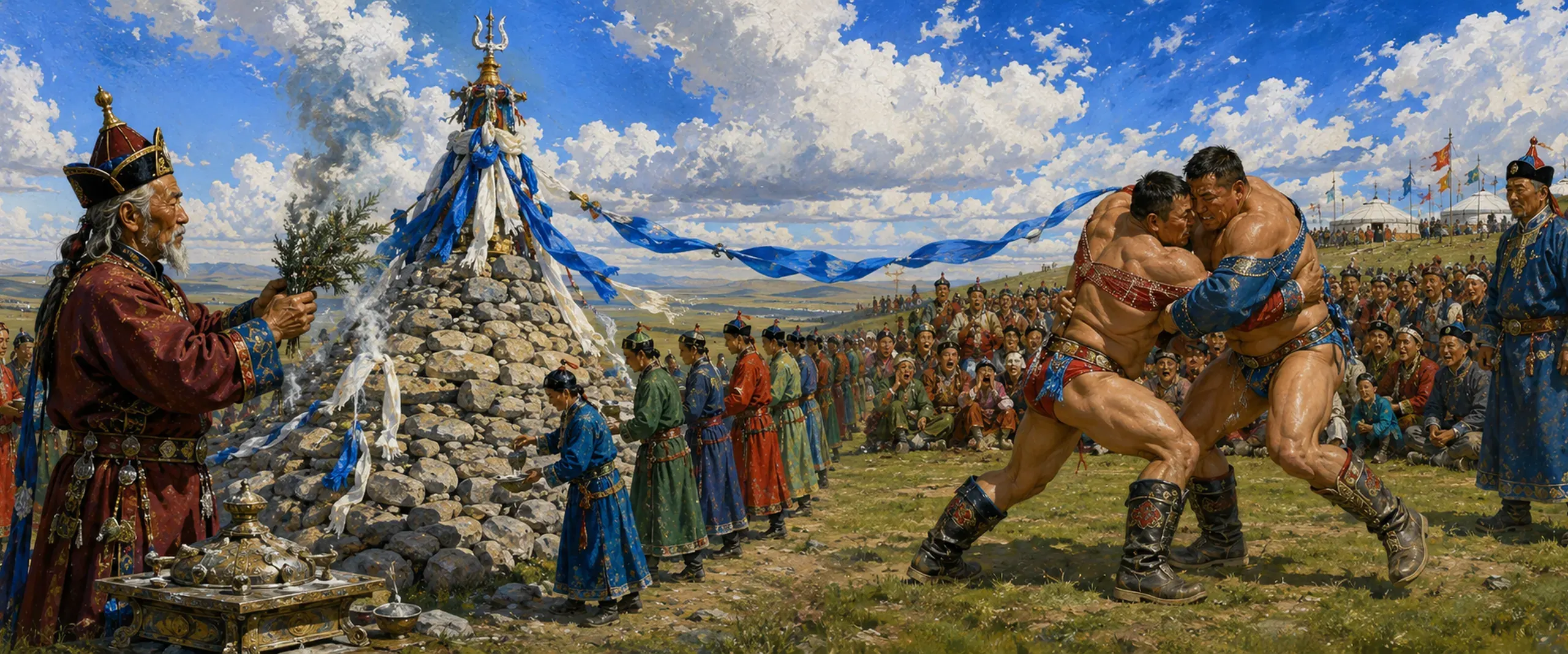
Ovoo worship is one of the most important religious rituals associated with Naadam. On the day before the ceremony, the ovoo is carefully redecorated. Decorations are renewed, including the gugeli, or horsehair associated with the sacred sülde that symbolizes the spiritual essence of the ovoo, fresh branches placed on its summit, and multicolored ribbons and streamers. Branches are densely inserted into the cairn, while brightly colored strips of cloth and paper prayer flags bearing sacred texts are hung around it. Every decorative element carries symbolic meaning: branches represent life, multicolored cloth symbolizes auspiciousness, and prayer flags represent divine protection.
Ovoo Worship: The Oldest Root of Naadam
Ovoo worship is among the oldest and most sacred rituals connected with Naadam and forms one of its deepest spiritual foundations. Naadam developed in close association with the Mongolian tradition of worshipping the ovoo. If Naadam is imagined as a flourishing tree, ovoo worship is its root.
The Ovoo: From Landmark to Sacred Altar
The Mongolian word “ovoo” literally means a “heap” or “pile.” An ovoo is generally a conical solid mound built from stones, earth, willow branches, or similar materials. Originally, ovoos served practical purposes on the open grasslands, marking roads, borders, or territorial boundaries. Across the immense and often featureless steppe, they functioned much like lighthouses at sea, helping nomadic herders orient themselves.
Within shamanic traditions based on the belief that spiritual forces inhabit the natural world, however, these structures standing between Heaven and Earth gradually acquired sacred meaning. Mongolian communities believed that mountains, forests, springs, and other features of nature possessed spiritual power, while ovoos became places where these beings might reside or manifest themselves. People therefore began making offerings at ovoos and praying for favorable weather, healthy livestock, and peace. In this way, the ovoo evolved from a practical landmark into a sacred altar and a spiritual link connecting Heaven, Earth, and humanity.
The Complete Ovoo Worship Ceremony
A typical Naadam-associated ovoo ritual includes decorating the ovoo, preparing offerings, the chanting of scriptures by lamas, offering dairy foods, circling the ovoo three times clockwise, invoking blessings, scattering wind-horse prayer papers, and sharing the offerings afterward.
The ceremony usually begins at dawn. Lamas recite ritual texts aloud while participants circle the ovoo three times clockwise, sprinkling fresh milk and alcohol toward it as they walk. They then bow or prostrate themselves in front of the ovoo, add stones they have brought to the cairn, and decorate it with willow branches, khadag ceremonial scarves, and colorful flags. During the ritual, participants may also scatter or offer milk liquor, dairy foods, pastries, and other items toward the ovoo. The atmosphere is solemn and reverent, with the chanting of the lamas mingling with the wind of the grasslands.
Through the solemn annual worship of the spirits associated with the ovoo, Mongolian communities preserve and promote an ethical ideal of harmony between humanity and nature, regarding respect for life, care for the ecological environment, and harmonious coexistence with the natural world as fundamental responsibilities.
Functions of Ovoo Worship: Blessing, Gratitude, and Community Cohesion
Ovoo worship serves several functions. The first is prayer for blessings: participants ask for favorable weather, healthy growth of the five principal kinds of livestock, peace, and good fortune. The second is gratitude: they thank Heaven, Earth, and the spirits for protecting them through the previous year and for providing fertile grasslands and healthy animals. The third is social cohesion: herders dispersed across the wide grasslands gather through a shared ritual, reaffirming their belonging to the same community and strengthening social connections.
After the ritual, traditional horse racing, archery, and wrestling competitions begin. The solemn reverence of the sacred ceremony and the energetic excitement of athletic competition form two complementary rhythms of Naadam—stillness and movement, reverence and joy. Young men and women who have developed affection for one another may also quietly slip away to meet privately. Thus, after ovoo worship, not only competition but also romance begins.
The Opening Ceremony of Naadam
Following the ovoo ritual, the formal opening ceremony of Naadam begins. Modern government-organized Naadam festivals generally include a ceremonial entrance, an official declaration of opening, the national anthem, the raising of the national flag, speeches by officials, athletes’ oaths, and music and dance performances.
Ceremonial Entrance: A Procession of Festival Dress
During the opening ceremony, delegations of herders from different banners, counties, and sums enter the grounds in succession. Participants wear festive traditional clothing and ride fine horses, presenting the richness and diversity of Mongolian dress. Men wear Mongolian hats and robes with Mongolian knives at the waist, while women wear elaborate headdresses and brightly colored robes adorned with silver ornaments that ring as they move.
The flag-raising ceremony follows the entrance procession. As the national anthem plays, the national flag rises over the grasslands. Officials then deliver speeches, athlete representatives take their oaths, and Naadam is formally declared open.
Performing Arts: The Sound of the Morin Khuur and Long Song
Artistic performance is an indispensable part of the opening ceremony. The resonant sound of the morin khuur, or horse-head fiddle, carries across the grasslands, while Mongolian long song rises in extended, powerful melodies that seem to evoke the ancient nomadic past. Performers in ceremonial dress present traditional Mongolian dances, expressing the warmth, openness, and bold spirit associated with life on the steppe.
The Three Manly Skills: The Soul of Naadam
At the heart of Naadam are the “Three Manly Skills”—Bökh wrestling, horse racing, and archery. These are not merely fixed traditional sporting events but some of the most vivid expressions of the energetic and heroic spirit of grassland culture. Since ancient times, the Three Manly Skills were regarded as essential abilities for men and as measures of personal capability. Mongolian society treated them as practical skills necessary for life and production; without mastery of wrestling, riding, and archery, a man would traditionally have found it difficult to travel widely, protect the community, or achieve distinction.
The Three Manly Skills can be traced back to ancient tribal confederations, when wrestling, horse racing, and archery were reportedly used as criteria in selecting tribal leaders. Only those who excelled in all three fields were considered qualified for leadership.
Bökh Wrestling: A Contest of Strength and Intelligence
Bökh is the Mongolian term for wrestling. With a history of roughly two thousand years, it developed from the long nomadic experience of the Mongolian people and combines athletic competition with entertainment. Bökh is one of the most ritualized and visually distinctive events of Naadam.
Bökh Clothing and Equipment
Traditional wrestling attire is elaborate. Wrestlers wear loose white trousers under embroidered outer trousers decorated with animal and floral motifs. The upper garment is made from durable leather and covered with silver or brass studs; a round mirror or auspicious characters may appear on the back. Around the waist is a short apron of red, blue, and yellow silk, and the wrestler wears Mongolian boots or riding boots.
Distinguished wrestlers wear colorful collars known as jangga around the neck. The number of colored strips attached to the jangga represents victories achieved in previous competitions and therefore functions as a visible symbol of honor. Wrestlers also wear specialized equipment including a studded leather vest known as zodog, embroidered trousers, and a colored short overskirt known as shuudag or related regional forms.
Rules of Bökh
Traditional Mongolian wrestling does not divide competitors by age or weight class. Participant numbers are arranged in even-numbered brackets such as 2, 4, 8, 16, 32, 64, or 128. Competitors are paired either by respected judges or by drawing lots.
The central rule is direct: if any part of the body above the ankle touches the ground first, the wrestler loses. Bökh emphasizes skillful control rather than brute force alone, embodying the principle of overcoming strength through technique and firmness through flexibility.
Wrestlers are also expected to observe established etiquette. Before and after a match they greet their opponent and the audience. If an opponent’s clothing becomes loose or disordered, attacks are stopped until it is corrected. After throwing an opponent, the winner must help him back to his feet.
Ritual and Spirit of Bökh
Bökh retains a strong ceremonial character. To the deep and resonant sound of the traditional Uria praise song, wrestlers enter the arena in two lines. Wearing open-chested wrestling garments and Mongolian or riding boots, they perform movements inspired by bears, lions, eagles, and other powerful animals. As they enter, they swing their arms like soaring birds before beginning the bout. Singers may chant challenge songs before competition.
The eagle-like entrance dance symbolizes strength, freedom, and victory, giving Bökh a ritual meaning that extends beyond sport.
Horse Racing: A Contest of Speed and Endurance
The Mongolian people are often described as a “people on horseback,” and horse racing occupies an especially important place in Naadam. Traditional Mongolian racing includes several distinct forms.
Types of Horse Racing
Naadam traditionally features races alongside wrestling and archery. Horse events may include speed racing, gaited racing, and other specialized mounted competitions. Speed races test pure velocity, generally over straight courses of approximately 20, 30, or 40 kilometers, with the first horse to reach the finish declared the winner. Gaited races emphasize the steadiness, smoothness, and elegance of a horse’s movement. Other forms feature distinct traditional equestrian techniques.
Young riders often participate in the fastest races. Starting and finishing areas are decorated with bright flags, while the riders wear colorful headscarves and sashes and drive their horses forward with impressive confidence and agility.
The Spectacle of Horse Racing
Some races are composed entirely of young riders. On the racing ground, they wear colorful clothing and streaming ribbons, starting together at the signal of a red flag or whistle. Rankings are determined by finishing order. At banner-level Naadam competitions, champion horses may receive the honorary title of “fine steed” and be decorated with colorful ribbons and tassels. The sight of large numbers of horses racing across the grasslands is one of Naadam’s most dramatic spectacles.
Archery: Precision and Composure
Archery is among the oldest activities associated with Naadam. Traditional Mongolian archery includes both standing archery and mounted archery.
Rules of Archery
Competitions traditionally do not impose strict divisions according to age or gender. Participants provide their own horses and bows, and older forms allowed broad freedom in bow design, draw weight, arrow length, and arrow weight.
A common competition format consists of three rounds and nine arrows, with each participant shooting three arrows per round. Winners are determined by the number of successful hits. Mongolian archery includes standing, mounted, and long-distance forms, with shooting distances such as 25, 50, or 100 paces.
Traditional kharaa archery at Naadam requires traditional shooting methods, including drawing the string with the thumb, often using a thumb ring, and placing the arrow on the outer side of the bow hand. Bows are expected to use natural materials such as wood or bamboo for the body, while arrow nocks must likewise be made from natural materials rather than modern synthetic components.
The Spectacle of Archery
In standing archery, competitors shoot from the ground after the judge gives the signal, and the best performers are determined according to accuracy. Mounted archery is even more dramatic: riders draw their bows while galloping and release arrows toward targets at speed, testing both horsemanship and precision. The combination of speed, balance, and accuracy makes mounted archery one of Naadam’s most impressive events.
Other Competitive Activities
In addition to the Three Manly Skills, Naadam includes a wide range of other traditional competitions and recreational activities.
Mongolian Chess
Mongolian chess, often called shatar, is an important intellectual competition at Naadam. Its board resembles that of international chess, but the shapes and names of the pieces reflect Mongolian cultural traditions. It is not merely a board game but an expression of strategic thinking and intellectual skill.
Bulu Throwing
Bulu is a traditional Mongolian throwing sport somewhat comparable to javelin throwing. Competitors throw a specially designed implement called a bulu over distance, and the longest throw wins. The event tests both strength and technique and remains a popular traditional competition.
Horse Roping
Horse roping is a fundamental skill of Mongolian herders and one of the most visually exciting activities at Naadam. Riders use long roping poles while galloping to catch the necks of unbroken horses with precision, displaying remarkable horsemanship and courage. It is therefore both a technical contest and a test of nerve.
Modern Sporting Events
Contemporary Naadam festivals often supplement the traditional Three Manly Skills with track and field, tug-of-war, volleyball, basketball, martial arts, polo, mounted archery, mounted sword-cutting, horse-walking races, trick riding, motorcycle performances, and other modern events. While wrestling, horse racing, archery, horse roping, and Mongolian chess remain core ethnic sports, some regions also include basketball, athletics, and other contemporary competitions.
Food Culture of Naadam
Naadam is not only a sporting festival but also a major celebration of grassland cuisine. Around the competition grounds, stalls serve a wide variety of Mongolian foods.
Hand-Pulled Mutton
Hand-pulled mutton is one of the most characteristic Mongolian dishes. Large bone-in pieces of lamb are boiled, traditionally with relatively simple seasoning, so that the natural flavor of the meat remains prominent. Large iron pots simmer with chunks of mutton, which are lifted out and served in large bowls. Diners may eat the meat hot with chopsticks or hold it directly in their hands.
This method reflects one of the most elemental culinary traditions of nomadic life: meat boiled in water without excessive seasoning, emphasizing freshness and the original taste of the ingredients. Its straightforward preparation also reflects the open and forthright character associated with grassland culture.
Milk Tea and Dairy Foods
At Naadam tea stalls and food tents, visitors can drink rich Mongolian milk tea. Traditionally prepared from brick tea and milk, it has a savory, full-bodied flavor. During Naadam, milk tea serves not only as a drink but also as a form of hospitality.
A wide range of other dairy products is also served, including cheese, dried milk curds, cream, fermented milk products, milk tofu, and yogurt. These foods developed directly from the pastoral way of life and remain indispensable parts of the Naadam table.
Whole-Sheep Banquet
Festivals such as Naadam provide occasions for elaborate traditional Mongolian dishes, among which the whole-sheep banquet represents one of the highest forms of hospitality. An entire sheep may be roasted or boiled and presented with a golden surface and rich aroma. Sharing the whole animal is not simply a meal but a social ritual through which guests experience the generosity and hospitality of the grasslands.
Clothing and the Arts: Cultural Expression at Naadam
Naadam is one of the most important occasions for the concentrated display of Mongolian clothing and artistic traditions. Herders attend in their finest ceremonial dress.
Mongolian Festival Dress
During Naadam, participants wear newly prepared traditional garments. Men wear Mongolian hats, blue or red robes, belts, and Mongolian boots, presenting a confident and vigorous appearance. Women wear elaborate headdresses, brightly colored robes, and silver ornaments that ring as they move. Mongolian clothing commonly uses red, blue, white, yellow, and other strong colors, together with finely designed decorative patterns that reflect established aesthetic traditions.
Morin Khuur and Long Song
As night falls, the expansive and emotionally resonant sound of the morin khuur drifts across the grasslands. The instrument is named for the carved horse head at the top of its neck and is one of the most representative musical instruments of Mongolian culture. Its timbre is broad, plaintive, and far-reaching, often evoking the immense landscapes and long history of nomadic life.
Mongolian long song is another treasure of Mongolian musical culture, distinguished by its wide vocal range and extended melodic lines. It has been recognized by UNESCO as part of the Representative List of the Intangible Cultural Heritage of Humanity. During Naadam, the melodies of long song and the morin khuur blend together to create one of the most characteristic soundscapes of the grasslands.
Bonfire Gatherings and Song and Dance
At night, young men and women sing and dance beside bonfires. People form circles around the flames, hold hands, and perform traditional Mongolian dances. Firelight illuminates their faces while songs and laughter carry into the night.
The bonfire gathering is more than entertainment. It strengthens social bonds, allowing participants to share both the joy of the festival and their relationships with one another.
Regional Variations
Xilingol, Inner Mongolia
Largest scale, permanent festival grounds, traditional Three Manly Skills, Ulan Muqir performances
Haixi, Qinghai
Origin in Lake Worship traditions, provincial-level intangible heritage, emphasis on harvest celebration
Bayingolin, Xinjiang
Epic of Jangar performance, sheep-snatching competitions, ethnic costume shows, bonfire gatherings
Subei, Gansu
Ulan Muqir performances, trade fairs, recognition of exemplary community members
Contemporary Transmission
### Recognition as National Intangible Cultural Heritage
In 2006, Naadam was included in the first batch of China’s National Intangible Cultural Heritage. In 2008, the Naadam tradition submitted by Hejing County in the Xinjiang Uyghur Autonomous Region was added as an expanded national-level heritage project.
### The Scale of Contemporary Naadam
Far from declining in contemporary society, Naadam has continued to expand. According to available statistics, since 2024, Naadam events in Inner Mongolia alone have received more than six million visitors and generated more than 4.1 billion yuan in comprehensive tourism revenue. Naadam has become a major cultural-tourism phenomenon, continuously encouraging new forms of cultural consumption and expanding festival-related experiences.
### The Innovative “Naadam Every Day” Model
To ensure that intangible cultural heritage is not limited to a few festival days but becomes more closely integrated into everyday life, different parts of Inner Mongolia have introduced the innovative “Naadam Every Day” model. Local areas use their distinctive customs and resources to develop year-round Naadam activities, creating a broader cultural-tourism network.
This approach allows visitors to experience the atmosphere and traditions of Naadam at different times of the year and enables Naadam culture to continue as a living tradition across a wider range of places and seasons.
### The Integration of Tradition and Modernity
Contemporary Naadam preserves its traditional cultural foundations while actively incorporating modern forms. Festival grounds may be divided into functional areas for food and consumption, specialty-product sales, Three Manly Skills competitions, intangible cultural heritage workshops, and folk interaction.
Visitors can watch wrestling, horse racing, and archery, while also participating in shagai anklebone games, cheese exhibitions, grassland hotpot, and other distinctive activities. Naadam has therefore developed into an integrated cultural-tourism brand combining folk sports, artistic performance, heritage experience, travel, and exchange.
Mongolia also holds winter Naadam-style celebrations that may include camel polo, mounted archery from camels, camel speed racing, and other events.
Closing Note
The folk traditions of Naadam form a vast cultural narrative about “ritual” and “competition.” From the solemnity of ovoo worship to the ceremonial procession of the opening celebration, from the contest of strength and intelligence in Bökh to the speed and exhilaration of horse racing, from the precision and composure of archery to the strategic contest of Mongolian chess, from the robust simplicity of hand-pulled mutton to the expansive sound of the morin khuur and long song, and from the laughter of bonfire gatherings to the contemporary innovation of “Naadam Every Day,” Naadam brings together Mongolian reverence for Heaven and Earth, remembrance of the past, admiration for strength and skill, and love of life.
At the heart of Naadam are “ritual” and “competition.” Ovoo worship expresses reverence toward Heaven, Earth, and sacred forces. Through the ritual, Mongolian communities give thanks for the gifts of nature and pray for favorable weather, flourishing livestock, peace, and prosperity. The Three Manly Skills express admiration for ability and excellence: Bökh demonstrates strength and intelligence, horse racing displays speed and courage, and archery requires precision and composure. Since ancient times, these skills were considered essential accomplishments and important measures of personal capability.
Naadam is also a festival of gathering. Herders who spend much of the year dispersed across the vast grasslands come together through Naadam to renew relationships, exchange information, and strengthen social ties. Formed over the long historical development of nomadic society, Naadam is both athletic competition and cultural transmission; it is both the reinforcement of community and a process of collective spiritual renewal.
In 2006, Naadam was included in the first batch of China’s National Intangible Cultural Heritage. From ancient ovoo worship to contemporary heritage protection, from gatherings of tribal confederations to the cultural-tourism innovation of “Naadam Every Day,” Naadam has crossed centuries while continuing to flourish across the vast grasslands. Like the expansive sound of Mongolian long song and the vigorous resonance of the morin khuur that carry across the Naadam grounds, it is not merely the music of a festival but the cultural heartbeat of the Mongolian people—a heartbeat that has endured centuries of historical change while retaining its bold, open, and vigorous character. True to the meaning of its name—“games” and “celebration”—Naadam is a manifestation of strength and beauty on the grasslands, a contest of physical ability and intelligence, speed and endurance, an important vehicle of Mongolian cultural tradition, and a brilliant expression of the diversity within the broader cultural fabric of China.
—-
Readers’ Comments
Calendar and traditional culture enthusiasts from around the world, sharing the same moon.
Sign in or register to join the conversation. Your comment account is created automatically the first time you use a connected account.
No comments yet
Share your thoughts with readers around the world.