Naadam

NaadamCuisine of Naadam

「 那达慕上烤羊香。 」

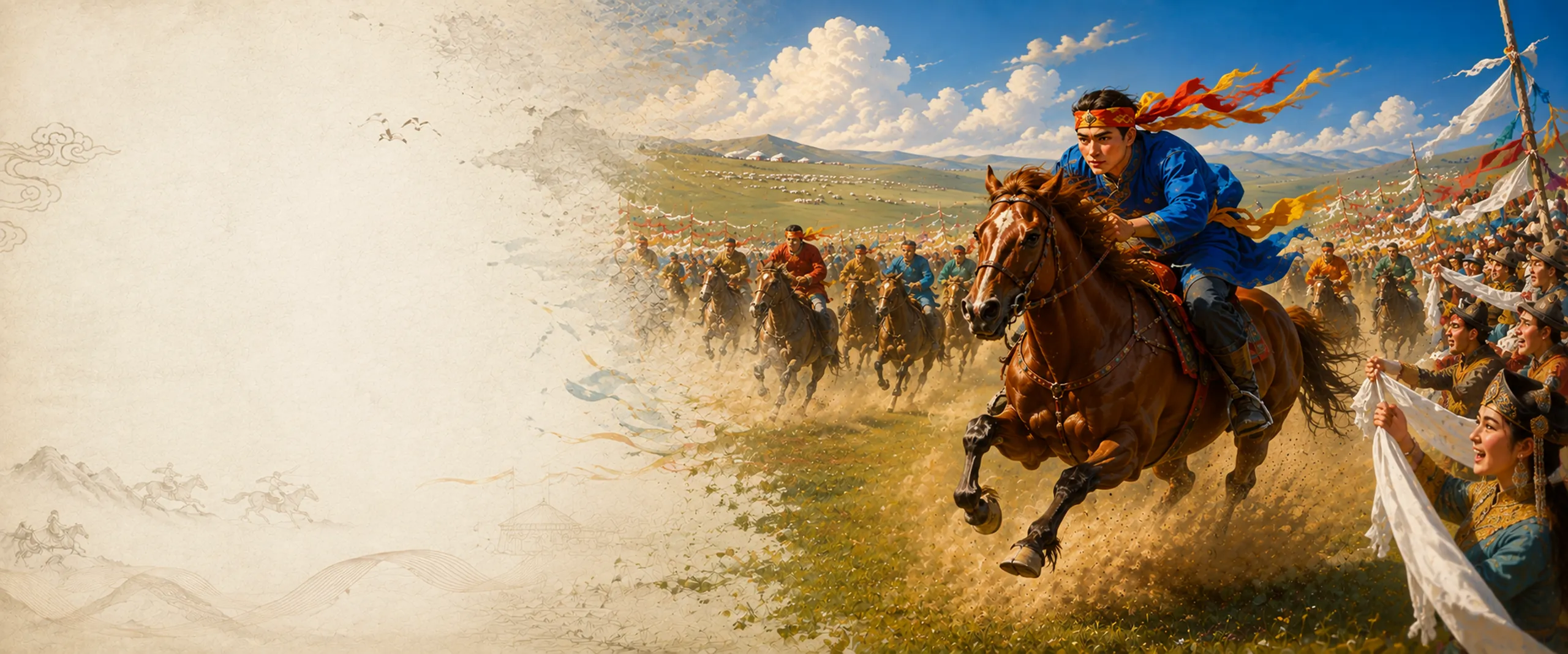
Naadam is a traditional festival with a long history among the Mongolian people. “Naadam” is a Mongolian transliteration meaning “entertainment” or “games,” generally held in summer and autumn when the grass and water are plentiful. The most…

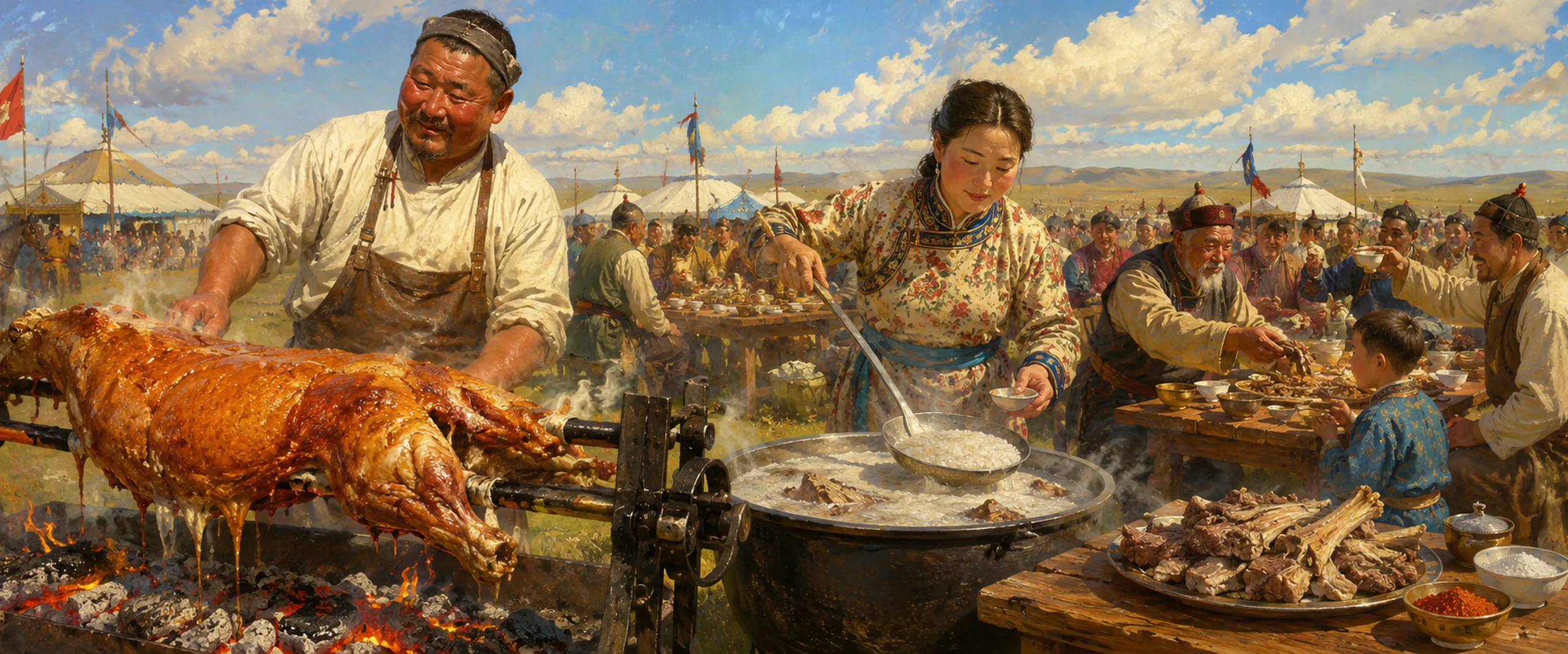
Naadam is a traditional Mongolian festival with a long history, and food is woven deeply into the celebration. Among its many dishes, none is more representative than whole roasted lamb. Golden on the outside and rich with roasted fragrance, it stands as the highest form of hospitality in Mongolian culture.

Hand-held mutton belongs to an equally enduring tradition. Large pieces of lamb are simmered in plain water and eaten by hand, allowing the meat to retain its most direct and natural freshness. Dairy foods, meanwhile, form the essence of Mongolian culinary culture. Cheese, dried milk products, cream, milk curds, milk tofu, yogurt, and many other varieties reveal both remarkable diversity and a distinctive range of flavors. During Naadam, visitors may also drink butter milk tea.

These foods do more than satisfy the appetite. They carry within them the deep foundations of Mongolian nomadic culture. Interwoven with horse racing, wrestling, archery, and other traditional competitions, they complete the vivid and many-layered picture of Naadam.

Naadam / Cuisine of Naadam

Festival Food Gallery

Seasonal Menu

Food in Detail

Seeking the True Flavor

Hand-Held Mutton

Meat & Seafood

Basic Information

  • Category: Stewed meat
  • Popular Areas: Throughout Inner Mongolia, especially Xilingol and Hulunbuir
  • Main Ingredients: Free-range grassland sheep, preferably around two years old, salt
  • Also Known As: Hand-pulled mutton, hand-grabbed mutton, Mongolian hand-held mutton

Historical Origins

Hand-held mutton has been part of Mongolian food tradition for centuries, and it is said that only on the grasslands can one taste the dish in its most authentic form. Its name comes directly from the way it is eaten. After washing the hands, one grips the meat with one hand and holds a knife in the other, cutting every strip of flesh cleanly from the bone.

Yet hand-held mutton is more than a method of cooking or eating. It has become a cultural symbol, “holding within it our love for the grasslands, our reverence for our ancestors, and our enthusiasm for life.” At Naadam, it belongs to the festival’s most solemn forms of feasting. When guests arrive at home, it becomes one of the most sincere expressions of welcome. During holidays and festivals, it is associated with reunion.

Its history is inseparable from centuries of Mongolian nomadic life. Generation after generation lived by herding on the grasslands, where sheep were among the most important animals in pastoral society. Through long experience, Mongolian ancestors discovered that lamb needed little embellishment: simmered in plain water and seasoned with no more than a handful of salt, it could yield an exceptionally fresh and satisfying flavor. Such simplicity is not a lack of technique, but a distilled expression of the nomadic philosophy of “taking from nature while respecting nature.”

Cultural Meaning

Hand-held mutton is usually made from a well-fattened, tender sheep, often around two years old and raised on grassland pasture. The lamb is cut into several large pieces and placed in a pot of plain water to simmer. Seasoning remains deliberately restrained: only a small handful of salt is added, or the meat is salted shortly before being removed from the pot.

When cooked properly, the meat is done without becoming tough, tender and flavorful, neither overly gamey nor greasy, and easy to digest. Sheep raised by herders feed on wild onions and many varieties of grass; with meat shaped by this pasture, little more than water and salt is needed.

The way hand-held mutton is eaten is unmistakably grassland in character. A piece is lifted while still hot, or simply taken in the hand and brought straight to the mouth. The meat is chewed in broad, hearty mouthfuls; torn fibers mingle with rich juices before being swallowed with satisfaction.

If the richness begins to linger, a few bites of sour, salty pickled vegetables quickly refresh the mouth and stimulate the appetite. One may then raise a mug and drink a generous serving of baijiu or beer.

Hand-held mutton carries several layers of meaning within Mongolian food culture. First, “the highest hospitality.” It is among the most sincere dishes offered to guests. Second, “the flavor of the festival.” At Naadam, hand-held mutton belongs to the most solemn expressions of festive dining. Third, “the flavor of reunion.” During holidays and celebrations, it becomes a symbol of people coming together. Fourth, “the beauty of original flavor.” Simmering lamb in plain water with little more than salt is perhaps the clearest expression of confidence in the meat itself.

Simple Preparation

  • Ingredients: 1,000 g grassland lamb ribs or leg, salt as needed
  • Steps:
  1. Cut the lamb into large pieces, approximately 200–300 g each, and place them in a pot of cold water.
  2. Bring to a boil over high heat, skim off the foam, then reduce to medium heat and simmer for about 40–50 minutes, adjusting according to the size of the pieces.
  3. Add salt shortly before removing from the pot; alternatively, serve with salt for dipping.
  4. Eat while hot, holding the meat in the hand, accompanied by chive-flower sauce or garlic chili sauce.

Tip: Free-range grassland sheep are preferred for their fuller natural flavor. Add enough water at the beginning and do not replenish it during cooking. Hand-held mutton should be “cooked through without becoming tough”; control of the heat is essential.

Whole Roasted Lamb

Meat & Seafood

Basic Information

  • Category: Barbecued meat
  • Popular Areas: Throughout Inner Mongolia, especially Xilingol and Alxa
  • Main Ingredients: Whole lamb, salt, spices
  • Also Known As: Whole-lamb banquet, whole roasted lamb, whole-lamb roast

Historical Origins

Whole roasted lamb is one of the indispensable centerpieces of a Mongolian feast and an undisputed star of Naadam and other major celebrations. More than a spectacular dish, it carries the full warmth of grassland hospitality and represents the highest honor extended to a distinguished guest.

At Naadam, the whole roasted lamb often appears at the most animated moment of the gathering. Its fragrance travels through the open air before the dish itself comes into view; then the golden surface of the lamb draws the attention of the crowd. Aroma, color, and ceremony converge in a single presentation.

The history of whole roasted lamb is closely tied to Mongolian traditions of ritual sacrifice and celebration. In traditional belief, a whole sheep served as an important offering to Heaven and Earth, ancestors, and deities. Naadam itself arose from oboo sacrificial rites, and whole roasted lamb gradually moved from ritual offering to festive banquet, from “honoring the divine” toward “delighting people.”

Its preparation changed with time as well. Early roasting over an open flame developed into slow cooking in specially designed ovens, giving rise to the qualities prized today: a yellow-red surface, crisp skin, tender flesh, richness without heaviness, and a deeply roasted fragrance.

Cultural Meaning

Whole roasted lamb is made from freshly slaughtered sheep, ensuring the freshness of the meat. Once prepared and seasoned, the lamb is placed in a roasting oven, the opening is sealed, and the meat is slowly cooked over gentle heat.

The finished lamb is yellow-red and glossy, its skin crisp and its flesh tender. Rich without being greasy, it combines a delicate crispness with pronounced roasted aroma. At Naadam food-experience areas, whole roasted grassland lamb and other characteristic dishes are served in abundance.

Whole roasted lamb carries some of the highest meanings within Mongolian food culture. First, “the highest hospitality.” It is the supreme honor offered to distinguished guests. Second, “the soul of the festival.” Whole roasted lamb is an undisputed centerpiece of Naadam. Third, “the flavor of the grasslands.” Its aroma spreading through the open steppe is one of the most immediate sensory expressions of grassland life. Fourth, “reverence for fire.” The slow roasting of an entire lamb belongs to the same cultural lineage as Mongolian reverence for fire. Fire is one of the most sacred elements of grassland life, and food prepared through it becomes an expression of respect toward the fire deity.

Mongolian Milk Tea (Pot Tea)

Drinks & Fine Wines

Basic Information

  • Category: Dairy beverage
  • Popular Areas: Throughout Inner Mongolia
  • Main Ingredients: Brick tea, fresh cow’s milk, salt, roasted rice, milk skin, milk tofu, butter
  • Also Known As: Pot tea, salted milk tea, Mongolian salted milk tea

Historical Origins

Mongolian milk tea is woven into everyday life and also plays an important role in receiving guests during Naadam. In Inner Mongolia, milk tea is characteristically savory rather than sweet. Milk and brick tea are simmered together in a pot according to traditional methods; milk tofu, cheese, milk skin, air-dried meat, roasted rice, and other ingredients may then be added and cooked directly in the tea.

A copper pot is brought to the table. The tea is ladled into bowls, and the thin layer of butter floating on the surface is gently blown aside before drinking. After a bowl, the fragrance lingers on the lips and teeth.

The origins of Mongolian milk tea are closely tied to the demands of life in cold grassland regions. Vegetables were scarce; brick tea supplied vitamins and trace elements, fresh milk supplied protein and fat, and salt replenished electrolytes. Brought together, the three formed what was effectively a grassland “all-purpose drink”—nourishing, warming, and suited to life in a harsh climate.

Milk tea is also an important part of white-food culture. To serve it in a silver bowl is regarded as one of the highest forms of Mongolian hospitality.

Cultural Meaning

The method is distinctive in its simplicity. Brick tea is broken apart, combined with milk and a small amount of salt, then brought to a boil. The result is mildly salty, deeply milky, and aromatic.

A good pot of tea is enriched with milk skin, roasted rice, and butter, and may also contain several pieces of fried dough. Bowl follows bowl: the tea quenches thirst, eases hunger, and leaves the body feeling comfortably warm and satisfied. Traditionally, Mongolian milk tea is drunk from a wooden bowl.

Inside reception yurts, visitors taste fragrant milk tea while listening to the melodies of welcoming music, encountering grassland hospitality almost immediately. Pot tea allows many foods to be enjoyed at once: besides the tea itself, the pot may contain fried dough, roasted rice, hand-held mutton or air-dried meat, milk skin, milk tofu, and more.

Mongolian milk tea carries the deeper meaning of “grassland warmth.” First, “warmth of the highlands.” On a cold morning across the steppe, a steaming bowl of milk tea is one of the simplest forms of comfort. Second, “the ritual of hospitality.” It is among the first drinks offered to guests, and its mellow aroma carries the warmth and generosity of the host. Third, “the soul of white foods.” Milk tea gathers milk skin, milk tofu, butter, and roasted rice into a single bowl, becoming a concentrated expression of the grassland wisdom of “bringing many things together.”

Milk Tofu (*Huruuda*)

Drinks & Fine Wines

Basic Information

  • Category: Dairy product
  • Popular Areas: Throughout Inner Mongolia
  • Main Ingredients: Cow’s milk, sheep’s milk, mare’s milk
  • Also Known As: Huruuda, white milk tofu, Chagan Ide

Historical Origins

Milk tofu, known in Mongolian as Huruuda, is a familiar dairy food in pastoral households. Made from cow’s milk, sheep’s milk, or mare’s milk through coagulation and fermentation, it resembles ordinary tofu in shape, hence its Chinese name. Milk tofu belongs to the category of Chagan Ide, or white foods, and its preparation requires fresh milk to be fermented, simmered, and reduced.

Its history is closely bound to nomadic life. On the grasslands, fresh milk was abundant but difficult to preserve. Mongolian ancestors developed techniques of fermenting, simmering, reducing, and solidifying milk, transforming a highly perishable ingredient into milk tofu that could be stored over long periods and kept as an important winter reserve.

In this way, milk tofu became more than a dairy product. It came to embody a practical form of pastoral intelligence—the wisdom of “exchanging time for flavor.”

Cultural Meaning

Fresh cow’s milk, sheep’s milk, or mare’s milk is first fermented, then poured into a pot and simmered. Constant stirring encourages the moisture to evaporate gradually. As the liquid thickens and concentrates, it is transferred into molds and left to cool and set.

The finished milk tofu is pale and tender in appearance, yet firm in texture, with a full milk aroma. Mongolian dairy foods are remarkable for both their variety and their distinctive flavors; they “are not only an important part of everyday pastoral diets, but also carry the rich culture of the grasslands.”

Milk tofu can be eaten in many ways. It may be enjoyed on its own or placed in a steaming bowl of Mongolian milk tea, together with milk skin, butter, and roasted rice. The result is smooth, mellow, and layered—soft without becoming mushy, rich without becoming greasy.

Milk tofu carries the deeper meanings of white-food culture. First, “purity and auspiciousness.” Its white color resonates with Mongolian ideas of purity, good fortune, and nobility. Second, “the ritual of hospitality.” White foods represent the highest honor shown to guests. Third, “the roots of the grasslands.” Milk tofu belongs to the core of everyday pastoral diets and stands as one of the clearest expressions of nomadic culinary wisdom.

Roasted Leg of Lamb

Meat & Seafood

Basic Information

  • Category: Barbecued meat
  • Popular Areas: Throughout Inner Mongolia
  • Main Ingredients: Hind leg of lamb, salt, spices
  • Also Known As: Roasted lamb leg, charcoal-roasted lamb leg

Historical Origins

Roasted leg of lamb is a widely enjoyed grassland specialty at Naadam. Alongside hand-held mutton, milk skin, cheese, and other foods, it is one of the best-known dishes in Mongolian-inhabited regions. Banquets featuring lamb saddle, hand-held mutton, roasted lamb leg, whole roasted lamb, grilled beef steak, blood sausage, and other ethnic specialties are themselves an important part of the festival.

The dish grew from the Mongolian practice of making full use of sheep in nomadic life. The hind leg is one of the most active parts of the animal, giving the meat a firm texture and satisfying chew. Over time, Mongolian cooks discovered that slow roasting over charcoal could brown and crisp the exterior while keeping the inside tender, filling the air with the fragrance of lamb and fire.

At Naadam, hand-held mutton, meat stuffed in tripe, roasted lamb ribs, and other dishes are often prepared fresh on site.

Cultural Meaning

Roasted leg of lamb carries the meaning of “the flavor of the grasslands.” Browned and crisp on the outside, tender within, and rich with roasted aroma, it is one of the most immediate culinary expressions of grassland character. Together with whole roasted lamb and hand-held mutton, it forms one of the three major pillars of Naadam’s “red food” tradition.

Blood Sausage and Meat Sausage

Meat & Seafood

Basic Information

  • Category: Stuffed meat products
  • Popular Areas: Throughout Inner Mongolia
  • Main Ingredients: Lamb blood or beef blood, buckwheat flour, sheep intestines, lamb
  • Also Known As: Blood sausage, meat sausage, lamb blood sausage

Historical Origins

Blood sausage and meat sausage are among the most distinctive stuffed-meat foods in Mongolian cuisine and are widely enjoyed at Naadam. Both occupy an important place in traditional food culture, and in the sheep-food sections of the festival they are considered indispensable dishes.

Their origins lie in the pastoral principle of “making full use of everything.” After an animal was slaughtered, blood and intestines were not regarded as waste. Mongolian ancestors discovered that sheep blood could be mixed with buckwheat flour and spices, filled into intestinal casings, and boiled to make blood sausage. Chopped lamb could be stuffed in the same way to make meat sausage.

What might otherwise have been discarded was transformed into food. This practical intelligence became part of the distinctive culinary culture created through life on the grasslands.

Cultural Meaning

Blood sausage and meat sausage embody the grassland wisdom of “making full use of everything.” Turning sheep blood, intestines, and meat alike into food reflects the Mongolian people’s care for, and gratitude toward, the gifts of nature. The “red” of blood sausage and the “red” of meat sausage together form an important part of Naadam’s red-food culture.

Lamb Offal

Soups, Broths & Congee

Basic Information

  • Category: Soup / stewed dish
  • Popular Areas: Throughout Inner Mongolia
  • Main Ingredients: Lamb organs including heart, liver, lung, intestines, and tripe; lamb-bone broth
  • Also Known As: Lamb-offal soup, mixed lamb offal

Historical Origins

Lamb offal is one of the most deeply everyday foods of grassland cuisine. Made from the internal organs of the sheep—heart, liver, lung, intestines, tripe, and more—it is simmered with lamb-bone broth into a dish rich in warmth and aroma. At Naadam, lamb offal occupies an important place in the sheep-food section.

Its origins lie in the same pastoral principle of making complete use of the animal. After slaughter, the organs were no less valuable than the meat itself and were not to be wasted. Mongolian cooks discovered that simmering them together with lamb bones produced a broth of deep savor, while the offal softened and absorbed the richness of the soup.

For this reason, lamb-offal soup became one of the grasslands’ most unmistakably lived-in, everyday foods.

Cultural Meaning

The preparation demands care. The offal is washed repeatedly to remove unwanted odors, blanched, then simmered with lamb bones. Scallion, ginger, Sichuan peppercorn, salt, and other seasonings are added.

The finished broth is rich yet clear, the offal tender without overpowering gaminess, and the overall flavor deep, savory, and aromatic. A steaming bowl warms the body and awakens the appetite.

Lamb offal carries the meaning of “the everyday warmth of the grasslands.” It is one of the foods most closely associated with ordinary pastoral life. A hot bowl offers a simple, direct kind of comfort.

Amusu (Auspicious Congee)

Soups, Broths & Congee

Basic Information

  • Category: Congee / thick porridge
  • Popular Areas: Zhaowuda League, especially Ongniud, Inner Mongolia
  • Main Ingredients: Yellow millet, milk, cream, butter, yogurt, brown sugar
  • Also Known As: Auspicious Congee, mixed congee, Amusu

Historical Origins

Amusu is a traditional Mongolian mixed congee, also called “Auspicious Congee.” Popular in the Ongniud region, it has a history of more than a thousand years. It is a thick mixed porridge served on major occasions, including fire sacrifices, oboo sacrifices, Naadam, weddings and funerals, and Buddhist temple ceremonies.

After the craft of making Amusu was listed as county-level intangible cultural heritage in Kailu County, it was included in Tongliao City’s municipal intangible cultural heritage list in 2022. In 2024, Ongniud Banner added the “Craft of Making Amusu (Auspicious Congee)” to its eighth batch of banner-level intangible cultural heritage projects.

The history of Amusu is closely connected with Mongolian sacrificial traditions. At important religious ceremonies such as fire sacrifices and oboo rites, it is an indispensable ritual food. Amusu is divided into two principal forms: a white-food version, made by cooking yellow millet with milk, cream, and butter; and a meat version, combining beef or mutton with rice, yogurt, and other ingredients.

The white-food version symbolizes purity and auspiciousness. In the meat version, beef cavity bones are simmered for 18–25 hours until the meat comes away from the bone, then combined with red dates, raisins, and other ingredients. With both “white” and “red” forms, Amusu becomes a distinctive expression of the meeting between Mongolian white-food and red-food traditions.

Cultural Meaning

For white-food Amusu, cream is first brought to a boil and mixed with water. Yogurt, brown sugar, salt, and soaked rice are then added and simmered gently, after which butter is stirred through the mixture.

For the meat version, beef cavity bones are simmered for 18–25 hours until the meat separates from the bone, then combined with red dates, raisins, and other ingredients.

Amusu brings many ingredients together in a single bowl. In doing so, it becomes a concentrated expression of the culinary wisdom of “bringing all things together.”

Amusu carries the deeper meaning of “auspiciousness and fulfillment.” First, “congee for honoring the divine.” It is a ritual food served at fire sacrifices, oboo ceremonies, Naadam, Buddhist temple gatherings, and other important occasions. Second, “the meaning of auspiciousness.” Its alternative name, “Auspicious Congee,” makes the symbolism explicit: eating Amusu expresses a wish for good fortune in the year ahead. Third, “the meeting of white and red.” With both white-food and meat versions, Amusu embodies the integration and harmony of Mongolia’s two great culinary categories.

Food Culture

Foodways

Viewed as a whole, the food traditions of Mongolian Naadam reveal a cultural logic that runs through the festival from beginning to end:

I. “White” as the highest honor. Mongolian culture holds the color white in particular esteem, associating it with purity, auspiciousness, and nobility. Dairy foods are collectively known as Chagan Ide, or “white foods.” In Mongolian custom, white foods embody purity, good fortune, and exalted status; to receive a guest with them is to offer one of the highest forms of respect.

White foods stand at the heart of traditional Mongolian cuisine. Made from cow’s milk, sheep’s milk, mare’s milk, and camel’s milk through processes such as coagulation and fermentation, they take many forms: milk tofu, milk skin, urumo, butter, yogurt, milk wine, and more. They are central to everyday pastoral life, yet they also occupy an indispensable place in hospitality, where they carry a sense of sanctity. Milk tea served in a silver bowl is regarded as one of the highest expressions of Mongolian courtesy toward a guest. Through this culture of white foods, ideals of “purity” and “sacredness” are given a visible and edible form.

II. “Red” as abundance. Mongolian meat foods are collectively called Ulan Ide, or “red foods.” At Naadam, red foods take center stage. Whole roasted lamb is the supreme dish for honored guests; hand-held mutton has been eaten by Mongolian communities for centuries.

Around the competition grounds, large iron pots simmer with great pieces of lamb. Vendors lift the meat from the broth and place it into broad bowls. Diners seize a piece while it is still hot, sometimes with chopsticks, sometimes simply with the hand, and bite into it in generous mouthfuls. The meat pulls apart into fibers, its juices spreading richly across the palate. This way of “eating meat in great mouthfuls” is one of the most immediate culinary expressions of the bold and resolute temperament traditionally associated with Mongolian grassland life.

Yet red-food culture is not only about abundance or appetite. Beneath its vigor lies gratitude for what nature has given, together with admiration for the strength and vitality of life itself.

III. The “original” as flavor. At the heart of Mongolian cooking is a commitment to the original character of the ingredient itself. What comes from the grassland is treated with remarkable restraint: cooking strips away complication, while seasoning serves only to bring the ingredient’s own flavor into clearer relief.

Hand-held mutton asks for little more than water and a small handful of salt—sometimes not even added until the meat is ready to leave the pot. The sheep raised by herding families grow on wild onions and the varied grasses of the steppe; with meat of this quality, plain water and salt are enough. Whole roasted lamb begins from the same confidence in freshness, using meat from a newly slaughtered animal.

Behind this apparent simplicity lies a culinary philosophy of “the great Way made simple”: an absolute trust in the quality of the ingredient, joined to deep respect for what nature has provided.

IV. “Courtesy” as affection. Naadam food is never only about taste. It is also a language of etiquette and human feeling. The whole-lamb banquet is an undisputed centerpiece of the festival, and whole roasted lamb represents the highest honor that can be offered to an esteemed guest. Traditional banquets featuring lamb saddle, hand-held mutton, roasted lamb leg, and other ethnic specialties are themselves an important part of Naadam.

Dairy foods carry an equally strong sense of grassland culture. Naadam also functions as a fair for agricultural and pastoral goods, and butter milk tea can be found at tea stalls and restaurants throughout the gathering. In this setting, food becomes one of the most direct ways in which the people of the grasslands express warmth, openness, and hospitality.

Regional Distribution

Foodways
Region Distinctive Naadam Foods
Xilingol League Whole roasted lamb, hand-held mutton, stone-roasted meat, hot-pot mutton, lamb shank bones, meat stuffed in tripe, blood sausage, meat sausage, lamb offal, lamb head, lamb trotters, grilled lamb skewers; lamb pies, lamb buns, lamb soup with butter rolls; Xilingol cheese, milk jiaoke, milk skin, milk tofu, butter, yogurt, milk tea; Sunite mutton
Hulunbuir City Hand-held mutton, charcoal hot-pot mutton in copper pots, Buryat buns with thin wrappers and generous fillings, bursting with juices and a pronounced milky aroma; pot tea, red-headed lamb skewers, copper-pot milk tea, candied milk skin; Russian-style Western dishes such as borscht, clay-pot beef, and Russian sausage; Hulunbuir blueberry wine
Tongliao City Horqin beef pies, a municipal-level intangible cultural heritage food, with daily sales reaching 1,500 pieces; hand-held mutton, Horqin Mongolian pies, creative dairy products
Chifeng City Chifeng duijia, an intangible-cultural-heritage food with crisp pastry enclosing smoked meat and juices that burst at the first bite; intangible-heritage barbecue from the Harqin Prince’s Mansion; Mongolian dairy foods, wheat-based foods, and milk tea
Hinggan League Whole roasted lamb, intangible-heritage roasted lamb leg, large skewers of suspended fresh lamb; Choer River grilled fish, Tianmuzhen beef; multicolored rice cakes, Zhalaite rice; Mongolian Flavor Food Market featuring authentic Mongolian dishes, fragrant dairy foods, and grassland barbecue
Alxa League Alxa camel milk, camel-milk curds, camel-milk ice cream; air-dried camel meat, cistanche drinks; Mongolian wucha traditional meat dishes, hand-held mutton, dairy products
Baotou City (Damao Banner) Damao-style Mongolian cuisine featuring high-quality beef and mutton, fresh milk, and wheat-based foods; Damao lamb shaomai, blood sausage; hand-held meat, local lamb skewers cut and grilled to order, tender and juicy; whole roasted lamb, grassland-style hot-pot meat
Bayannur City Bayannur sunflower seeds
Ulanqab City Lamb saddle, hand-held mutton, roasted lamb leg, whole roasted lamb, grilled beef steak, blood sausage; assorted dairy products
Subei, Gansu Traditional roasted lamb ribs with crisp exterior and abundant juices; authentic hand-held mutton slowly simmered in plain water to preserve its natural freshness; Buryat buns; pulled-sugar milk skin, handmade milk tofu, fragrant milk tea, and other dairy desserts
Wuhan (Mulan Grassland) Xilingol lamb tasting, Xilingol cheese tasting, salted milk tea, fried pastries, air-dried meat, large-pot stewed meat stuffed in tripe

Additional Notes:

  • Red foods and white foods: Mongolian cuisine distinguishes between “red foods,” centered on meat, and “white foods,” centered on dairy. Lamb lies at the core of red-food culture: whole roasted lamb is indispensable to a major Mongolian feast, while hand-held mutton is one of the most distinctive traditional dishes. White foods are represented by dairy products. Milk jiaoke is produced through the natural fermentation and coagulation of fresh cow’s milk, and 10 jin of fresh milk are required to make just 1 jin.
  • Five-Livestock Banquet: Naadam in Xilinhot has introduced a themed feast titled “Five Livestock at One Banquet · The Finest Flavors of the Grassland,” with five separate tasting areas devoted to sheep, goats, cattle, horses, and camels. The sheep area serves whole roasted lamb, hand-held mutton, and related dishes; the goat area offers whole stewed goat and mutton stews; the beef area features whole roasted cattle and air-dried beef; the horse area serves fermented mare’s milk and mare’s milk wine; and the camel area presents a whole-camel banquet including air-dried camel meat, stone-roasted camel meat, braised camel hoof, clear-stewed camel hump, roasted camel ribs, and other dishes.
  • New forms of Naadam cuisine: Modern Naadam has evolved from a traditional grassland gathering into a tourism-oriented festival integrating culture and travel. Food exhibition areas bring together specialty products from all twelve leagues and cities of Inner Mongolia, displayed in dedicated Mongolian yurts filled with local goods. At the same time, new grassland dairy creations have emerged, including Mongolian-style salted milk-tea yogurt and milk-skin lattes, precisely tuned to the tastes of younger visitors.

Closing Reflections

Foodways

Autumn wind moves across the grasslands, stirring the five-colored prayer flags, and the cooking smoke of Naadam begins to rise through the plaintive resonance of the morin khuur. In Mongolian, Naadam means “games” or “entertainment,” yet the grandest festival of the grasslands has never been complete without the paired presence of “red foods” and “white foods.” Mongolians call meat Ulan Ide, or “red food,” and dairy Chagan Ide, or “white food.” Red food expresses warmth and generosity; white food is reserved for the highest honor. Between them lies a cultural temperament in which strength and gentleness are held in balance.

Whole roasted lamb is the undisputed great dish of the Naadam banquet. Freshly slaughtered meat is slowly roasted over gentle heat for several hours, until the skin grows crisp and taut and the pale flesh takes on an even golden sheen. When people gather around it, small knives slice through the crisp outer layer into the tender meat beneath, and the most direct boldness of the grasslands is felt in the act of sharing and eating. Hand-held mutton returns to an even greater simplicity. The lamb is divided into pieces, simmered in plain water, and seasoned with only a handful of salt. Cooked through yet never tough, tender without heaviness, fresh without gaminess, it is perhaps the grassland’s most open declaration of confidence in the ingredient itself.

If red food gives Naadam its intensity, white food gives it warmth. Mongolian herders regard dairy foods as treasures: milk tofu, milk skin, urumo, butter, yogurt, milk wine—each with its own texture, fragrance, and place in grassland life. And among them, the bowl of savory Mongolian milk tea is one of the festival’s defining tastes. Brick tea is broken apart and simmered with milk, seasoned with a little salt, then accompanied by roasted rice, milk tofu, and air-dried meat. The bowl is warm in the hands; after drinking, its milky fragrance remains on the lips and teeth.

The culinary landscape of Naadam continues to expand. In Xilingol, the “Five Livestock at One Banquet” gives sheep, goats, cattle, horses, and camels their own tasting areas. On the grasslands of Subei, Buryat buns appear alongside pulled-sugar milk skin. Elsewhere, meat pies are cooked fresh in intangible-cultural-heritage workshops, while in Arxan, “Liuke” buns are prepared before an eighty-meter-long oven. Grassland food now greets visitors from every direction in an ever richer range of forms.

Yet beneath these new expressions, its cultural core remains unchanged. To eat at Naadam is to taste the abundance that Heaven and Earth have bestowed upon cattle and sheep, but also to encounter the life philosophy of a nomadic people: reverence for nature, generosity toward others, and an open-hearted way of meeting the world. When the bonfire is lit and the singing begins, the aroma of hand-held mutton and the warmth of milk tea mingle in the night air of the grasslands. In that meeting of fire, food, song, and hospitality lies one of Naadam’s simplest promises—the enduring bond between the Mongolian people, Heaven and Earth, and guests who have come from afar.

—-

Continue exploring Naadam culture

Readers’ Comments

Calendar and traditional culture enthusiasts from around the world, sharing the same moon.

Sign in or register to join the conversation. Your comment account is created automatically the first time you use a connected account.