Mongol Empire Period
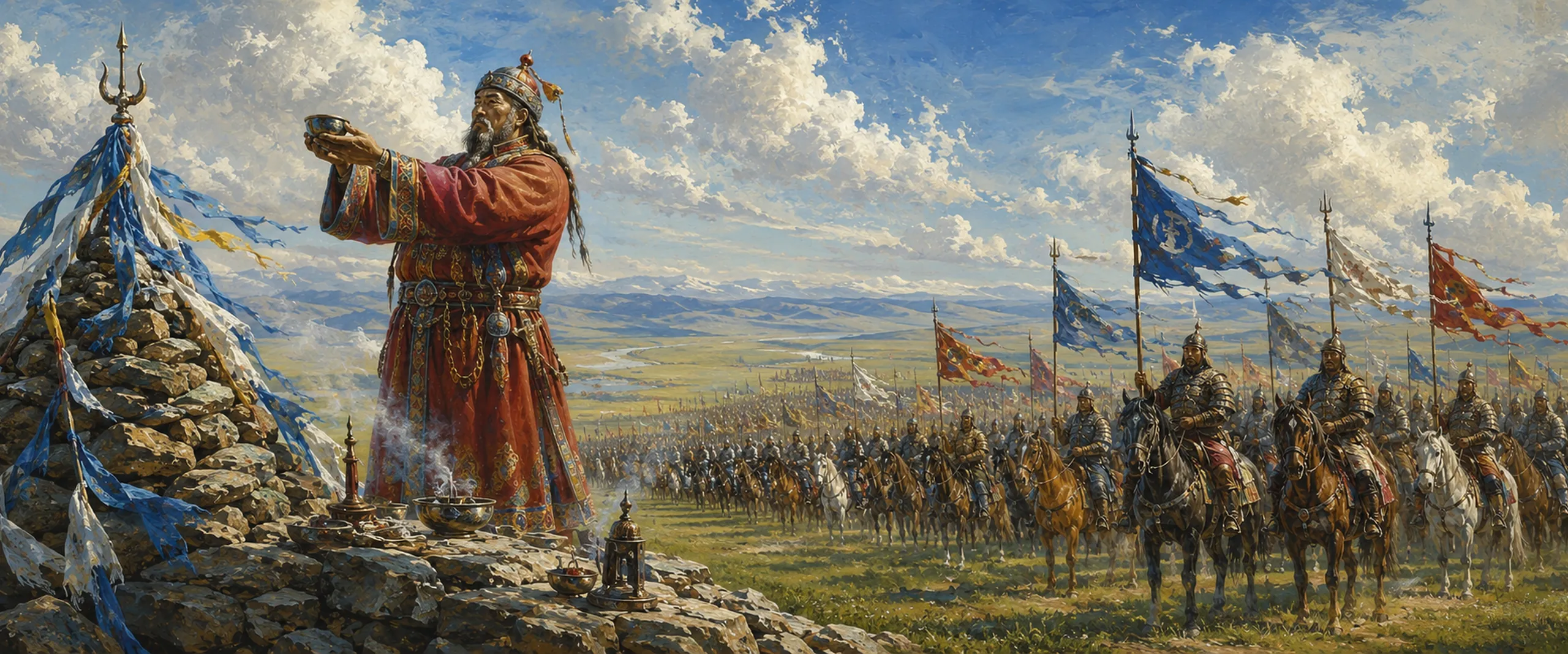
The predecessor of Nadam can be traced back to the Ovoo sacrifice and shamanist beliefs of the Mongolian ancestors. Before the establishment of the Mongol Empire, the nomadic tribes scattered across the grasslands, whenever the grass and water were lush, held sacrificial ceremonies at the Ovoos. After the sacrifices, people held horse racing, archery, wrestling, and other competitive activities to display strength, select warriors, and unite the tribe. This tradition of “Ovoo sacrifice” was the oldest source of Nadam—the carnival flower blooming from the solemn religious altar.
In 1206, Genghis Khan unified the tribes of the Mongolian Plateau and established the Great Mongol Empire. To consolidate the new regime, strengthen cohesion among the tribes, inspect his troops, and maintain and allocate pastures, Genghis Khan held a “Great Khuriltai” (great assembly) every July–August. This “Great Khuriltai” was not only a political occasion for discussing state affairs, enacting laws, appointing and removing officials, and meting out rewards and punishments, but also a grand celebration. During the gatherings, to show solidarity and friendship and to pray for a good harvest, Nadam activities were always held.
The earliest precise record of Nadam comes from the *Genghis Khan Stone Inscription* (also known as the *Genghis Khan Stele*), carved in Uighur‑Mongolian script on a cliff in 1225. This inscription records that Genghis Khan, to celebrate his victory over the Khwarezmian Empire, held a grand Nadam at Bukha Suqihai, where an archery competition was held. This was the first appearance of Nadam in historical records, marking its entry from folk tradition into the grand narrative of national history.
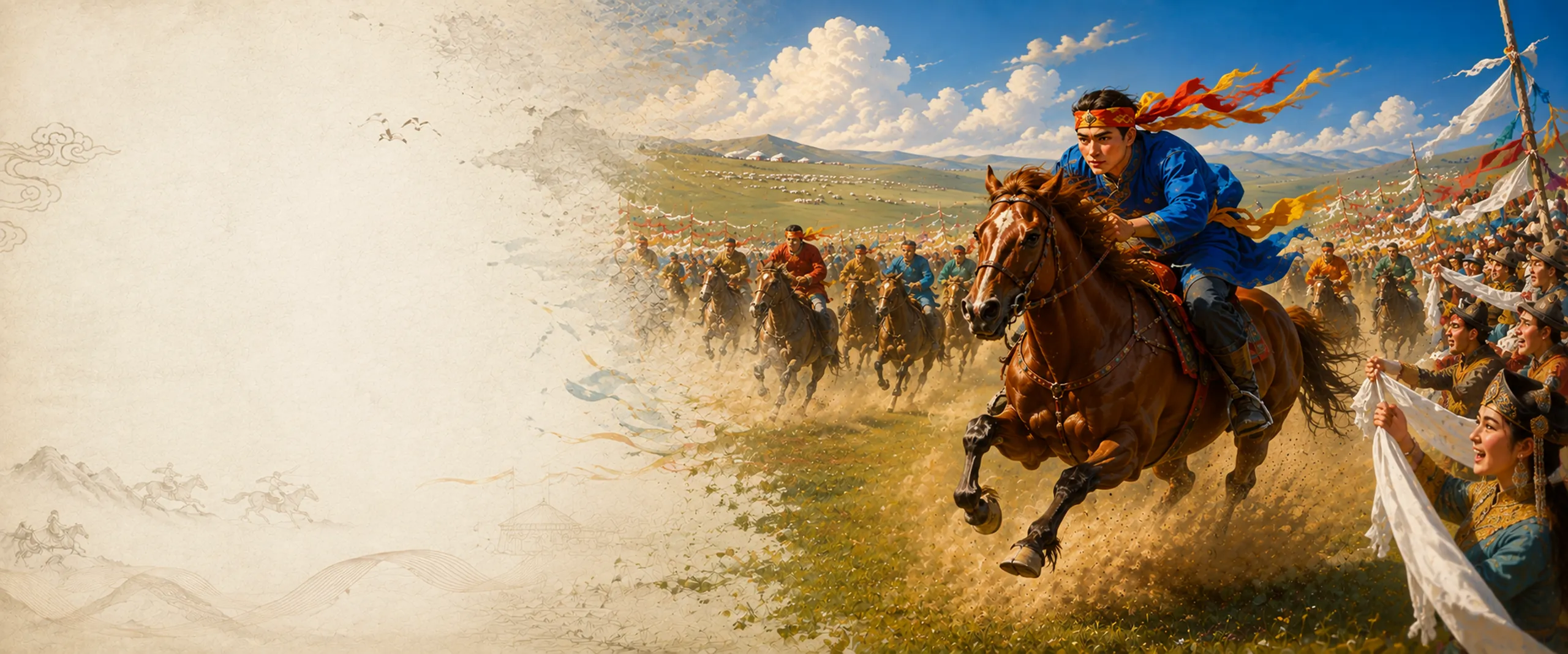
Genghis Khan placed great value on cultivating courage, resourcefulness, and tenacity. He collectively called horse riding, archery, and wrestling the “Three Manly Arts,” making them important content for training soldiers and the populace. Initially, the competitions may have been relatively simple, featuring only one event—archery, horse racing, or wrestling. However, by the Mongol Empire period, these three skills had already been endowed with a status surpassing mere sports, becoming the fundamental standard for measuring whether a Mongolian man was capable of venturing far and achieving greatness.
Yuan Dynasty
In 1271, Kublai Khan established the Yuan dynasty, with its capital at Dadu (modern‑day Beijing). As the Mongol rulers entered the Central Plains, Nadam also expanded from the grasslands to a broader stage. In 1260, when Kublai Khan ascended the throne in Shangdu (in present‑day Zhenglan Banner, Inner Mongolia), a grand Nadam was also held. During the Yuan dynasty, Nadam was not only a gathering of the Mongols but also an important occasion to display imperial prestige and connect with leaders of various ethnic groups.
Yuan‑dynasty Nadam, building on the traditions of the Mongol Empire, became further institutionalised and standardised. The Yuan rulers regarded the “Three Manly Arts” as a national custom and actively promoted them in the court and the military. On every major festival or state occasion, Nadam was an indispensable component. However, as the Yuan rulers penetrated deep into the Central Plains, the space for Nadam activities expanded from the grasslands to the cities, and its function grew from purely tribal cohesion to include the political significance of displaying imperial majesty and connecting with leaders of various ethnic groups.
It is worth noting that during the Yuan dynasty, the three events of archery, horse racing, and wrestling were gradually combined to form the fixed form of “Nadam,” with the “Three Manly Arts” as its main content. This process of standardisation laid the foundation for the classic form of Nadam that would follow.
Ming Dynasty
After the fall of the Yuan dynasty, the Mongol ruling group retreated to the northern grasslands, a period known in history as the “Northern Yuan.” During this period, although they had lost their political centre in the Central Plains, the Mongols still maintained their traditional nomadic lifestyle and social organisation on the grasslands. Nadam, as an important carrier of Mongolian culture, continued to be transmitted and developed on the grasslands.
In the Ming dynasty, the various Mongol tribes still held Nadam activities on major festivals, league and banner gatherings, or Ovoo sacrifices. It was precisely during this period that archery, horse racing, and wrestling were formally combined to form the fixed form centred on the “Three Manly Arts,” which has continued to the present day. Although Ming‑dynasty Nadam was not as grand or influential as the imperial court Nadam of the Yuan dynasty, it maintained vigorous vitality among the grassland populace. Nadam gatherings between tribes became an important way to maintain the social order of the steppe and promote inter‑tribal communication.
The Nadam in the Ming‑dynasty Mongol region also displayed new characteristics in its organisational form. With the constant divisions and reunifications among the Mongol tribes, the holding of Nadam no longer depended solely on a unified khan’s court but was increasingly organised autonomously by tribal chiefs. This trend towards decentralisation gave Nadam different local characteristics in various places, while preserving its core “Three Manly Arts” content.
Qing Dynasty
The Qing dynasty was an important period for the development of Nadam. To strengthen its rule over the Mongol regions, the Qing government implemented the league‑banner system. With the establishment of this system, Nadam gradually transformed from a spontaneous, loose tribal activity into a regularly held, organised, and purposeful recreational activity organised by official authorities.
During this period, Nadam was generally held once every half‑year, one or two years, or at the league, banner, or sumu level. On the basis of standardised competition rules, the three events—wrestling, archery, and horse racing—were formally designated as the fixed, mandatory competitions for every Nadam. Called the “Three Manly Arts” by the Mongols, they became the main content of Nadam culture and have continued to the present day. Competition rules, attire, and awards all became more standardised.
During the Qing dynasty, the entertainment and trade functions of Nadam were also strengthened. At that time, merchants and vendors from near and far also set up stalls, selling daily necessities and purchasing livestock products. Nadam gradually evolved from a purely sacrificial and competitive activity into a comprehensive gathering integrating competition, trade, and social interaction. The Qing government’s institutionalised management of Nadam, to some extent, weakened its spontaneity, but it also allowed this tradition to be preserved and continued within a more regulated framework.
Contemporary Era
In the 20th century, Nadam entered a new period of development. After the founding of the Inner Mongolia Autonomous Region in 1947, “Nadam” gradually became the general term for this traditional celebration, replacing historical names such as “Nair.” This change of name reflects the historical shift of Nadam from a broad tribal gathering to a sports competition centred on the “Three Manly Arts.”
In 2006, Nadam was inscribed on the first batch of China’s National Intangible Cultural Heritage list. This recognition marked the highest official affirmation of Nadam’s cultural value at the national level. As a national intangible cultural heritage, the protection and transmission of Nadam received more systematic policy support and social attention. Nadam covers an extremely wide area, and in different Mongolian settlements, it displays rich regional characteristics and transmission forms. The Nadam of Xilin Gol League is particularly representative; in 2008, the Nadam declared by Hejing County in the Xinjiang Uygur Autonomous Region was included in the national intangible cultural heritage list as an extension item.
In the 21st century, Nadam has ushered in unprecedented prosperity and development. It is no longer merely a pastime for grassland herders but has become a super IP for cultural tourism in Inner Mongolia and even nationwide. According to statistics, since 2024, Nadam activities in the Inner Mongolia Autonomous Region alone have received a cumulative total of over 6 million visitors, generating tourism revenue exceeding 4.1 billion yuan. Nadam has become a phenomenon‑level cultural tourism activity, continuously leading the emergence of new business forms and expanding consumption scenarios.
To make this intangible heritage transcend “festival‑only” status and truly integrate into the daily lives of all ethnic groups, various places in Inner Mongolia have innovatively launched the “Daily Nadam” model. Based on local customs, features, and resource endowments, they have created year‑round Nadam events, forming a “Daily Nadam” cultural tourism development matrix. Since 2024, “Daily Nadam” has flourished everywhere. This innovative model allows visitors to experience the warmth and charm of Nadam whenever they come to the grasslands, and also enables the living transmission of Nadam culture across a broader time and space.
Contemporary Nadam, while adhering to its traditional cultural core, actively embraces modern elements. From the traditional arena of the “Three Manly Arts” to a comprehensive celebration integrating more than 20 core activities—folk sports, artistic performances, intangible cultural heritage workshops, grassland music festivals, automobile Nadam, mass self‑driving tours, costume photo shoots, and more—Nadam has completed a magnificent transformation from traditional folklore to a modern cultural tourism brand.
Readers’ Comments
Calendar and traditional culture enthusiasts from around the world, sharing the same moon.
Sign in or register to join the conversation. Your comment account is created automatically the first time you use a connected account.
No comments yet
Share your thoughts with readers around the world.