From the Pre-Qin Period to the Qin and Han Dynasties
As the traditional New Year of the Qiang people, the Qiang New Year is said to have roots extending back into the pre-Qin period. The Qiang are among the ancient peoples recorded in Chinese history, and traditional historical narratives sometimes describe them as descendants of Yandi, the Yan Emperor (炎帝). Archaeological remains in areas such as Ganxi in the eastern part of present-day Beichuan also preserve evidence of human activity dating back to the late Neolithic period.
During the pre-Qin era, Qiang communities underwent an important historical transition from pastoral civilisation to settled agriculture. The transformation from “moving in search of water and pasture” to “dwelling against the mountains and building houses of stone” fundamentally changed the relationship between livelihood, seasonality, and time. Accurate observation of seasonal cycles and natural phenomena became increasingly important, encouraging the development of a distinctive ten-month solar calendar: ten months of thirty-six days each, followed by five New Year days, producing a total of 365 days.
The present association of the Qiang New Year with the first day of the tenth lunar month is traditionally linked to this ancient calendrical heritage and to the calculations of Shibi ritual specialists.
During the Qin and Han periods, Qiang populations were distributed primarily across areas corresponding to modern Sichuan, Gansu, and Qinghai, and maintained extensive cultural contact with the Central Plains. After the Qin unified the warring states, the Zhuanxu calendar (颛顼历) was promoted, taking the tenth month as the beginning of the year. The *Records of the Seasonal Customs of Jing and Chu* (《荆楚岁时记》) contains the line:
> “十月朔日,黍曜,俗谓之秦岁首。” > “On the first day of the tenth month, millet shines ripe; popular custom calls this the Qin beginning of the year.”
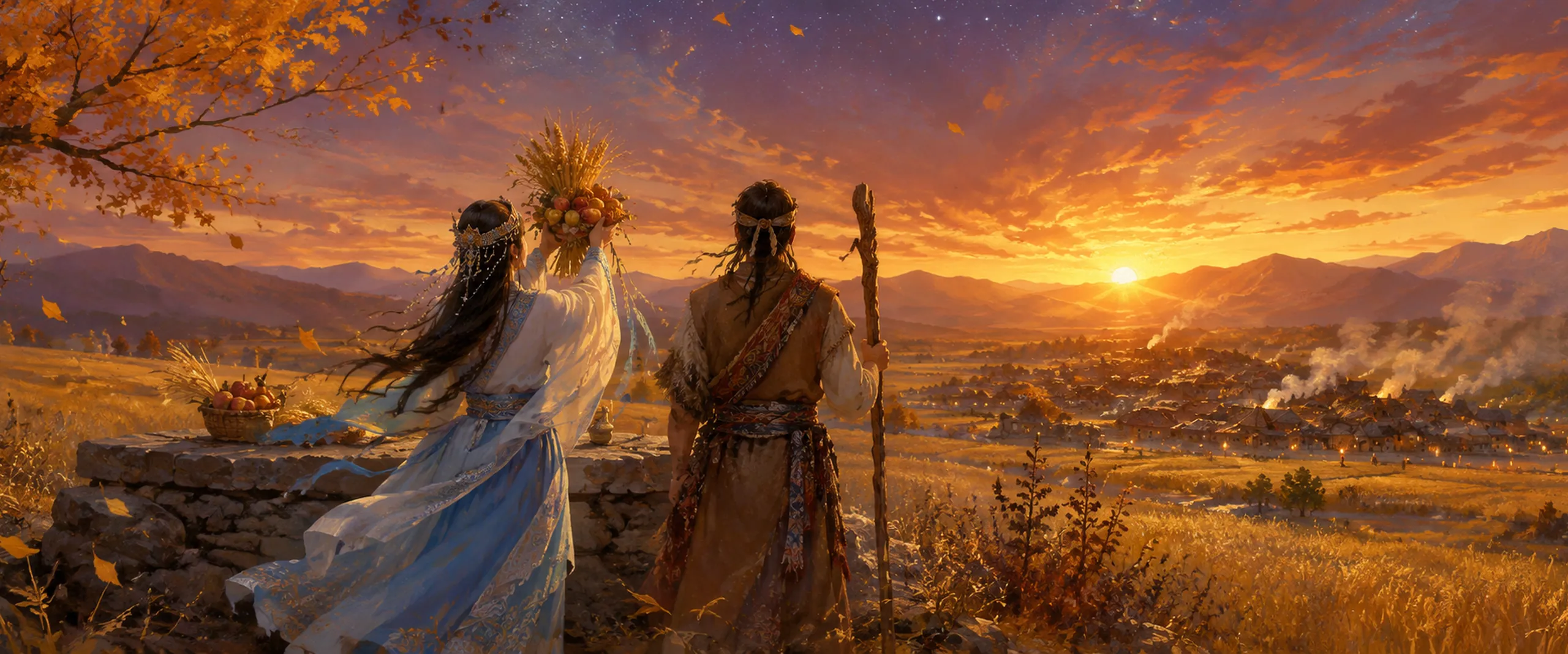
The ancient Qiang New Year was fundamentally an annual celebration of harvest and thanksgiving. Its association with the first day of the tenth lunar month therefore creates a striking historical parallel with the Qin tradition of taking the tenth month as the beginning of the year.
From the Sui and Tang to the Song and Yuan Dynasties
During the Sui and Tang dynasties, contact between Qiang communities and the Central Plains became increasingly close. After the rise of the Tibetan Empire during the Tang period, some Qiang groups gradually became culturally Tibetanised, while communities in the upper Min River valley continued to preserve relatively distinct cultural traditions. The Qiang New Year, as one of their most important festivals, continued to be transmitted and developed.
According to the surviving body of Shibi ritual texts cited in Qiang cultural tradition, the festival’s sacrificial rites and mythological narratives had already taken relatively stable form by the Tang period. The upper-altar classic Mujiezhu preserves the full narrative sequence of the Heavenly Deity’s daughter descending to the human world, the autumn sacrifice, and the establishment of the New Year celebration, suggesting that the cultural framework associated with the festival had become well developed.
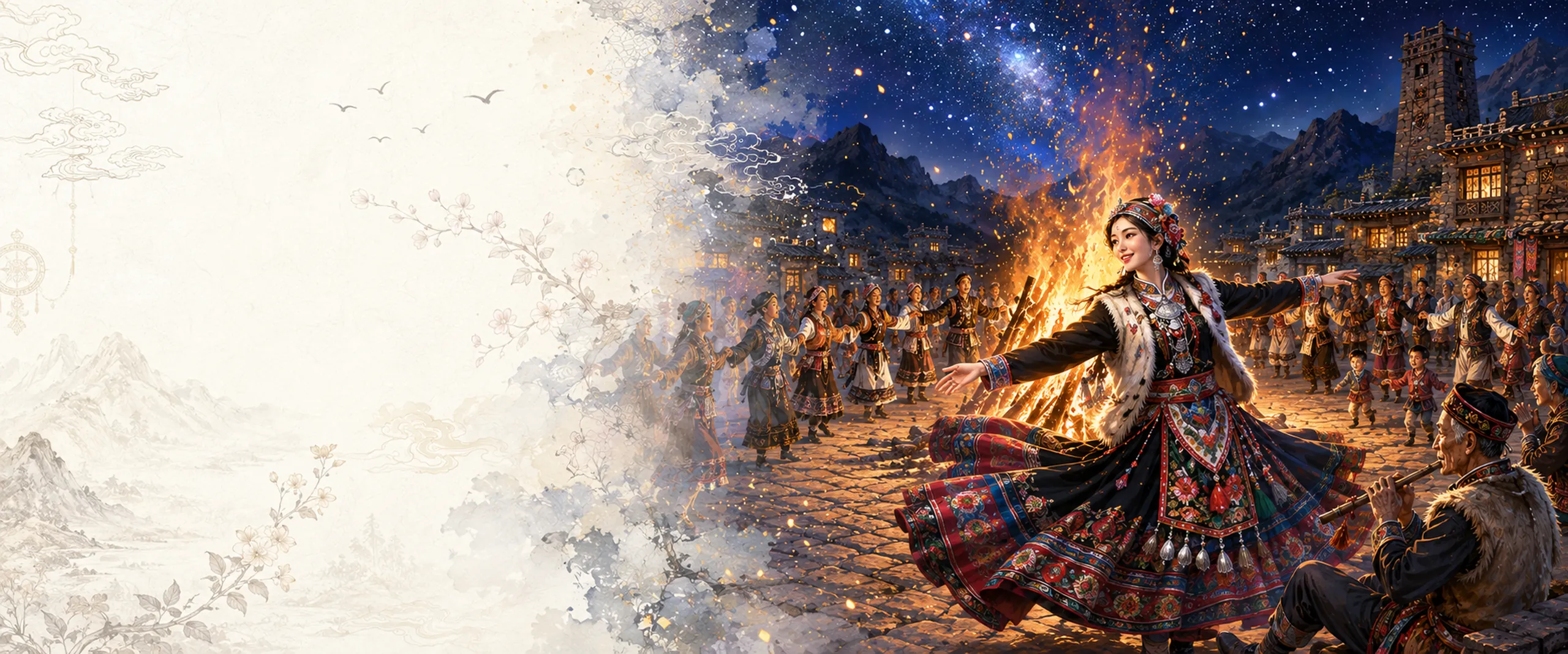
The Song dynasty was another important period in the development of Qiang culture. Communities in the upper reaches of the Min River developed a comparatively stable settlement pattern. Festival customs are said to have become increasingly elaborate. Alongside the central rite of offering sacrifices to Heaven and fulfilling vows, distinctive cultural forms such as Shalang (沙朗) circle dancing, communal drinking of zajiu (咂酒), and foods such as Wada (瓦达) steamed dumplings became increasingly associated with the celebration.
Contact between Qiang and Han communities also intensified during the Song period. The temporal difference between the Qiang New Year in the tenth month and the Han Spring Festival in the first month contributed to the use of the expression “Little New Year” in areas where Qiang and Han populations lived in close proximity.
During the Yuan dynasty, although China was ruled by the Mongols, many Qiang communities remained relatively remote and experienced comparatively limited cultural assimilation. The transmission of the Qiang New Year continued largely through the Shibi institution and village-based social organisation. The Yuan tusi (土司) system of hereditary native chieftains nevertheless affected the political organisation of Qiang communities. Festival organisation gradually moved in some areas from relatively autonomous tribal structures toward systems influenced by local hereditary authorities. Even so, the Qiang New Year remained primarily a village-based festival and preserved much of its traditional form.
The Ming and Qing Dynasties
The Ming and Qing periods represented a crucial turning point during which the Qiang New Year gradually shifted from prosperity toward decline. In the late Ming and early Qing periods, the calendrical knowledge of the Qiang Shibi still impressed outside observers. Gu Yanwu wrote that they could “calculate solar and lunar eclipses and cyclical calendrical matters without the slightest error; generally they regarded ten months as one year.” This record suggests that Shibi specialists still possessed sophisticated knowledge of the ancient ten-month calendar in the Ming period and that the Qiang New Year continued to be determined according to a distinctive Qiang calendrical tradition.
Before the Kangxi period, the festival date was still calculated according to the Qiang calendar. During the Kangxi and Qianlong eras, however, the flourishing agriculture and handicraft industries of the Chengdu region drew large numbers of Qiang men and women to the Chengdu Plain for seasonal work after their traditional New Year. Changes in economic life gradually brought the lunar-calendar Spring Festival more deeply into Qiang culture, while the New Year calculated according to the traditional Qiang calendar steadily declined.
As the ten-month calendar disappeared, the festival lost the calendrical system that had once defined its timing. Qiang communities retained memories of their own New Year, but the exact date gradually became uncertain. The Spring Festival eventually became the most important annual celebration in many Qiang communities, while the older Qiang New Year assumed a secondary position.
The Qing government’s implementation of gaitu guiliu (改土归流)—particularly its large-scale expansion in western Sichuan during the Yongzheng reign—accelerated political and cultural integration in Qiang regions. The Han lunar calendar and Spring Festival customs consequently became more deeply embedded in Qiang social life. Yet, as one scholar quoted in discussions of the festival has observed:
> “The Qiang celebrated their New Year around the winter solstice and called it the ‘Little New Year’ to distinguish it from the Han Spring Festival. This was in fact an expression of their continued attachment to the older festival during the process in which the Han Spring Festival gradually replaced the Qiang calendrical New Year.”
The cultural memory of the Qiang New Year therefore did not disappear. Instead, it persisted tenaciously through the idea of the “Little New Year.”
Although the festival declined at the official level during the Ming and Qing periods, it continued to be passed down orally within villages. The Shibi, as key custodians of Qiang culture, continued to preside over sacrifices and recite ritual classics. This pattern—survival among local communities despite declining formal recognition—allowed the festival to retain vitality in collective memory even after its original calendar disappeared, laying the cultural groundwork for its revival in the 1980s.
The Contemporary Era
In the modern period, the Qiang New Year has undergone a remarkable journey from decline to revival and from a local tradition to internationally recognised heritage.
In 1986, on the first day of the tenth lunar month, the First Qiang Calendar New Year Celebration for Qiang Compatriots in Beijing was held in the capital. In 1987, the Sichuan Provincial Ethnic Affairs Commission organised a Qiang New Year celebration in Chengdu. In 1988, the Rimai Festival, also referred to at the time as the Qiang Calendar New Year, was officially designated by the People’s Government of the Aba Tibetan and Qiang Autonomous Prefecture as a statutory festival for the Qiang people. In 1991, the Beichuan County People’s Government organised an official county-level Qiang New Year celebration for the first time. Since then, Qiang communities have celebrated the festival each year on the first day of the tenth lunar month.
In 2008, the Qiang New Year was approved by the State Council for inclusion on China’s second national list of intangible cultural heritage. In the same year, a national experimental zone for the ecological protection of Qiang culture was established.
In 2009, the Qiang New Year was inscribed by UNESCO on the List of Intangible Cultural Heritage in Need of Urgent Safeguarding. In 2024, it was transferred from the Urgent Safeguarding List to the Representative List of the Intangible Cultural Heritage of Humanity, marking the first formal implementation of such a transfer procedure under the listing mechanisms of UNESCO’s Convention for the Safeguarding of the Intangible Cultural Heritage. In this sense, the Qiang New Year has indeed travelled “from antiquity to the present, from mountain villages to the nation and onward to the United Nations,” marking a historic transition from emergency safeguarding to living transmission.
Readers’ Comments
Calendar and traditional culture enthusiasts from around the world, sharing the same moon.
Sign in or register to join the conversation. Your comment account is created automatically the first time you use a connected account.
No comments yet
Share your thoughts with readers around the world.