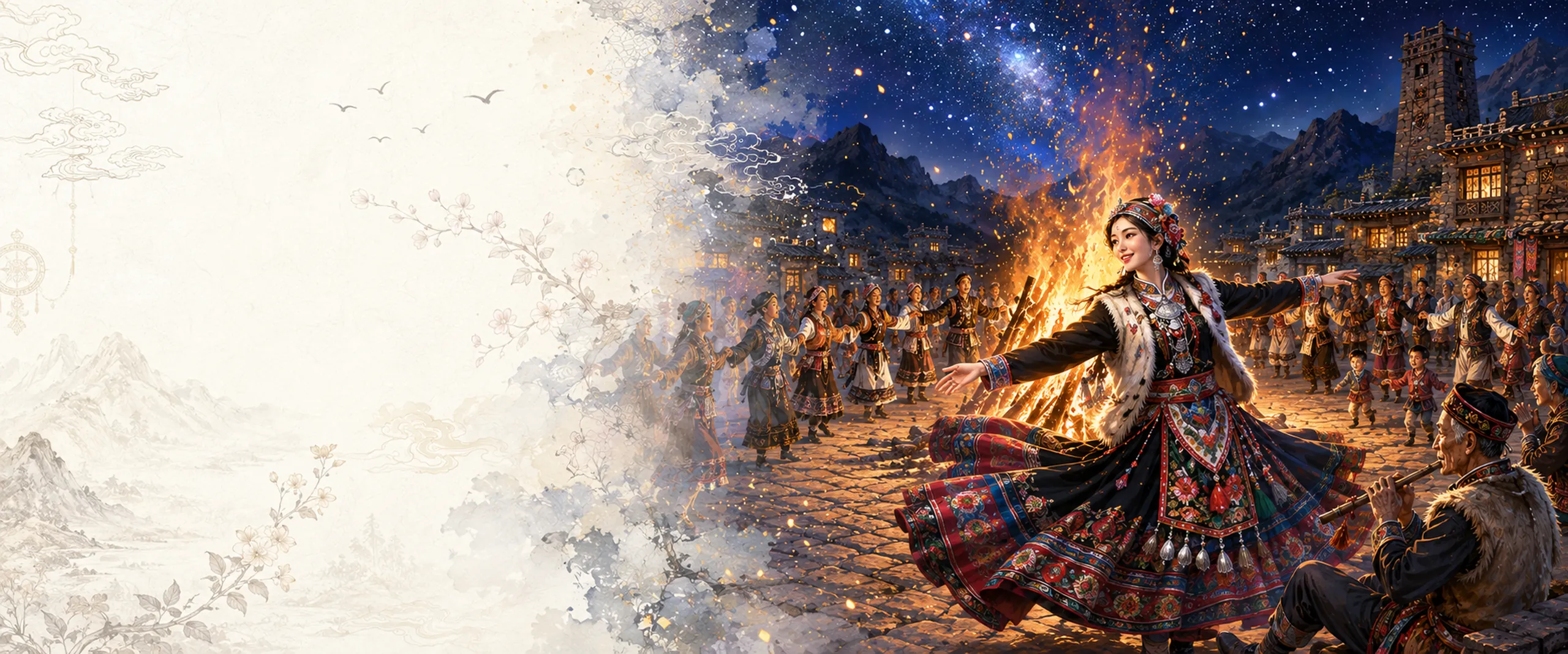
Qiang New Year is the grandest and most solemn traditional festival of the Qiang people. In the Qiang language, it is known as Rimai Festival or Rimeiji, meaning “a day of auspiciousness and joy.”
With a history of more than 2,000 years, Qiang New Year centers on worshipping Heaven, praying for blessings, expressing gratitude, and fulfilling vows. It is a comprehensive folk tradition integrating folk belief, oral traditions, song and dance, demonstrations of craftsmanship, and the transmission of knowledge.
In 2006, it was included in the first batch of China’s National Intangible Cultural Heritage List. In 2024, it was transferred from the List of Intangible Cultural Heritage in Need of Urgent Safeguarding to the Representative List of the Intangible Cultural Heritage of Humanity.
Every year on the first day of the tenth lunar month, Qiang communities celebrate through mountain-circling rituals, Salang dances, communal drinking of zajiu, and other traditional activities focused on worshipping Heaven, praying for blessings, giving thanks, and fulfilling vows.
In Qiang villages high among the clouds, the rhythms of sheepskin drums and the glow of bonfires offer a vivid way to experience the distinctive charm of Qiang culture.
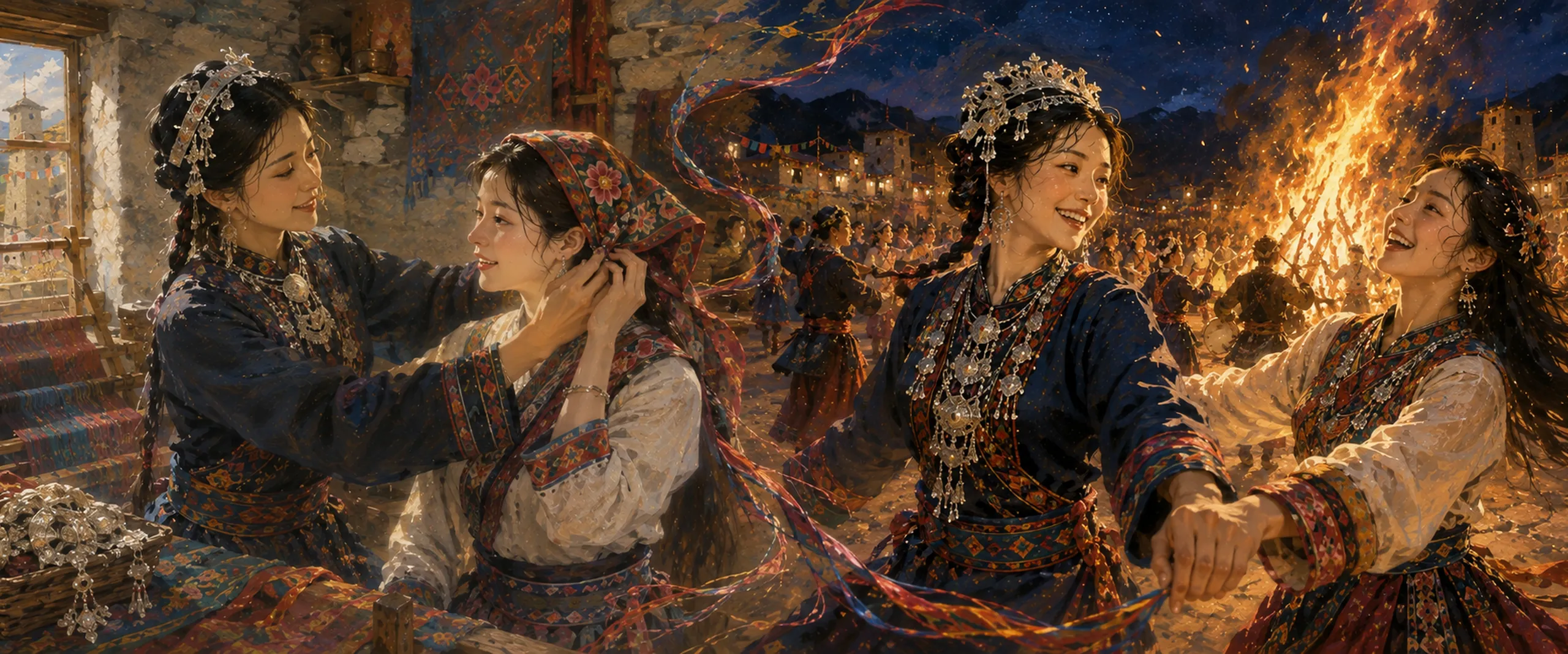
Event Schedule and Venues
### Core Dates of Qiang New Year
Qiang New Year falls on the first day of the tenth lunar month each year, corresponding to mid-to-late November in the Gregorian calendar.
Celebrations in Qiang villages across different regions begin gradually from mid-November, reaching their peak on the first day of the tenth lunar month. Some activities continue for several days.
The core schedule is as follows:
| Time | Activity | Description |
|---|---|---|
| From mid-November | Qiang villages begin preparations and celebrations | Qiang villages across Mao County, Wenchuan County, and Li County |
| November 18 | Chibusu “Rimaixi” folk cultural activities | Chibusu Town, Mao County — parade participants in traditional clothing carry cypress branches and zajiu toward the ritual tower |
| November 19 | Blessing ceremony led by a Shibi | Taoping Qiang Village in Li County, Qiangfeng Village in Miansi Town of Wenchuan County, and other locations |
| First day of the tenth lunar month | Formal opening of Qiang New Year — ritual ceremonies, city-gate opening ceremony, Qiang New Year celebrations, communal banquets, and mass Salang dancing | Qiang villages across different regions celebrate simultaneously |
### Traditional Qiang New Year Customs
The core themes of Qiang New Year are “celebrating the harvest and praying for peace.”
The Qiang are known as the “people above the clouds” and are one of China’s most ancient ethnic groups.
Main customs include:
| Custom | Description |
|---|---|
| Ritual Ceremonies | Led by a Shibi, a Qiang ritual specialist. Villagers dress in festive attire, circle mountains and villages, and hold solemn rituals at sacred grove ritual towers and household shrines to give thanks to Heaven and Earth and honor their ancestors |
| Shibi Chanting | The Shibi chants traditional Qiang epics and serves as a living transmitter of Qiang culture, beating a sheepskin drum during the ritual |
| Salang Dance | A traditional Qiang circle dance in which people of all ages form a circle and move to the rhythm of Qiang songs. The sight of thousands dancing Salang together is especially spectacular |
| Zajiu | A fermented drink made from highland barley and other grains and regarded as a treasured expression of Qiang hospitality. An elder opens the jar, inserts a long slender bamboo tube into the earthenware vessel, and the drink is passed in sequence beginning with the most senior person |
| City-Gate Opening Ceremony | Held at the Ancient Qiang City of China. As horns sound, the city gate slowly opens and Qiang men and women in festive dress ascend the stone steps |
### Recommended Activities by Region
Mao County — Core Main Venue for Qiang New Year:
Mao County has the greatest concentration of Qiang New Year activities.
The Ancient Qiang City of China in Mao County is the world’s largest platform for showcasing Qiang culture. During Qiang New Year, it hosts the city-gate opening ceremony: to the sound of horns, the gates slowly open as Qiang men and women in festive attire ascend the steps, creating a striking scene.
Other activities include:
* The “Rimaixi” folk cultural event in Chibusu Town, where parade participants in traditional dress carry cypress branches and jars of zajiu toward the ritual tower
* Heihu Qiang Village, one of China’s first designated traditional villages, known for its thousand-year-old clusters of Qiang watchtowers and exceptionally well-preserved Qiang cultural heritage
* An intangible heritage experience zone, where practitioners demonstrate Qiang embroidery, Qiang flute making and performance, Qiang paper cutting, and other traditional crafts
Wenchuan County — Qiang New Year Celebrations:
Wenchuan County is another major center of Qiang New Year festivities.
Yingxiu Town hosts Qiang New Year celebrations in which hundreds of Qiang participants in festive attire dance to the flowing sound of Qiang flutes and the powerful beat of sheepskin drums.
Qiangfeng Village in Miansi Town, known as the “First Village of Western Qiang,” follows ancient traditions by beating sheepskin drums, giving thanks for nature’s gifts, and praying for favorable weather in the coming year.
Li County — Shibi Blessing Ceremony at Taoping Qiang Village:
Taoping Qiang Village in Li County is a venue for ancient Qiang Shibi blessing rituals, with the ceremony led by a Shibi.
Beichuan Qiang Autonomous County — Mass Salang Dance:
Beichuan is another important center of Qiang New Year celebrations.
From November 20 to 24, thousands of people gather to dance Salang together. Visitors may join the traditional circle dance at any time.
Other Qiang New Year activities include:
* Practical training in Qiang embroidery
* Classes on Qiang New Year folk customs
* Live demonstrations of intangible cultural heritage skills
* Traditional Qiang sporting events
Nanbaoshan Town, Qionglai, Chengdu:
This is the nearest major concentration of Qiang villages to Chengdu. Qiang villages such as Muti Village hold their own celebratory activities.
Pre-Trip Preparation
### Visas and Entry
The regions where Qiang New Year is celebrated, including Aba Prefecture in Sichuan and Mianyang, follow China’s unified visa policies:
* 240-Hour Visa-Free Transit for Citizens of 54 Countries: Travelers may enjoy up to 240 hours of visa-free transit, with the permitted stay area covering Sichuan Province.
* Tour Groups from ASEAN Countries: Groups organized through travel agencies may enter visa-free through designated ports.
* Other Nationalities: Apply in advance for a tourist visa, or L visa, through the relevant Chinese embassy or consulate and ensure that your passport remains valid for more than six months.
* Latest Policies: Before departure, consult the official website of China’s National Immigration Administration or the relevant embassy or consulate.
### Adapting to the Climate
Qiang New Year falls on the first day of the tenth lunar month, corresponding to mid-to-late November.
At this time, the western Sichuan plateau and mountain regions have the following climate characteristics:
* Temperature: Average November temperatures in Mao County and Wenchuan range from around 2°C to 12°C; Beichuan is around 7°C to 15°C. Day-night temperature differences are large, and nighttime temperatures in mountain areas may approach 0°C.
* Rainfall: November is relatively dry, with mostly clear and cold weather. Outdoor activities are suitable, but mornings and evenings can feel distinctly cold.
* Clothing: Use a layered system — thermal underwear as a base layer, fleece or a light sweater in the middle, and a down jacket or heavy shell jacket as the outer layer.
It is recommended to bring:
* Scarf
* Gloves
* Warm hat
These are essential for long periods outdoors.
Shoes should be warm, non-slip hiking shoes or athletic shoes, suitable for slippery mountain roads.
### Travel Insurance
It is strongly recommended to purchase travel insurance covering:
* Accidental injury and acute illness treatment, including outpatient care
* Loss of or damage to personal belongings
* Travel delays or cancellations, including changes caused by mountain weather
### Currency and Payment
* Currency: Renminbi (CNY).
* Cash: Carry a reasonable amount of cash. Network coverage can be weak in mountain villages, making cash payments more reliable.
* Cards: Visa and MasterCard may be accepted at larger hotels and supermarkets in county towns; they are generally not accepted inside villages.
* Mobile Payment: Alipay and WeChat Pay are widely used in county towns and some scenic areas.
### Communications and Internet
* Important: Many Qiang villages lie between high mountains and deep valleys, and mobile signals can be weak in some areas.
* It is strongly recommended to download offline maps in advance. Use Baidu Maps or AutoNavi and download maps of Aba Prefecture or Mianyang to your phone while connected to Wi-Fi.
How to Get There
### Core Venue 1: Mao County, Wenchuan County, and Li County, Aba Prefecture
| Transportation | Details |
|---|---|
| Air | Fly to Chengdu Shuangliu International Airport or Chengdu Tianfu International Airport, both connected with major domestic and international cities. Continue to Aba Prefecture by high-speed rail or road |
| High-Speed Rail | Take a train from Chengdu East Railway Station to Mao County Station, about 1.5 hours, or to Wenchuan Station. This is the most convenient way to reach the core Qiang New Year region |
| Bus | Chengdu Chadianzi Bus Station has services to Mao County and Wenchuan, with a journey of around 3–4 hours |
| Driving | From Chengdu, take the Duwen Expressway, G4217, directly toward Wenchuan and Mao County. Mountain roads have many curves and narrow stretches, so drive carefully |
High-Speed Rail Ticket Tip:
Tickets can be in high demand during Qiang New Year in November. Advance purchase through the Railway 12306 App is recommended.
### Core Venue 2: Beichuan Qiang Autonomous County, Mianyang
| Transportation | Details |
|---|---|
| Air | Fly to Chengdu Shuangliu / Tianfu Airport or Mianyang Nanjiao Airport, then continue by road to Beichuan |
| High-Speed Rail / Train | Take a train from Chengdu East Railway Station to Mianyang Station, about 45 minutes, then continue by road to Beichuan, about 1.5 hours |
| Driving | From Chengdu, take the Chengdu–Mianyang Expressway, G5, to Mianyang, then continue toward Beichuan via Liaoning Avenue |
### Transportation Tips During the Festival
* Mao County: Traffic becomes heavy in the county town and around the Ancient Qiang City of China during Qiang New Year. Park according to traffic-police guidance.
* Qiang Villages: Roads leading into many villages are winding mountain roads with numerous bends and narrow sections. Do not park on the roadway.
* Travel Recommendation: The essence of Qiang New Year lies in following the parade processions and participating in village celebrations. It is recommended to leave vehicles in county towns or designated parking areas and participate mainly on foot.
Accommodation Reservations
| Key Point | Recommendation |
|---|---|
| When to Book | November is a peak tourism period locally during Qiang New Year. Book more than one month in advance |
| Mao County | Mao County town — convenient transportation and more hotel choices; around the Ancient Qiang City of China; characteristic guesthouses near Heihu Qiang Village |
| Wenchuan | Wenchuan County town, Yingxiu Town, and Qiangfeng Village in Miansi Town — the “First Village of Western Qiang” |
| Beichuan | Beichuan County town and guesthouses in surrounding Qiang villages |
| Special Experience | Stay in a Qiang village guesthouse, gather around a traditional hearth, taste local hotpot, and share zajiu |
| Price Reference | Budget around RMB 150–300 per night, mid-range RMB 300–600, high-end accommodation above RMB 600 |
| Booking Platforms | Major platforms such as Ctrip, Qunar, and Meituan; rooms with free cancellation are preferable |
Pre-Trip Packing Checklist
| Category | Essential Items | Special Notes |
|---|---|---|
| Clothing | Thermal underwear, fleece, down jacket / heavy shell jacket, warm trousers | The western Sichuan plateau is cold in November. Staying warm is the top priority; nighttime temperatures in mountain areas may approach 0°C |
| Shoes | Warm, non-slip hiking shoes / athletic shoes | Qiang villages often have stone-paved streets and mountain paths that can be cold and slippery |
| Accessories | Scarf, gloves, warm hat, thick socks | Essential for mornings, evenings, and extended outdoor activities |
| Sun Protection | SPF30+ sunscreen, sunglasses | Highland UV exposure should not be overlooked |
| Medicine | Cold medicine, gastrointestinal medicine, adhesive bandages, motion-sickness medicine | Mountain roads are winding; local food is often sour, spicy, and meat-based |
| Electronics | Power bank, phone, camera, spare batteries | Cold weather accelerates battery drain |
| Storage | Small bag / waist pouch for documents and cash | Protect belongings in crowded areas |
| Other | Insulated bottle for hot water, tissues / wet wipes | Facilities in mountain areas can be limited |
Cultural Respect
### Respect for Religious Belief and Ritual Etiquette
Qiang New Year centers on worshipping Heaven, praying for blessings, giving thanks, and fulfilling vows, making it one of the most solemn expressions of Qiang spiritual culture.
* Remain Solemn During Rituals: Keep quiet and respectful during ritual ceremonies. Do not shout, laugh loudly, or play around.
* Do Not Interfere: Do not obstruct or disturb the normal conduct of ceremonies.
* Viewing Etiquette: If permitted to observe, remain in designated areas, do not move about freely, and do not touch offerings or ritual implements.
* Photography Restrictions: Ritual ceremonies generally prohibit photography. Confirm with on-site personnel in advance.
### Etiquette When Joining Village Activities
Qiang New Year is a festival of reunion for entire villages. If invited into a Qiang household or to participate in village activities, observe the following customs:
* Entering a Home: Offer a greeting before entering and wait for the host’s permission.
* Hearth Custom: The Qiang hearth is the center of the household and symbolizes the continuity of the family. Do not casually straddle, sit on, or step on the hearth without permission.
* Zajiu Etiquette: Zajiu is opened ceremonially by an elder and passed in sequence beginning with the most senior person. If invited to drink, follow the order and receive the vessel with both hands as a sign of respect. If you do not drink much alcohol, take only a light sip with both hands and explain with a smile.
* Joining the Salang Dance: When thousands gather to dance Salang, visitors may join the circle at any time. Follow the lead dancers’ steps and rhythm, and do not disrupt the formation.
### Photography Etiquette
* Ask Permission: Before photographing Qiang participants in festive attire, Shibi ritual specialists, elderly people, or children, smile and ask first.
* Respect Portrait Rights: Do not use photographs of others commercially without permission.
* Drone Regulations: Drone flights over Qiang villages require advance registration with local public-security authorities.
### Safety Guidelines
* Cold Protection: The western Sichuan plateau is cold in November. Dress warmly during long outdoor activities and guard against hypothermia.
* Fire Safety: Many Qiang village buildings are constructed from stone and timber. Pay close attention to fire safety.
* Crowd Safety: Parades and major celebrations can become crowded. Stay alert and supervise elderly family members and children.
* Property Safety: Store valuables in the hotel safe and carry only essentials at festival venues.
* Traffic Safety: Mountain roads are narrow and winding. Follow traffic regulations and never park on the roadway.
Emergency Information
| Item | Contact / Description |
|---|---|
| Emergency Numbers | Police 110, Fire 119, Ambulance 120 |
| Major Hospitals | Mao County People’s Hospital, Wenchuan County People’s Hospital, Beichuan County People’s Hospital; serious illnesses may require transfer to Chengdu |
| Tourist Police / Lost Property | Permanent police posts are located at all major venues. Report lost valuables immediately to the nearest police office |
| Tourist Information | Official platforms of the Aba Prefecture Culture and Tourism Bureau and Mianyang Culture and Tourism Bureau |
| Time Zone | UTC+8, China Standard Time |
| Voltage / Plugs | 220V; plug types A / C / I |
Special Reminders
* Confirm the Qiang New Year Date: Qiang New Year falls on the first day of the tenth lunar month, corresponding to mid-to-late November each year. Different villages begin celebrations gradually from mid-November, so confirm the specific program for your destination before departure.
* 2026 Is an Important Year Following Its Transfer to the Representative List of the Intangible Cultural Heritage of Humanity: In December 2024, Qiang New Year was transferred from the List of Intangible Cultural Heritage in Need of Urgent Safeguarding to the Representative List of the Intangible Cultural Heritage of Humanity. The 2026 celebrations will therefore be an important festival following this transfer, with a larger scale and richer program.
* Cold-Weather Protection: The western Sichuan plateau is cold in November. A down jacket, thermal underwear, scarf, and gloves are essential.
* Respect Belief: Qiang New Year rituals are among the most solemn spiritual activities of the Qiang people. Always obtain permission before taking photographs.
* Zajiu Etiquette: If you encounter the communal passing of zajiu, receiving it with both hands and passing it in sequence are basic forms of etiquette.
* Traffic Controls: Traffic restrictions are implemented around festival venues during Qiang New Year. Plan your travel route in advance.
* Weather Awareness: Mountain areas are generally clear and cold in November, with especially chilly mornings and evenings. Check the weather before departure and bring sufficient warm clothing.
*May you experience the distinctive charm of a thousand years of intangible cultural heritage in Qiang villages high among the clouds and, amid the rhythms of sheepskin drums and the steps of the Salang dance, receive the beautiful blessing of “auspicious joy, happiness, and well-being.”*
—
Readers’ Comments
Calendar and traditional culture enthusiasts from around the world, sharing the same moon.
Sign in or register to join the conversation. Your comment account is created automatically the first time you use a connected account.
No comments yet
Share your thoughts with readers around the world.