Qiang New Year

Qiang New YearFolk Arts of the Qiang New Year

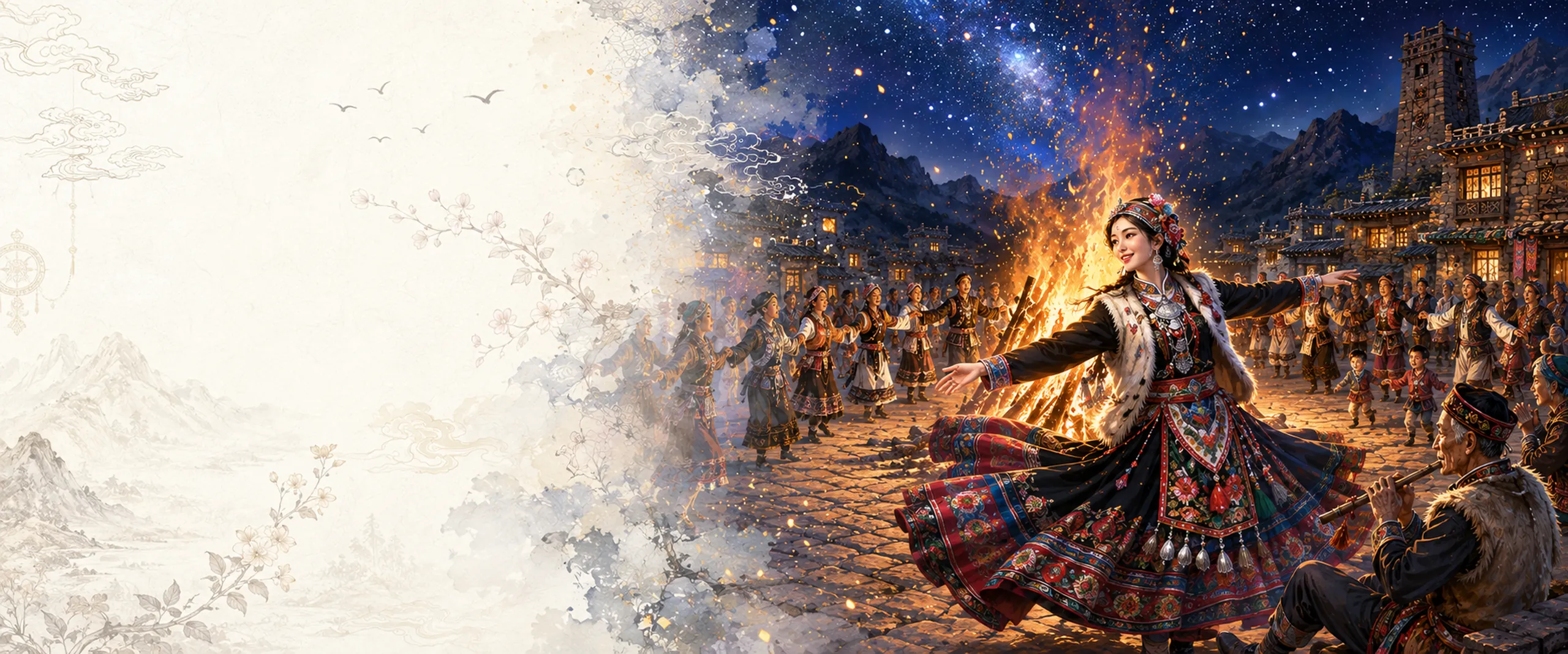
「 咂酒飘香祭天地,莎朗欢舞庆丰年。 」

The Qiang New Year is held on the first day of the tenth lunar month. It is the grandest festival of the year for the Qiang people, celebrating the harvest, offering blessings, and praying for safety. In the Qiang language, it is called “Rimeiji,”…

Opening Verse:

咂酒飘香祭天地,莎朗欢舞庆丰年。

Introduction:

Poetry associated with Qiang New Year often centers on zha wine, the Salang dance, and rituals of worshipping Heaven. “咂酒飘香” evokes the spirit of unity embodied in people taking turns drinking from the same vessel; “莎朗欢舞” depicts the joy of dancing around the bonfire; while “祭天地” records the central theme of Qiang New Year—giving thanks to nature.

Qiang New Year is the grandest traditional festival of the Qiang people, and its poetry frequently portrays zha wine and the Salang dance. Zha wine is the most representative beverage of Qiang New Year—people gather around a wine jar and take turns drinking through bamboo tubes, embodying the Qiang people’s spirit of solidarity and mutual support. Salang, meanwhile, is the signature dance of Qiang New Year: men and women, young and old, join hands to form a circle and dance gracefully to the melodious sound of the Qiang flute. The poetry and songs of Qiang New Year often take prayers to Heaven, blessings, gratitude, and the fulfillment of vows as their themes—Qiang New Year originated in the ancient Qiang people’s awe, gratitude, and reverence toward nature, embodied in what is known as “祭天还愿”. In plain and sincere language, Qiang New Year poetry records the devotion and celebration of this ancient people as they give thanks after the autumn harvest to the heavenly deities for the gift of abundant grain.

Qiang New Year / Folk Arts of the Qiang New Year

Art Forms

Forms of Expression

Shibi

Other 羌族

Connecting Heaven and Earth

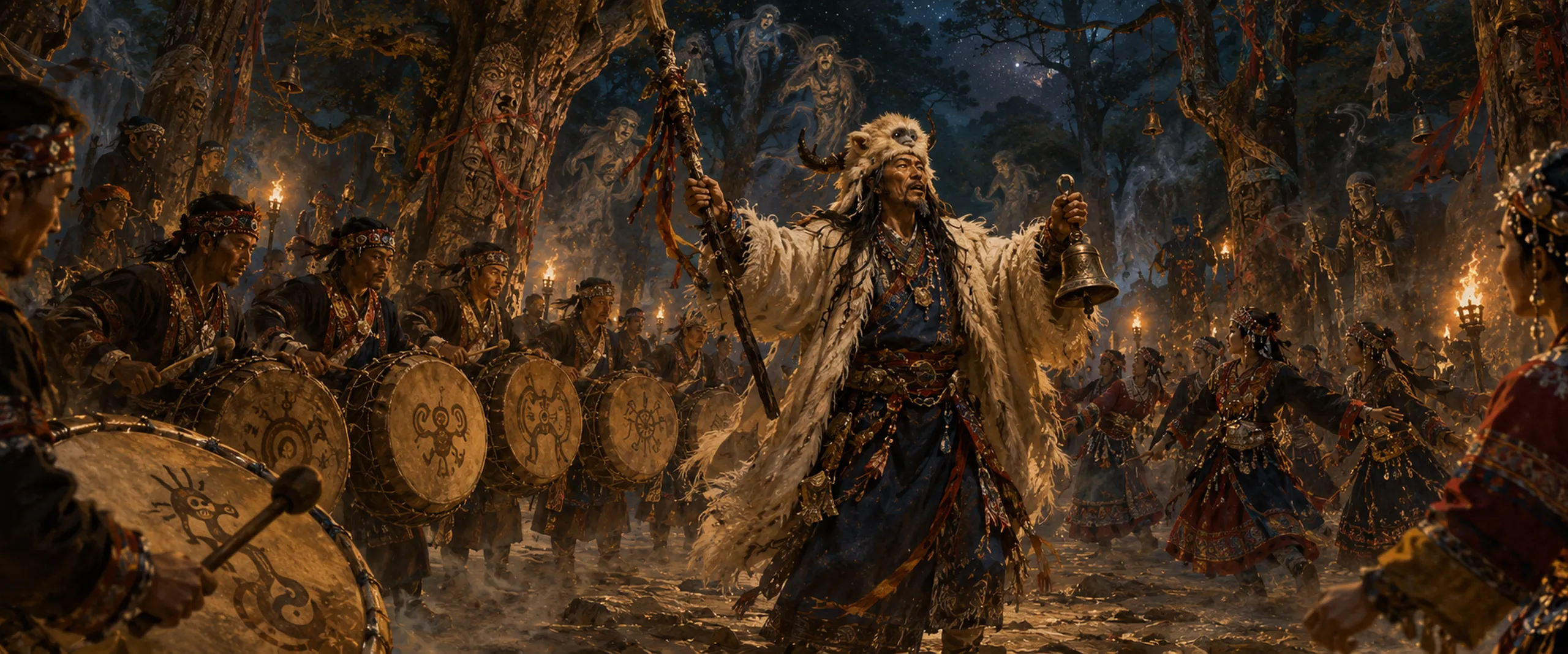
The Shibi—called “许” in the Qiang language, or respectfully “阿爸许”—are the most authoritative cultural figures and repositories of knowledge among the Qiang people, regarded as those who connect the worlds of life and death and communicate directly with the spirits. They are priests and physicians, shamans and chroniclers alike, and are the most important transmitters and guardians of Qiang culture. Through oral and heart-to-heart transmission, Shibi pass down the tradition of chanting sacred texts, and through a wide range of ritual activities they present ethnic literature, music, dance, and other forms while transmitting the contents of Shibi culture.

Because the Qiang people traditionally had no writing system of their own, the continuity of Qiang culture over thousands of years could only depend upon “oral and heart-to-heart transmission.” The ancient Shibi chants likewise rely entirely on transmission from one Shibi to another and have been preserved in the memories of successive generations of Shibi. Shibi culture is rich in content, encompassing the people’s philosophical thought, folk literature, ethnic music, ethnic dance, customs, and much more, and constitutes an important part of Qiang intangible cultural heritage. The Shibi plays a central role throughout the sacrificial ceremonies of Qiang New Year—the Qiang New Year “苏布士” activities proceed in sequence under the Shibi’s direction, and the Shibi primarily conducts a peace ritual consisting of nine chapters.

Shibi Chanting

Shibi chanting is the oldest oral tradition of the Qiang people. “释比的经书反映了羌族的历史、文化、生产、生活,是羌族的‘荷马史诗’和百科全书”. Rich in content, Shibi chants are an important part of Qiang cultural heritage. From the perspective of folk literature, Shibi chanting may be regarded as a form of rhythmic poetry.

The Qiang Shibi Cultural Corridor reminds visitors in precisely these words: “释比的经书反映了羌族的历史、文化、生产、生活,是羌族的‘荷马史诗’和百科全书”. Local gazetteers compiled in Maoxian in recent years likewise state that “由释比保存的古唱经,是羌民族传统文化中的核心部分”.

During Qiang New Year rituals, Shibi chant traditional Qiang epics, while people in the village sing, drink, exchange food, and celebrate to their hearts’ content. The epics 《木姐珠》 and 《羌戈大战》, recited through the voices of Shibi during Qiang New Year rituals, praise the ancestors and recount history, and through years of transmission have helped form a shared cultural identity. 《颂神禹》, known as one of the four great Qiang epics, comes from Shibi chanting and is a long narrative ritual song.

Of particular note, Shibi beat sheepskin drums while chanting the Qiang historical and cultural epics 《天路之歌》 and 《围阿诺》, which together extend to 16,000 lines. They are among the longest folk oral narrative-and-song epics still in circulation anywhere in the world today, and their content concerns the ancient social history of the Qiang people. This epic of tens of thousands of lines has been passed down from generation to generation among Qiang Shibi through oral and heart-to-heart transmission and is one of the most precious treasures of Qiang folk arts.

Although Chinese is also widely used in Qiang regions, Shibi chants are almost entirely performed in ancient Qiang language. This ancient linguistic medium has enabled Shibi chanting to preserve the most original cultural genes of the Qiang people and has made it the most sacred and irreplaceable part of Qiang New Year folk arts.

Sheepskin Drum Dance

Other 羌族

Cultural Status

The sheepskin drum dance is the most representative sacrificial dance of Qiang New Year and one of the most mysterious and powerful forms of Qiang folk art. According to documentary records, the sheepskin drum dance was originally a religious dance performed by Qiang “Shibi” while conducting ritual ceremonies, and later gradually evolved into a folk dance. The sheepskin drum dance is an indispensable part of Qiang social practices, rituals, and festive activities. It is mysterious and carries a strong atmosphere of primitive religious sacrifice. Its movements are also vigorous and forceful.

In the Qiang language, the sheepskin drum dance is called “莫恩纳莎”, “莫尔达沙”, or “布滋拉”. It is a sacrificial dance performed by the “Shibi” during ritual activities and is one of the principal dance forms in Qiang sacrificial ceremonies, displaying highly distinctive Qiang cultural characteristics. The sheepskin drum dance is a sacrificial dance inherited from Qiang Shibi culture and art, an important vehicle of Shibi culture, and an indispensable cultural expression within Qiang customs and ways of life.

Whenever mountain-worship rituals are held at the beginning of spring plowing or during “Qiang New Year” on the first day of the tenth lunar month, a sheepskin-drum dance troupe led by a Qiang “Shibi” beats the drums and dances in worship of all things. The sheepskin drum dance not only embodies Qiang spiritual culture, but also vividly reflects the living conditions and inner world of the ancient Qiang people. It is a Qiang folk sacrificial dance shaped by the core concept of “天人合一”, originating in the Three Kingdoms and Western and Eastern Jin periods and possessing a history of more than two thousand years.

Dance Characteristics

The sheepskin drum dance is mysterious in style and full of strength. With their knees constantly trembling, dancers hold sheepskin drums and continuously perform such “商羊步” movements—commonly known as “禹步舞”—as “持鼓绕头”, “屈腿左右旋转”, and “旋摆髋部”. The crossing-and-leaping step in the sheepskin drum dance is especially regarded as a unique technique found only in Qiang dance.

The Qiang name for the sheepskin drum dance is “刮浦日”, and it was created by the priest “Shibi”. The Qiang folk sacrificial dance “刮浦日” is often performed by several people dancing opposite one another, imitating animal movements and displaying the simple faith with which Qiang ancestors revered nature. During the “祭天祈福还愿” ceremony, the Shibi holds a ritual staff and beats the sheepskin drum while walking slowly forward. Young men dressed in Qiang clothing proceed toward the sacrificial platform, hang Qiang red cloth, slaughter a sheep, and offer its head in sacrifice, praying for favorable weather and abundant harvests in the coming year.

Intangible Cultural Heritage Status

In 2008, the sheepskin drum dance was included in China’s national list of intangible cultural heritage. Its inheritors sustain its cultural vitality through performances at festivals. During the “祭天祈福还愿” ceremony in Enda Qiang Village, the Shibi beats the sheepskin drum while young men walk toward the sacrificial platform, and all pray together for peace. This ancient sacrificial dance has been passed down from generation to generation through the rituals of Qiang New Year and continues to live on.

Salang

Other 羌族

Cultural Meaning

Salang—“Salengw” in the Qiang language, meaning “singing and dancing” in Chinese—is the most representative participatory collective dance of the Qiang people and the liveliest, most joyful form of folk art during Qiang New Year. The Qiang people love song and dance and traditionally form circles as they sing and dance together. Salang evolved from sacrificial dance. It is called “莎朗” in Qiang, meaning “载歌载舞” in Chinese, and is a circular song-and-dance form through which the Qiang people entertain themselves collectively.

There are many forms of Qiang Salang: dances such as “克西格拉”, “瓦曲切莫”, and “惹姆惹丝”, performed during major celebrations such as Qiang New Year, are known as festive Salang, also called ceremonial Salang; “布滋拉(皮鼓舞)” belongs to the sacrificial Salang tradition; and “对衣襟” is a love Salang. During Qiang New Year, Salang is the activity with the broadest popular participation—“载歌载舞的沙朗” is the shared revelry of the entire Qiang village.

Qiang Salang has been included in the second batch of the Sichuan Provincial Intangible Cultural Heritage List. The Qiang term “萨朗” means “载歌载舞” in Chinese. Salang is led by skilled singers and dancers, has a lively rhythm, and the songs performed are mostly ancient Qiang songs passed down orally, sung almost entirely in the Qiang language.

Performance Form

The performance form of Salang is simple, ancient, and spirited. Whenever Qiang New Year arrives, every village holds solemn celebrations under the direction of a respected elder. Men and women, young and old, form circles on the grass. They first sing and dance together in what is commonly known as “跳喜庆沙朗”, then begin drinking zha wine, exchange food with one another, offer New Year wishes, and celebrate to their hearts’ content until late at night before returning home satisfied.

Participation in Salang is exceptionally broad—men and women, young and old can all join. During Qiang New Year, villagers dress in festive clothing, sing and dance exuberantly, drink in celebration, and express both the joy of harvest and the devotion of their prayers. People form circle after circle, singing, drinking, and dancing as they go, continuing until late into the night before returning home fully satisfied. In places such as Beichuan, the sight of a thousand people dancing Salang together has become one of the most iconic scenes of Qiang New Year.

During Qiang New Year celebrations, the “万年火” is lit in the hearth, lively Salang dances begin, and a thousand-person open-air banquet celebrates the harvest and reunion. Salang is the most concentrated cultural expression of Qiang New Year, allowing Qiang culture to “come alive” through singing and dancing in everyday life. Qiang Salang is the most participatory form of Qiang folk art and the one with the highest level of public involvement. It makes every person a participant in the festival rather than merely a spectator.

Qiang Guozhuang

Qiang Guozhuang originated from the Salang dance and evolved from sacrificial dance, possessing both recreational and fitness functions. Its dance art is closely connected with the history of Qiang development. Influenced by living environments and ways of life, hand movements vary relatively little, while footwork is extremely rich, with a lively rhythm and a relaxed, natural quality.

When two Qiang people fall in love, they sing love songs; when unhappy and distressed, they sing sorrowful songs; at weddings, they sing joyful songs; when a loved one dies, they sing funeral songs; at New Year gatherings, they sing drinking songs; and while working to relieve fatigue, they sing mountain songs. The Salang of Qiang New Year is the most concentrated embodiment of this cultural tradition of “accompanying dance with song and carrying song through dance”—in Qiang New Year Salang, every emotion of human life can be sung and danced.

Folk Music

Other 羌族

Qiang Flute

The Qiang flute is an ancient single-reed aerophone in China with a history of more than 3,000 years and is widely found in Qiang-inhabited areas of Sichuan. Ma Rong of the Eastern Han dynasty wrote in 《长笛赋》 that “近世双笛从羌起”. The Qiang flute is an ethnic folk instrument originating among the ancient Qiang people and is said to have been invented by Qiang pastoralists who lived nomadically on the northwestern plateau during the Qin and Han periods.

The Qiang flute consists of two pipes with several finger holes—formerly five, now usually six—and is played vertically using a distinctive cheek-inflation circular-breathing technique. Its sound is clear, high, and deeply stirring. Frequently performed pieces include 《折柳词》, 《思想曲》, 《莎郎曲》, and 《羌山情》. The sound of the Qiang flute often creates an impression at once dreamlike, elusive, and deeply moving, and the Qiang people often use it to express emotions ranging from joy and anger to sorrow, happiness, reunion, and separation.

In May 2006, Qiang flute performance and manufacturing techniques were included in the first batch of China’s national intangible cultural heritage list. These techniques are mainly transmitted in Maoxian, Aba Prefecture, Sichuan Province. The principal inheritors of the Maoxian Qiang flute include He Wangquan and Chen Haiyuan. He Wangquan is a national-level inheritor of intangible cultural heritage. Gong Dairen is a representative inheritor of the Qiang flute performance and manufacturing techniques project in the second batch of national intangible cultural heritage. The famous line by Tang poet Wang Zhihuan, “羌笛何须怨杨柳,春风不度玉门关”, made the Qiang flute an indelible sonic symbol in Chinese cultural memory.

Qiang Polyphonic Folk Songs

Qiang polyphonic folk songs are among the oldest indigenous unaccompanied harmonic folk-song traditions of the Qiang people. Their melodies often employ pentatonic and heptatonic scales, and in two-part singing, one voice generally begins first as the lead.

The Qiang polyphonic folk song 《尼莎》 is a treasure of Qiang folk art. The national intangible cultural heritage treasure of polyphonic “尼莎” conveys ethnic hope through a mother singing the Qiang song “尼莎” and passing it onward through repeated performance. 《尼萨·妈妈的歌谣》 uses song and dance to present “尼莎”, the nationally recognized Qiang polyphonic folk-song tradition. The song 《尼莎·妈妈的歌谣》 tells the story of the Qiang people’s migration through ancient sounds, and generation after generation of Qiang people have grown up listening to “尼莎”. During Qiang New Year activities in Songpan, programs including the Qiang polyphonic folk songs 《尼莎》 and 《酒歌》 were performed. Karsdavin dance and Armai polyphonic folk songs performed by teachers and students from Heishui County also received repeated applause from audiences.

The Qiang polyphonic folk song 《云岭羌音》 flows and echoes gently, creating a Qiang New Year atmosphere in which there is “一步一景、移步换戏”. Qiang polyphonic folk song is one of the most distinctive forms within Qiang folk music, and the beauty of its unaccompanied harmony is exceedingly rare even in world music.

Folk Songs and Oral Traditions

Other 羌族

Qiang New Year Songs

In 2026, 《羌年年歌(曲谷三龙篇)》 was officially released across online platforms. Grounded in the culture of Qiang New Year, the album features melodies that are ancient in character and gently flowing, with sincere emotion. Every note is filled with the Qiang people’s gratitude toward heaven, earth, mountains, and rivers; remembrance of their ancestors; joy in the harvest; and prayers for peace, vividly recreating scenes from Qiang production and everyday life. The release of this New Year song collection marked the movement of the Qiang New Year song tradition from oral transmission toward recorded preservation, and from the villages toward a wider world.

The Integration of Qiang New Year and Oral Tradition

The folk artistic expression of Qiang New Year is inseparable from the Shibi oral tradition. Throughout the entire “苏布士” activity, the Shibi primarily conducts the peace ritual, which consists of nine chapters. During the ritual process, the Shibi must also perform the sheepskin drum dance according to different needs. Beating the sheepskin drum, the Shibi chants the Qiang historical and cultural epics 《天路之歌》 and 《围阿诺》, which extend to 16,000 lines—among the longest folk oral narrative-and-song epics still in circulation in the world today. These epics are repeatedly recited during Qiang New Year rituals, merging the historical memory of the Qiang people with festive celebration.

Qiang New Year takes “祭天祈福、感恩还愿” as its central theme. Sacrificial rites are presided over by a Shibi or an elder of great age and prestige. During Qiang New Year, the Qiang people sing ancient historical songs of their people, transmitting Qiang historical memory from generation to generation. The song tradition of Qiang New Year was formed through the interweaving of Shibi chanting and communal singing—the Shibi chants sacred scriptures, while the people sing songs of everyday life; the Shibi’s chanting connects heaven and earth, while the people’s songs bind the community together.

Contemporary Transmission

Heritage & Transmission 羌族

Intangible Cultural Heritage Lists

In 2009, “Qiang New Year” was included in UNESCO’s first List of Intangible Cultural Heritage in Need of Urgent Safeguarding. On December 5, 2024, the UNESCO Intergovernmental Committee for the Safeguarding of the Intangible Cultural Heritage reviewed and approved the transfer of “Qiang New Year” from the “List of Intangible Cultural Heritage in Need of Urgent Safeguarding” to the “Representative List of the Intangible Cultural Heritage of Humanity.” On the evening of December 6, Qiang people celebrated the good news of Qiang New Year’s “transfer of lists” with joyful singing and dancing. “Qiang New Year” is a comprehensive cultural practice integrating the song and dance arts, traditional skills, festive rituals, and other traditions passed down through generations of Qiang people, providing an all-encompassing presentation of Qiang culture.

Contemporary Folk Celebration

The 2024 Qiang New Year celebration was held in Maoxian. Qiang people from counties across the Qiang regions of Sichuan dressed in festive attire and joined visitors and guests in sharing this distinctive festival. During the event, Qiang Salang, polyphonic folk songs, the Qiang flute, and other forms of folk art were presented together. Surrounded by mountains, the Ancient Qiang City opened its gates to welcome guests, while 100 Qiang performers in ethnic festive dress sang and danced in a half-hour indigenous-style “Qiang New Year” celebration.

A series of Qiang New Year celebrations was held in Wenchuan in 2025. The Qiang polyphonic folk song 《云岭羌音》 created a feast for the ears, while Qiang papercutting and Tibetan calligraphy were exhibited in pavilions, fully displaying the intangible-cultural-heritage principle of “见人见物见生活”. During Wenchuan’s immersive Qiang New Year night tour, Qiang polyphonic folk songs, Salang dance, and other forms of folk art allowed guests to experience, while walking through the event, the appeal of intangible cultural heritage across ethnic and national boundaries.

During Qiang New Year celebrations in Maoxian, teachers and students from Aba Teachers University performed 《尼萨·妈妈的歌谣》, using song and dance to interpret “尼莎”, the nationally recognized Qiang polyphonic folk-song tradition. Karsdavin dance and Armai polyphonic folk songs performed by teachers and students from Heishui County received repeated applause from the audience. During Qiang New Year, Shibi beat sheepskin drums while chanting Qiang historical and cultural epics, becoming one of the folk-art performances with the strongest ritual character during the festival.

In November 2024, Songpan County held highly participatory cultural activities under the theme “幸福麦吉·欢乐羌年”, drawing on folk arts and intangible cultural heritage. The event consisted of two parts: the Qiang New Year ceremony and the Qiang New Year banquet. The ceremony presented Qiang New Year customs such as sacrificial rites and Qiang dress, while the banquet featured programs including 《开坛仪式》, the Qiang polyphonic folk song 《尼莎》, the dances 《云朵上的羌寨》, 《火把舞》, and 《萨朗姐》, the songs 《挂羌红》, 《毕曼》, and 《云朵上的羌寨》, as well as costume performances.

Inheritors in Action

Qiang flute performance and manufacturing techniques have several national-level representative inheritors of intangible cultural heritage. Gong Dairen is a representative inheritor of the Qiang flute performance and manufacturing techniques project in the second batch of national intangible cultural heritage. Qiang flute inheritors He Wangquan and Chen Haiyuan are the principal inheritors of the Maoxian Qiang flute tradition. Through festival performances, they sustain the cultural vitality of the Qiang flute. Shibi inheritors likewise transmit Shibi chanting from generation to generation during Qiang New Year rituals through oral and heart-to-heart instruction. Shibi culture is rich in content and encompasses the people’s philosophical thought, folk literature, ethnic music, ethnic dance, customs, and much more.

Contemporary Value

Qiang New Year integrates folk beliefs and customs, oral traditions, performing arts, and traditional handicrafts, and is both the historical accumulation and concentrated presentation of Qiang culture. Qiang New Year brings together literature, history, religion, architecture, ethics, philosophy, folk customs, singing, dance, foodways, and many other forms of culture, presenting the distinctive characteristics of Qiang culture from multiple perspectives. It creates a harmonious natural ecological space.

As the most important traditional festival of the Qiang people, the folk-artistic value of Qiang New Year is increasingly being recognized and cherished. Qiang New Year is not only a festival through which the Qiang people celebrate the harvest and give thanks to heaven and earth, but also a grand stage for the living transmission of Qiang folk arts. Within the framework of the national-level Qiang Cultural Ecology Protection Zone, the folk arts of Qiang New Year are moving from “rescue-oriented safeguarding” toward “living transmission.” In December 2024, Qiang New Year was successfully transferred to the Representative List of the Intangible Cultural Heritage of Humanity, marking the movement of this ancient festival and the folk arts it carries from the “云朵上的民族” toward the world.

Closing Reflections

Overview 羌族

The folk artistic expression of Qiang New Year differs fundamentally from the “literati poetry” associated with Han festivals. It is not “written” in words, but “sung,” “danced,” and “performed” at the festival itself. It does not arise from an external perspective of “watching” and “reflection,” but from an internal perspective of “speaking” and “revelry.”

From the ancient tradition in which the Shibi “以口传心授的方式传承释比唱经,以各种仪式活动为依托,展示民族文学、音乐、舞蹈”, to the mysterious strength of the sheepskin drum dance that “击鼓而舞,以祀万物”; from the circular revelry of Salang, where people “载歌载舞”, to the lively freedom of Qiang Guozhuang, with its “脚下动作极为丰富,节奏明快,松弛自然”; from the three-thousand-year echo of the Qiang flute, whose “音色清脆高亢、动人心魄”, to the celestial beauty of the “无伴奏和声” of Qiang polyphonic folk song; from the 16,000-line epic narratives 《天路之歌》 and 《围阿诺》 preserved in Shibi chanting, to the contemporary songs of 《羌年年歌》 moving from the villages into the wider world—the folk artistic expression of Qiang New Year takes “ritual” and “dance” as its twin cores, and “reverence” and “joy” as its central spirit, forming a complete, living, and continuously flourishing system of cultural expression.

The scriptures of the Shibi reflect Qiang history, culture, production, and everyday life and constitute the Qiang people’s “Homeric epics” and encyclopedia. The ancient chants preserved by Shibi form a core part of traditional Qiang culture. Qiang New Year integrates literature, history, religion, architecture, ethics, philosophy, folk customs, singing, dance, foodways, and numerous other forms of culture, offering a multifaceted presentation of the distinctive character of Qiang culture. Qiang New Year is the deepest cultural heartbeat of the “云朵上的民族”—when the Shibi’s sheepskin drum resounds through a Qiang village, when circles of Salang turn beneath the moonlight, when melodies of the Qiang flute echo through mountain valleys, and when the celestial harmonies of polyphonic folk song drift across the night sky—that is the Qiang people using their own voices, their own bodies, and their own dances to offer their deepest and most enduring declaration of love to “heaven and earth” and “life.” Qiang New Year has “从远古走到今天,从山寨走向国家乃至联合国”, and the folk arts it carries have likewise completed, through this journey, the transition from “rescue-oriented safeguarding” to “living transmission,” becoming a cultural treasure shared by all humanity.

—-

Continue exploring Qiang New Year culture

Readers’ Comments

Calendar and traditional culture enthusiasts from around the world, sharing the same moon.

Sign in or register to join the conversation. Your comment account is created automatically the first time you use a connected account.