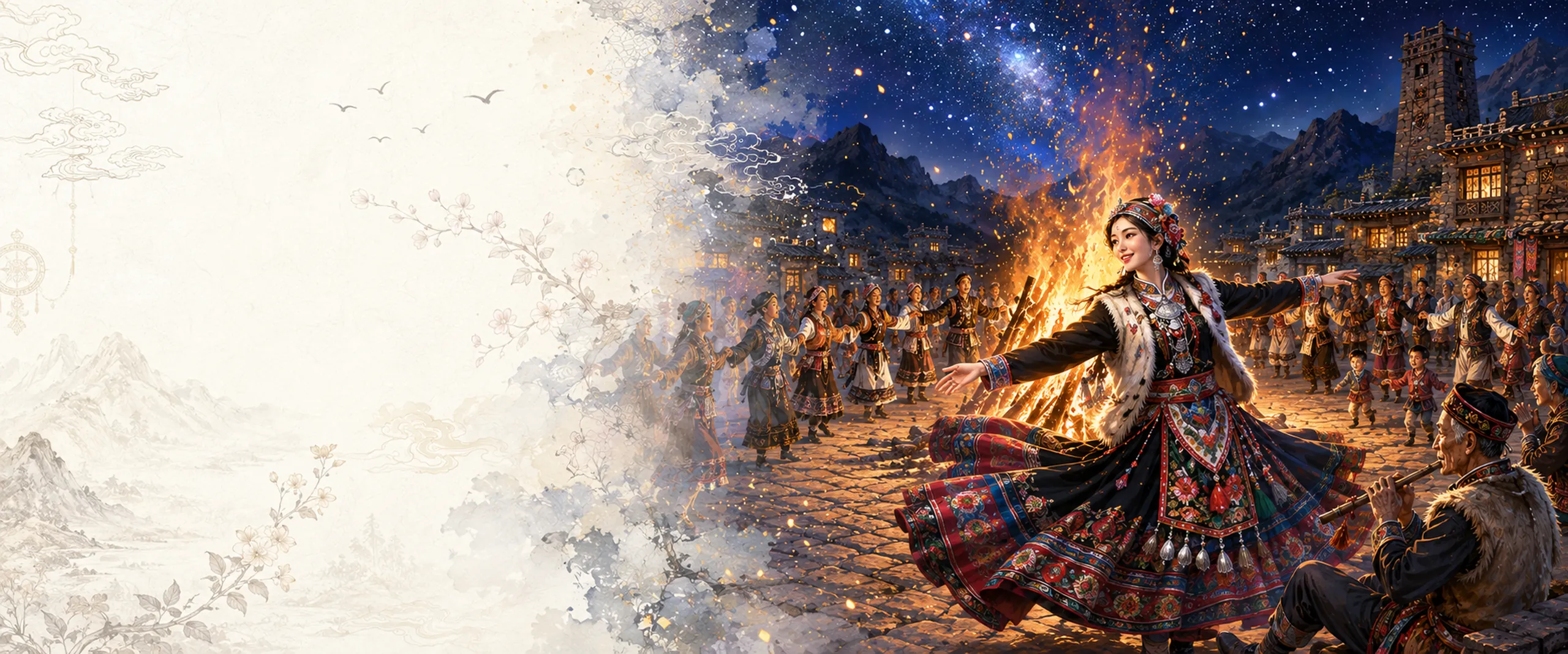
The Qiang New Year, also known as the “Qiang Calendar New Year,” centers on worshiping Heaven for blessings, expressing gratitude, and fulfilling vows. The celebrations are presided over by a highly respected elder of the village or a “Shibi” (priest). Ritual activities include worship of Heaven and Earth, ancestors, village deities, and other sacred beings. Everyone in the village eats a reunion meal together, drinks Zajiu, and dances the Salang (Shalang) until the celebration comes to a joyful end. Zajiu is an indispensable drink during the Qiang New Year—people gather around a wine jar and take turns drinking through bamboo tubes, embodying the Qiang people’s spirit of solidarity and mutual assistance. The Qiang New Year is a comprehensive folk festival integrating belief, history, singing, dancing, demonstrations of skill, traditional clothing, and Qiang cuisine.
Main Customs
Date and Names of the Qiang New Year
The Qiang Calendar: Ancient Wisdom of the Ten-Month Solar Calendar
The Qiang New Year falls on the first day of the tenth lunar month, a date jointly calculated according to the ancient Qiang ten-month solar calendar and the “iron-plate calculation” of the Qiang Shibi, namely an ancient Xia-calendar calculation method. After the Qiang people transitioned from a nomadic people to an agricultural people, calculations based on the ancient Qiang ten-month solar calendar designated the first day of the ninth month of the Qiang calendar, corresponding to the first day of the tenth lunar month, as the Qiang New Year. The Qiang calendar consists of ten months in a year, with thirty-six days in each month and the remaining five days designated as New Year days. By the Qing dynasty, this ancient Qiang calendrical system gradually disappeared, but the festival tradition was preserved. To this day, the Qiang New Year is still observed beginning on the first day of the tenth lunar month and generally lasts for three to five days, while in some villages celebrations continue until the tenth day of the tenth lunar month.
“Rimeiji” and the “Rimai Festival”: A Festival of Auspiciousness and Joy
The Qiang New Year has several names in the Qiang language. “Rimeiji” means “a festival of auspiciousness and joy,” directly expressing the festival’s central emotion. In the name “Rimai Festival,” “Rimai” refers to the Qiang people’s self-designation “Erma” (Qiang people), while “Festival” means a festive occasion; together, the name means “the festival of the Qiang people” or “Qiang New Year.” The Qiang New Year is also known as the “Harvest Festival,” the “Vow-Fulfillment Festival,” and the “Minor New Year.” The designation “Minor New Year” is particularly thought-provoking—it reflects the Qiang people’s attachment to and persistence in maintaining their own ethnic festival during the long historical process in which the Han Chinese Spring Festival gradually became the predominant festival.
The Qiang New Year comes as the high-altitude mountainous regions enter early winter, when livestock are fat and strong and granaries are full. It is also a time to enjoy the fruits of a year’s labor, and the celebratory banquet of the Qiang New Year is therefore also called the “Harvest Wine.” In the harvest season, when all grain has been gathered into the granaries and livestock fill the pens, people celebrate the harvest, express gratitude to the deities of Heaven and Earth, and voice their hopes for the coming year.
The Legend of the Qiang New Year: Mujiezhu and Douanzhu
Concerning the origins of the Qiang New Year, a beautiful folk legend circulates among the Qiang people about Mujiezhu, daughter of a heavenly deity, descending to the human world. According to the Qiang Shibi scripture Mujiezhu, Mujiezhu, the youngest daughter of the heavenly deity Mubita, insisted on descending to the human world to marry the young Qiang man Douanzhu. Before she left, her parents gave her tree seeds, grain, and livestock as her dowry. After Mujiezhu arrived in the mortal world, humanity quickly multiplied, the trees she planted suddenly grew into forests, grain harvests became abundant, and livestock multiplied into herds. Remembering the grace of her parents, after the autumn harvest Mujiezhu placed the harvested grain and well-fed livestock out on the open land and prayed toward Heaven. From then on, the Qiang New Year became a day on which the Qiang people celebrated the harvest and gave thanks to Heaven. Through highly vivid imagery, this legend reveals the threefold cultural meaning of the Qiang New Year—gratitude, harvest, and giving back.
Preparations Before the Festival: The Bustle of Welcoming the New Year
Preparations for the Qiang New Year begin several days before the festival, and the entire Qiang village becomes immersed in the bustle and joy of welcoming the New Year.
Sweeping Away Dust and Preparing Firewood
Before the Qiang New Year arrives, every household removes dust and sweeps the floors, washes clothes, and prepares the feast. People clean the areas in front of and behind their homes and sweep out the accumulated dust of the past year, symbolizing bidding farewell to the old and welcoming the new. They must also prepare ample firewood and sufficient fodder for their livestock. According to traditional Qiang customs, every household must complete these preparations before the New Year to ensure that the home is clean and supplies are plentiful when the New Year arrives.
Slaughtering Pigs and Sheep
In the past, whenever the Qiang New Year approached, every household became busy slaughtering pigs and sheep to make offerings to the ancestors and heavenly deities. Slaughtering the New Year pig was one of the most important preparations for the Qiang New Year. During the winter and twelfth lunar months, people slaughtered New Year pigs, smoked cured pork, and prepared New Year provisions. Slaughtering the New Year pig was not merely a way to prepare festival food, but also a community activity—clans took turns slaughtering pigs and hosting one another at banquets, strengthening relationships and sharing the joy of the harvest in the process. In some mountain villages, people also used flour to make colorful offerings in the shapes of cattle, sheep, chickens, horses, dogs, and other animals for worship of the ancestors and heavenly deities.
Steaming “Wada” and Making Offerings
As the Qiang New Year approaches, every household becomes busy steaming “Wada”—a large three-pronged steamed dumpling made from buckwheat dough filled with meat and tofu. Some people use buckwheat flour to make offerings shaped like cattle, sheep, chickens, and other animals for worship of the ancestors and deities. Some households paint swastika-grid patterns on their walls to celebrate the flourishing of people and livestock and abundant harvests. The New Year banquet is also known as the “Harvest Wine”—celebrating the rich yield finally brought by a year of hard work while also praying for favorable weather, abundant grain harvests, and thriving livestock in the coming year.
Brewing Zajiu
The Qiang people are very fond of the Zajiu they brew themselves, an indispensable festive drink for the “New Year Festival” on the first day of the tenth lunar month. Zajiu is made from highland barley, barley, and corn. The grains are cooked, mixed with a fermentation starter, placed in a jar, and covered with grass to ferment. During the brewing process, divination must also be used to determine the proper timing, and many taboos are observed. Zajiu is sealed in a large-bellied jar and opened only when it is time to drink. During the Qiang New Year, whichever household you visit, the host will serve guests tender, fragrant radish-and-pork dishes and potato rice and urge them to drink Zajiu.
Ritual Ceremonies: The Soul of the Qiang New Year
Ritual worship is the central and most solemn activity of the Qiang New Year. The festival centers on worshiping Heaven for blessings, expressing gratitude, and fulfilling vows. The rituals are presided over by a Shibi or a respected and authoritative elder.
Shibi: Cultural Messengers Connecting Heaven and Earth
The Shibi, known in the Qiang language as “Xu,” are the most authoritative cultural figures and repositories of knowledge among the Qiang people, individuals believed to connect the realms of life and death and communicate directly with the spirits. They are priests as well as healers, shamans as well as historians, and are the most important inheritors and guardians of Qiang culture. Qiang culture, which historically lacked a written record, has been transmitted from generation to generation precisely through the Shibi’s chanting of scriptures. The entire ritual process of the Qiang New Year is presided over by the “Xu” (Shibi, Subushi).
Mountain Worship: The Most Solemn Ritual
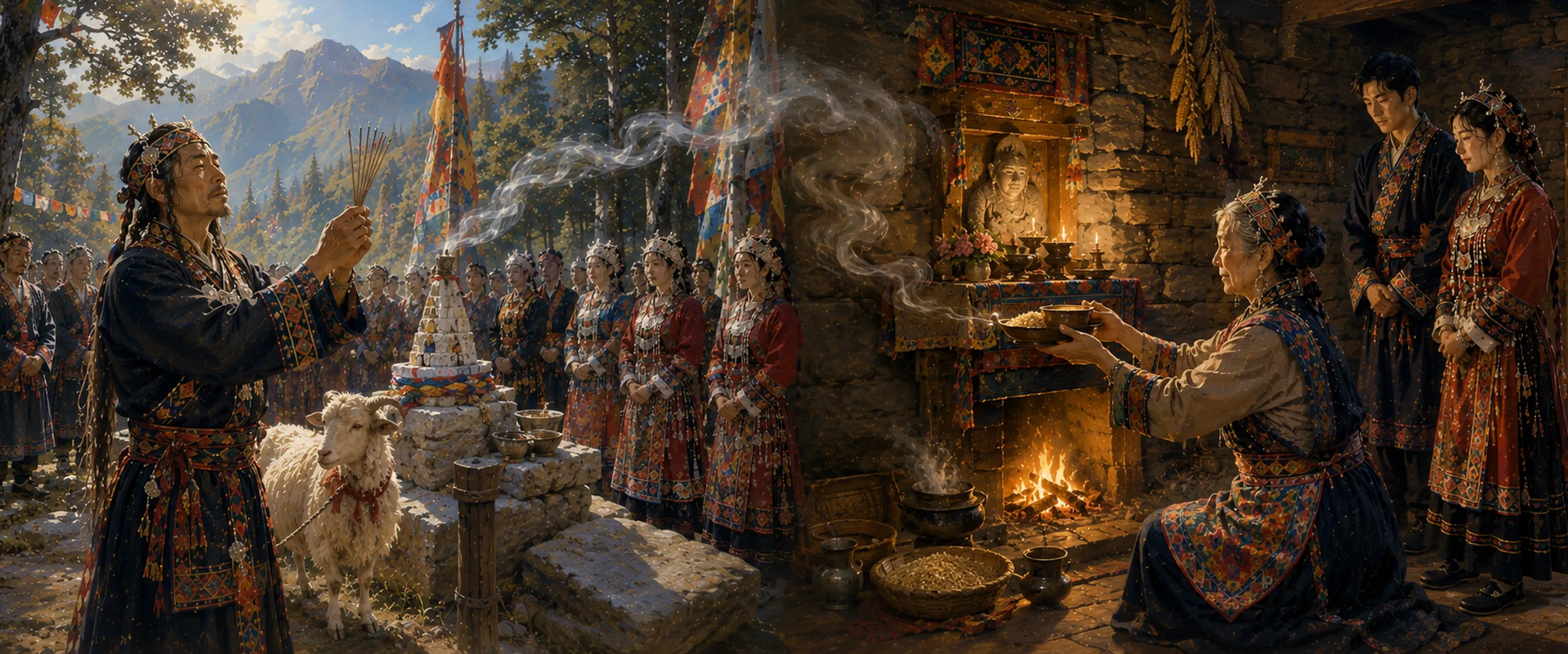
Mountain worship is the central ritual ceremony of the Qiang New Year. The Mountain Worship Festival, also known as the Mountain Reverence Festival or Heaven Worship Festival, is conducted by individual villages and is generally held in a sacred grove on a divine mountain near the village. Men and unmarried women participate, wearing their finest clothing and bringing elaborate festival food and drink while leading live cattle, sheep, chickens, and other livestock up the mountain. Once the altar has been arranged, the Shibi begins the ritual of worship and vow fulfillment—chanting scriptures, beating a sheepskin drum, purifying the offerings, worshiping the mountain deity, the Ox King, and the Jade Emperor, and finally making symbolic dough figures from cornmeal and chopping them apart with a knife to prevent animals from damaging the crops in the coming year and to pray for favorable weather.
The ritual is presided over by a Shibi or a respected and authoritative elder. After the benedictions have been recited, cattle, sheep, and chickens are slaughtered as offerings to the heavenly deity, mountain deity, and forest deity, and juniper branches are burned as incense. Auspicious words are then recited, and the participants collectively fulfill and make vows. The ceremony may last several hours or even an entire day. Everyone remains prostrated and does not rise, while only the Shibi or ritual leader may move about. Finally, after collectively swearing to uphold village rules, community agreements, and ancestral traditions, the participants shout together, fire guns, cheer, feast, sing, and dance until they have fully enjoyed themselves and return home.
Worshiping Heaven and Fulfilling Vows: Gratitude and Prayer
The rituals of the Qiang New Year include worship of Heaven and Earth, the ancestors, village deities, and other sacred beings. The “Qiang New Year” is a post-harvest occasion for thanking the heavenly deities for abundant grain harvests and favorable weather; in essence, it is an agricultural ritual of praying in spring and giving thanks in autumn. Ritual worship is the most important activity of the Qiang New Year. Villagers wear their finest clothing to participate, and work ceases during this period. On the first day, ritual worship is the principal activity. People remain in their own homes, burn incense, worship the deities of Heaven and Earth and household deities, report the year’s harvests, disasters, blessings, and misfortunes, and pray for favorable weather, prosperity for both people and livestock, peace in the country, and security for the people in the coming year.
Stages of the Ritual
“Subushi” is the Qiang-language name for the traditional Qiang religious ritual known as the “Mountain Worship Festival.” The Shibi scriptures contained within “Subushi” consist of three parts—the Upper Altar Scripture, Middle Altar Scripture, and Lower Altar Scripture—which respectively reflect Qiang perspectives on the three major realms of “deities,” “human beings,” and “nature.” The entire “Subushi” activity proceeds in sequence under the Shibi’s direction. The Shibi primarily performs rites for peace, comprising nine chapters in total. During the ritual process, the Shibi also performs the sheepskin-drum dance in response to different needs.
Cultural Significance of the Rituals
The Qiang are a people who revere ancestral spirits as well as Heaven, Earth, mountains, rivers, forests, and trees. During the Qiang New Year, the Qiang people express respect for the sun, moon, mountains, rivers, and all things in nature through solemn ritual ceremonies, maintaining their historical memory of and emotional attachment to their ancestors and homeland. “Unity between Heaven and humanity” is one of the ideals most highly esteemed by the Qiang people, and their respect and reverence for the sun and moon, mountains and rivers, all things in nature, their homeland, and their ancestors are fully manifested in the rituals of the Qiang New Year.
Ritual Dances: The Sheepskin-Drum Dance and Shibi Ceremonies
Ritual dance is an important component of Qiang New Year ceremonies and one of the most distinctive artistic expressions of Qiang culture.
Sheepskin-Drum Dance: The Soul Dance of Ritual Worship
The sheepskin-drum dance is the central dance performed by the Shibi during ritual ceremonies. Ritual activities begin with the sheepskin-drum dance, while the Shibi, holding a ritual staff, recites scriptures reflecting Qiang history and customs of production and daily life. The sheepskin drum is the Shibi’s most important ritual implement and musical instrument. Its drumhead is made of sheepskin, and its sound is deep and resonant. The Shibi drums while dancing, and the sound of the drum intertwines with the chanting of scriptures, creating a sacred and mysterious atmosphere.
When performing the sheepskin-drum dance, the Shibi wears specialized ritual clothing, a ritual crown, and carries a ritual staff and sheepskin drum. The dance steps change with the rhythm of the chanting, at times measured and solemn, at times rapid and intense. The sheepskin-drum dance is not merely a dance, but a means by which the Shibi communicates with the deities—through the drumbeats and dance steps, the Shibi conveys human prayers to the deities and communicates the will of the deities to the human world.
Shamanic Dance: Entertaining the Deities Through Dance
Qiang folk dance can broadly be divided into two major categories—ritual dances performed primarily by shamans, known as shamanic dances, and “Guozhuang,” called “Salang” in the Qiang language. Shamanic dance is performed by the Shibi during ritual ceremonies and carries a strong religious character. Its movements imitate various animals and natural phenomena, reflecting the Qiang people’s awe and reverence toward nature.
The characteristic of “entertaining the deities through dance” is fully expressed in passages from Qiang epic chants such as Mujizhuo and Douanzhu and The Qiang-Ge War. During ritual ceremonies, the Shibi pleases the deities through dance and prays for their protection and blessings. Shamanic dance is not only a religious ritual but also an important carrier of Qiang culture—through dance, Qiang historical memory, myths and legends, and religious beliefs are transmitted from generation to generation.
Shalang: The Song-and-Dance Celebration of the Qiang New Year
Shalang is the most iconic collective dance of the Qiang New Year and the most exuberant artistic expression of Qiang culture.
Origins and Evolution of Shalang
Shalang is the most widespread dance form in the Qiang region and has a long history. As early as the Shang period, traces of dance already appeared in the ritual practices of the ancient Qiang people. Qiang Shalang can be divided into two major categories: ritual music and dance, and recreational music and dance. Ritual music and dance originated among the ancient Qiang, and “Shalang” itself evolved from ritual dance. Recreational music and dance arose from productive labor and, accompanied by recurring musical melodies, uses dance movements to depict scenes of Qiang labor. Today, Shalang generally refers to recreational music and dance, and the songs performed by dancers cover a broad range of subjects and contain rich lyrics.
The dance most frequently performed by the Qiang during the Qiang New Year is the Salang dance, also known as Qiang Guozhuang. Qiang Guozhuang originated from Shalang and evolved from ritual dance, possessing both recreational and physical-fitness functions. The characteristic of Shalang dance as a means to “entertain the deities through dance” is fully expressed in Qiang epic chanting and represents one of the most concentrated artistic expressions of Qiang culture.
The Form of Shalang Dance
The celebratory Guozhuang is performed during festivals, weddings, and after work. Men and women stand opposite one another, each forming a row, and dance while holding hands. An elder skilled in both singing and dancing often leads the group, with men and women singing responsively while dancing. When the dance reaches its faster section, the rhythm becomes increasingly rapid, the steps become quicker, and the participants’ enthusiasm rises accordingly. The art of dance is closely connected to the history of Qiang development. Influenced by the people’s living environment and way of life, hand movements vary relatively little, while footwork is extremely rich, with a brisk rhythm and a relaxed, natural quality.
Participation in Shalang is extremely broad—men and women, young and old, can all take part. During the Qiang New Year, villagers wear festive clothing, sing and dance exuberantly, drink in celebration, and express both the joy of the harvest and the sincerity of their prayers. People form circle after circle, singing and dancing as they move, and do not return home until late at night after fully enjoying themselves. In places such as Beichuan, a thousand people dancing Salang together has become one of the most iconic sights of the Qiang New Year.
Songs of Shalang
The songs sung during Shalang dances are extremely diverse. There are joyful songs praising the harvest, love songs expressing affection, ancient songs recounting history, and songs of praise celebrating heroes. The lyrics are often improvised, with elders leading the singing and everyone joining in chorus. The songs of Shalang echo through the valleys of Qiang villages, melodious yet exuberant, forming one of the most moving soundscapes of the Qiang New Year.
Food Culture of the Qiang New Year
The Qiang New Year table is a feast for the senses and the most concentrated display of Qiang food culture.
Zajiu: The Soul of the Festival
Zajiu is the most representative drink of the Qiang New Year. Among the Qiang, men and women, old and young alike enjoy Zajiu brewed at home from highland barley and barley. To make it, highland barley is cooked, mixed with a fermentation starter, sealed in a jar, and allowed to ferment for seven to eight days before drinking. During the brewing process, divination must also be used to determine the timing, and numerous taboos must be observed.
The method of drinking is distinctive and ancient. Zajiu is sealed in a large-bellied jar and opened only when it is time to drink. Thin bamboo tubes are inserted into the jar, and everyone sits around it to drink together or take turns sipping through the tubes. Before drinking, clear water is poured into the jar, after which the drink is sucked through thin bamboo tubes. Water is continuously added while drinking until the flavor becomes weak. The Zajiu jar is opened by a highly respected elder of the village. Everyone in the village drinks Zajiu until the gathering comes to a joyful end. During the Qiang New Year, whichever household you visit, the host will enthusiastically urge you to drink Zajiu.
Wada: Large Three-Pronged Steamed Dumplings
“Wada” is the most representative food of the Qiang New Year—a large three-pronged steamed dumpling made from buckwheat dough filled with meat and tofu. Family members gather at home to steam “Wada,” and once cooked, they divide and eat them together. Wada resembles the Chinese character for “mountain” in shape, and the filling usually consists of chopped cured pork, chopped tofu, and pickled wild vegetables. Buckwheat is one of the principal food crops of the Qiang region, and making New Year foods from buckwheat flour reflects the Qiang people’s appreciation of local produce and commitment to tradition.
Harvest Wine: The New Year Banquet
The Qiang New Year banquet is known as the “Harvest Wine.” “Harvest Wine” means celebrating the rich harvest finally obtained after a year of hard work, while also praying for continued favorable weather, abundant grain harvests, and thriving livestock in the coming year. In addition to Wada and Zajiu, the New Year feast includes traditional Qiang foods such as potato glutinous cakes, radish with pork, pickled-vegetable dough pieces, and hand-grabbed mutton.
Sun Buns and Moon Buns
During the Qiang New Year, people also make flour-based offerings and foods in a variety of shapes. Sun buns and moon buns are among the most distinctive—they are made from wheat flour in the shapes of the sun and moon and serve both as ritual offerings and festival foods. Some people also use wheat flour to make colorful offerings in the shapes of cattle, sheep, chickens, horses, dogs, and other animals. These flour creations are delicately shaped and carry auspicious meanings, reflecting the Qiang people’s rich imagination and accomplished skills in making flour-based foods.
Shehuo Performances and Competitions of the Qiang New Year
In addition to rituals, songs, and dances, the Qiang New Year also includes a rich variety of Shehuo folk performances and athletic competitions.
Traditional Sports Competitions
During the Qiang New Year, people hold various traditional sports competitions. Pole pushing is one of the most distinctive Qiang traditional sports—two or more participants hold a long pole and push against one another, competing in strength and technique. Basket jumping is another interesting competition: participants jump into carrying baskets and compete in speed while maintaining their balance. These sports are not only contests of strength but also demonstrations of courage and skill.
Shibi Feats of Skill
During the Qiang New Year, Shibi also perform various extraordinary feats. “Striking oil fire” is one of the traditional feats performed by Qiang Shibi. Climbing the “mountain of knives” is even more thrilling—the Shibi climbs barefoot up a “mountain” constructed from sharp blades, displaying exceptional courage and skill. These performances are not merely entertainment, but demonstrations of the Shibi’s ritual power and courage, reflecting the Qiang people’s awe and reverence toward supernatural forces.
Shehuo Processions
In Qiang New Year celebrations held in county seats and townships, Shehuo processions are an indispensable part of the festivities. Various folk-cultural procession groups hold solemn ritual ceremonies before the sacrificial tower in Yuwang Square. In the procession, people wear festive clothing, perform a range of traditional skills, and display the richness and diversity of Qiang culture.
Integration of Modern Sports Activities
With the development of the times, modern sports such as basketball and tug-of-war have gradually been incorporated into Qiang New Year celebrations. Tradition and modernity have achieved an organic integration within the Qiang New Year—the traditional core of ritual worship, song, and dance has been preserved while new elements such as modern athletic competitions have also been introduced. The Qiang New Year has become an important platform for presenting Qiang culture, promoting ethnic unity, and advancing the integration of culture and tourism.
Family Reunion and Community Bonds
The Qiang New Year is not only a celebration for the entire village, but also an occasion for family reunion and community connection.
Household Worship: Honoring Household Deities and Repaying the Fire Deity
After the collective rituals and celebrations of the daytime, each household holds a family ritual in the evening under the direction of the head of the family, worshiping household deities, giving thanks to the Fire Deity, and holding a family banquet. Household worship is one of the warmest parts of the Qiang New Year—before the household shrine, family members burn incense and light candles, express respect to the household deities and Fire Deity, and pray for family peace and prosperity for both people and livestock in the coming year. After the household ritual, the entire family sits together and shares the New Year feast, experiencing the warmth of family and the joy of reunion.
Married Daughters Returning to Their Parental Homes
During the Qiang New Year, married daughters return to their parental homes for reunion. This is an important expression of Qiang kinship culture. Married daughters return with their spouses and children to spend the New Year with their parents, brothers, and sisters. At the New Year feast, the whole family reunites in happiness and harmony. This custom of returning to the parental home reflects the Qiang people’s emphasis on family ethics and their deep appreciation of kinship.
Visits Among Relatives and Neighbors
On the second day, relatives and neighbors invite one another to visit, exchange congratulations, drink Zajiu together, enjoy food, laugh, talk, and play games before returning home fully satisfied. On the third day, the able-bodied men of the entire village put on festive clothing, tuck bamboo sticks adorned with pheasant feathers into their belts, sing and dance, form pairs, and visit each household to offer New Year greetings and congratulations. This custom of moving through the village to exchange New Year greetings strengthens emotional ties between families and villages. During the festival, relatives and friends may exchange congratulations and invite one another to visit. The entire Qiang village is immersed in a festive and joyful atmosphere.
Regional Variations
Mao County
Singing ancient historical songs of the people; the most completely preserved traditional ritual ceremonies
Li County
Performing the “Yochubu” folk dance; celebrations presided over by Shibi
Wenchuan
The whole village gathers at the village entrance for celebrations; cultural revival during post-disaster reconstruction
Beichuan
White-stone procession through the entire village; a thousand people dancing Salang together; the most elaborate celebrations in the county
Contemporary Transmission
### From “Emergency Safeguarding” to “Living Transmission”
The devastating Wenchuan earthquake of 2008 dealt a destructive blow to Qiang culture. It destroyed cultural spaces where the Qiang New Year was held, damaged related clothing and ritual implements, and, more gravely, took the lives of many tradition bearers. In 2008, the Qiang New Year was inscribed on the second national list of representative items of intangible cultural heritage. In the same year, the National Qiang Cultural Ecological Protection Experimental Zone was established, and Qiang New Year traditions were gradually restored. In 2009, the Qiang New Year was inscribed by UNESCO on the first List of Intangible Cultural Heritage in Need of Urgent Safeguarding. On December 5, 2024, the Qiang New Year was successfully transferred to the Representative List of the Intangible Cultural Heritage of Humanity. This was the first formal implementation of a transfer procedure within the framework of UNESCO’s listing mechanism.
The Qiang New Year’s transition from “in need of urgent safeguarding” to a “representative intangible cultural heritage of humanity” marks the movement of its protection from an “emergency safeguarding” phase into a new stage of “living transmission.” The establishment of the National Qiang Cultural Ecological Protection Experimental Zone introduced coordinated planning and development in cultural spaces, project practice, transmission, dissemination, research, promotion, and other areas, implementing comprehensive protection for the Qiang New Year.
### The Flourishing Qiang New Year Today
Far from declining in contemporary society, the Qiang New Year has instead taken on increasingly rich and diverse forms. During the festival, Qiang communities in townships and villages, under the careful guidance of township governments or Shibi, dress in festive clothing and hold solemn mountain-worship ceremonies. In county seats, under the leadership of county Party committees and county governments, county cultural authorities organize celebrations for the Qiang New Year across the entire county.
The celebrations begin with ritual worship, during which Shibi lead various folk-cultural procession groups in solemn ceremonies before the sacrificial tower in Yuwang Square. This is followed by exhibitions and performances of intangible cultural heritage projects, folk song-and-dance performances, exchanges involving photography, calligraphy, and fine arts, folk-cultural performances, exhibitions of Qiang New Year cultural and creative products, and other activities. On New Year’s night, a “Night of Qiang City” Shalang bonfire evening is held. Activities include ritual worship, exhibitions and performances of intangible cultural heritage projects, folk song-and-dance performances, the “Night of Qiang City” Shalang bonfire evening and folk-cultural performances, exhibitions of Qiang New Year cultural and creative products, and more. These activities both publicize and present the cultural content of Qiang New Year folk customs and strongly promote the integrated development of culture and tourism.
During the 2025 Qiang New Year, Jiuhuang Mountain Scenic Area in Beichuan launched the activities “Eat a Qiang Feast, Collect Qiang Blessings, Celebrate the Qiang New Year.” Through an integrated model of “intangible cultural heritage + tourism + consumption,” ancient folk customs were transformed into an immersive experience that could be “seen, felt, and played.” Visitors scanned a code to log in to the “Five Qiang Blessings” mini program and traveled to various check-in points to collect all “Five Qiang Blessings,” changing from “spectators” into “participants.” At noon, the opening ceremony of the Paotang banquet brought the atmosphere to a climax, as a Qiang feast of eight dishes and one soup—including cured sausage and warming Paotang soup—was served in succession. This form of “immersive participation” allows intangible cultural heritage to cease being merely an exhibit behind museum glass and instead become a tangible and perceptible experience of everyday life.
Closing Note
The folk activities of the Qiang New Year form a long cultural scroll centered on “ritual” and “celebration.” From the solemn ceremonies in which the Shibi beats the drum and chants scriptures to the exuberant celebration of the entire village dancing Shalang in circles, from the mellow sweetness released when a jar of Zajiu is opened to the fragrance of grain rising from steaming Wada dumplings, from the mysterious solemnity of the white-stone procession to the breathtaking sight of a thousand people dancing together—the customs of the Qiang New Year unite the Qiang people’s reverence for Heaven and Earth, gratitude toward their ancestors, celebration of the harvest, and love of life.
The Qiang New Year is a festival of “ritual.” In the chanting of the Shibi echo three thousand years of Qiang historical memory; in the beats of the sheepskin-drum dance are transmitted the Qiang people’s reverence and gratitude toward the deities of Heaven and Earth. Worship of the mountains, worship of Heaven, worship of ancestors, worship of deities—the ritual ceremonies of the Qiang New Year are a means by which the Qiang people converse with the divine and a lived expression of the philosophy of “unity between Heaven and humanity.” The Qiang New Year, “whether viewed in terms of form or content, is living material for the study of Qiang history, culture, art, customs, and more.”
The Qiang New Year is also a festival of “celebration.” The songs of Shalang overflow with the joy of the harvest; the mellow fragrance of Zajiu carries the sweetness of life; the joyful gathering of the long-table banquet embodies the warmth of the community. The Qiang New Year is an open and social festival—people leave their homes and gather together to celebrate the festival, celebrate the harvest, and envision the future together. Through celebration, the Qiang people express their love of life and confidence in the future.
In 2008, the Qiang New Year was inscribed on the second national list of intangible cultural heritage. In 2009, it was included by UNESCO on the first List of Intangible Cultural Heritage in Need of Urgent Safeguarding. In 2024, the Qiang New Year was successfully transferred to the Representative List of the Intangible Cultural Heritage of Humanity. From “urgent safeguarding” to becoming a “representative intangible cultural heritage of humanity,” from emergency protection after the earthquake to living transmission, the Qiang New Year has passed through thousands of years and, with its distinctive cultural vitality, continues to flourish among the high mountains and deep valleys of the upper Min River. The Qiang New Year has “journeyed from antiquity to the present, from mountain villages to the nation and even to the United Nations”; it is not only a cultural treasure of one people, but also a shared spiritual heritage of all humanity. Like the melodies of the Shalang dance and the mellow fragrance of Zajiu, it has passed through a thousand years of storms and still pulses with the most fervent cultural heartbeat in the hearts of the “people above the clouds.”
—
Readers’ Comments
Calendar and traditional culture enthusiasts from around the world, sharing the same moon.
Sign in or register to join the conversation. Your comment account is created automatically the first time you use a connected account.
No comments yet
Share your thoughts with readers around the world.