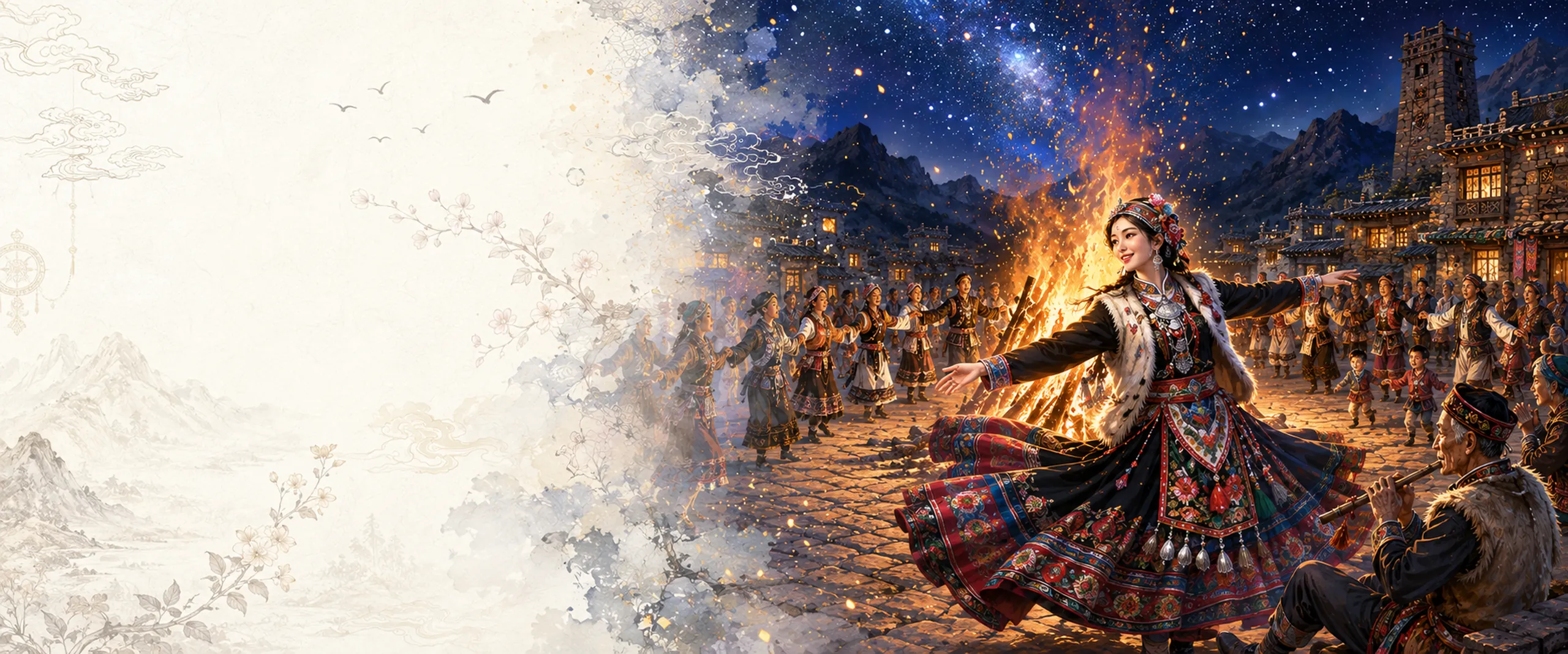
Qiang New Year, also known as the Qiang Calendar New Year, is celebrated each year on the first day of the tenth lunar month and is an important festival through which the Qiang people give thanks to nature and honor their ancestors. In 2008, Qiang New Year was included together with the Dragon Boat Festival and other elements in UNESCO’s intangible cultural heritage system, with Qiang New Year placed on the List of Intangible Cultural Heritage in Need of Urgent Safeguarding. Centered on rites to Heaven and prayers for blessings, the drinking of zajiu, and the Shalang dance, Qiang New Year is a comprehensive folk celebration integrating belief, history, song, dance, clothing, and food. Following its inclusion in the world intangible cultural heritage system, the cultural value of Qiang New Year gained recognition and attention from the international community, while also creating an important opportunity for the safeguarding and transmission of Qiang culture. Through ancient ritual ceremonies and joyful song and dance, Qiang New Year tells the world a thousand-year story of the Qiang people living in harmony with nature.
Celebrated Worldwide
Intangible Cultural Heritage
The most important channel through which Qiang New Year entered the world stage has been UNESCO’s intangible cultural heritage system.
Inscribed on the “Urgent Safeguarding List” in 2009 — the beginning of international attention. In 2009, at the fourth session of UNESCO’s Intergovernmental Committee for the Safeguarding of the Intangible Cultural Heritage, held in the United Arab Emirates, Qiang New Year was formally approved for inclusion on the List of Intangible Cultural Heritage in Need of Urgent Safeguarding. This marked the first time Qiang New Year entered the international field of vision. UNESCO described it as “an occasion for the Qiang people to express gratitude and reverence, reaffirm a harmonious and respectful relationship with nature, and promote social and family harmony.”
The crisis behind “urgent safeguarding” and the response to it. Qiang New Year’s inclusion on the Urgent Safeguarding List had a profound historical background. UNESCO noted that participation in the festival had already declined at the time, due to population migration, waning interest among younger generations in Qiang heritage, and the influence of outside cultures. The devastating 2008 Wenchuan earthquake destroyed countless Qiang villages, placing Qiang New Year at serious risk. Yet the disaster also awakened a stronger consciousness of cultural safeguarding. UNESCO specifically noted that, since its inscription on the Urgent Safeguarding List, Qiang New Year has played a key role in “rebuilding faith and resilience” during post-disaster reconstruction.
Transferred to the “Representative List” in 2024 — international recognition of safeguarding achievements. On December 5, 2024, at the 19th session of UNESCO’s Intergovernmental Committee for the Safeguarding of the Intangible Cultural Heritage, held in Asunción, Paraguay, Qiang New Year, together with the “traditional Li textile techniques: spinning, dyeing, weaving and embroidering” and “traditional design and practices for building Chinese wooden arch bridges,” was transferred from the Urgent Safeguarding List to the Representative List of the Intangible Cultural Heritage of Humanity. UNESCO noted in its evaluation that safeguarding efforts for Qiang New Year had achieved remarkable results and that its viability had continued to strengthen. Qiang New Year has “played an important role in safeguarding traditional Qiang culture and in promoting the development of local cultural ecotourism and distinctive rural tourism.”
From “urgent safeguarding” to “a representative heritage of humanity”—this 15-year journey bears witness to Qiang New Year’s passage from endangerment to renewal and marks the highest level of international recognition received by Qiang culture within the global intangible cultural heritage safeguarding system.
International Visitors
The most direct form of Qiang New Year’s global dissemination is to “invite” the world into the Qiang villages of Aba, Sichuan, allowing international visitors to take part personally in this thousand-year-old New Year celebration.
Friends from many countries gather in Wenchuan — the international contingent of Qiang New Year 2025. From November 19 to 20, 2025, a series of Qiang New Year celebrations themed “Beautiful Aba · Happy Qiang New Year” was held in Wenchuan County. This was the first Qiang New Year after the festival’s transfer from the Urgent Safeguarding List to the Representative List of the Intangible Cultural Heritage of Humanity. The festivities extended from Yingxiu Town to Weizhou Town and Miansi Town.
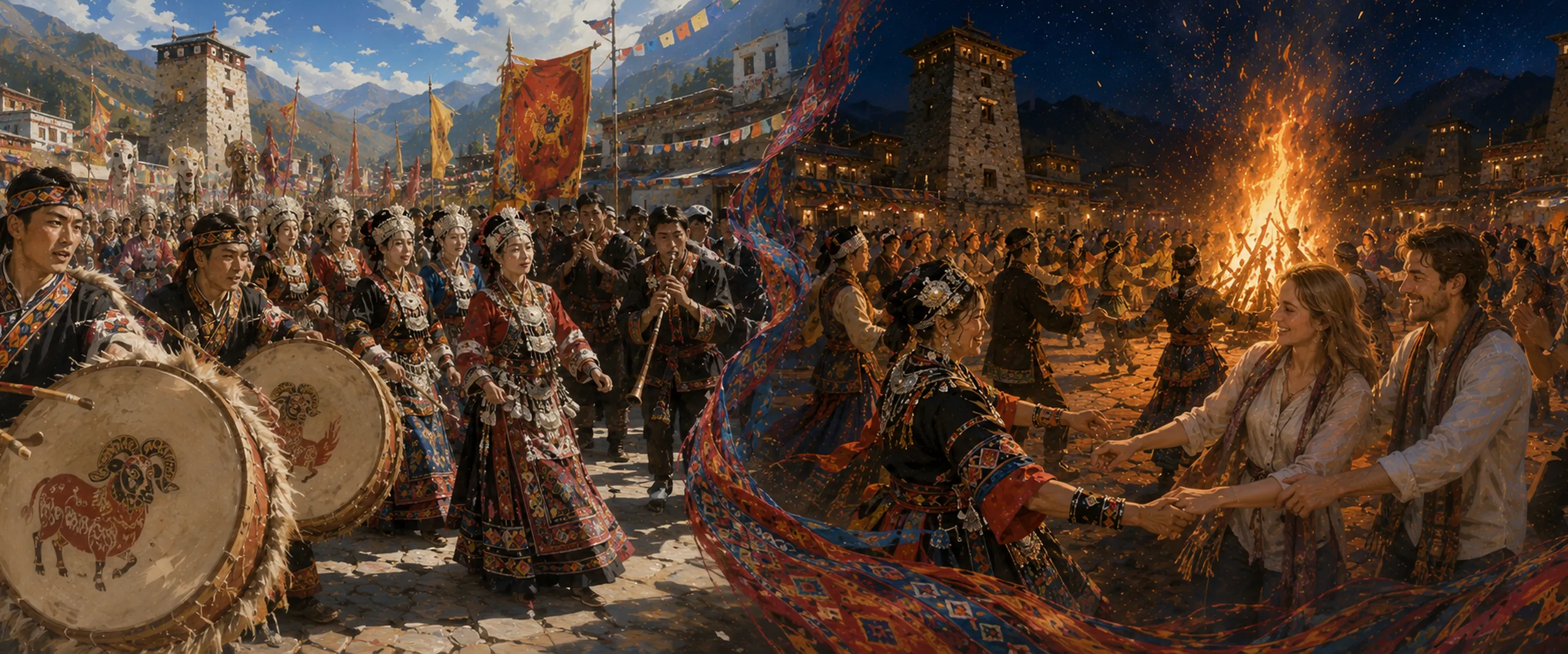
During the “Radiant Spirit” parade on the afternoon of the 19th, Qiang participants in traditional clothing moved through the streets, displaying intangible cultural heritage elements such as Qiang embroidery and silver ornaments. The most eye-catching group in the procession was an “international contingent” made up of participants from multiple countries—international friends from New Zealand, Melbourne, Thailand, Slovakia, Uzbekistan, and elsewhere joined the parade in festive dress and celebrated together with local Qiang residents and visitors of different ethnic groups. This cultural encounter across national borders not only brought Qiang New Year culture closer to the world, but also created a bridge for civilizational dialogue based on “each appreciating its own beauty, and all sharing beauty together” (各美其美、美美与共).
International arts groups perform together. During the 2025 Wenchuan Qiang New Year celebrations, performance groups from eight Qiang-inhabited areas of Sichuan appeared together with five international arts troupes, including the Trenčín Folk Dance Ensemble from Slovakia and Thailand’s “Thai Perfect” Traditional Dance Arts Troupe. Artistic elements from different peoples and regions met and mingled here—combining the passionate exuberance of Qiang performers with the varied charms of song and dance from abroad. Thailand’s “Thai Perfect” Traditional Performing Arts Troupe was invited to participate in the Qiang New Year celebrations, allowing traditional Thai arts and Chinese intangible cultural heritage to meet on the same stage and spark cultural exchange.
Immersive experience — allowing the world to touch Qiang culture. The 2025 Qiang New Year celebrations centered on “living transmission + immersive experience + international interaction.” Visitors could witness the solemn blessing rituals of the Shibi (释比), traditional Qiang ritual specialists, listen firsthand to the sounds of the Qiang flute and the ethereal harmonies of Qiang polyphonic folk songs, and personally join in folk interactions such as the bonfire Shalang dance and zajiu tasting. At the large open-air “paotang feast” (吃刨汤) for a thousand people, visitors from across the country and Qiang residents gathered together, tasted distinctive Qiang foods, and raised their cups to welcome the Qiang Calendar New Year. Yingxiu’s streets also featured a living intangible cultural heritage experience area.
From a “disaster zone” to a “cultural destination” — Wenchuan’s international transformation. The 2008 earthquake made Wenchuan a focus of world attention. Seventeen years later, Wenchuan was using Qiang New Year, now on the Representative List of the Intangible Cultural Heritage of Humanity, as a cultural calling card to attract arts groups and visitors from countries around the world. As local media in Wenchuan put it, Qiang New Year “uses the festival as a medium to transmit the roots of intangible heritage and song as a bridge for cultural exchange, allowing this traditional celebration inscribed on the Representative List of the Intangible Cultural Heritage of Humanity to blossom in the new era with a distinctive charm that crosses mountains and seas.”
Overseas Arts Groups
The international dissemination of Qiang New Year is reflected not only in “inviting the world in,” but also in overseas arts groups actively learning from and re-creating Qiang culture.
Thailand’s “Thai Perfect” arts troupe and its journey through Chinese intangible heritage. In November 2025, at the invitation of Wenchuan’s culture and tourism authorities, Thailand’s “Thai Perfect” Traditional Performing Arts Troupe traveled to Wenchuan County to participate in the Qiang New Year celebrations. Traditional Thai arts met Chinese intangible cultural heritage on the Qiang New Year stage, generating sparks of cultural exchange.
Chaoshan Yingge dance, Zhejiang Baiye Dragon, Inner Mongolian Ulan Muqir — cultural resonance from across China. The 2025 Qiang New Year parade included not only traditional Qiang performances, but also intangible cultural heritage teams from around China. The drumbeats of Chaoshan Yingge dance thundered through the streets; Zhejiang’s Baiye Dragon rolled through the wind with poetic grace; and the songs of Inner Mongolia’s Ulan Muqir carried the vastness of the grasslands. The entire street became a moving cultural theater. This gathering of intangible cultural heritage traditions from across China at Qiang New Year has made the festival not only a Qiang celebration, but also a platform for the concentrated presentation of China’s diverse ethnic cultures.
Participation by international arts groups. Performance teams from Mexico and other countries also joined the Qiang New Year celebrations. Qiang New Year is becoming an important platform for international folk-art exchange, attracting growing numbers of cultural groups from around the world.
Documentary and Film Dissemination
Documentary film constitutes another important channel through which Qiang New Year has reached the world.
Above the Clouds — the first Chinese documentary to win a UK TVE film award. In 2024, at the 13th UK TVE Global Sustainability Film Awards, the Qiang cultural documentary Above the Clouds (《云朵之上》), produced and written by Wang Qinjia, a young member of the overseas Qiang community from Beichuan, received the Special Jury Award. It was the first Chinese documentary in the history of the awards to be selected and to win a prize.
The documentary takes the ancient traditional culture of the Qiang people and the spirit of cultural transmission as its narrative background. Through a distinctive perspective on local customs, it explores in depth the harmonious relationship between the Qiang people and nature, expressing their respect for and dependence on mountains, forests, rivers, and other natural elements. The story unfolds against the background of the devastating natural disaster of 2008. Above the Clouds appeared at the awards ceremony in London, competing among nearly a thousand films from more than a hundred countries worldwide. From the Qiang mountains of Beichuan to the awards stage in London, Above the Clouds enabled the world to discover Qiang New Year and Qiang culture through moving images.
Our Shared Festivals — telling the ethnic story of Qiang New Year. The Sichuan-produced micro-documentary series Our Shared Festivals (《我们共同的节日》), created to transmit and promote outstanding traditional Chinese culture, tells vivid and moving stories from traditional celebrations including the Torch Festival, Qiang New Year, the Mid-Autumn Festival, Tibetan New Year, and Spring Festival. The series was named one of the ten outstanding works in the micro-documentary category at the 31st China Documentary Academic Awards.
Inspiration China — international communication for Generation Z. The international video program Inspiration China (《灵感中国 Inspiration》), produced by Sichuan Daily Press Group, is aimed at Generation Z audiences in China and overseas and explores cultural calling cards of China such as ancient Shu civilization for global viewers. The series has released features including What Is Qiang New Year?, introducing Qiang New Year culture to international audiences through a younger and more contemporary style of expression.
International Academic Dialogue
The international dissemination of Qiang New Year has also been deepened through academic exchange and cultural-brand development.
The “China Qiang New Year” Cultural Exchange Conference. In November 2025, the “China Qiang New Year” Cultural Exchange Conference, themed “Carrying Forward the Millennia-Old Heritage of Yu and Qiang · Drawing a New Chapter of Exchange Together,” was held. The conference brought together international cultural scholars, university representatives, intangible cultural heritage inheritors, and guests from government and business, exploring from multiple perspectives the safeguarding and transmission, innovative transformation, and international dissemination of Qiang culture. This international dialogue brought new thinking to the living development of intangible cultural heritage of humanity.
Beichuan — building a cultural brand in China’s only Qiang autonomous county. Beichuan is China’s only Qiang autonomous county, with a Qiang population of 86,000, accounting for one-third of the country’s total Qiang population. Drawing on distinctive folk-cultural brands such as the Dayu sacrificial rites, Qiang New Year, and Shalang Festival, Beichuan has developed more than 30 forms of Qiang song and dance and fostered more than ten distinctive culinary traditions, including “Thirteen Flowers of the Qiang Family” and “Ten Great Bowls of the Qiang Family.” With Qiang New Year as its central cultural IP, Beichuan is building a system of Qiang cultural brands oriented toward the world.
Launch of the Qiang New Year IP “Ranbiwa.” During Qiang New Year in 2025, the Qiang cultural IP “Ranbiwa” (燃比娃) was officially launched. The introduction of this cultural IP marks Qiang New Year culture’s movement toward the world through a more modern and youthful form.
Mutual Learning Among Civilizations
Dialogue with Global “New Year / Harvest Festivals”
Qiang New Year is the traditional New Year of the Qiang people and also a festival celebrating the harvest. Celebrating the New Year and the harvest on the first day of the tenth lunar month creates an interesting resonance with the harvest festivals of many peoples around the world.
From Asia to Europe, from Africa to the Americas, agricultural civilizations have widely developed festivals centered on “giving thanks for the autumn harvest.” Thanksgiving in the United States celebrates the harvest in November; Germany’s harvest festivals give thanks for the gifts of the land in October; India’s harvest festivals celebrate the rice harvest in January; and many peoples in Africa also hold ancestral rites and celebrations after the autumn harvest. Qiang New Year shares with these festivals a common human emotion—gratitude toward the land, joy in abundance, and hopes for the coming year.
In its description of Qiang New Year, UNESCO notes that it is an occasion for the Qiang people to “express gratitude and reverence and reaffirm a harmonious and respectful relationship with nature.” This spirit of “gratitude toward nature and reverence for Heaven and Earth” is precisely a value shared by agricultural civilizations around the world. What distinguishes Qiang New Year is that it brings “New Year” and “harvest” together as one—it both bids farewell to the old and welcomes the new, while also giving thanks for the harvest. This dual theme gives Qiang New Year a distinctive place among the world’s festivals.
Global Dialogue on “Post-Disaster Cultural Reconstruction”
The most distinctive and moving part of the story of Qiang New Year lies in its relationship with the 2008 Wenchuan earthquake.
UNESCO clearly noted that the 2008 earthquake “destroyed many Qiang villages, placing Qiang New Year at serious risk.” Yet it was precisely this disaster that first brought concentrated global attention to the Qiang people and Qiang New Year. In 2009, Qiang New Year was included on UNESCO’s Urgent Safeguarding List—an acknowledgment by the international community that the festival was endangered, and also a commitment to its protection.
Even more moving is the unexpected role Qiang New Year played in post-disaster reconstruction. UNESCO noted that Qiang New Year “played a key role in rebuilding faith and resilience following the 2008 earthquake.” After physical homes had been destroyed, culture became a force for rebuilding spiritual homes. This story of “culture as a force in post-disaster reconstruction” carries universal significance around the world. Following Japan’s 3/11 earthquake, traditional culture likewise helped communities rebuild cohesion; after the Indian Ocean tsunami, communities in Southeast Asia also used traditional rituals to restore social bonds. The story of Qiang New Year demonstrates that intangible cultural heritage is not merely “heritage,” but also a living force through which communities repair themselves in times of crisis.
Dialogue with Global “Intangible Heritage Safeguarding Models”
Qiang New Year’s journey from the Urgent Safeguarding List to the Representative List provides a noteworthy case for the safeguarding of intangible cultural heritage around the world.
When it was placed on the Urgent Safeguarding List in 2009, participation in Qiang New Year had already declined, while the earthquake had destroyed countless villages. Over the following fifteen years, governments at different levels in China invested substantial resources. Between 2014 and 2019 alone, more than 30 million yuan in central government funding was invested in supporting the development of the Qiang cultural ecological protection area. Laws and regulations including the Regulations of Aba Prefecture on the Safeguarding of Intangible Cultural Heritage were introduced. Knowledge and skills related to Qiang New Year, together with the use of the Qiang language, were incorporated into formal education, stimulating young people’s interest in and identification with relevant cultural traditions. Qiang New Year and its safeguarding measures were also incorporated into local economic and social development plans, contributing to sustainable community livelihoods and increasing employment and income.
From endangerment to revival, from “urgent safeguarding” to “a representative heritage of humanity”—the safeguarding of Qiang New Year has provided Chinese experience for similar cases around the world. UNESCO’s transfer of Qiang New Year from the Urgent Safeguarding List to the Representative List is itself an international recognition of the effectiveness of these safeguarding efforts.
Dialogue with Global “Minority Cultural Safeguarding”
The Qiang are one of China’s most ancient ethnic groups, with a population of approximately 300,000, making them a relatively small population group. The global dissemination of Qiang New Year offers a noteworthy case for the safeguarding of minority cultures around the world.
The story of Qiang New Year shows that even the culture of a relatively small population group can receive world-level recognition. From Qiang-language education entering schools to Qiang embroidery and sheepskin-drum dance being included in national intangible cultural heritage, from the training of Shibi inheritors to the establishment of Qiang cultural ecological protection areas, safeguarding Qiang New Year has never been an isolated effort, but rather part of systematic protection of the entire Qiang cultural ecology.
UNESCO has noted that Qiang New Year has become an open festival jointly participated in by multiple ethnic groups. It is not only a Qiang festival, but also a celebration shared by Qiang, Han, Tibetan, Hui, and other communities. This feature of “multi-ethnic sharing” has made Qiang New Year an important force for promoting social inclusion.
The success of Qiang New Year offers confidence and a reference point for other relatively small population groups around the world seeking to safeguard their own cultural heritage—cultural influence does not depend on population size, but on the distinctive value of the culture, the effort devoted to safeguarding it, and the wisdom with which it is communicated.
Closing Note
The global dissemination of Qiang New Year traces a distinctive path from the high mountains and deep valleys of western Sichuan in China to the world stage of intangible cultural heritage. Its inclusion in China’s national intangible cultural heritage list in 2008, its inscription on UNESCO’s Urgent Safeguarding List in 2009, and its transfer to the Representative List of the Intangible Cultural Heritage of Humanity in 2024—these three milestones clearly outline the complete journey of Qiang New Year from endangerment to renewal and from southwestern China to the global stage.
Unlike the exuberance of “water” in the Water-Splashing Festival, the passion of “fire” in the Torch Festival, or the spirit of “competition” in Naadam, the global dissemination of Qiang New Year has followed a distinctive path of “rebirth through disaster, revival through safeguarding, and sharing through exchange.” The 2008 earthquake destroyed countless Qiang villages, yet it also brought concentrated world attention to the Qiang people and Qiang New Year for the first time. From “urgent safeguarding” to “a representative heritage of humanity”—this 15-year journey is an epic of cultural resilience.
On the UNESCO stage, Qiang New Year has received the highest level of international recognition as a Representative Intangible Cultural Heritage of Humanity. Among the Qiang villages of Wenchuan, Mao County, and Beichuan, every year on the first day of the tenth lunar month, the chants of the Shibi still echo through the valleys, while the rhythms of the sheepskin-drum dance still pulse beside the bonfires. Through the lenses of international visitors, Qiang New Year processions have become an important window through which the world can understand China’s ethnic minority cultures. Through the participation of international arts groups, Qiang New Year is becoming an important platform for international folk-art exchange. Through documentary images, its story has traveled from the Qiang mountains of Beichuan to an awards stage in London.
More moving still is the fact that, throughout its journey into the world, Qiang New Year has always maintained a profound connection with the high mountain valleys of western Sichuan. The Shibi still chant in the ancient Qiang language during rituals of offering to the mountains and fulfilling vows; the white-stone totems still guard Qiang beliefs in village communities; and every stitch of Qiang embroidery still carries thousand-year-old skills forward through the hands of women. Qiang New Year has not diluted the richness of its culture merely in order to “go out into the world”—instead, it allows the world to enter Qiang villages by “inviting people in,” while allowing the story of Qiang New Year to travel across the globe by “going out.”
As UNESCO has described it, Qiang New Year is an occasion for the Qiang people to “express gratitude and reverence, reaffirm a harmonious and respectful relationship with nature, and promote social and family harmony.” This spirit of “gratitude, reverence, and harmony” is a set of values shared by humanity as a whole. The story of Qiang New Year tells us that even in the most difficult moments, culture can become a force for reconstruction; and even from the most distant valleys, culture can enter into dialogue with the world. The lights of Qiang New Year are glowing among the mountains of western Sichuan and within the world’s field of vision, enduring and renewing without end.
—-
Readers’ Comments
Calendar and traditional culture enthusiasts from around the world, sharing the same moon.
Sign in or register to join the conversation. Your comment account is created automatically the first time you use a connected account.
No comments yet
Share your thoughts with readers around the world.