
Qiang New Year

Qiang New YearCuisine of the Qiang New Year

「 咂酒香,羊肉鲜。 」

The Qiang New Year is held on the first day of the tenth lunar month. It is the grandest festival of the year for the Qiang people, celebrating the harvest, offering blessings, and praying for safety. In the Qiang language, it is called “Rimeiji,”…

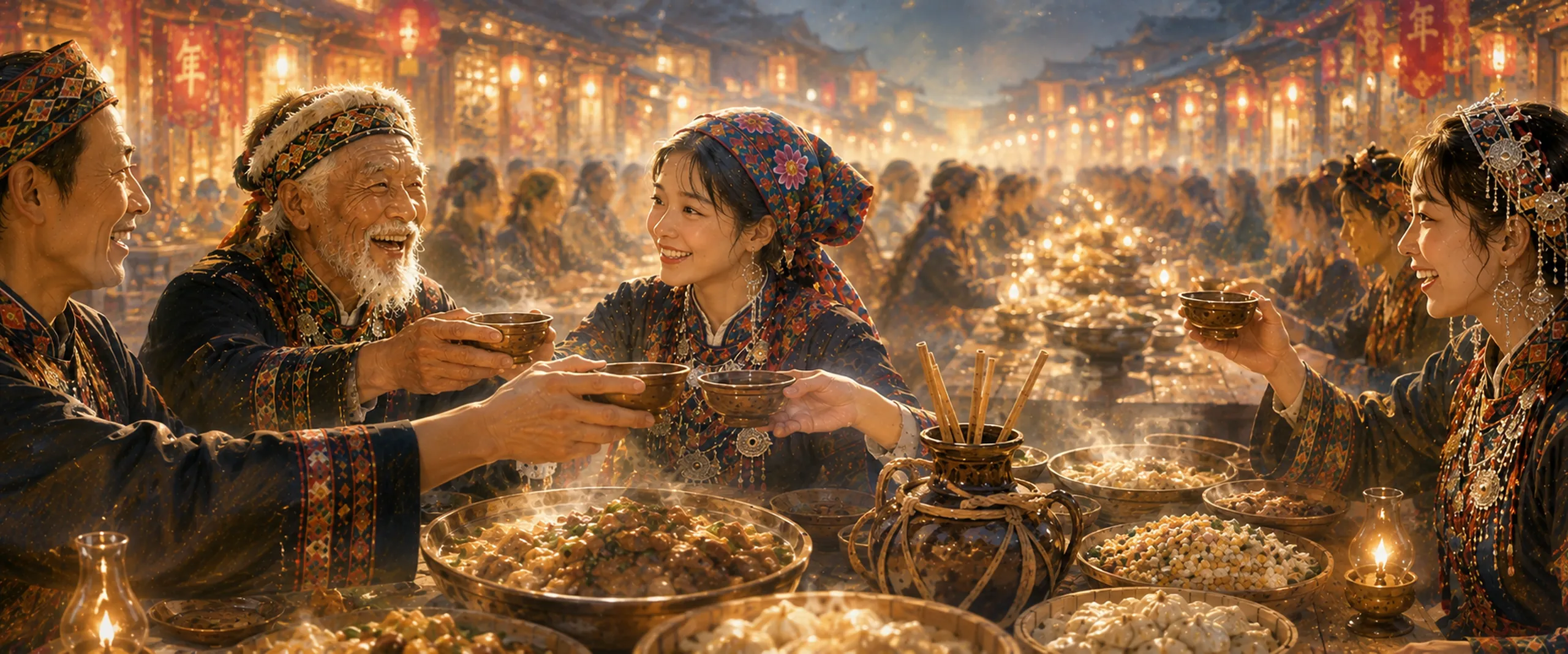
Qiang New Year is the grandest traditional festival of the Qiang people, and food stands at the heart of its celebration. The most representative drink is zajiu, brewed from highland barley or wheat and shared communally as people gather around a wine jar, taking turns sipping through bamboo tubes.

Dressed in festive clothing, Qiang villagers sit together around blazing bonfires and share characteristic foods such as hand-grabbed mutton and noodle pieces with pickled greens. Qiang cured pork is another traditional specialty, made from locally raised pigs that are salted and smoke-cured until the exterior takes on a lustrous yellow hue and a deep, dry fragrance.

During the festival, families also prepare Wada, large steamed dumplings made with buckwheat dough and filled with cured-pork pieces and tofu. In some places, wheat dough is shaped into cattle, sheep, chickens, horses, and other animals as colored ritual offerings. Potato ciba and earthen hot pot are also commonly seen on Qiang New Year tables.

In their most unadorned forms, these foods express enduring Qiang beliefs: gratitude toward nature, reverence for ancestors, and respect for the sacred order that binds people to the mountains in which they live.

Qiang New Year / Cuisine of the Qiang New Year

Festival Food Gallery

Seasonal Menu

Food in Detail

Seeking the True Flavor

Qiang Mountain Old Cured Pork

Meat & Seafood

Basic Information

  • Category: Salt-cured and smoked meat
  • Popular Areas: Qiang communities in Aba Prefecture, Sichuan, and Beichuan in Mianyang
  • Main Ingredients: Locally raised mountain pigs, salt, Sichuan peppercorn, pepper, fennel, cinnamon and other spices, fresh cypress branches, qinggang oak branches
  • Also Known As: Qiang cured pork, Beichuan old cured pork, zhubiao rou, fire-hearth cured pork

Historical Origins

Qiang Mountain Old Cured Pork is one of the most representative traditional foods of the Qiang people and the undisputed centerpiece of the Qiang New Year table. As one of Beichuan’s traditional Qiang specialties, its history is said to reach back to the era of Yu the Great and his flood-control works. This ancient method of preserving food has been passed through generations of Qiang families for more than a thousand years.

The craft of making Beichuan old cured pork grew from one of the Qiang people’s earliest techniques for preserving food. Around the winter solstice each year, every household traditionally slaughtered its New Year pig.

After the Qiang learned to raise domestic pigs during their migrations, they began making cured pork. Beichuan has long stood at the intersection of Qiang and Han life and culture, while its northwestern mountain districts are traditionally regarded as Qiang territory. Here, the craft of curing pork has a long history and is known for accomplished technique, fine color, and good flavor.

For Qiang households, cured pork has traditionally been an indispensable family food. Zhubiao rou became one of the rustic foods most strongly associated with Qiang domestic life. In high-mountain villages in particular, the amount of cured pork stored by a household once served as a visible measure of wealth. The craft of making Beichuan old cured pork has been included on Mianyang City’s municipal list of intangible cultural heritage.

Cultural Meaning

Beichuan old cured pork is made from locally raised pigs fed throughout the year on household-grown coarse grains and fresh grasses. The meat is first cut into sections, salted, and placed in stone vats to cure for about seven days.

The salt must first be heated until almost too hot to touch. Thick cuts receive more salt, thin cuts less—the exact amount is judged by experience. Once removed from the vat, the meat is hung for another one or two days until excess brine has fully drained away.

The cured pork is then slowly smoked over pine and cypress branches, sugarcane peel, Chinese toon bark, or burning brushwood. Finally, it is hung above the household fire pit or over the cooking stove. Qiang families traditionally keep wood fires burning, and from the winter of one year until March or April of the next, the pork may remain suspended in the smoke. Prepared in this way, it can be preserved for one to two years.

Qiang cured pork develops a golden-yellow skin, pale-yellow fat, and richly red lean meat. It can be stir-fried, steamed, deep-fried, boiled, eaten directly, or cooked with dried or fresh vegetables. Once cooked, its fragrance fills the air; the texture is satisfying, and the aftertaste lingers.

There are many ways to serve it. It may simply be boiled and sliced, prepared as twice-cooked cured pork, turned into cured-pork fried rice, or stir-fried with green garlic, garlic shoots, celery, bitter melon, and other vegetables.

Qiang Mountain Old Cured Pork carries several layers of meaning within Qiang food culture. First, “the memory of hearth smoke.” The pork hangs for months above the fire pit, absorbing smoke and flame; every bite carries the taste of home. Second, “the flavor of time.” Months of patient waiting and smoking embody the Qiang philosophy that careful work takes time. Third, “the highest hospitality.” Cured pork is a characteristic dish for festivals and for receiving guests. Fourth, “a symbol of wealth.” In high-mountain villages, household prosperity was traditionally judged in part by the amount of cured pork stored at home.

During Qiang New Year, cured pork becomes entwined with the larger cycle of festival customs: celebrating the new year, slaughtering the New Year pig, eating the paotang feast, drinking zajiu, and dancing Shalang. At Qiang New Year Bàbà Banquets, zajiu, cured pork, and other specialties all make their appearance, carrying gratitude for the harvest and prayers for the year ahead.

Zajiu

Drinks & Fine Wines

Basic Information

  • Category: Fermented alcoholic drink
  • Popular Areas: Qiang communities in Aba Prefecture, Sichuan, and Beichuan in Mianyang
  • Main Ingredients: Highland barley, barley, wheat, corn, sorghum
  • Also Known As: Pole wine, bamboo-tube wine, jar wine, daweng, Double Ninth wine, yumai zhengzheng jiu

Historical Origins

Zajiu is a much-loved homemade drink among the Qiang and an indispensable festive brew for the “year festival” held on the first day of the tenth lunar month. The Qiang tradition of brewing stretches far back in time.

In ancient times, zajiu was known as daweng. The term originally did not refer to a particular wine, but rather to an old drinking custom. Qiang communities also developed variations known as “Double Ninth wine” and yumai zhengzheng jiu.

Within Qiang culture, zajiu holds exceptionally high status. A folk expression says: “羌人爱咂酒,骆驼爱杨柳。有肉无酒难为乐。” The Qiang love zajiu as camels love willow; where there is meat without wine, joy is hard to find. Another saying recalls the brewing season: “旧历九月九,羌人煮青稞为咂酒。” On the ninth day of the ninth lunar month, the Qiang cook highland barley to make zajiu.

The brewing process itself is subject to custom: the proper time must be determined through divination, and numerous prohibitions must be observed. Zajiu brewed in the ninth lunar month is traditionally regarded as the finest and is known among Qiang people as “重年酒”, a prized form of the drink.

Cultural Meaning

Zajiu is made from highland barley, barley, wheat, corn, or sorghum. The grain is cooked, mixed with fermentation starter, placed in an earthen jar, and covered with grass while it ferments.

In one traditional method, steamed highland barley is mixed with the starter, sealed, and fermented for seven to eight days before drinking. The finished beverage is said to reach around 20 degrees alcohol and to contain sugars, amino acids, and other nutrients. Other methods involve a longer fermentation period.

Its drinking method is remarkably distinctive. Before drinking, hot water or cool water is poured into the jar, and the wine is drawn through thin bamboo tubes. When relatives, friends, and honored guests arrive, everyone drinks in turn. After each round, more water is added, and this continues until the wine becomes weak. The remaining lees are then eaten, giving rise to the expression “连渣带水,一醉二饱”—lees and liquid together, bringing both intoxication and fullness.

Wine songs accompany the drinking. The whole village gathers for a reunion meal, drinks zajiu, dances Shalang, and celebrates until everyone has had their fill of joy.

The jar is opened by a respected elder of the village. The mouth of the jar is uncovered, hot water is added to activate the brew, and drinking tubes are inserted. Water continues to be added as people drink, until the bottom of the jar grows warm and the wine flavor has been fully drawn out.

Zajiu carries profound meanings within Qiang food culture. First, “drinking together in shared joy.” Its round-by-round communal drinking embodies the Qiang spirit of sharing and collective celebration. Second, “a brew for honoring the gods.” Zajiu is an indispensable offering in rituals to the heavenly and mountain deities. Third, “the soul of the festival.” It is the undisputed centerpiece of the Qiang New Year “harvest wine” banquet. Fourth, “respect for elders.” The jar is opened by a highly respected elder of the village, reflecting the Qiang tradition of honoring age and seniority.

Wada (Buckwheat Steamed Dumplings)

Grains & Staples

Basic Information

  • Category: Grain staple
  • Popular Areas: Qiang communities in Aba Prefecture, Sichuan, and Beichuan in Mianyang
  • Main Ingredients: Buckwheat flour, diced cured pork, tofu
  • Also Known As: Large three-pronged steamed dumplings, buckwheat dumplings

Historical Origins

Wada is one of the most distinctive seasonal foods of Qiang New Year: a large, three-pronged steamed dumpling made from buckwheat dough wrapped around meat and tofu.

As Qiang New Year approaches, households become busy steaming Wada. Its three-pronged form resembles the Chinese character for “mountain” and is understood as an expression of the mountain way of life—“living from what the mountains provide.”

During the Qiang “Little New Year,” large three-pronged steamed dumplings are made from oat flour, with fillings of diced cured pork and tofu. Buckwheat is one of the principal grain crops of Qiang regions, and turning buckwheat flour into festival food reflects both respect for local produce and an enduring commitment to inherited tradition.

Making Wada requires the participation of the entire family, making the dish itself a symbol of reunion during Qiang New Year.

Cultural Meaning

Wada embodies the unadorned beauty of Qiang culinary culture. First, “the symbolism of the mountain form.” Its three-pronged shape represents the mountains and reflects the Qiang mountain way of life—“living from what the mountains provide.” Second, “the flavor of reunion.” The entire household participates in its making, turning it into a symbol of family gathering. Third, “the fragrance of cured pork.” The diced cured pork in the filling extends the flavor of Qiang Mountain Old Cured Pork and reflects the Qiang culinary wisdom of making full use of every ingredient.

Simple Preparation

  • Ingredients: 300 g buckwheat flour, 100 g diced cured pork, 100 g tofu, chopped scallion, minced ginger, salt
  • Steps:
  1. Add warm water to the buckwheat flour and knead into a smooth dough. Let rest for 20 minutes.
  2. Finely chop the cured pork, crumble the tofu, and combine with scallion, ginger, and salt to make the filling.
  3. Roll the dough into wrappers, add the filling, and pinch into a three-pronged shape with three corners.
  4. Once the steamer is producing steam, add the dumplings and steam over high heat for 15–20 minutes.
  5. Serve with chili dipping water or mashed garlic.

Paotang Feast

Soups, Broths & Congee

Basic Information

  • Category: Soup-pot / banquet
  • Popular Areas: Qiang communities in Aba Prefecture, Sichuan, and Beichuan in Mianyang
  • Main Ingredients: Fresh pork, pork offal, pig blood, accompanying vegetables
  • Also Known As: Paotang pork, Paotang banquet, New Year pig-slaughter feast

Historical Origins

The Paotang feast is one of the most powerful forms of communal cohesion during Qiang New Year. As the festival approaches, households slaughter pigs and sheep. After a year of labor, Qiang families begin making cured pork, while men, women, elders, and children across the village turn to one of the year’s most important occasions: eating Paotang pork.

The gathering is presided over by a respected elder of the village. Mountain deities are worshipped, ancestors are honored, and prayers are offered for favorable weather, good harvests, and safety for everyone in the settlement.

Men divide the work of slaughtering pigs and curing pork. Women work together to stew shoulders and cook meat. Children gather to play, while cats and dogs watch the pork hungrily from nearby. People dance Shalang, drink zajiu, and eat meat in great pieces.

This is Qiang life: a cycle repeated year after year, absorbed into collective memory and carried forward to the present.

Slaughtering the New Year pig is one of the most important preparations for the festival. According to Qiang tradition, after Qiang New Year and the arrival of winter, families begin slaughtering pigs and smoking cured pork.

On the day of the slaughter, men and women, elders and children from the entire village are invited, along with visitors from elsewhere. A solemn ritual is held, and the fresh pork and offal are transformed into table after table of abundant dishes. With zajiu beside them, people gather around bonfires and celebrate freely.

In Yingxiu Town, Wenchuan County, the event known as “Qiang New Year Bàbà Banquet · Eating Paotang Every Day” sets out distinctive communal feasts, where people sit together and share steaming bowls and pots of Paotang.

Cultural Meaning

The Paotang feast embodies the highest spirit of Qiang communal cohesion. First, “sharing and eating together.” The entire village joins one meal, offering one of the clearest expressions of the Qiang ideal of gathering and sharing. Second, “honoring deities and ancestors.” Rituals to the mountain gods and ancestors precede the slaughter, reflecting the traditional Qiang ethic of revering Heaven and following the ancestral way. Third, “celebrating the harvest.” After a full year of labor, slaughtering the New Year pig and sharing Paotang is one of the most direct ways of celebrating abundance.

Potato Ciba

Pastries & Snacks

Basic Information

  • Category: Grain-style snack
  • Popular Areas: Qiang communities in Aba Prefecture, Sichuan
  • Main Ingredients: Potatoes, honey for sweet versions, or pickled greens and sliced meat for savory versions
  • Also Known As: Potato ciba, potato cakes

Historical Origins

Potato ciba is one of the Qiang people’s most distinctive foods made from staple crops and an indispensable seasonal dish on the Qiang New Year table.

The Qiang traditionally eat locally produced corn, potatoes, buckwheat, highland barley, and other coarse grains. From these humble staples, they create carefully worked foods such as potato ciba. Among characteristic Qiang specialties, it holds a particularly prominent place.

Potato ciba embodies the Qiang culinary wisdom of “turning the coarse into the refined.” The most ordinary potato is transformed, through repeated pounding, into something smooth, delicate, soft, and glutinous.

Cultural Meaning

The making of potato ciba requires considerable care. Cooked potatoes are peeled and pounded until they form a sticky mass. Traditionally, whole potatoes are boiled, peeled, and then pounded into a purée before being worked into ciba. High-starch potatoes are preferred.

The finished ciba may be served with white sugar, honey, Sichuan-pepper oil, sesame oil, aromatic vinegar, mashed garlic, and other seasonings. It may be pan-fried or deep-fried and then mixed with honey. Alternatively, it can be sliced and cooked in soup with pickled greens and pieces of meat.

Tasting potato ciba, Qiang Mountain Old Cured Pork, buckwheat steamed dumplings, and other richly characteristic dishes is an indispensable part of experiencing Qiang New Year through the palate.

Potato ciba embodies the Qiang wisdom of “turning the coarse into the refined.” Potatoes are among the humblest of ingredients, yet repeated pounding transforms them into a smooth, soft, glutinous food. In this process lies the Qiang philosophy of taking rough staples and working them with care.

Potato ciba may be sweet or savory, fried or simmered, reflecting the breadth and adaptability of Qiang food culture.

Buckwheat Jiaotuan

Grains & Staples

Basic Information

  • Category: Grain staple
  • Popular Areas: Qiang communities in Aba Prefecture, Sichuan
  • Main Ingredients: Buckwheat flour, water
  • Also Known As: Jiaotuan, buckwheat jelly

Historical Origins

Jiaotuan is one of the Qiang people’s most characteristic coarse-grain foods. Made primarily from cornmeal, buckwheat flour, and similar grains, it is prepared by stirring the flour into water and cooking it into a thick mass.

Qiang food traditions include potato ciba, jiaotuan, pickled-greens soup, and cornmeal soup with pickled greens. Jiaotuan itself is a familiar part of characteristic Qiang cuisine.

The staple ingredients used for such foods include corn, wheat, beans, potatoes, buckwheat, and vegetables.

Cultural Meaning

To make jiaotuan, cornmeal or buckwheat flour is slowly sprinkled into boiling water while being stirred continuously. The mixture is worked until it thickens into a paste, then cooked through completely.

It is commonly served with pickled-greens soup, chili dipping water, and other accompaniments.

Among Qiang specialties are potato ciba, “Gold Wrapped in Silver,” and buckwheat foods, with potato ciba being particularly representative. Buckwheat preparations may also be served alongside potato ciba.

Jiaotuan embodies the Qiang wisdom of “making use of coarse grains.” Buckwheat is an important crop in Qiang regions, and turning it into a soft and finely textured staple offers another expression of the Qiang philosophy of carefully refining humble ingredients.

Gold Wrapped in Silver

Grains & Staples

Basic Information

  • Category: Grain staple
  • Popular Areas: Qiang communities in Aba Prefecture, Sichuan
  • Main Ingredients: Cornmeal, rice
  • Also Known As: Silver Wrapped in Gold, mian zhengzheng

Historical Origins

Gold Wrapped in Silver is one of the most distinctive Qiang staple foods, a mixed-grain dish made by steaming cornmeal together with rice.

Corn zhengzheng, also called mian zhengzheng, may be made by mixing rice that has been cooked to roughly sixty percent doneness into corn flour. This preparation is known as “Gold Wrapped in Silver.”

Unfermented corn dough or whole-bran dough can also be shaped into buns, cooked on a flat pan or iron griddle, and then buried in wood ash to finish baking.

Gold Wrapped in Silver is widely eaten in Wenchuan, Mao County, Li County, Beichuan, and other Qiang regions.

Its preparation reflects the survival wisdom of Qiang ancestors during periods of grain scarcity: a small amount of refined grain—rice—was mixed with a larger quantity of coarse grain—cornmeal. This improved texture while also conserving food supplies.

The cornmeal is “gold,” the rice “silver,” and because the two are wrapped together, the dish came to be known as “Gold Wrapped in Silver.”

Cultural Meaning

Gold Wrapped in Silver carries the unadorned philosophy of Qiang food culture. First, “combining coarse and refined grains.” Steaming corn together with rice was a practical solution devised during times of scarcity. Second, “a house filled with gold and jade.” The name “Gold Wrapped in Silver” carries wishes for prosperity and auspiciousness and expresses hope for a better life. Third, “the flavor of home.” It is one of the most familiar everyday staples of Qiang households and one of the simplest expressions of home cooking.

Sun Buns and Moon Buns

Pastries & Snacks

Basic Information

  • Category: Grain pastry
  • Popular Areas: Qiang communities in Aba Prefecture, Sichuan
  • Main Ingredients: Wheat flour
  • Also Known As: Sun buns, Moon buns

Historical Origins

Sun Buns and Moon Buns are among the most symbolically charged ritual foods of Qiang New Year. The Qiang people revere nature, with particular devotion to the sun and the moon. The sun is regarded as the source from which all things grow, while the moon serves as guardian of the night.

Before Qiang New Year begins, families prepare daotou rou, Moon Buns, and Sun Buns and place them before the household shrine on the night preceding the festival in gratitude to their ancestors.

In some mountain villages, small wheat-flour buns are shaped into cattle, horses, chickens, and sheep and offered to ancestors and heavenly deities. Elsewhere, wheat dough is made into colored offerings shaped like cattle, sheep, chickens, horses, dogs, and other animals for the same ritual purpose.

These flour offerings are finely shaped and auspicious in meaning, revealing both the rich imagination of the Qiang people and their accomplished skill in working with dough.

Cultural Meaning

Sun Buns and Moon Buns carry the deeper meanings of Qiang nature worship. First, “reverence for the sun and moon.” The sun and moon are among the natural divinities most deeply revered by the Qiang, and these buns are offerings made to them. Second, “a heart of gratitude.” Presenting Sun and Moon Buns before Qiang New Year expresses gratitude for the blessings of Heaven and Earth. Third, “an auspicious sign.” The sun and moon shining together symbolize good fortune, and the buns carry prayers for favorable weather and a smooth year ahead.

Pickled-Greens Noodle Pieces

Grains & Staples

Basic Information

  • Category: Grain staple
  • Popular Areas: Qiang communities in Aba Prefecture, Sichuan
  • Main Ingredients: Buckwheat flour or wheat flour, pickled greens
  • Also Known As: Mianpizi, pickled-greens noodle pieces

Historical Origins

Pickled-greens noodle pieces are one of the most characteristic everyday staples of Qiang cuisine. Traditional Qiang foods include pickled-greens soup, cornmeal soup with pickled greens, and mianpizi—handmade pieces of noodle dough.

During Qiang New Year, villagers sit together to share hand-grabbed mutton, pickled-greens noodle pieces, and other characteristic foods.

The dish reflects the Qiang wisdom of “living from the mountains and using what is at hand.” The pickled greens are fermented at home; the noodle pieces are rolled and torn at home. The ingredients are simple, yet the flavor is full and deeply satisfying.

Among Qiang everyday foods, noodle pieces are one of the most common household staples.

Cultural Meaning

Pickled-greens noodle pieces carry the meaning of “the flavor of home.” They are among the most ordinary foods in Qiang daily life, yet for those living far away, they can become one of the most deeply missed tastes of home.

At Qiang New Year, when families come together again, a bowl of pickled-greens noodle pieces becomes an especially tender return to the memory of home.

Bàbà Banquet (Long-Table Banquet)

Others

Basic Information

  • Category: Composite banquet
  • Popular Areas: Wenchuan County, Mao County, Li County in Aba Prefecture, Sichuan, and Beichuan in Mianyang
  • Main Ingredients: Qiang cured pork, zajiu, buckwheat foods, potato ciba, and other traditional Qiang dishes
  • Also Known As: Qiang New Year Bàbà Banquet, long-table banquet, Paotang banquet

Historical Origins

The Bàbà Banquet is one of the most visually striking and communally cohesive forms of Qiang New Year dining. In Wenchuan County, people stream out of their homes to watch artistic performances and intangible-cultural-heritage parades and to join Bàbà Banquets as part of the festival celebrations.

In Zhongtanbao Village, Yingxiu Town, the Qiang New Year Bàbà Banquet opens in a warm communal atmosphere. Zajiu, cured pork, and other distinctly Qiang foods fill the tables, carrying gratitude for the harvest and prayers for blessings in the coming year.

At the long tables, host and guest are not sharply distinguished. Visitors are drawn directly into the atmosphere of reunion, while the tradition of “using food as a medium and the banquet to gather affection” continues from one generation to the next. Laughter and conversation fill the meal.

During Qiang New Year in 2025, 1,200 Qiang and Han residents gathered with guests who had traveled from afar as a steaming Qiang-calendar New Year hot-pot Bàbà Banquet began. The mellow fragrance of zajiu mingled with the numbing heat and spice of the hot pot and drifted through the mountains.

At Xiqiang Shenmuzhai in Beichuan, when the New Year pig is slaughtered, men and women, elders and children from the entire village, together with visitors from elsewhere, are invited to take part in a solemn ritual. Fresh pork and offal are turned into table after table of abundant dishes, served with zajiu, while everyone gathers around the bonfire and celebrates without restraint.

Cultural Meaning

The Bàbà Banquet embodies some of the highest ideals of Qiang food culture. First, “gathering and sharing.” Thousands of people sitting together and sharing food offers the fullest expression of the Qiang ideal of gathering together and sharing the harvest. Second, “community cohesion.” The banquet draws Qiang people scattered across different places back into one shared space, renewing communal bonds through eating together. Third, “no distinction between host and guest.” Sitting side by side at long tables without rigid separation between those receiving and those being received expresses the Qiang tradition of generous hospitality.

Food Culture

Foodways

Viewed as a whole, the cuisine of Qiang New Year reveals a cultural logic that runs consistently through the festival:

I. Sacrifice as the source. Qiang New Year is a festival of harvest celebration, gratitude toward Heaven and Earth, and ancestral worship. Ritual observances are presided over by the Shibi, known in the Qiang language as Xu. The Shibi is regarded as one of the most authoritative bearers of knowledge and culture within Qiang society—a figure able to connect the realms of the living and the dead and communicate directly with the divine.

Before Qiang New Year arrives, every household prepares daotou rou, Moon Buns, and Sun Buns. On the night before the festival, these are placed before the household shrine as offerings of gratitude to the ancestors. Other sacrificial foods include daotou rou, Sun-and-Moon buns, and grains of five colors.

Families also polish the white-stone deity on the rooftop until it shines again and replace the sacred “spirit-tree pole” with a new one. Once the rites are completed, the offerings become food for the banquet, completing a transformation from “honoring the divine” to “loving people.”

II. Smoking as wisdom. The making of Qiang cured pork is an extreme expression of the principle of “exchanging time for flavor.” The traditional method used for Beichuan old cured pork originated in one of the Qiang people’s oldest techniques of food preservation.

Around the winter solstice each year, families slaughter the pigs raised for New Year. The pork is cut into sections, salted, and placed in stone vats to cure for roughly seven days. Once removed, the meat is hung for one or two days so that the excess brine can drain away. It is then suspended over the household fire pit or cooking stove to be slowly smoked.

During smoking, people gather fresh local cypress branches and qinggang oak branches to feed the smoke. From December until March or April of the following year, the cured pork may remain hanging above the fire. Prepared in this way, it can be preserved for one to two years, and once cooked, its fragrance spreads richly through the room.

By Qiang custom, the cured pork made from the New Year pig slaughtered around the winter solstice is eaten from the beginning of the year all the way to its end. It is a signature dish for receiving guests and, in mountain villages, has also traditionally served as a measure of household wealth.

III. Brewing as joy. Zajiu is an indispensable festive brew during the Qiang New Year “year festival.” It is made from highland barley, barley, or corn: the grains are cooked, mixed with a fermentation starter, placed in a jar, and covered with grass while they ferment.

Even the making of zajiu is surrounded by custom. The proper time must be determined through divination, and numerous taboos accompany the process. When the wine is ready to drink, hot or cool water is first poured into the jar, and the liquid is then drawn up through thin bamboo tubes.

The entire village drinks together until everyone has enjoyed the occasion to the fullest. The jar is traditionally opened by a highly respected elder of the settlement. This practice of “taking turns drinking and rejoicing together” is one of the most distinctive sensory expressions of cohesion within Qiang community life.

IV. Refinement born from coarse grains. The Qiang traditionally rely on locally grown corn, potatoes, buckwheat, highland barley, and other coarse grains. Yet these seemingly humble ingredients are worked with care and transformed into distinctive foods such as potato ciba, jiaotuan, and buckwheat jelly.

Potatoes are boiled, peeled, and repeatedly pounded until thick and glutinous to make potato ciba. Buckwheat dough is combined with pieces of cured pork and tofu to form the large, three-pronged steamed dumplings known as Wada. Cornmeal is steamed together with rice to make “Gold Wrapped in Silver.”

This philosophy of “turning the coarse into the refined” is a distinctive form of culinary intelligence created by Qiang ancestors in the difficult conditions of mountain life.

Regional Distribution

Foodways
Region Distinctive Qiang New Year Foods
Mao County Copper hot pot, Nine Great Bowls, potato ciba; hand-grabbed mutton, pickled-greens noodle pieces; fresh fruits including Qiang crisp plums, sweet cherries, Maowen apples, and off-season loquats; zajiu; earthen hot pot, Qiang cured pork; Moon Buns, Sun Buns; beef head and tripe slowly stewed over a wood-fired stove
Wenchuan Hand-grabbed mutton, pickled-greens noodle pieces; “Gold Wrapped in Silver”—corn rice mixed with white rice—and buckwheat buns; zajiu; potato ciba, Qiang old cured pork
Li County Hand-grabbed mutton, pickled-greens noodle pieces; “Gold Wrapped in Silver,” buckwheat buns; zajiu; Tibetan-style hot pot, yak soup pot, stone-milled tofu pudding, chicken stewed with matsutake, gastrodia chicken, combining Tibetan and Qiang flavors
Beichuan County Paotang feast—a harvest celebration centered on the New Year pig slaughter; potato ciba, Qiang cured pork; hand-grabbed mutton, pickled-greens noodle pieces; zajiu; Wadi, a large steamed dumpling made from wheat or buckwheat dough, crescent-shaped and filled with meat; animal-shaped wheat foods in forms such as cattle, horses, sheep, and chickens
Songpan County Hand-grabbed mutton, pickled-greens noodle pieces; zajiu; daotou rou, Moon Buns, Sun Buns
Heishui County Hand-grabbed mutton, pickled-greens noodle pieces; zajiu

Additional Notes: * Zajiu is the drink most closely associated with Qiang New Year. It is fermented from grains such as highland barley and wheat. Bamboo tubes are inserted into the jar, and people drink in turn while repeatedly adding water, giving rise to the saying “连渣带酒水,一醉二饱”—wine and lees together, bringing both intoxication and fullness. The Qiang also say, “不喝咂酒心不宽”. * Potato ciba is one of the most representative Qiang staple foods. Highland potatoes are steamed and repeatedly pounded until sticky and glutinous; the finished ciba may be fried or cooked in pickled-greens soup. * Qiang old cured pork is the substantial showpiece dish of festive hospitality. It is made from locally raised mountain pigs, salted, air-dried, and smoked over cypress branches. In ordinary households, old cured pork preserved for three to five years may still be brought out for guests. * Sacrificial offerings: Before Qiang New Year formally begins, every household prepares daotou rou, Moon Buns, and Sun Buns and places them before the domestic shrine in gratitude to the ancestors. * Banquet tradition: In places such as Mao County, thousand-person communal Qiang New Year Bàbà Banquets are held, expressing the warmth and hospitality of the Qiang people.

Closing Reflections

Foodways

On the first day of the tenth lunar month, when the white-stone deity on the roof of the stone watchtower has been washed clean of dust, the Qiang New Year arrives as promised in the joy of harvest. In the Qiang language it is called “Rimeiji,” meaning “Harvest Festival.” On this day of celebrating abundance and giving thanks to Heaven and Earth, zajiu runs through the festivities like a living thread. Brewed from highland barley, wheat, and other grains, the wine rests sealed in earthen jars until the moment they are opened and bamboo tubes are inserted for everyone to drink in turn, accompanied by high-mountain cured pork and hand-grabbed mutton. “不喝咂酒心不宽”—without zajiu, the heart does not open wide. From sacrifice to song and dance, from the banquet table to the bonfire, the act of sharing a single jar gathers the bonds of kinship within an ancient people into one communal gesture.

Beside the zajiu stands the abundance of the Qiang family table. Potato ciba, one of the most representative staples, begins with highland potatoes steamed and pounded again and again until they become soft, sticky, and elastic—carrying both the resilience of “being tempered through a thousand blows” and the unadorned character of the mountains. Qiang old cured pork is made from locally raised mountain pigs, salted, air-dried, and smoked over cypress until the fat becomes rich without heaviness and the fragrance seems to penetrate to the bone. Then there is “Gold Wrapped in Silver,” where corn and rice mingle in the colors of harvest; and the great crescent-shaped steamed dumpling known as Wadi, some versions of which are shaped into cattle, sheep, chickens, horses, and other animals. Each dish begins with newly harvested grain, while cooking smoke and the aroma of meat drift along the stone-paved lanes of the Qiang villages.

The liveliest moment of all belongs to the Qiang New Year banquet. At the Qiang New Year Reunion Bàbà Banquet in Mao County, copper hot pots bubble and steam through the winter air as families gather around them to share “reunion and happiness,” while the Nine Great Bowls bring the weight and abundance of a traditional feast. In Wenchuan, hundred-meter long-table banquets stretch through the streets and lanes; in Taoping Qiang Village, drinking songs rise between the dishes; in villages high on the mountain slopes, entire communities sit together around the Bàbà Banquet to celebrate the harvest. Qiang New Year cuisine is the most heartfelt answer offered by this “people above the clouds” to Heaven and Earth at the moment of abundance—deepened by cypress smoke, brightened by the clean sweetness of zajiu, and carried from one generation to the next through bonfire light and the rhythms of the Shalang dance.

—-

Continue exploring Qiang New Year culture

Readers’ Comments

Calendar and traditional culture enthusiasts from around the world, sharing the same moon.

Sign in or register to join the conversation. Your comment account is created automatically the first time you use a connected account.