Frog Festival

Frog FestivalFolk Arts of the Frog Festival

「 铜鼓声声唤蛙神,蚂拐舞中祈丰年。 」

The Maguai Festival is a unique traditional festival of the Zhuang people, celebrated in the Hongshui River basin of Guangxi Zhuang Autonomous Region. “Maguai” is the Zhuang term for frog. The Zhuang ancestors believed that frogs were the sons of…

Opening Verse:

铜鼓声声唤蛙神,蚂拐舞中祈丰年。

Introduction:

The poetry of the Maguai Festival centers on the worship of the Frog Deity and on Maguai songs and dances. “铜鼓声声唤蛙神” depicts the solemn ritual of invoking and worshipping the Frog Deity through the resounding beat of bronze drums, while “蚂拐舞中祈丰年” describes people imitating the movements of frogs in dance as they pray for an abundant harvest. The poetry frequently records the complete ritual sequence of finding the Maguai, worshipping the Maguai, observing mourning and filial rites for the Maguai, and finally burying the Maguai.

The Maguai Festival is a Zhuang festival centered on frog worship, and the line “铜鼓声声唤蛙神,蚂拐舞中祈丰年” summarizes its core meaning. Zhuang ancestors believed that the frog was the son of the Thunder God and a rain-bringing deity who governed wind and rainfall. The poetry and songs of the Maguai Festival preserve the complete ritual sequence: people search the fields for frogs newly awakened from hibernation (“找蚂拐”), conduct sacrificial rites (“祭蚂拐”), sing Maguai songs and perform the Maguai Dance (“孝蚂拐”), and finally bury the frog (“葬蚂拐”). The movements of the Maguai Dance largely imitate those of frogs, and festival poetry frequently describes both the sound of bronze drums and the movements of the frog dance. The poetry of the Maguai Festival carries forward a thousand-year Zhuang belief in the frog as a sacred spirit and in dance as a means of praying for a good harvest.

Frog Festival / Folk Arts of the Frog Festival

Art Forms

Forms of Expression

Maguai Songs

Other 壮族

A Long Tradition

Maguai songs are the central sonic form of the Maguai Festival and an ancient body of song that arose alongside the festival itself. Sung in the Zhuang language, they revolve around themes such as the origins of the Maguai Festival, legends of Maguai worship, and prayers for favorable weather and plentiful harvests. According to Maguai songs transmitted in Zhuang communities, there are three broadly similar accounts of the festival’s origin. Maguai songs are not merely musical accompaniment to the festival; they are also an important vessel of its cultural memory—recording origin legends, transmitting the frog-totem worship of Zhuang ancestors, and expressing generation after generation of Zhuang people’s hopes for a bountiful harvest.

The singing of Maguai songs runs through the entire festival. Beginning on the first day of the first lunar month, when people search for the Maguai, young participants carry the Maguai coffin from household to household, reciting blessings and singing ancient Maguai songs. At night, people carry the Maguai beneath the Maguai pavilion, perform the Maguai Dance, and sing Maguai songs as a way of keeping vigil for the Maguai. On the climactic day of the burial, the Maguai song gathering reaches its height—the banks of the Hongshui River resound with song, and men and women, old and young, from village after village all make their way to the singing ground.

Maguai Song Gathering

The Maguai Festival is also known as the “Maguai Song Gathering,” a name that itself reveals the central importance of song. The Maguai song gathering is one of the festival’s most solemn and lively events. In Zhuang villages stretching for more than a hundred li along both banks of the Hongshui River, whenever the Spring Festival arrives, people spontaneously gather around the Maguai pavilion for a grand and spirited song gathering. Gongs and drums are sounded, singers are summoned from all directions, everyone dresses in festive attire, and the countryside fills with song.

The Maguai song gathering is also, in practice, a gathering of people from multiple ethnic groups. Zhuang participants improvise mountain songs whose subject matter ranges widely across astronomy and geography, historical legends, customs and human relationships, life skills, and agricultural labor. The songs are broad in scope, humorous in tone, and rich in philosophical reflection. At the song fair, people make friends through song and convey affection through song, while young men and women may also find the person they love through antiphonal mountain singing during the Maguai Festival. This tradition of using song as a matchmaker means that the Maguai Festival is not only a religious festival centered on worshipping deities, but also a romantic season for young men and women to meet and fall in love.

Contemporary Transmission

Maguai songs are transmitted primarily through oral instruction and direct teaching, with elders passing down melodies, lyrics, and performance techniques to younger generations. In contemporary Maguai Festival celebrations, the song gathering remains one of the festival’s most important components. In 2026, during the Maguai Festival in Baying Village, Donglan, women and children sang simple yet melodious Zhuang mountain songs about family traditions, combining the festival’s traditional meanings of praying for favorable weather and household peace with the spirit of the present age. These ancient mountain songs have gained renewed vitality in contemporary society, while the Maguai song gathering has developed from a purely ritual form of singing into a comprehensive song fair combining folk-custom display and cultural exchange.

Maguai Dance

Other 壮族

Cultural Status

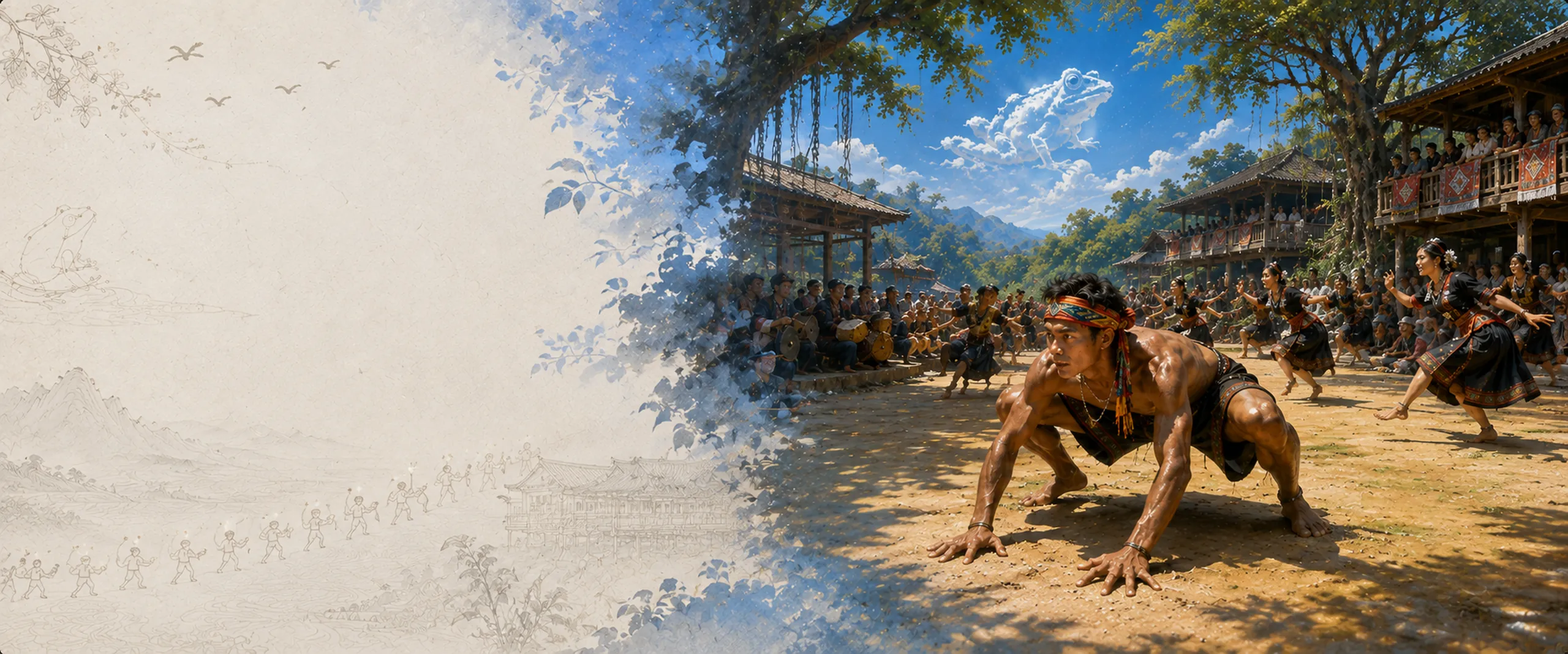
The Maguai Dance is a core component of the Zhuang Maguai Festival. It is a folk dance performed to worship the Frog Deity and pray for favorable weather and abundant harvests. The dance is mainly found in Zhuang villages in Tian’e, Donglan, Nandan, Fengshan, and other counties of Hechi along the Hongshui River basin in Guangxi. Its history can be traced back to the frog-totem worship of Zhuang ancestors. Its basic bodily posture is “frog-like”: the legs are spread apart, the arms opened with elbows bent upward, or one hand placed on the waist while the other bends downward at the elbow. In outward form, these poses closely resemble the “frog-like” figures seen in the Huashan cliff paintings. This continuity of bodily form across thousands of years has made the Maguai Dance a living “bodily memory” of Zhuang culture.

The Maguai Dance received the “Most Distinctive Ethnic Festival Award” in the China Outstanding Ethnic Festivals awards in both 2013 and 2014, and in 2017 it received the “Most Innovative Ethnic Festival Award.” Nadong Village in Tian’e County has been designated a transmission base for the autonomous-region-level representative intangible cultural heritage project of the Zhuang Maguai Dance.

Performance Form

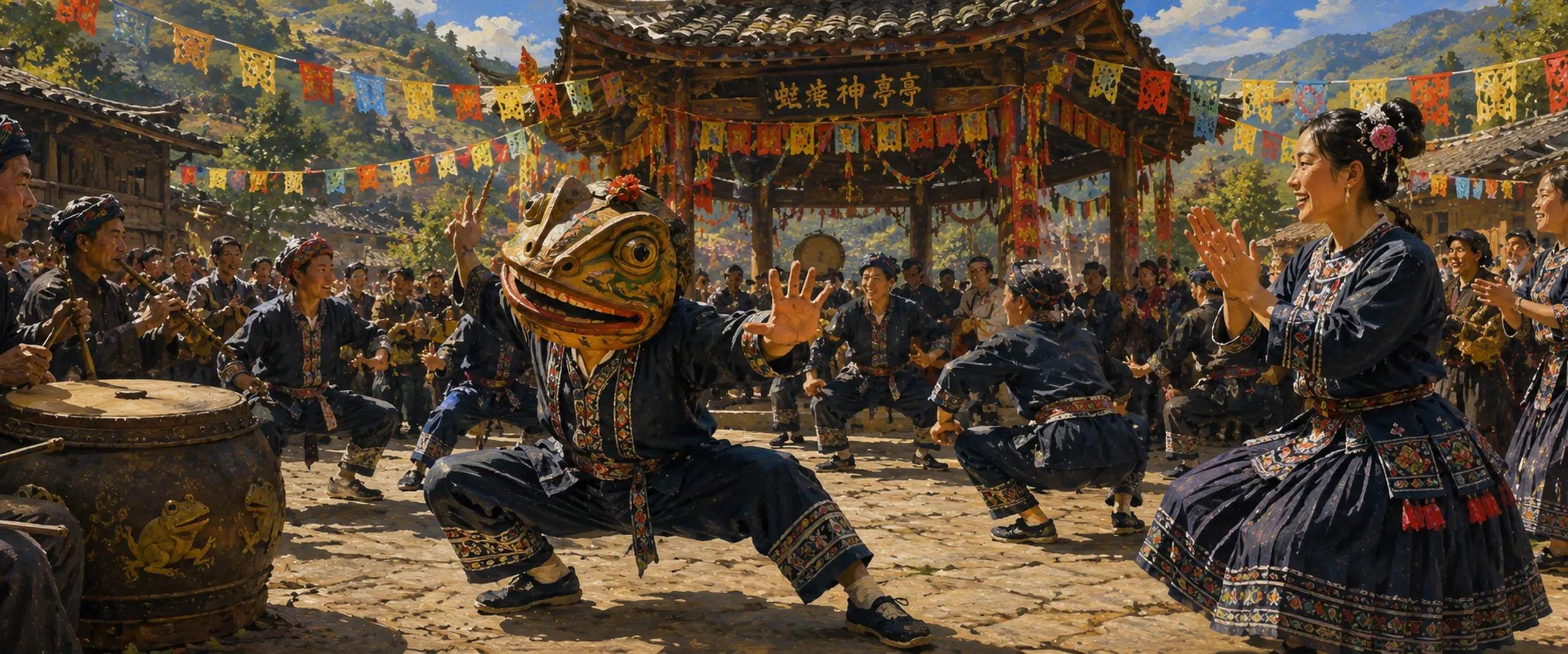
The Maguai Dance follows a strict sequence and encompasses a rich variety of forms. During a performance, the decorated bridge and palanquin of the Maguai are set up at a site east of the village. On both sides stand small colored flags bearing images of dragons, phoenixes, tigers, frogs, and the six domestic animals. Four bronze drums hang directly in front of the decorated palanquin, while a musical ensemble of gongs, drums, and suona players stands to one side. Two skin drums are also placed directly in front of the bronze drums. Dozens of young people perform according to the prescribed sequence: some dress as frogs, some wear masks representing various deities, and others portray farmers and village women, all moving to the sound of drums and music.

The movements of the Maguai Dance largely imitate the form of frogs. Most basic movements take the shape of frog-like walking and frog-like hopping, and the usual path of movement follows a zigzag pattern. Principal movements include deep squats with both legs, leaning backward while supporting the body with a stick, shuffling sideways in small steps, and raised stamping movements with trembling accents. These movements are full of the flavor of everyday life and possess a humorous, playful quality. Through twisting and moving the hands, legs, head, and waist, dancers create a strong sense of rhythm and entertainment. The core rhythmic pattern is “两跳一停五点步,” and the movements are ancient, simple, rough-hewn, and vigorous. Musical accompaniment centers on percussion—bronze drums and skin drums—as well as suona. The basic rhythm is steady and powerful, such as “仓咚仓咚怆咚咚咚仓,” and is closely coordinated with the dance movements.

Dance Chapters

The Maguai Dance is not a single dance, but a complete series of dance sections that vividly presents ancient Zhuang folk customs and the wisdom of daily life. It is divided into multiple lively and expressive chapters. A full, traditional performance of the Zhuang Maguai Dance series generally includes: skin-drum dance, Maguai birth dance, bronze-drum worship dance, drum-honoring dance, Hairy Man dance, Maguai battling the Hairy Man, exorcising evil and eliminating pestilence dance, harrowing dance, plowing dance, seedling-sowing dance, rice-transplanting dance, seedling-weeding dance, harvesting dance, fishing and shrimp-catching dance, spinning and weaving dance, harvest-celebration dance, and others.

From the Maguai’s “birth” to its “battle with the Hairy Man,” from “driving away evil and pestilence” to “harrowing and plowing the fields,” and from “sowing and transplanting seedlings” to “harvesting and celebrating abundance,” the Maguai Dance presents through movement a complete cycle of agricultural labor across the four seasons of the year, carrying the audience into the mysterious world of ancient Zhuang farming civilization. This tradition of narrating through dance and recording history through movement has made the Maguai Dance the most vivid “bodily text” of Zhuang agricultural culture.

Cultural Meaning

The Maguai Dance embodies the Zhuang people’s belief tradition of “敬畏自然、感恩神灵” and their ethnic spirit of “勤劳耕作、生生不息”. The Maguai is regarded as a messenger who governs wind and rain, and the dance therefore becomes a bridge between human beings and the divine—by imitating the form and movements of the Maguai, people express reverence for the Frog Deity and offer their prayers. At the same time, the many dances representing agricultural labor—harrowing, plowing, transplanting seedlings, harvesting, and others—provide a vivid reenactment of Zhuang wet-rice agricultural civilization. The Maguai Dance is both a religious rite and a song of praise to labor; it is at once worship of the divine and celebration of life.

Bronze Drums

Other 壮族

Cultural Status

The bronze drum is the most iconic musical instrument of the Maguai Festival and one of the most important symbols of Zhuang culture. Zhuang bronze-drum music is mainly found in Zhuang-inhabited areas such as Donglan, Tian’e, and Nandan in the middle reaches of the Hongshui River, where it is used during the Maguai Festival, Spring Festival, song-fair festivals, weddings, funerals, and other communal occasions. The Maguai Festival is considered to have arisen alongside the bronze-drum culture of the Zhuang people in the Hongshui River basin and to have been passed down from generation to generation ever since. It can be said that without the bronze drum, there would be no Maguai Festival—the sound of the bronze drum is the festival’s spiritual voice.

A Spectacular Soundscape

The bronze-drum gathering is one of the great highlights of the Maguai Festival. During the festival, people beat bronze drums as part of the worship of the Maguai. At the Baying Maguai Festival, visitors from around the world and local residents strike 300 bronze drums together, creating a grand and overwhelming spectacle. When 300 bronze drums thunder simultaneously, their sound shakes heaven and earth and reverberates among the mountains on both sides of the Hongshui River—this is the most magnificent soundscape of the Maguai Festival and one of the most powerful expressions of Zhuang folk music.

When Zhuang communities in Donglan perform bronze-drum music, they generally use an ensemble of four bronze drums passed down through generations. During performance, four drums of differing pitches and timbres are suspended in a horizontal line and can combine to produce a harmonious scale resembling “1 5 3 2.” The rhythm of the bronze drums is steady and forceful and closely coordinated with the movements of the Maguai Dance, together creating an atmosphere that is both festive and solemn.

Cultural Symbolism

During the Maguai Festival, the bronze drum is not only a musical instrument, but also a symbol of power and belief. It is regarded as a sacred object capable of connecting heaven and earth and summoning deities. In the ritual worship of the Maguai, the sound of the bronze drum serves as an acoustic channel carrying human prayers to the Frog Goddess—the louder the drums, the deeper the sincerity, and the more readily the deity can perceive it. Bachou Township is the birthplace and transmission center of the national intangible cultural heritage Zhuang Maguai Festival and a core area of the National Bronze Drum Culture (Hechi) Ecological Protection Zone. Donglan County has established eight bronze-drum cultural transmission bases, forming a multi-level transmission system of “基地传习、校园培育、群众参与”.

Traditional Instruments

Other 壮族

Skin Drums and Suona

Performances of the Maguai Dance depend on the accompaniment of skin drums and suona. At the dance site, two skin drums are placed directly in front of the bronze drums, while an ensemble of gongs, drums, and suona players stands to one side. The deep resonance of the skin drums contrasts with the crisp sound of the bronze drums, while the piercing brightness of the suona adds a festive and exuberant quality to the dance. The combination of skin drums, gongs and drums, and suona forms the basic instrumentation of the Maguai Festival folk ensemble.

Tongdeng

Tongdeng is one of the most distinctive bamboo instruments of the Maguai Festival and one of the Zhuang people’s favorite instruments for entertainment. Tongdeng is essentially a bamboo drum: two or three thin bamboo strips are cut and raised from a long section of bamboo, with wooden pieces inserted beneath both ends of the strips, thus forming a bamboo drum. Tongdeng is a kind of bamboo-tube zither and is generally made from mature bitter bamboo or moso bamboo four or five years old, with a usual length of approximately 40 to 60 centimeters. In earlier times, Tongdeng was a distinctive struck chordophone. Its body was made from a section of moso bamboo 60 to 70 centimeters long; one end of the tube had a circular sound hole, while fine strands of the bamboo skin were lifted from the middle section of the tube to serve as strings.

The sound of Tongdeng resembles that of the bronze drum but is crisper and more pleasing to the ear. During Maguai Festival activities, Tongdeng is played together with bronze drums, the two complementing and enhancing one another, creating for audiences a feast of folk culture and ethnic music. On market days and holidays, villagers in Baying spontaneously organize activities rich in Zhuang characteristics, including mountain-song singing, bronze-drum playing, seven-stringed zither performance, Tongdeng playing, and Maguai dancing.

Seven-Stringed Zither

The seven-stringed zither is also a traditional instrument frequently heard during Maguai Festival activities. In Baying Village, villagers play the seven-stringed zither on market days and holidays. Its gentle and graceful tone contrasts with the grandeur of the bronze drum and the crispness of Tongdeng, together creating the festival’s rich and multidimensional soundscape.

Core Rituals

Other 壮族

Finding the Maguai

After breakfast on the first day of the first lunar month, adults and children go out in groups of three or five to fields and field edges to search for Maguai. According to custom, two are taken, one male and one female. The person in charge of the activities places them inside a split section of bamboo called the “Maguai coffin,” closes and ties it tightly, and covers its surface with colored paper. On the following day, young participants carry the Maguai coffin from household to household throughout the village, reciting blessings and wishing each household success in all things during the New Year, thriving livestock, and abundant harvests.

Worshipping the Maguai and Visiting the Village

On the fifteenth day of the first lunar month, a five- or six-meter-high colored paper banner is erected beside the customary Maguai grave. Offerings are laid out, bronze drums and skin drums are beaten, and the Maguai is worshipped. From that day until around the twenty-fifth day of the first lunar month, children carry the decorated pavilion and treasured coffin from household to household during the daytime, singing ancient Maguai songs. At night, everyone in the village—men and women, old and young—gathers in the pavilion to keep vigil for the Maguai while bronze drums are sounded. During the vigil, people perform the Maguai Dance and sing Maguai songs.

During the procession through the village and the worship of the Maguai, villagers reverently worship the Toad Ancestor and express gratitude for nature’s gifts. The Maguai procession moves through the village, while board lions bring blessings into households and neighbors celebrate together. This procession, in which the entire community participates, makes the sacrificial activities of the Maguai Festival not only a religious practice but also an important means of strengthening communal cohesion.

Burying the Maguai and Divination by Examining the Bones

The date for burying the Maguai varies from place to place. In Baying Hamlet of Bachou Township, Donglan County, it takes place on the second day of the second lunar month; in Nongfa Hamlet of Jingu Township, on the third day of the second lunar month; and in Qiejin Hamlet of Datong Township, on the twenty-eighth day of the first lunar month. All, however, fall within the period from the twenty-fifth day of the first lunar month to the seventh day of the second lunar month. Burial rituals also differ in form and scale, with the ceremony in Baying Hamlet of Bachou Township being the most solemn.

During the burial, people open the treasured coffin containing the frog buried the previous year and examine the color of the Maguai’s bones to divine the fortunes of the coming year—a golden-yellow color is considered auspicious and predicts favorable weather and abundant harvests. This practice of divining by bone color reflects the Zhuang ancestors’ concept of “万物有灵” and is also a central component of the Maguai Festival ritual. The burial procession extends in orderly formation, creating a solemn and reverent scene.

Bonfire Gathering and Vigil Songs and Dances

Some villages hold nighttime bonfire gatherings, antiphonal mountain-song singing, torchlight village processions, and other celebrations. Bonfires are lit, bronze drums sound, and people dance around the flames in masked grass-skirt dances and Maguai dances while singing mountain songs in alternation. These bonfire gatherings form part of the vigil ritual but are also a form of festival revelry—people sing and dance in the firelight, pray for blessings through song, and express praise for life through dance.

Contemporary Transmission

Heritage & Transmission 壮族

Intangible Cultural Heritage Recognition

The Zhuang Maguai Festival was included in the first batch of China’s national representative intangible cultural heritage projects in 2006. In both 2013 and 2014, it received the “Most Distinctive Ethnic Festival Award” in the China Outstanding Ethnic Festivals awards, and in 2017 it received the “Most Innovative Ethnic Festival Award.” Baying Village in Donglan County has been recognized as the birthplace and transmission center of the national intangible cultural heritage project of the Zhuang Maguai Festival. Nadong Village in Tian’e County has been designated a transmission base for the autonomous-region-level representative intangible cultural heritage project of the Zhuang Maguai Dance.

Inheritors

Liao Xifu is an inheritor of the national representative intangible cultural heritage project of the Zhuang Maguai Festival. As the eighth-generation inheritor of Maguai Festival customs, Liao Xifu leads villagers each year in the filial rites and sacrificial ceremony for the Maguai, presenting the traditions of the festival. Liao Kejiang, a representative inheritor of the Guangxi autonomous-region-level intangible cultural heritage project of the Zhuang Maguai Festival, has explained that the festival originated more than four hundred years ago, when local people, following the instructions of Buluotuo, the ancestral figure of the Zhuang, beat bronze drums and invited the Frog Goddess back to the village to celebrate the New Year. Through their commitment and dedication, these inheritors have enabled the ancient rituals of the Maguai Festival to continue in contemporary society.

Contemporary Celebration

Far from declining in contemporary society, the Maguai Festival has instead grown increasingly large in scale. Each year, tens of thousands of people gather to celebrate. On February 18, 2026, Baying Village in Bachou Township, Donglan County, held a Zhuang Maguai Festival celebration that attracted large numbers of visitors. The 2025 Banlong Maguai Festival was held under the theme “蛙婆赐福闹元宵”, presenting in multiple dimensions the appeal of Zhuang intangible cultural heritage in the Hongshui River basin. More than 30,000 visitors came to Baying on the day of the event to experience Maguai Festival customs.

Contemporary Maguai Festival activities have expanded from traditional sacrificial rites into a comprehensive festival integrating folk-custom performances, bronze-drum gatherings, antiphonal mountain singing, Maguai Dance performances, exhibitions of traditional handicrafts, and tourism. At the Bronze Drum Culture Square and Maguai Culture Performance Square in Baying Village, people beat a thousand bronze drums to welcome guests and present performances themed around Maguai culture. Donglan County has established a multi-level transmission system of “基地传习、校园培育、群众参与” and has trained more than seventy intangible cultural heritage inheritors at different levels.

Closing Reflections

Overview 壮族

The folk artistic expression of the Zhuang Maguai Festival differs fundamentally from the artistic forms of other ethnic festivals. It is not the “雅集唱和” of literati, but a living culture that Zhuang ancestors along the Hongshui River have, for centuries and millennia, “sacrificed into being,” “sung into being,” “danced into being,” and “played into being.” It is not an external perspective of “观赏” and “采风,” but an internal perspective of “信仰” and “狂欢.”

From the ancient and melodious Maguai songs to the spirited improvisation of antiphonal mountain singing; from the frog-like imitations of the Maguai Dance to the reenactment of labor in cultivation dances; from the thunderous impact of a thousand bronze drums to the crisp and pleasing sound of Tongdeng bamboo drums; from the solemn rite of finding the Maguai to the divination of the year’s fortunes during its burial—the folk artistic expression of the Zhuang Maguai Festival takes “祭” as its root, “歌” as its soul, “舞” as its sinews and bones, and “器” as its sound and resonance, forming a complete, living, and continuously flourishing system of cultural expression.

Since ancient times, the Maguai Festival has been an important space for emotional expression, cultural identity, and communal cohesion among the Zhuang people living along the Hongshui River—people pray for favorable weather through ritual, transmit ethnic history through song, reenact agricultural life through dance, and communicate with the deities of heaven and earth through the sound of drums. From the ancient legend of Donglin’s filial devotion to the Maguai to the grand contemporary celebrations of the festival, the folk arts of the Zhuang Maguai Festival have crossed thousands of years while continuing to carry generation after generation of Zhuang people’s reverence for the divine, hopes for abundant harvests, love of life, and longing for all that is good.

Like the Maguai songs that have been sung beside the Hongshui River for a thousand years, they have passed through wind and rain yet remain as deeply heartfelt as ever. When 300 bronze drums thunder simultaneously in Baying Village, when Maguai dancers recreate the ancient rhythms of agricultural life through frog-like postures, when the crisp sound of Tongdeng intertwines with the grandeur of bronze drums in the night, and when national-level inheritor Liao Xifu leads villagers in the filial sacrificial rites for the Maguai—that is the Zhuang people using their own voices, their own bodies, their own dances, and their own instruments to offer their most reverent and enduring declaration to “heaven” and “earth,” “deity” and “humanity.” The folk arts of the Maguai Festival are an undying cultural flame beside the Hongshui River and an ever-renewing song of a people among the mountains of western Guangxi.

—

Continue exploring Frog Festival culture

Readers’ Comments

Calendar and traditional culture enthusiasts from around the world, sharing the same moon.

Sign in or register to join the conversation. Your comment account is created automatically the first time you use a connected account.