Sun Worship
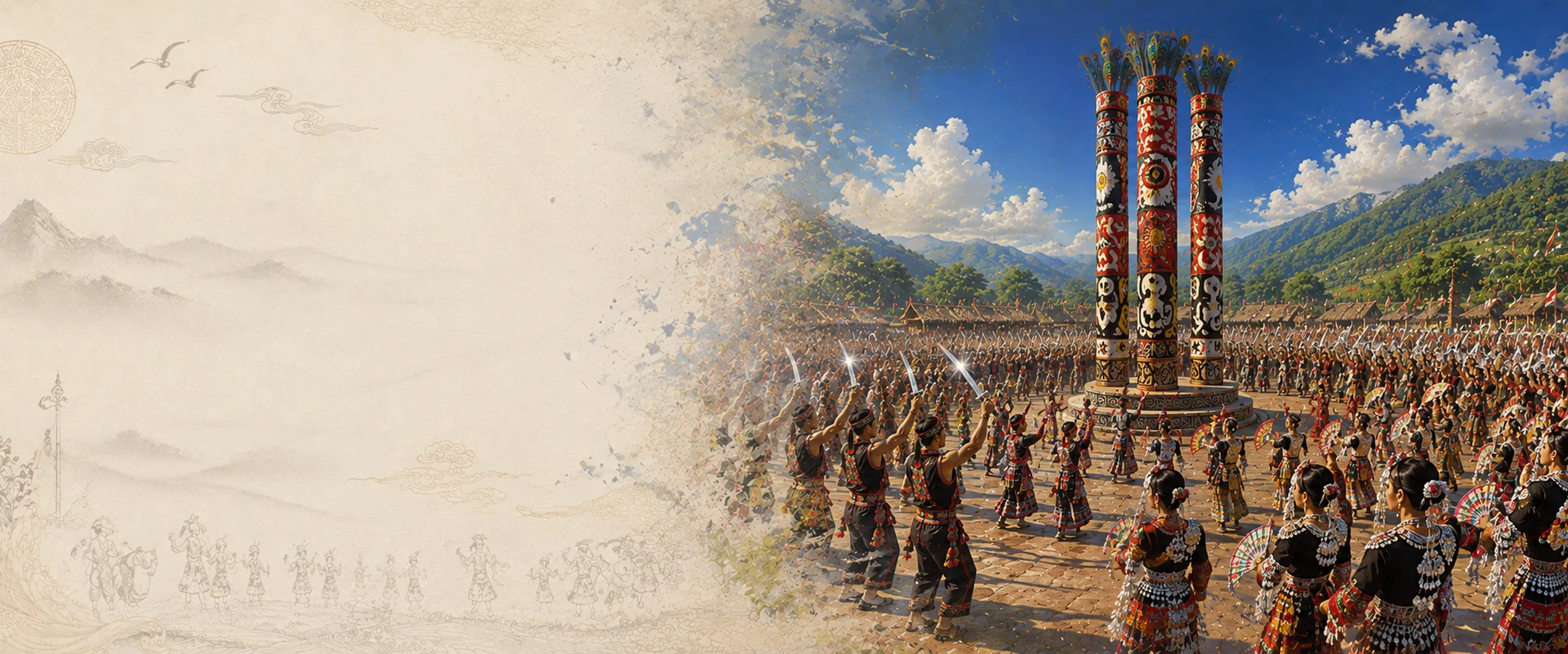
The oldest source of Munao Zongge can be traced back to the Jingpo ancestors’ primitive worship of the sun. This is the deepest and most essential cultural gene of Munao Zongge.
In the primitive religious beliefs of the Jingpo people, the sun god “Mudai” is the supreme deity. Munao Zongge was originally a grand sacrificial ritual held to worship the sun god “Mudai.” The Jingpo people are a cross‑border ethnic group whose ancestors have ethnic affinity with the Di‑Qiang (氐羌) nomadic groups of the northwest. In the cold environment of the Gansu‑Qinghai Plateau, the sun not only brought light to humanity but also warmth; therefore, the Jingpo ancestors held the sun god in special reverence.
In Jingpo creation myths and heroic epics, the sun god occupies a central position. It is said that the Jingpo people originated from the Gansu‑Qinghai Plateau, where snow covered the ground all year round and the land was frozen and bitterly cold. In this extremely cold environment, the sun was the fundamental guarantee of life. The Jingpo ancestors integrated their gratitude and reverence for the sun into religious rituals, forming the tradition of Munao Zongge centred on worshipping the sun god.
The very name “Munao Zongge” contains the worship of the sun—“Mu” refers to the celestial god “Mudai,” the sun god. Munao Zongge is essentially a grand ceremony paying tribute to the sun god.
Birds Bringing the Dance
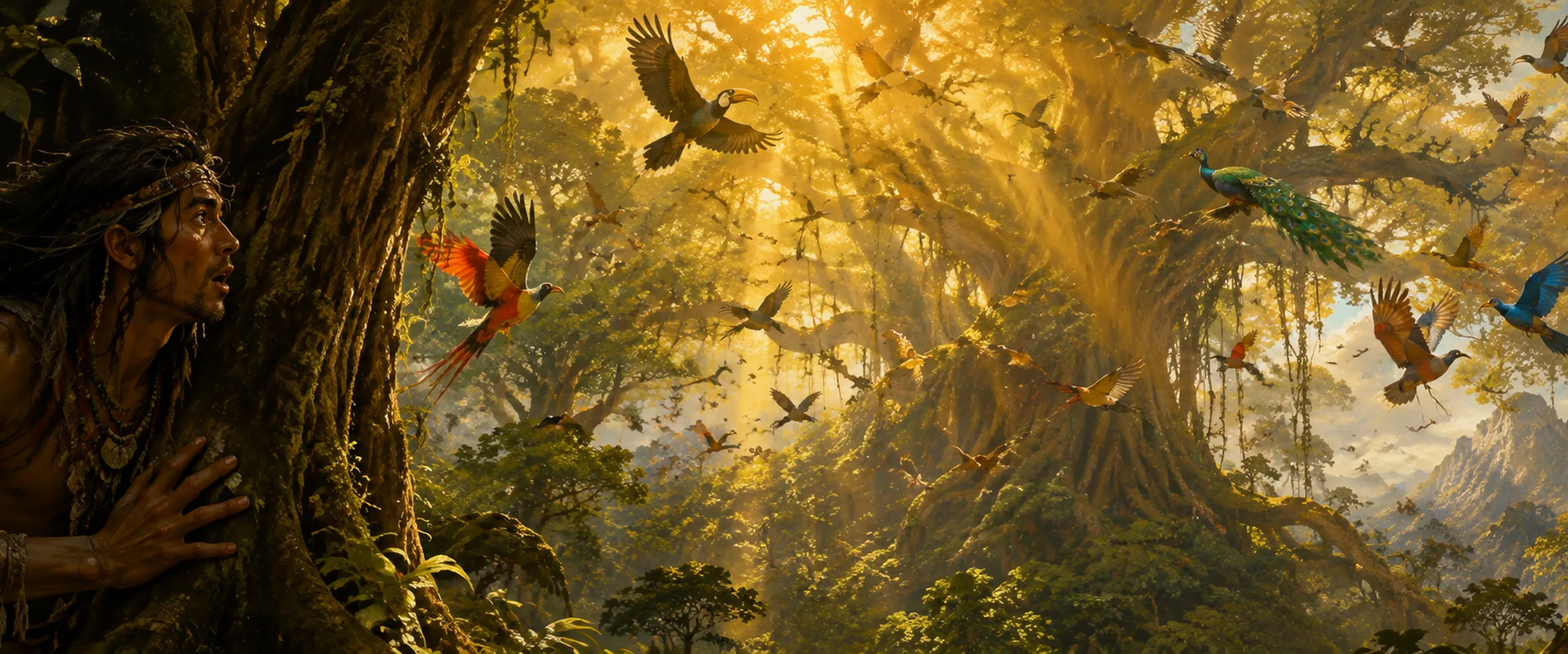
Among the many origin legends of the Jingpo people, the story of “birds learning the dance from the Sun Palace and bringing it to the human world” is the most widely spread and influential. This legend infuses Munao Zongge with its most moving cultural narrative.
#### The Sun King’s Invitation and the Mission of the Hundred Birds
Legend has it that in ancient times, only the children of the sun in the Sun Palace could perform the Munao Zongge. Once, the Sun God invited all beings in heaven and earth to a Munao Zongge grand gathering he was hosting, and the beings on earth sent all the birds to attend.
The birds, bearing this important mission, flew out of the forests and wilderness, crossed mountains and rivers, and flew over the Muzhai Shengya slopes, finally reaching the Sun Palace, where they sang and danced with the sun’s children. They were awestruck by the magnificent dance and enchanting music of the Sun Palace, and threw themselves wholeheartedly into this sacred revelry.
Another version of the legend is more specific: the nine sun brothers, who should have appeared one each day, all appeared in the sky at once and did not go back at night. All living beings on earth were scorched and could not survive. So the animals and humans jointly elected the “Kongrang” (hornbill) and “Wudong” (peacock) as envoys to plead with the Sun King. Upon arriving at the Sun Palace, they happened to catch the Sun King holding a “Zhan Munao” and were invited to participate. Their dashing bearing and melodious voices won the Sun King’s favour.
#### Bird Munao and the Three‑Level Evolution
After learning the Munao dance in the Sun Palace, the birds returned to the ground. Deeply moved by the beauty of the Munao, they decided to hold a Munao on the ground as well—this is the “Wu Munao” (Bird Munao). According to legend, the Munao held by the birds on the ground was witnessed by the Jingpo ancestor Ningguanwa (宁贯娃, also known as Ningguanwa). The Jingpo ancestors were enchanted by the birds’ melodious voices and graceful dances, and were deeply inspired, so they created the Jingpo people’s own Munao. Thus, human Munao was born.
This legend not only explains the origin of the Munao Zongge but also reveals a core concept of Jingpo culture: human culture is not created out of nothing, but is learned from nature and obtained from the gods. Birds, as messengers connecting heaven and earth, transmitted the culture of the sun god to humanity. This concept of “culture descending from heaven” endows Munao Zongge with sacredness.
The Jingpo legends about the origin of Munao form a clear three‑stage evolutionary chain: “Zhang Munao” (Sun Palace Munao) → “Wu Munao” (Bird Munao) → “Shenjing Munao” (Human Munao). “Zhang Munao” is the sacred source—the dance that only the sun god’s children could perform. “Wu Munao” is the bridge of transmission—the dance that birds brought from the Sun Palace and performed on the ground. “Shenjing Munao” is the human creation—the dance that the Jingpo ancestors learned from the birds and further developed according to their own needs.
This three‑stage structure not only explains the origin of Munao but also reveals the developmental logic of Jingpo culture: culture originates from the divine (the sun god), is transmitted through nature (birds), and is ultimately mastered and developed by humanity. Through this narrative, the Jingpo people place their own culture within the cosmic order—Munao Zongge is not only a human dance but also a divine gift and a natural offering.
#### The Hornbill and the Peacock
The influence of the bird‑transmission legend is still profoundly evident in the ritual details of Munao Zongge. During the Munao Zongge dance, the “Naoshang” (瑙双, lead dancers) all wear hats made of peacock feathers and hornbill skulls as a mark of commemoration. This is not just decoration but also a tribute to the birds that transmitted the dance.
The hornbill has special significance for the Jingpo people. In the legend, the hornbill (“Kongrang”) was chosen as the envoy to the Sun Palace. The peacock (“Wudong”) was another important bird envoy. These two birds became the most important animal totems of Munao Zongge; their images appear not only on the headdresses of the lead dancers but also in the carvings on the Munao Shidong.
Heroic Legends
Beyond the beautiful myth of birds transmitting the dance, the Jingpo people also have several origin legends of Munao Zongge associated with heroic figures. These legends infuse Munao Zongge with the spiritual connotations of struggle, courage, and national dignity.
In the Jingpo creation epic, Ningguanwa (宁贯娃, also known as Ningguanwa) is one of the most important heroic figures. He is the creator hero who separated heaven and earth, and also the son‑in‑law of the sun god. According to legend, Munao Zongge was a dance performed by the attendant birds of the goddess of fertility in the distant Sun Palace, and was later brought back to the human world by the Jingpo ancestor Ningguanwa. The sun god’s bird is thus revered as the god of dance, and the Jingpo people use dance to commemorate their ancestors’ great migration. As the son‑in‑law of the sun god, Ningguanwa had a special status as a bridge between heaven and earth. He could enter the Sun Palace, witness the sacred “Zhang Munao,” and bring it back to the human world. This narrative model of “the hero retrieves culture from the divine realm” is common in myths around the world—Prometheus bringing fire from heaven, Ningguanwa bringing dance from the Sun Palace—both are humanity’s collective imagination of cultural origins.
Another widely circulated legend links the origin of Munao Zongge to the story of the Jingpo hero Leipan (雷盼) defeating a demon king. According to legend, the Jingpo people once lived a happy life in peace. Later, a demon king appeared who survived by eating children. The Jingpo hero Leipan bravely stepped forward and fought a desperate battle with the demon king. The sun god, moved by Leipan’s courage, gave him a precious sword forged from flames. With this divine sword, Leipan ultimately defeated the demon king that devoured children. The Jingpo people held songs and dances to commemorate their ancestors’ victory—this is the origin of Munao Zongge. In this legend, Munao Zongge is not only a religious ritual to worship the sun god but also a grand celebration of victory and a commemoration of heroes. The demon king symbolises evil and disaster; the hero’s victory symbolises the power of justice and light. Thus, Munao Zongge acquired the spiritual connotation of “defeating evil and defending the homeland.”
Although the legends of Ningguanwa and Leipan have different protagonists, they share the same narrative pattern: the hero saves his people from adversity, and Munao Zongge is a commemoration and celebration of that victory. Whether Ningguanwa retrieving the dance from the Sun Palace or Leipan defeating the demon king with a divine sword, Munao Zongge is always closely linked to the narrative chain of “hero—salvation—victory—commemoration.” These two legends are not mutually exclusive but explain the cultural significance of Munao Zongge from different perspectives. The Ningguanwa legend emphasises the origin of culture (from heaven to the human world), while the Leipan legend emphasises the function of culture (exorcism and celebration). Together, the two legends constitute a complete cultural narrative of Munao Zongge—it is both sacred (from the sun god) and secular (celebrating human victory); both religious (worshipping celestial gods) and social (uniting the community).
Readers’ Comments
Calendar and traditional culture enthusiasts from around the world, sharing the same moon.
Sign in or register to join the conversation. Your comment account is created automatically the first time you use a connected account.
No comments yet
Share your thoughts with readers around the world.