Qiang New Year

Qiang New YearOrigins of the Qiang New Year

「 <p>天神之女,下嫁羌人,秋收献祭,日美吉庆。</p> 」

The Qiang New Year is held on the first day of the tenth lunar month. It is the grandest festival of the year for the Qiang people, celebrating the harvest, offering blessings, and praying for safety. In the Qiang language, it is called “Rimeiji,”…

The precise beginnings of the Qiang New Year can no longer be established, although tradition places its formation as early as the pre-Qin period. At its core, the festival arose from the ancient Qiang people’s reverence for, gratitude toward, and worship of the natural world—the ritual tradition known as “offering sacrifices to Heaven and fulfilling vows” (祭天还愿). The Qiang are traditionally said to have first calculated the year through a solar calendar; during the Qin period, this gradually gave way to a lunar calendrical system corresponding to what is now the traditional Chinese lunar calendar. The date of the Qiang New Year is understood as deriving jointly from the ancient Qiang ten-month solar calendar and the calendrical calculations of the Shibi (释比), the ritual specialists of Qiang society. Celebrated after the autumn harvest, the festival is fundamentally an agricultural thanksgiving rite honouring Heaven for abundant grain and favourable weather. According to legend, Mujiezhu (木姐珠), daughter of the Heavenly Deity, descended to the human world and married a Qiang youth, bringing with her seeds, livestock, and agricultural tools. After the harvest, she offered the fruits of abundance back to Heaven in gratitude, giving rise to the tradition of the Qiang New Year.

Qiang New Year / Origins of the Qiang New Year

The Name of the Qiang New Year

Origins & Anecdotes · Tracing the Past

“Rimeiji” and the “Rimai Festival”

The Qiang New Year has several names in the Qiang language, among which “Rimeiji” (日美吉) and “Rimai Festival” (日麦节) are the most common. *Rimeiji* means “an auspicious and joyful festival,” directly expressing the celebration’s central emotional qualities: good fortune and happiness. In *Rimai Festival*, “Rimai” is connected with the Qiang people’s self-designation “Erma” (尔玛), while “festival” simply denotes the occasion itself; together, the phrase means “the festival of the Qiang people” or “the Qiang New Year.” One name emphasises the emotional spirit of the occasion, while the other emphasises its ethnic identity. Together, they reveal two complementary dimensions of the festival’s cultural meaning.

In Chinese-language contexts, the festival is also called the “Qiang Calendar New Year” (羌历年), “Little New Year” (过小年), “Harvest Festival” (丰收节), and “Festival of Fulfilling Vows” (还愿节). The expression “Little New Year” is particularly revealing. It reflects the Qiang people’s attachment to their own traditional festival during the long historical process in which the Han Chinese Spring Festival gradually became the dominant New Year celebration in Qiang areas. The Qiang New Year, held on the first day of the tenth lunar month, and the Spring Festival, held on the first day of the first lunar month, are separated by roughly three months. Yet culturally they share important themes—bidding farewell to the old, welcoming the new, giving thanks, and seeking blessings. Their emphasis differs subtly: the Qiang New Year is centred more strongly on gratitude for the harvest, whereas the Spring Festival places greater emphasis on renewal and the transition into a new year. This distinction vividly reflects the particular character of Qiang agricultural culture alongside that of Han farming traditions.

“Qiang New Year” and “Qiang Calendar New Year”

The distinction between the terms “Qiang New Year” (羌年) and “Qiang Calendar New Year” (羌历年) has important historical roots. “Qiang New Year” now refers to the festival observed on the first day of the tenth lunar month, while “Qiang Calendar New Year” points to the fact that the Qiang historically possessed their own calendrical tradition.

The late Ming scholar Gu Yanwu (顾炎武) recorded that Qiang Shibi (释比) could “calculate solar and lunar eclipses and determine the cyclical days and calendrical auspices without the slightest error; in general, they regarded ten months as one year.” According to this description, the Qiang calendar divided the year into ten months, each containing thirty-six days, with the remaining five days reserved for the New Year, producing a total of 365 days. This ancient Qiang calendar differed markedly from the calendrical systems promoted by the central state.

By the Qing dynasty, however, this older calendar gradually disappeared. Before the reign of the Kangxi Emperor, the date of the Qiang New Year was still calculated according to the Qiang calendar. During the prosperous Kangxi and Qianlong periods, agriculture and handicraft production expanded rapidly around Chengdu, and large numbers of Qiang men and women travelled to the Chengdu Plain for seasonal work during the agricultural slack period after their own New Year. Changes in livelihood patterns gradually introduced the lunar-calendar New Year—the Spring Festival—into Qiang cultural life. The New Year calculated according to the traditional Qiang calendar gradually declined, and the Spring Festival eventually became the grandest annual celebration among many Qiang communities.

When the Qiang New Year was revived in the 1980s, both names—“Qiang New Year” and “Qiang Calendar New Year”—came into use. Because the old Qiang calendar itself had disappeared and the festival date was now determined according to the lunar calendar, “Qiang New Year” became the formal name. However, the first major celebration held after the revival used “Qiang Calendar New Year” on its official banner, and the older expression consequently remained widespread.

Today, as a nationally recognised intangible cultural heritage tradition, the festival is officially known as the Qiang New Year. It has been described as having travelled “from antiquity to the present, from mountain villages to the nation and even to the United Nations.” It is therefore not merely a festival of one people, but also a cultural epic extending across thousands of years.

Origins of the Festival

Origins & Anecdotes · Tracing the Past

The Ancient Qiang Ten-Month Solar Calendar

At its deepest level, the origins of the Qiang New Year are rooted in the distinctive calendrical system of the Qiang ancestors—the ancient Qiang ten-month solar calendar. This constitutes one of the festival’s most fundamental cultural foundations.

According to the late Ming scholar Gu Yanwu, Qiang Shibi could “calculate solar and lunar eclipses and determine cyclical days and calendrical auspices without the slightest error; in general, they regarded ten months as one year.” The Qiang calendar divided a 365-day year into ten months of thirty-six days each, with the remaining five days serving as the New Year period. This calendrical system is closely associated with a major transformation in ancient Qiang livelihood—from “following water and pasture” as mobile pastoralists to “dwelling by the mountains and building houses of stone.” The *Gazetteer of Maowen Qiang Autonomous County* (《茂汶羌族自治县志》) records: “According to tradition, the earliest Qiang calendar was the Pingyang calendar. The ancient Qiang divined with sheep bones to calculate the calendar and determine the Qiang year, dividing one year into ten months.”

The concept of “ten months forming one year” in the Qiang calendar is closely related to the broader tradition of ancient Chinese ten-month solar calendars. Some scholars hold that Qiang calendrical calculation combined the ancient Qiang ten-month solar calendar with the “iron-board calculation” (铁板算) practised by the Shibi, described in the source tradition as a method related to the ancient Xia calendrical system. Under this scheme, a year consisted of ten thirty-six-day months, with five additional days reserved for New Year celebrations. Its structure closely resembles that of the Yi ten-month solar calendar and may reflect a broader calendrical tradition historically shared among several peoples of southwest China.

The reason the Qiang New Year is now celebrated on the first day of the tenth lunar month is traditionally explained through this combination of the ancient ten-month solar calendar and Shibi calendrical calculation. The festival falls in late autumn, and the Qiang traditionally inhabit mountainous zones roughly 1,000 to 2,500 metres above sea level, where this period coincides closely with the end of the autumn harvest. For this reason, the Qiang-language understanding of the festival is also closely associated with the idea of harvest and abundance.

#### From a Ten-Month Calendar to a Twelve-Month Calendar

The precise period during which the Qiang ten-month calendar disappeared cannot be established, but the process is generally associated with the period after the Kangxi reign of the Qing dynasty. Research cited in the source tradition holds that before Kangxi, the Qiang New Year was still calculated according to the traditional Qiang calendar. During the prosperous Kangxi and Qianlong eras, however, agriculture and handicrafts developed rapidly in the Chengdu region. Large numbers of Qiang people travelled to the Chengdu Plain for seasonal employment after the Qiang New Year, during the agricultural slack period. As livelihoods changed, the lunar-calendar New Year—the Spring Festival—entered Qiang cultural life, while the festival date calculated according to the older Qiang system gradually faded.

This calendrical transition was not a simple act of one calendar “replacing” another. It was a long and complex historical process. As one scholarly interpretation quoted in discussions of the festival explains:

> “The Qiang celebrated the New Year around the winter solstice. To distinguish it from the Han Spring Festival, it was called the ‘Little New Year.’ This was in fact an expression of the Qiang people’s continued attachment to their older festival during the process in which the Han Spring Festival gradually replaced the Qiang calendrical New Year.”

Once the special ten-month calendar had gradually disappeared, Qiang communities continued to remember their traditional festival, but its exact date became increasingly uncertain; people could often identify only an approximate period.

Yet it was precisely this combination of fading calendrical precision and enduring emotional attachment that allowed the Qiang New Year to survive after the calendar itself disappeared. A calendrical system may vanish, but the cultural memory encoded in a festival can continue to live.

Mujiezhu and Dou’anzhu

Among the Qiang is preserved a beautiful and moving legend that provides the festival with its most emotionally resonant origin narrative. It is closely associated with the long Qiang narrative poem Mujiezhu and Dou’anzhu (《木姐珠与斗安珠》).

According to the legend, in the distant past Mujiezhu (木姐珠), the youngest daughter of the Heavenly Deity, fell in love with a Qiang young man named Dou’anzhu (斗安珠). Defying the laws of Heaven, she insisted on descending to the human world to marry him. Mujiezhu, the youngest daughter of the heavenly god Mubita (木比塔), chose the Qiang youth despite divine prohibition. Before her departure, her parents gave her tree seeds, grain seeds, and livestock as part of her dowry.

After Mujiezhu reached the human world, humanity flourished. The tree seeds she planted grew rapidly into forests, grain fields produced abundant harvests, and livestock multiplied into herds. She planted the seeds her parents had given her across mountains and fields and released the animals onto the grasslands. By autumn, forests had spread, the five grains had ripened in abundance, livestock and poultry had multiplied, human communities prospered, and the earth was filled with vitality.

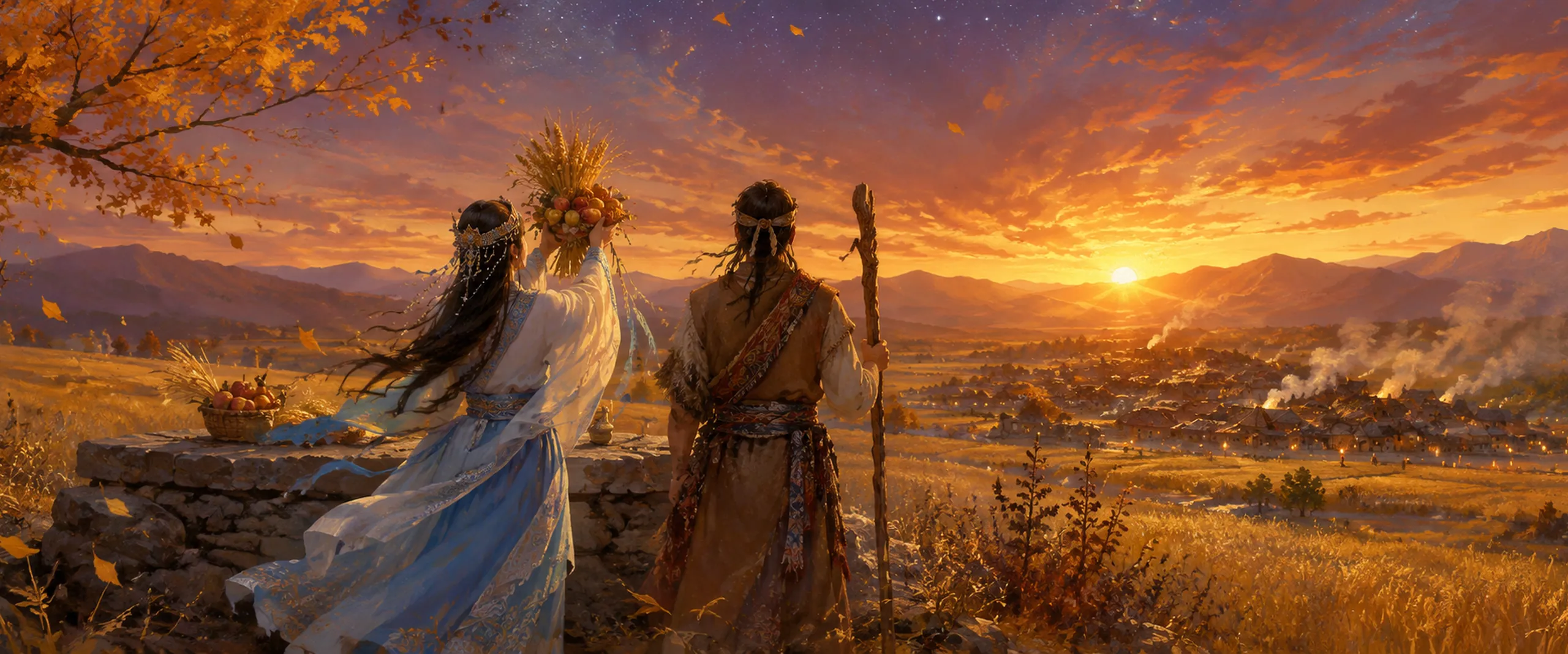
Mujiezhu did not forget the generosity of her parents. After the autumn harvest, she placed abundant grain and well-fed livestock in the open fields and offered them in sacrifice to Heaven, expressing gratitude for the blessings she had received. From that time onward, the Qiang New Year became a day on which the Qiang celebrated the harvest and gave thanks to Heaven.

The legend vividly expresses three central dimensions of the festival:

Gratitude — Mujiezhu gives thanks to her parents for the seeds and livestock, paralleling the Qiang people’s gratitude toward Heaven and Earth for the harvest.

Harvest — the sacrifice takes place after the autumn harvest, corresponding directly to the agricultural timing of the Qiang New Year.

Reciprocity — the fruits of abundance are offered back to Heaven, corresponding to the festival’s central rite of returning thanks through sacrifice.

A commentary associated with the National Ethnic Affairs Commission of China (国家民委) makes the point clearly: “Whether the myth is literally true is not important. What matters is the Qiang people’s reverence for, gratitude toward, and worship of nature—the practice known as ‘offering sacrifice to Heaven and fulfilling vows.’” After the sowing of spring and the harvest of autumn, Qiang farming communities entered a period of agricultural rest. Singing, dancing, and celebrating the harvest became the natural means through which they expressed the joy accumulated after a year of labour.

#### From Legend to Festival

The legend of Mujiezhu and Dou’anzhu has had a profound influence within Qiang society. The story is fully preserved in Mujiezhu (《木姐珠》), one of the upper-altar ritual classics of Qiang indigenous religious tradition. As an important part of the body of texts transmitted by the Shibi, *Mujiezhu* is not only recited or sung during ritual occasions, but also plays an important role in the everyday transmission of Qiang cultural memory.

The Qiang New Year legend exists in numerous versions throughout Qiang communities, a typical feature of oral culture. Details may differ from one region or village to another, but the central narrative remains remarkably stable:

the daughter of the Heavenly Deity descends to the human world → she brings seeds and livestock → after the autumn harvest she offers sacrifice in gratitude → the New Year festival is established.

The persistence of this narrative structure suggests that the legend of the Qiang New Year has become deeply embedded in the collective memory of the Qiang people.

Historical Development

Origins & Anecdotes · Tracing the Past

From the Pre-Qin Period to the Qin and Han Dynasties

As the traditional New Year of the Qiang people, the Qiang New Year is said to have roots extending back into the pre-Qin period. The Qiang are among the ancient peoples recorded in Chinese history, and traditional historical narratives sometimes describe them as descendants of Yandi, the Yan Emperor (炎帝). Archaeological remains in areas such as Ganxi in the eastern part of present-day Beichuan also preserve evidence of human activity dating back to the late Neolithic period.

During the pre-Qin era, Qiang communities underwent an important historical transition from pastoral civilisation to settled agriculture. The transformation from “moving in search of water and pasture” to “dwelling against the mountains and building houses of stone” fundamentally changed the relationship between livelihood, seasonality, and time. Accurate observation of seasonal cycles and natural phenomena became increasingly important, encouraging the development of a distinctive ten-month solar calendar: ten months of thirty-six days each, followed by five New Year days, producing a total of 365 days.

The present association of the Qiang New Year with the first day of the tenth lunar month is traditionally linked to this ancient calendrical heritage and to the calculations of Shibi ritual specialists.

During the Qin and Han periods, Qiang populations were distributed primarily across areas corresponding to modern Sichuan, Gansu, and Qinghai, and maintained extensive cultural contact with the Central Plains. After the Qin unified the warring states, the Zhuanxu calendar (颛顼历) was promoted, taking the tenth month as the beginning of the year. The *Records of the Seasonal Customs of Jing and Chu* (《荆楚岁时记》) contains the line:

> “十月朔日,黍曜,俗谓之秦岁首。” > “On the first day of the tenth month, millet shines ripe; popular custom calls this the Qin beginning of the year.”

The ancient Qiang New Year was fundamentally an annual celebration of harvest and thanksgiving. Its association with the first day of the tenth lunar month therefore creates a striking historical parallel with the Qin tradition of taking the tenth month as the beginning of the year.

From the Sui and Tang to the Song and Yuan Dynasties

During the Sui and Tang dynasties, contact between Qiang communities and the Central Plains became increasingly close. After the rise of the Tibetan Empire during the Tang period, some Qiang groups gradually became culturally Tibetanised, while communities in the upper Min River valley continued to preserve relatively distinct cultural traditions. The Qiang New Year, as one of their most important festivals, continued to be transmitted and developed.

According to the surviving body of Shibi ritual texts cited in Qiang cultural tradition, the festival’s sacrificial rites and mythological narratives had already taken relatively stable form by the Tang period. The upper-altar classic Mujiezhu preserves the full narrative sequence of the Heavenly Deity’s daughter descending to the human world, the autumn sacrifice, and the establishment of the New Year celebration, suggesting that the cultural framework associated with the festival had become well developed.

The Song dynasty was another important period in the development of Qiang culture. Communities in the upper reaches of the Min River developed a comparatively stable settlement pattern. Festival customs are said to have become increasingly elaborate. Alongside the central rite of offering sacrifices to Heaven and fulfilling vows, distinctive cultural forms such as Shalang (沙朗) circle dancing, communal drinking of zajiu (咂酒), and foods such as Wada (瓦达) steamed dumplings became increasingly associated with the celebration.

Contact between Qiang and Han communities also intensified during the Song period. The temporal difference between the Qiang New Year in the tenth month and the Han Spring Festival in the first month contributed to the use of the expression “Little New Year” in areas where Qiang and Han populations lived in close proximity.

During the Yuan dynasty, although China was ruled by the Mongols, many Qiang communities remained relatively remote and experienced comparatively limited cultural assimilation. The transmission of the Qiang New Year continued largely through the Shibi institution and village-based social organisation. The Yuan tusi (土司) system of hereditary native chieftains nevertheless affected the political organisation of Qiang communities. Festival organisation gradually moved in some areas from relatively autonomous tribal structures toward systems influenced by local hereditary authorities. Even so, the Qiang New Year remained primarily a village-based festival and preserved much of its traditional form.

The Ming and Qing Dynasties

The Ming and Qing periods represented a crucial turning point during which the Qiang New Year gradually shifted from prosperity toward decline. In the late Ming and early Qing periods, the calendrical knowledge of the Qiang Shibi still impressed outside observers. Gu Yanwu wrote that they could “calculate solar and lunar eclipses and cyclical calendrical matters without the slightest error; generally they regarded ten months as one year.” This record suggests that Shibi specialists still possessed sophisticated knowledge of the ancient ten-month calendar in the Ming period and that the Qiang New Year continued to be determined according to a distinctive Qiang calendrical tradition.

Before the Kangxi period, the festival date was still calculated according to the Qiang calendar. During the Kangxi and Qianlong eras, however, the flourishing agriculture and handicraft industries of the Chengdu region drew large numbers of Qiang men and women to the Chengdu Plain for seasonal work after their traditional New Year. Changes in economic life gradually brought the lunar-calendar Spring Festival more deeply into Qiang culture, while the New Year calculated according to the traditional Qiang calendar steadily declined.

As the ten-month calendar disappeared, the festival lost the calendrical system that had once defined its timing. Qiang communities retained memories of their own New Year, but the exact date gradually became uncertain. The Spring Festival eventually became the most important annual celebration in many Qiang communities, while the older Qiang New Year assumed a secondary position.

The Qing government’s implementation of gaitu guiliu (改土归流)—particularly its large-scale expansion in western Sichuan during the Yongzheng reign—accelerated political and cultural integration in Qiang regions. The Han lunar calendar and Spring Festival customs consequently became more deeply embedded in Qiang social life. Yet, as one scholar quoted in discussions of the festival has observed:

> “The Qiang celebrated their New Year around the winter solstice and called it the ‘Little New Year’ to distinguish it from the Han Spring Festival. This was in fact an expression of their continued attachment to the older festival during the process in which the Han Spring Festival gradually replaced the Qiang calendrical New Year.”

The cultural memory of the Qiang New Year therefore did not disappear. Instead, it persisted tenaciously through the idea of the “Little New Year.”

Although the festival declined at the official level during the Ming and Qing periods, it continued to be passed down orally within villages. The Shibi, as key custodians of Qiang culture, continued to preside over sacrifices and recite ritual classics. This pattern—survival among local communities despite declining formal recognition—allowed the festival to retain vitality in collective memory even after its original calendar disappeared, laying the cultural groundwork for its revival in the 1980s.

The Contemporary Era

In the modern period, the Qiang New Year has undergone a remarkable journey from decline to revival and from a local tradition to internationally recognised heritage.

In 1986, on the first day of the tenth lunar month, the First Qiang Calendar New Year Celebration for Qiang Compatriots in Beijing was held in the capital. In 1987, the Sichuan Provincial Ethnic Affairs Commission organised a Qiang New Year celebration in Chengdu. In 1988, the Rimai Festival, also referred to at the time as the Qiang Calendar New Year, was officially designated by the People’s Government of the Aba Tibetan and Qiang Autonomous Prefecture as a statutory festival for the Qiang people. In 1991, the Beichuan County People’s Government organised an official county-level Qiang New Year celebration for the first time. Since then, Qiang communities have celebrated the festival each year on the first day of the tenth lunar month.

In 2008, the Qiang New Year was approved by the State Council for inclusion on China’s second national list of intangible cultural heritage. In the same year, a national experimental zone for the ecological protection of Qiang culture was established.

In 2009, the Qiang New Year was inscribed by UNESCO on the List of Intangible Cultural Heritage in Need of Urgent Safeguarding. In 2024, it was transferred from the Urgent Safeguarding List to the Representative List of the Intangible Cultural Heritage of Humanity, marking the first formal implementation of such a transfer procedure under the listing mechanisms of UNESCO’s Convention for the Safeguarding of the Intangible Cultural Heritage. In this sense, the Qiang New Year has indeed travelled “from antiquity to the present, from mountain villages to the nation and onward to the United Nations,” marking a historic transition from emergency safeguarding to living transmission.
Core Rituals

Origins & Anecdotes · Tracing the Past

The customs of the Qiang New Year are exceptionally rich, encompassing sacrifice, food, song and dance, social gathering, and communal celebration. Together they form one of the most concentrated expressions of Qiang culture.

Offering Sacrifices to Heaven and Fulfilling Vows

The sacrifice to Heaven is the most central and sacred ritual of the Qiang New Year. The festival is organised around the themes of praying to Heaven for blessings, expressing gratitude, and fulfilling vows. Even before the first day of the tenth lunar month, entire Qiang villages begin to take on a festive atmosphere, and those who live away from home return to reunite with their families.

The first day is primarily devoted to sacrifice. On the New Year itself, the entire village may go to the “sacred forest” (神树林) to fulfil vows and give thanks. Families clean their houses, sweep away dust, wash clothes, and prepare banquets. They then burn incense and make offerings to the deities of Heaven and Earth and to household gods, recounting the year’s harvests, disasters, blessings, and misfortunes. They pray for favourable weather in the coming year, prosperity for people and livestock, peace for the country, and security for the community. In some villages, sacrifices are also made to the Mountain Deity.

Worship of the Ox King

The Qiang place great value on working cattle and traditionally regard the ox as a provider of food and livelihood. The first day of the tenth lunar month is said in some traditions to be the birthday of the Ox Deity, and Qiang villagers may sacrifice chickens and fulfil vows at a Temple of the Ox King (牛王庙).

Through generations of agricultural labour, the close relationship between Qiang farmers and working cattle produced a belief that abundant grain harvests also depended upon the help of the Ox King. In some areas, customs associated with the traditional “Ox King Gathering” (牛王会) remain in practice.

Reunion New Year Banquet

The Qiang New Year is also a time for the entire village to reunite and share the harvest. On the evening of the first day, families eat the New Year banquet, also called the “Harvest Wine Banquet” (吃收成酒).

Families gather to prepare Wada (瓦达), a large steamed dumpling made from buckwheat flour and shaped somewhat like the Chinese character 山 (“mountain”). The filling commonly contains chopped cured pork, crumbled tofu, and preserved wild vegetables. Once steamed, the dumplings are divided and shared.

The New Year feast is also known as “Harvest Wine.” In some places, buckwheat flour is shaped into cattle, sheep, chickens, and other animals as sacrificial offerings to ancestors and deities. The ritual sequence is presided over by a ritual specialist identified in the tradition as “Xu” (许), while the jar of zajiu (咂酒)—a traditional communal alcoholic drink sipped through long straws—is ceremonially opened by a respected elder of the village. Everyone shares a reunion meal, drinks zajiu, and dances the Shalang until the celebration reaches its joyful conclusion.

The festival is also an important occasion for married daughters to return to their natal homes. On the following day, families traditionally prepare another banquet to welcome them back.

Shalang and Festival Dance

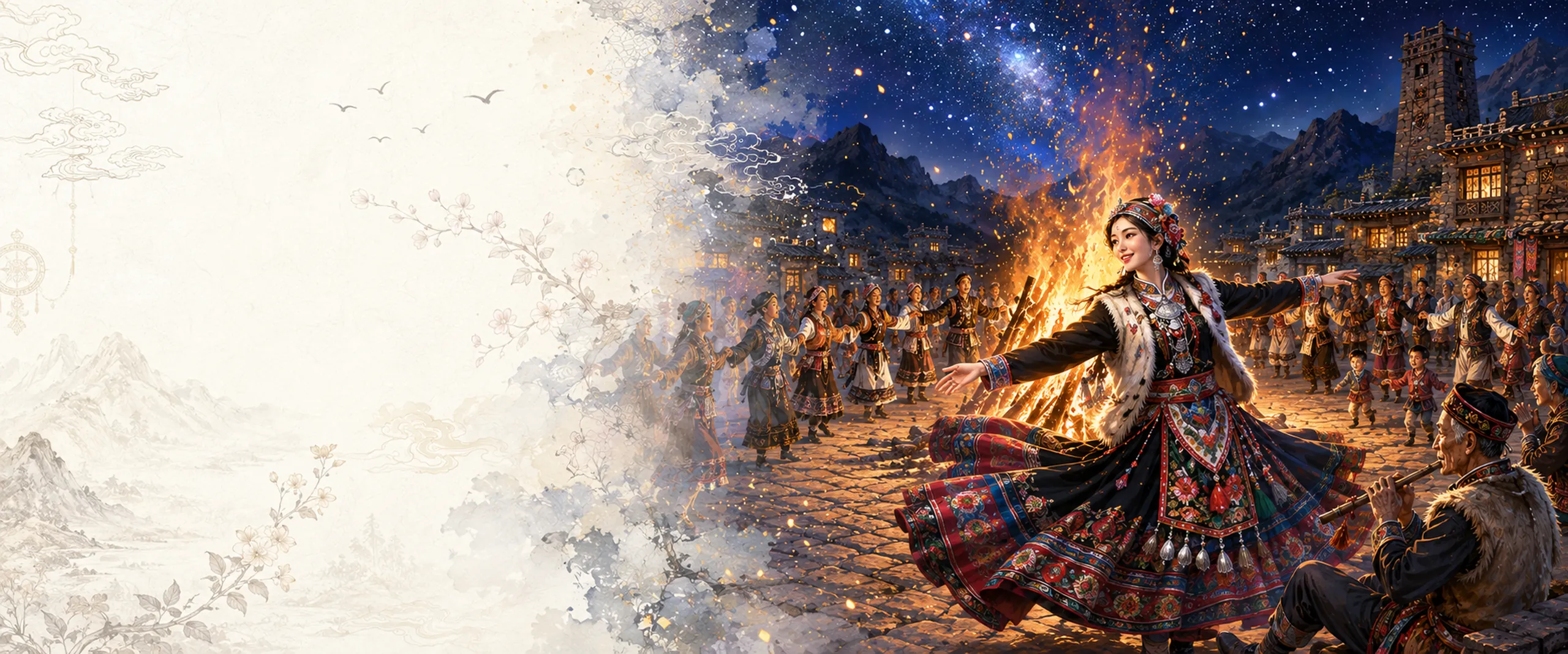
Shalang (沙朗) is the most representative communal dance of the Qiang New Year. It is believed to have developed from ritual dance and has become a highly participatory form of group entertainment. When the Qiang New Year arrives, men and women, young and old, dress in festival clothing and celebrate together.

People perform the circular group dance that is among the most distinctive forms of Qiang performing culture. In some villages, the entire community gathers in an open square or flat area, dancing Shalang and drinking zajiu together. The circle itself turns collective celebration into a visible expression of communal unity.

Wada and Qiang Flour-Based Foods

The Qiang New Year features many distinctive foods, among which Wada (瓦达) is especially representative. It is a large, three-pronged steamed dumpling made from buckwheat dough and filled with meat and tofu.

In some communities, wheat flour is also shaped into colourful representations of cattle, sheep, chickens, horses, dogs, and other animals, which are offered to ancestors and heavenly deities. Some households draw a swastika-pattern motif (“万”字格) on the wall as an auspicious symbol celebrating the flourishing of people and livestock and the abundance of crops.

Closing Reflections

Origins & Anecdotes · Tracing the Past

The formation of the Qiang New Year is the result of thousands of years of cultural accumulation and the continual addition of new meanings across changing historical eras. Its deepest calendrical roots lie in the ancient Qiang ten-month solar calendar, in which “ten months constituted one year” and the New Year followed the cycle of agricultural labour. In the beautiful legend of Mujiezhu and Dou’anzhu, the festival gained its most moving narrative expression. In the Qiang tradition of an animate, spiritually inhabited universe, it found profound religious foundations. In the calendrical knowledge and sacrificial practices of the Shibi, it acquired ritual authority. In agricultural celebrations of the autumn harvest, it received its most direct and practical meaning; and through Shalang dancing, zajiu drinking, Wada, and other food and artistic traditions, it gained its most vivid cultural forms.

From the ancient ten-month solar calendar to the present observance on the first day of the tenth lunar month; from cultural memories associated with the pre-Qin world to national intangible cultural heritage; from self-organised celebrations in Qiang mountain villages to UNESCO recognition—the Qiang New Year has undergone a long transformation from calendar to festival, from pastoralism to agriculture, from sacrifice to communal celebration, from local tradition to national heritage, and from national heritage to global recognition. It preserves the Qiang ancestors’ understanding of astronomy and seasonal time, their precise awareness of agricultural cycles, and their gratitude toward the forces that sustained life. At the same time, it carries the Qiang people’s enduring hopes for ancestral blessing, abundant harvests, communal unity, and a good life.

The Qiang New Year is both a historical accumulation and a concentrated expression of Qiang culture. As one scholarly assessment cited in discussions of the festival puts it, “in both form and content, it provides living material for the study of Qiang history, culture, art, customs, and related traditions.” Bringing together folk belief, oral tradition, performing arts, ritual practice, and traditional craftsmanship, the festival functions as a living cultural archive of the Qiang people.

In 2008, the Qiang New Year was entered on China’s national list of intangible cultural heritage. In 2009, UNESCO placed it on the List of Intangible Cultural Heritage in Need of Urgent Safeguarding. On 5 December 2024, it was transferred to the Representative List of the Intangible Cultural Heritage of Humanity. From “urgent safeguarding” to “representative heritage,” the Qiang New Year has crossed centuries while continuing to thrive among the high mountains and deep valleys of the upper Min River (岷江).

It has journeyed, in the words often used to describe it, “from antiquity to the present, from mountain villages to the nation and even to the United Nations.” It is not only a cultural treasure of the Qiang people, but part of the shared spiritual heritage of humanity. Like the circling rhythm of the Shalang and the mellow fragrance of zajiu, the story of the Qiang New Year has travelled through centuries of wind and rain and still beats with extraordinary vitality in the hearts of the Qiang—often poetically known as the “people above the clouds” (云朵上的民族).

—

Cultural Spirit

Cultural Core
Qiang New Year carries the Chinese people’s longing for a better life and their devotion to family, embodying the cultural spirit of reunion, harmony, gratitude and blessing — it is one of the most enduring traditional festivals in Chinese culture.
Gratitude Toward Nature
A Philosophy of Time
Community Cohesion

Gratitude Toward Nature

The deepest cultural spirit of the Qiang New Year is reverence for, gratitude toward, and worship of the natural world, expressed through the principle of “offering sacrifice to Heaven and fulfilling vows.”

In traditional Qiang cosmology, the universe contains many spiritual beings and divine forces, including the Heavenly Deity, Earth Deity, Mountain Deity, Tree Deity, Fire Deity, and Ox Deity. The Qiang New Year is the collective occasion on which people express gratitude to these powers.

This gratitude is not an abstract idea. It is enacted through specific rituals. Newly harvested grain and livestock are offered in thanksgiving for abundance; zajiu is shared and songs and dances are performed in gratitude for divine protection and peace. The festival’s ethic of gratitude expresses a Qiang ecological understanding comparable to the Chinese idea of “the unity of Heaven and humanity” (天人合一): human beings and nature share a common destiny, and people should respect the natural world, give thanks for its gifts, and live in harmony with it.

A Philosophy of Time

The Qiang calendrical principle that “ten months make one year” reflects a distinctive understanding of the cosmos and of time. For the ancestors of the Qiang, the annual cycle was not composed of twelve months but of ten months followed by five New Year days.

This structure created a clear conceptual distinction between ordinary time and festival time: the ten months represented the period of labour, while the additional five days represented rest, thanksgiving, and renewal. The Qiang New Year is therefore not simply a point on the calendar; it expresses a philosophy of time itself. It brings together labour and rest, cultivation and harvest, effort and gratitude as complementary parts of the same annual cycle.

Community Cohesion

The Qiang New Year is also an important mechanism for strengthening communal bonds. From the preparations before the festival—cleaning homes, making new clothes, and preparing food—to the collective sacrifices, shared banquets, drinking of zajiu, and communal Shalang dancing, every stage of the celebration reinforces connections among families, villages, and the wider community.

Households slaughter pigs and sheep and prepare Wada, while the entire village gathers for reunion meals and shared drink. Ritual proceedings are traditionally presided over by the Shibi. The Qiang New Year is therefore not simply a family festival but a festival of the entire community; its blessings are directed not only toward individuals, but toward the collective wellbeing of the village and the people as a whole.

Continue exploring Qiang New Year culture

Readers’ Comments

Calendar and traditional culture enthusiasts from around the world, sharing the same moon.

Sign in or register to join the conversation. Your comment account is created automatically the first time you use a connected account.