Qixi Festival

Qixi Festival

「 金风玉露一相逢,便胜却人间无数。 」

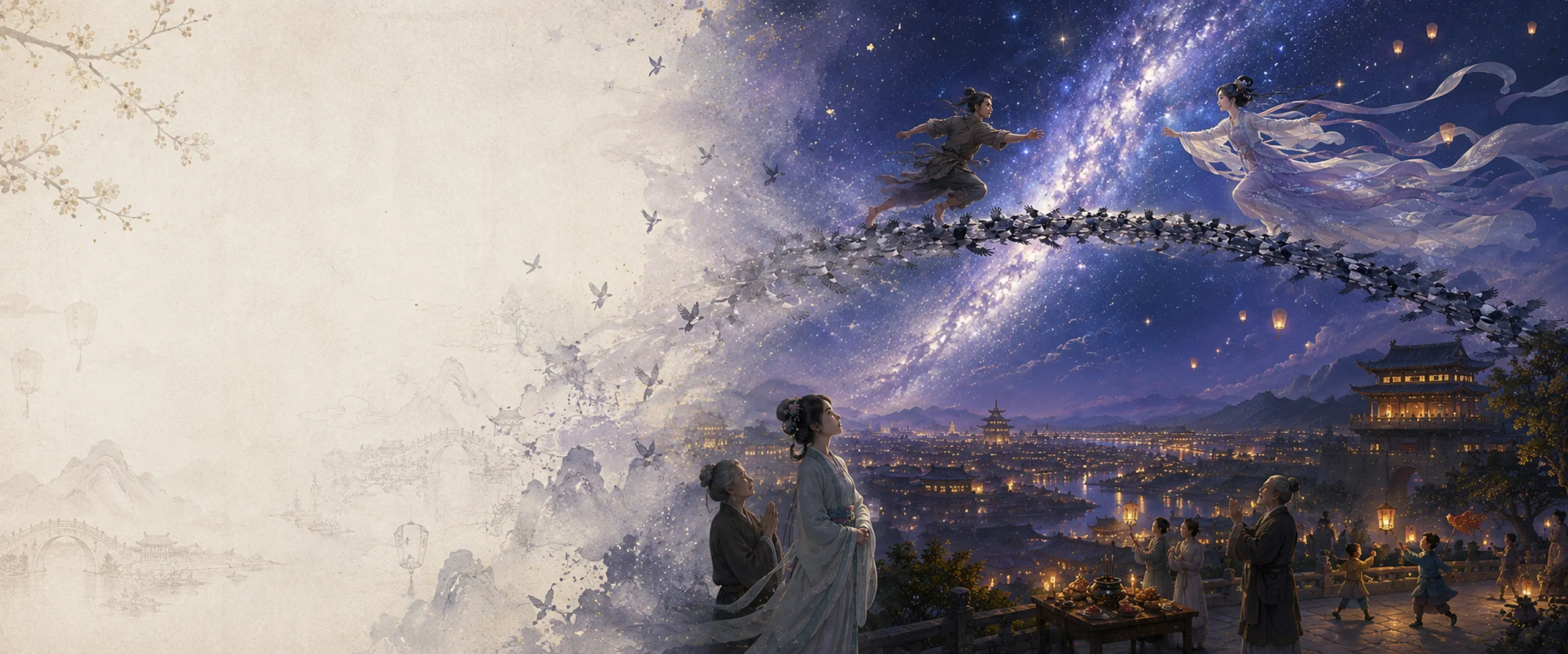
Qixi is the most romantic of China’s traditional festivals, born from the poignant legend of the Cowherd (Niulang) and the Weaver Girl (Zhinu). Praying for dexterity, worshipping the moon, and gazing at the Milky Way — this day carries the timeless…
Qixi Festival

The Qixi Festival originated in the Han dynasty, rooted in ancient star worship — the Cowherd star and the Weaver Girl star face each other across the Milky Way, giving rise to the beautiful tale of their annual reunion on the Magpie Bridge on the seventh night of the seventh month. Qin Guan’s ci poem “Immortal at the Magpie Bridge” (《鹊桥仙》) celebrates this sacred and eternal love: “纤云弄巧,飞星传恨,银汉迢迢暗度。金风玉露一相逢,便胜却人间无数。” (*Slender clouds weave their skill, shooting stars convey their longing; they cross the vast Milky Way in secrecy. When the golden wind meets the jade dew on this one night, it surpasses countless moments in the mortal world.*) Qixi is also known as the “Begging for Skills Festival” (乞巧节), when young women in ancient times prayed to the Weaver Girl for dexterous hands and a happy marriage. “年年此夕人千里,卧看银河彻夜明” (*Every year on this night, though we are a thousand li apart, I lie gazing at the Milky Way until dawn.*) Looking up at the stars, love endures. In 2006, Qixi was inscribed on China’s first list of National Intangible Cultural Heritage, becoming China’s equivalent of Valentine’s Day.

Next Qixi Festival in 289 days
Lunar Date
7th day of the 7th lunar month
Origin Dynasty
Han dynasty
Popular Regions
Throughout China
Cultural Heritage
National Intangible Cultural Heritage

Festival Journey

  1. Pre‑Festival Preparations

    Preparations for Qixi begin gradually from the start of the seventh lunar mo…

  2. The Day of Qixi

    Qixi falls on the seventh day of the seventh lunar month. Also known as the…

  3. After the Festival

    After Qixi, the young women exchange the crafts and toys they have made with…

Origins & Legends

History · Evolution · Legend
Qixi Festival · Origins & Legends

Tracing the Source · Historical Evolution

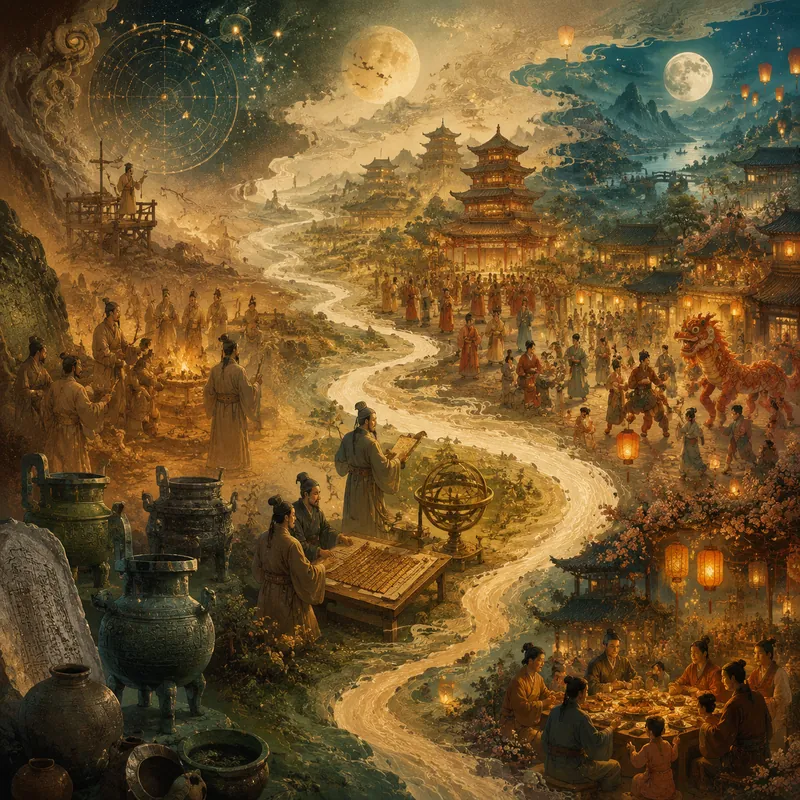
  • Han Dynasty The earliest documentary record of Qixi Qiqiao customs is found in Ge Hong’s Miscellaneous Records of the Western Capital of the Eastern Jin dynasty: “The maids of the Han court often threaded seven‑needle holes on the seventh day of the seventh month in the Pavilion of the Open Robe, and all the women followed this practice.” This is the earliest record of Qiqiao in ancient texts
  • Wei‑Jin and Northern and Southern Dynasties During the Wei‑Jin and Northern and Southern Dynasties, as the Cowherd and Weaver Girl love story became increasingly complete, Qixi had become a widespread festival, with increasingly diverse customs
  • Tang Dynasty The Tang dynasty was the peak period of Qixi’s development
  • Song and Yuan Dynasties The Song dynasty saw the further flourishing of Qixi customs
  • Yuan, Ming, and Qing Dynasties During the Yuan, Ming, and Qing dynasties, Qixi customs, while inheriting those of previous generations, showed characteristics of diversification and localisation

Festival Customs

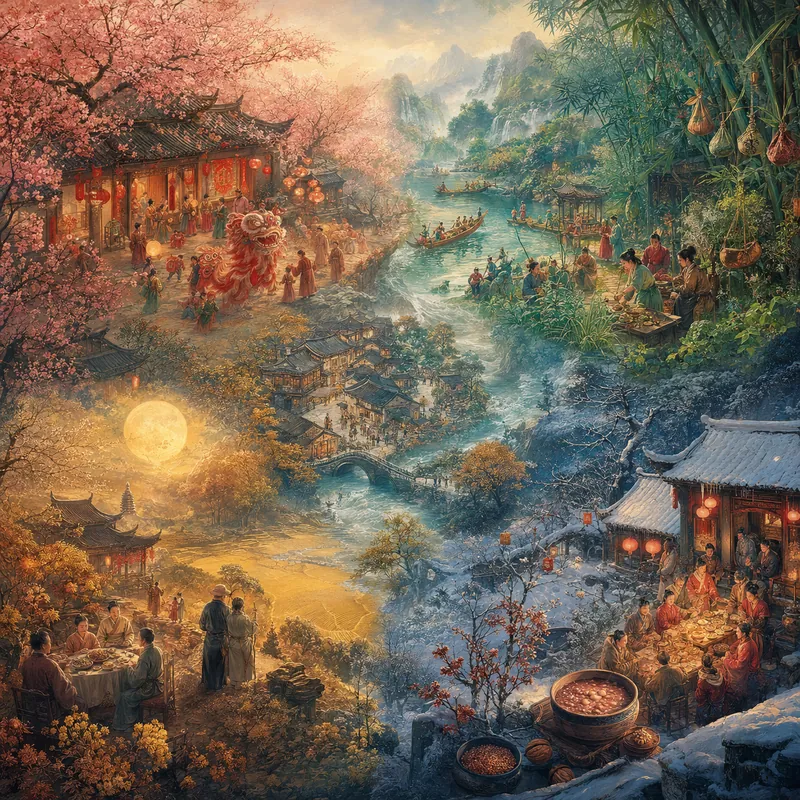
Customs · Local Traditions · Everyday Life
Festival Foods

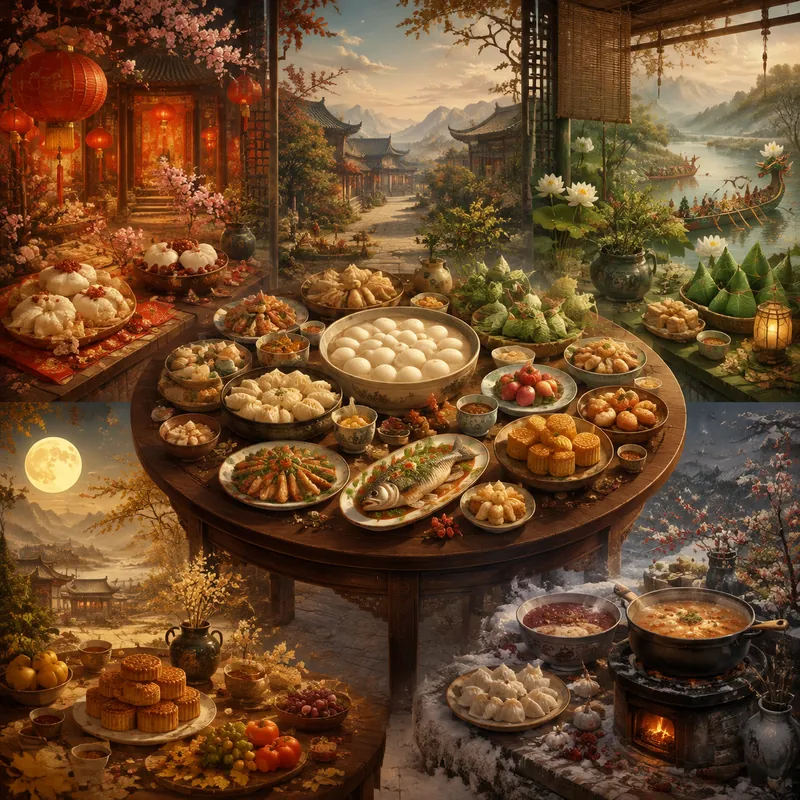
Food Traditions · Local Flavors · Taste
Poetry & Verse

Classics · Imagery · Legacy

Qixi Festival · Poetry & Verse

Representative Poems · Classic Selections

「鹊桥仙·纤云弄巧」

纤云弄巧,飞星传恨,银汉迢迢暗度。
金风玉露一相逢,便胜却人间无数。
柔情似水,佳期如梦,忍顾鹊桥归路。
两情若是久长时,又岂在朝朝暮暮。

Historical Development Core Imagery Thematic Categories Qixi Festival Folk Songs Closing Reflections

Global Features

Overseas · Chinese Communities · Celebrations

Qixi Festival · Global Features

Overseas Celebrations · Lights of Chinese Communities

01
Festival Scenes Abroad Japan

Japan is the country in which Qixi culture has undergone the most thorough transformation after spreading overseas. Qixi was introduced from China to Japan during the Nara period. After the Meiji Restoration, Japan abolished the lunar calendar, and Tanabata came to be celebrated on July 7 of the Gregorian calendar each year. Unlike China, where the love story occupies a central position, Japanese Tanabata places greater emphasis on praying for improvement in skills, particularly the hope that girls will acquire outstanding handicraft abilities. From the Nara period onward, the imperial court and aristocracy began imitating Tang-dynasty customs by holding Tanabata rituals, threading-needle competitions for skill, and elegant poetry gatherings. Hanging bamboo and writing poetry slips: the central customs of Japanese Tanabata. Beginning in the Edo period, adults and children would write wishes and poems on colorful elongated paper slips on Tanabata, hanging them together with paper decorations from small bamboo branches before setting the bamboo upright in the courtyard. After Tanabata ended, the bamboo and offerings were placed in rivers, symbolizing the hope that one’s wishes would reach the River of Heaven. In Sendai, Kyoto, and many other places, paper garments associated with Tanabata were regarded as a means of dispelling misfortune—people used these paper garments to pray for favorable winds and timely rain. Sendai Tanabata Festival: Japan’s largest Tanabata celebration. The Sendai Tanabata Festival is Japan’s largest and one of its most popular Tanabata celebrations. Every year from August 6 to 8, the shopping streets of central Sendai are filled with brightly colored paper and decorations, creating a spectacular sight. Tanabata events are also held throughout Japan, including portable-shrine processions, floats, drum-and-flute ensembles, and parades. Oita Tanabata Festival: a summer celebration of traditional dance. The Oita Tanabata Festival is the largest summer event in Oita City and is generally held on the first Friday and Saturday of August. Its principal highlight on the first day is “府内戦紙”, in which dance teams and vividly colored floats made with washi paper, shaped as dancers and rising dragons, proceed magnificently along Chuo-dori. On the second day, the “大分chikirin囃子市民総踊” is held. Dancers move to the cheerful rhythm of chikirin (钲), a traditional percussion instrument long used in Oita, striking bamboo sticks as they perform lively dances, while spectators are also welcome to join in. During the festival, downtown shopping streets are decorated with bamboo, paper cranes, paper wind streamers, and other traditional Japanese Tanabata ornaments. Goryokaku Tower Tanabata Festival: Qixi culture in Hakodate. Hakodate’s Goryokaku Tower holds a Tanabata Festival each year from July 1 to July 7, introducing the story of the Weaver Girl and the Cowherd and inviting visitors to experience Hakodate’s distinctive Tanabata culture. Tanabata blessings at the airport: a journey of wishes from Taoyuan to Sendai. Japan Airlines (JAL) once organized a Tanabata blessing activity at Taoyuan International Airport, placing a “Tanabata wishing bamboo” in front of the boarding gate for flights to Tokyo and inviting travelers to write down their wishes and hang them from the bamboo branches. All the wish slips were later flown to Japan and offered at Osaki Hachimangu Shrine in Sendai. By transforming an airport waiting area into a Tanabata prayer space, this creative initiative allowed Qixi culture to travel with people on their journeys.

02
Festival Scenes Abroad South Korea

South Korea’s Chilseok also originated in ancient China and is celebrated each year on the seventh day of the seventh lunar month. One of the most representative traditions of Korean Chilseok is worshipping the Weaver Girl Star, through which people pray for improved handicraft skills, particularly in weaving. On the morning of Chilseok, women place melons, fruits, and other offerings before the Weaver Girl Star and pray devoutly. Praying to the Weaver Girl Star: the Korean form of Qiqiao. Similar to China’s Qiqiao (乞巧), praying for dexterity, Korean women pray to the Weaver Girl during Chilseok for greater skill with their hands. That morning, women place melons, cucumbers, and other fruits on tables, bowing and praying that their weaving skills will become increasingly accomplished. Airing books and clothing: putting things in order during a quieter season. The seventh lunar month is the period when the intense heat gradually begins to subside, and it also comes after the busiest agricultural work has ended, while farming households wait for the autumn harvest. After the rainy season, farming families traditionally take out clothing and books that have become damp during the summer and dry them in the sun. Offerings and food: pumpkin pancakes and steamed cakes. Pumpkins, cucumbers, and melons begin to reach abundance during this period, and people often make offerings of fried pumpkin to the Big Dipper. Traditional Korean households prepare Chilseok pancakes and steamed cakes, while younger generations may go out to eat seafood pancakes or kimchi pancakes.

03
Festival Scenes Abroad Vietnam

Qixi celebrations in Vietnam are concentrated primarily among Chinese communities. Qixi is also known in Vietnam as “the Day of the Cowherd Lord and Weaver Lady.” Vietnamese Qixi likewise involves prayers for beautiful love, but places greater emphasis on collective worship and blessings than on romantic dates between couples. Among the Chinese community in Ho Chi Minh City, Qixi offerings are largely similar to those found in southern China, including water caltrops, 棋子饼, 金钱饼, peanuts, and two offerings closely associated with the legend of the Cowherd and Weaver Girl: “禾秧” and the “七姐盘”. Many young people also write their hopes for love and family on slips of paper, silently making wishes during worship and hoping for a happy and fulfilling future. One intriguing cultural difference is that while Chinese people regard Qixi as a lovers’ festival, Vietnamese people instead avoid holding weddings during the seventh lunar month, fearing that the bride and groom may end up living apart like the Cowherd and the Weaver Girl. This taboo itself demonstrates the depth of the legend’s influence in Vietnamese culture: the story has not simply been “romanticized,” but has instead been treated with a serious sense of reverence and caution.

04
Festival Scenes Abroad Southeast Asia

Chinese communities in Southeast Asia have mainly preserved two major Qixi traditions: Qiqiao, praying for skill, and “celebrating the sixteenth year,” a coming-of-age custom for children. Singapore: from the “Seven Sisters Associations” to a Guinness World Record. From the 1930s through the 1970s, Cantonese women in Singapore spontaneously organized “Seven Sisters Associations” (七姐会) to celebrate Qixi. They handmade paper altars, displayed handicrafts, sang songs, and prayed for blessings, turning neighborhood streets and lanes into festive spaces. Although this tradition faded for a time, it has been revived in recent years. Qixi Fest aims to revive this long-forgotten festival through a series of activities. In 2025, Singapore’s Qixi Qiqiao Carnival attracted more than 180,000 participants, including Prime Minister Lawrence Wong. During the event, organizers undertook a Guinness World Records challenge for the “largest team embroidery.” From July 7 to August 7, more than 600 participants from across Singapore took part, including older people, young people, school groups, families, migrant workers, and disadvantaged groups. From the handmade paper altars of the “Seven Sisters Associations” to an embroidery challenge involving 600 people, Singapore’s Qixi completed a striking transformation from tradition to modernity. Malaysia: three native-place communities, each with its own traditions. Ethnic Chinese account for about 23% of Malaysia’s population, and Chinese culture has taken deep root there. Among Chinese communities of different native-place origins, Fujianese, Cantonese, and Teochew communities celebrate Qixi most ceremonially: Fujianese families “celebrate the sixteenth year” for children who reach the age of sixteen; Cantonese communities maintain active customs of worshipping the Seven Sisters; and Teochew families hold “Chut Huay Hng” (出花园), “leaving the garden,” for children. The Fujianese and Teochew customs are relatively similar, being centered mainly on worshipping protective deities of children. Once children reach a certain age, a ritual is held to dissolve their “contract” with the protective deity. The Penang Tong On Association holds a Qiqiao Festival every year, continuing a tradition more than a century old. Penang has many century-old associations, but only the Tong On Association has consistently maintained its Qiqiao celebration. The festival was originally worshipped by “ma jie” (妈姐) women and was gradually passed down thereafter. Offerings include the handmade “Seven Sisters Basin” (七姐盆) prepared annually by members, as well as cosmetics, needles and thread, fans, seven-colored flowers, seven grains, seven cakes, and seven kinds of fruit. The Tong On Association is not only the only association in Penang to celebrate the Qiqiao Festival, but is even the only one in Malaysia, and many members from other states make special journeys to attend the ceremony. In Johor and surrounding areas, Chinese associations frequently organize Qixi handicraft markets, paper-cutting competitions, and blessing ceremonies. The Chinese community in Johor Bahru once organized an “Love in the South” cultural evening that attracted more than one thousand participants from various ethnic groups, with local media devoting extensive coverage to the event. After Cantonese Qixi customs spread to Malaysia, they underwent certain changes. Practices such as opera performances and singing, Taoist scripture recitation, and praying to the Weaver Girl for skill became relatively uncommon in Malaysia. Some offerings absorbed Fujianese customs. In regions where Fujian folk traditions predominate, communities of different native-place origins borrowed from one another and blended their cultures, forming a distinctive Nanyang form of Qixi. Thailand: Qixi memories among Chinese communities. Chinese communities in Thailand likewise maintain traditions during Qixi. The festival carries meanings of longing and reunion. Thai friends experience Qixi romance through traditional Chinese gifts such as fragrance sachets, round fans, 罗帕, combs, and hairpins.

Visitor Guide

Preparation · Etiquette · Take Part with Confidence
Qixi Festival · Visitor Guide

Start with Understanding, Step into the Festival with Confidence

01 Before You Join Event Schedule and Venues ### Core Qixi Festival Dates The Qixi Festival falls each year on the seventh day of the seventh lunar month, generally corresponding to mid- or late August in the Gregorian calendar. Activities usually begin over the weekend before the festival, reach their peak on Qixi Day itself, and in some places continue for one or two days afterward. The core schedule is as follows: Time Activity Description 1–2 days before the festival, often over the weekend Qixi warm-up activities and intangible cultural heritage markets begin Events such as river-lantern tourism and cultural festivals open in advance Seventh day of the seventh lunar month Qixi Festival Day Praying for skill, seeking blessings, collective weddings — the central day of celebration 1–2 days after the festival Some activities continue Intangible cultural heritage markets and traditional craft demonstrations remain open ### Traditional Qixi Festival Customs Qixi customs are rich and varied. At their heart is qiqiao (乞巧) — women praying to the Weaver Girl for intelligence and dexterous hands. Custom Description Threading Needles to Pray for Skill Women thread colored silk through needles with five, seven, or nine holes, competing to see who can finish fastest Floating Needles to Test Dexterity Needles are placed on water, and the shapes of their reflected shadows are observed to determine whether one has “obtained skill” Worshipping the Weaver Girl / Qiqiao Rites Women set out fruit and incense beneath the moon and worship the Weaver Star, praying for intelligence and skillful hands Making Qiaoguo Qiaoguo (巧果), also known as qiqiao guozi (乞巧果子), is a traditional Qixi food Keeping Vigil and Watching the Stars Looking up at the night sky to observe the stars associated with the Cowherd and the Weaver Girl Airing Books and Clothing In the clear summer sun of the seventh lunar month, people traditionally air clothing and books to prevent dampness and insects Releasing River Lanterns Setting lanterns afloat on rivers while making wishes is one of the festival’s most romantic activities ### Major Recommended Activities by Region National “Our Festival · Qixi” Themed Cultural Activities: Every year during Qixi, a number of cities across China are selected as demonstration sites for the national “Our Festival · Qixi” cultural program, jointly presenting a wide variety of Qixi activities. Previous demonstration sites have included Yixing, Jiangsu — the main venue and one of the birthplaces of the Butterfly Lovers legend; Yunxi, Shiyan, Hubei — known as the “Home of Chinese Qixi Culture” and a living center for the national intangible cultural heritage of Qixi; Xingtai, Hebei; Heyang, Weinan, Shaanxi — associated with the birth of *Guan Ju* (《关雎》); and Yantai, Shandong. Yixing, Jiangsu — “Faithful Love · Butterflies in Love at Qixi” National Themed Cultural Event: Yixing is one of the core birthplaces of the Butterfly Lovers legend. During Qixi, it hosts the main venue of the national “Our Festival · Qixi” themed cultural program, including: * AI Digital Technology Opening Ceremony — ancient legends are brought vividly back to life through AI digital technology * Collective Wedding Ceremony — couples from different professions enter marriage together in a ceremonial celebration * Five Distinctive Civic-Practice Markets — more than one hundred stalls combining intangible cultural heritage products, rural specialties, and other offerings * Cultural Salon — cultural scholars and industry experts discuss contemporary ways of expressing Chinese romance The event is also livestreamed in coordination with locations around the country. Yunxi, Shiyan, Hubei — “The Milky Way Shines Eternal · Love Reaches the Future” Qixi Cultural Event: Yunxi is known as the “Home of Chinese Qixi Culture.” Yunxi Qixi was included in the fourth batch of China’s national intangible cultural heritage list in 2014. The county has held Qixi cultural activities for many consecutive years and serves as a living center for the transmission of Qixi as national intangible cultural heritage. * Qixi Collective Wedding Ceremony: Couples are recruited nationwide and married through traditional Chinese wedding rituals * Themed Cultural Activities: Dramatic reenactments, intangible cultural heritage performances, love-story sharing, river-lantern releases, and the making of traditional qiaoshi foods * “Stroll Through the Intangible Heritage Market · Meet Beneath the Celestial River”: Dozens of intangible heritage booths featuring traditional craftsmanship, live demonstrations by artisans, and hands-on public experiences * Traditional Craft Demonstrations: Embroidery, qiqiao weaving, decorative steamed buns, root carving, handmade tea processing, and other crafts presented by folk artisans Xingtai, Hebei — “From the Heart of the Springs · Love in Xingtai” Qixi Cultural Event: The program is divided into four major sections: the origins of Qixi, romance in the city of springs, new approaches to marriage and relationships, and the “sweet economy.” More than ten featured activities are offered, including Searching for Today’s Weaver Star, a marriage and relationship cultural industry expo, and a Qixi love-poetry recital. Venues include Baiquan Yuanshui Park, Tianhe Mountain, Jingnan Houhai, Haonanguan Historical and Cultural District, Xingtai City Library, and other locations. Heyang, Weinan, Shaanxi — “Elegance Conveys Affection · A Match Made by Heaven” Qixi Cultural Event: Heyang is associated with the birthplace of *Guan Ju* (《关雎》) and is regarded as a homeland of the *Book of Songs* along the Yellow River, preserving authentic plateau-region qiqiao customs. * “Building a Bridge with Boats · Its Light Unseen” Collective Wedding: Newlyweds take part in an ancient-style group ceremony featuring the fan-removal rite, hand-washing rite, hejin (合卺) wedding-cup rite, and the hair-binding rite symbolizing lifelong union * “Delicate Hands · Qiaoniang Workshop” Traditional Craft Experience: Intangible cultural heritage creative products, calligraphy, painting, and other hands-on activities * “A Graceful Maiden · A Fine Gentleman Seeks Her” Youth Social Event: Bronze-plate marriage certificate experiences, gourd carving, and other activities * “Growing Old Together · Golden Wedding Portraits” Community Photography Collection: Selected images capturing sweet moments of couples celebrating golden and silver wedding anniversaries * “Green, Green Your Collar · Long, Long My Heart” Poetry and Calligraphy Program: Collection of original love poetry Rongchang, Chongqing — Qixi River Lantern Tourism and Cultural Festival: Held over several days in Wanling Ancient Town, the festival includes: * Starlight Concerts featuring classical-style dance and contemporary singing * Major intangible cultural heritage performance “Lanterns Reflect the Phoenix Dance”, with dazzling molten-iron fireworks bursting overhead alongside dragon-and-phoenix performances and Chinese-style dance on the water * Traditional Chinese-style parades * Interactive pop-up performances * Themed NPC experiences * “Qiao-Fun Garden Fair” and “Poetry Meets Qixi” poetry gatherings * Riverside specialty markets featuring local foods and intangible cultural heritage creative products Guangdong — Qixi Qiqiao Activities: * Guangzhou: “Lychee Bay · New Xiguan” Seventh-Day Qiqiao Gathering * Wangniudun, Dongguan: Wangxi Qixi Qiqiao Intangible Cultural Heritage Feast — Chinese-style evening performances, intangible heritage offering displays, and food markets * Across China: Communities and New Era Civic Practice Centers organize experiences including needle-threading qiqiao, lacquer-fan making, and brocade-fan making 02 Before You Join Pre-Trip Preparation ### Visas and Entry Qixi Festival destinations across China are subject to the country’s unified visa policies: * 240-hour visa-free transit for citizens of 54 countries: Travelers may enjoy visa-free transit for up to 240 hours, with permitted stay areas covering most administrative regions of China. * Tour groups from ASEAN countries: Organized tour groups may enter visa-free through designated ports. * Other nationalities: Apply in advance for a tourist visa, or L visa, through the relevant Chinese embassy or consulate, and ensure that your passport remains valid for more than six months. * Latest Policies: Before departure, consult the official website of China’s National Immigration Administration or the relevant Chinese embassy or consulate. ### Adapting to the Climate The Qixi Festival falls on the seventh day of the seventh lunar month, corresponding to mid- or late August in the Gregorian calendar. By this time, China is in the height of summer: Region Temperature Range Climate Characteristics Clothing Recommendations North China (Beijing, Xingtai) 22°C–32°C Hot with strong sunlight Short sleeves, sun-protective clothing, sun hat, sunscreen East China (Shanghai, Yixing, Jiangsu) 26°C–35°C Hot and humid, with occasional typhoons Short sleeves, quick-dry clothing, folding umbrella, sun protection South China (Guangzhou, Shenzhen) 27°C–35°C Hot and humid, frequent showers Short sleeves, quick-dry clothing, rain gear, sun protection Central China (Yunxi, Shiyan, Hubei) 24°C–33°C Hot with relatively high humidity Short sleeves, lightweight clothing, sun protection Southwest China (Chongqing) 25°C–35°C Hot and humid Short sleeves, quick-dry clothing, sun protection, rain gear Northwest China (Heyang, Shaanxi) 20°C–30°C Hot and dry, with a relatively large day-night temperature difference Short sleeves, light jacket, sun protection General Advice: August is a period of high temperatures across most of China, so sun protection and hydration are daily essentials. Many Qixi activities take place outdoors at night. Temperatures often remain high after dark, though carrying a light jacket is useful for air-conditioned environments. Quick-dry clothing is recommended, together with a sun hat, sunglasses, and sunscreen. ### Travel Insurance It is strongly recommended to purchase travel insurance covering: * Accidental injury and medical treatment for acute illness, including outpatient care * Loss of or damage to personal belongings * Travel delays or cancellations, as summer typhoons and thunderstorms may disrupt flights ### Currency and Payment * Currency: Renminbi (CNY). * Cash: Cash can be more reliable at night markets, intangible cultural heritage markets, and stalls in ancient towns. Carrying RMB 200–400 is recommended. * Cards: Visa and MasterCard are accepted at major hotels and shopping centers. * Mobile Payment: Alipay and WeChat Pay are widely used throughout China. ### Communications and Internet * Important: Popular scenic areas and event venues can become crowded during Qixi, and 4G/5G networks may become congested. It is strongly recommended to download offline maps in advance. Baidu Maps and AutoNavi are recommended; download your destination city map to your phone while connected to Wi-Fi. 03 Before You Join How to Get There ### Major Event Destinations Qixi is celebrated nationwide, with qiqiao activities, lantern events, collective weddings, and other traditions taking different forms around the country. Key recommended destinations include: Destination Featured Activity Transportation Yixing, Jiangsu Main venue of the national “Our Festival · Qixi” themed cultural event Fly to Nanjing Lukou Airport or Wuxi Shuofang Airport, then take high-speed rail to Yixing Station Yunxi, Shiyan, Hubei “The Milky Way Shines Eternal · Love Reaches the Future” Qixi themed cultural event Fly to Shiyan Wudangshan Airport or Xiangyang Liuji Airport, then transfer by road to Yunxi Xingtai, Hebei “From the Heart of the Springs · Love in Xingtai” Qixi themed cultural event Shijiazhuang Zhengding Airport or Xingtai Dalian Airport; Xingtai East Railway Station Heyang, Weinan, Shaanxi “Elegance Conveys Affection · A Match Made by Heaven” Qixi themed cultural event Fly to Xi’an Xianyang Airport, then take high-speed rail to Weinan or Heyang Rongchang, Chongqing Qixi River Lantern Tourism and Cultural Festival Chongqing Jiangbei Airport; Chongqing West Railway Station, then transfer by road to Wanling Ancient Town in Rongchang Guangzhou, Guangdong “Lychee Bay · New Xiguan” Seventh-Day Qiqiao Gathering Guangzhou Baiyun Airport; Guangzhou South Railway Station Wangniudun, Dongguan, Guangdong Wangxi Qixi Qiqiao Intangible Cultural Heritage Feast Shenzhen Bao’an Airport or Guangzhou Baiyun Airport, then transfer by high-speed rail / road to Dongguan ### Special Transportation Reminders In most years, Qixi falls on a working day and is not a statutory public holiday. Flights / High-Speed Rail: * If Qixi falls on a weekday, travel demand is concentrated mainly over the preceding weekend and on the day itself. * Tickets to popular destinations such as Yixing, Yunxi, and Xingtai may sell quickly. Purchasing in advance through the Railway 12306 App is recommended. Driving: * Important: Expressways are not toll-free during Qixi. Toll-free travel applies only during the four national statutory holidays of the Spring Festival, Qingming Festival, Labor Day, and National Day. Urban Transportation Tips: * Traffic controls may be introduced around major event venues. Public transportation is recommended. * Popular event sites can become crowded, so arrive early. 04 Before You Join Accommodation Reservations Key Point Recommendation When to Book Qixi falls during the peak summer travel season, and accommodation in popular destinations can become limited. Book hotels 2–3 weeks in advance Yixing Recommended Areas Central Yixing, Dingshu Town for its purple-clay culture, or areas near the main event venue Yunxi Recommended Areas Yunxi County town, along the Tianhe River, or near Shuiyun Square Xingtai Recommended Areas Central Xingtai, around Baiquan Yuanshui Park, or near Tianhe Mountain Heyang Recommended Areas Heyang County town or around Qiachuan Scenic Area Rongchang, Chongqing Recommended Areas Central Rongchang or within Wanling Ancient Town for an immersive ancient-town experience Price Reference Rates generally rise during the summer peak: budget around RMB 200–500 per night, mid-range RMB 500–1,000, high-end above RMB 1,000 Booking Platforms Major platforms such as Ctrip, Qunar, and Meituan; rooms with free cancellation are preferable Distinctive Experience Choose a guesthouse in an ancient town such as Wanling Ancient Town to experience the waterside atmosphere of Qixi

Readers’ Comments

Calendar and traditional culture enthusiasts from around the world, sharing the same moon.

Sign in or register to join the conversation. Your comment account is created automatically the first time you use a connected account.