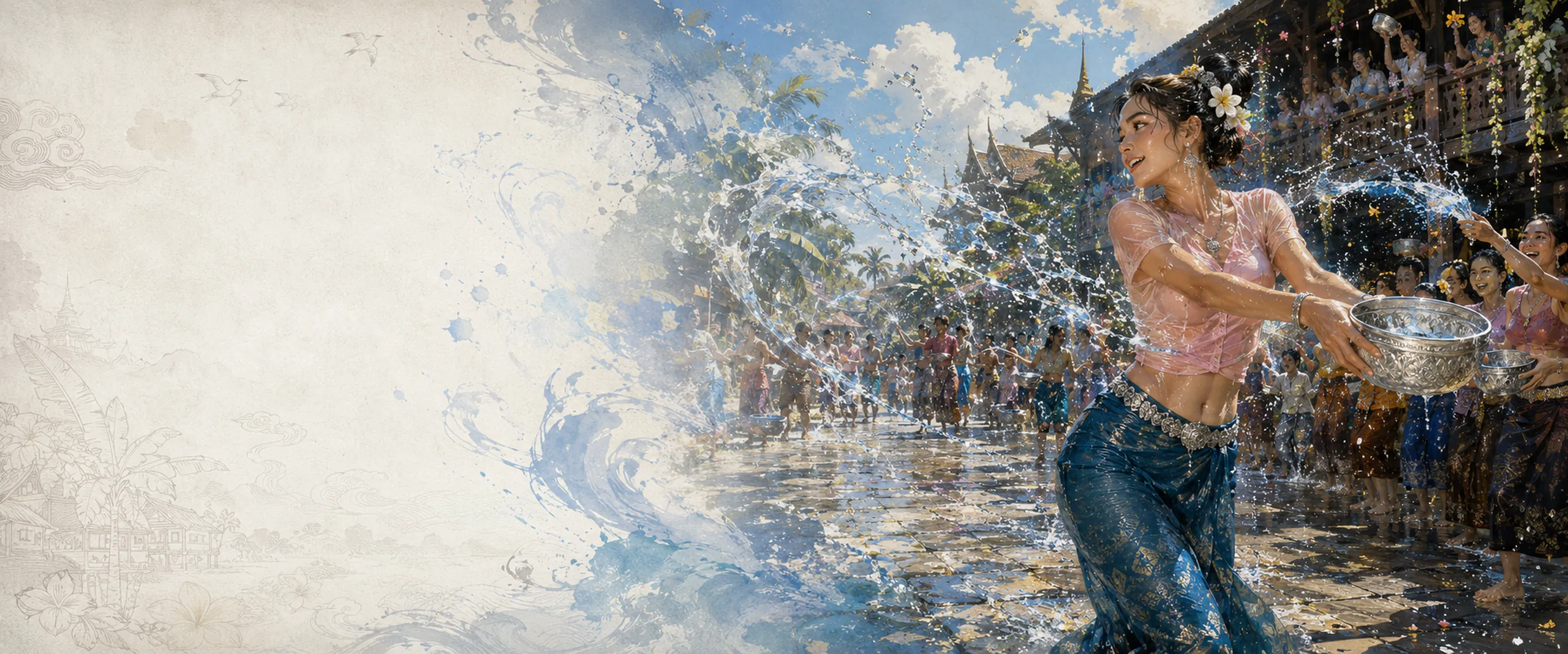

The Water‑Splashing Festival is held in mid‑April (the first month of the Dai calendar) each year and is the grandest traditional festival of the Dai ethnic group. During the festival, people splash pure water on one another, symbolising the washing away of misfortune and ill fate from the past year, and welcoming good fortune and happiness. The festival originated from the ancient ritual of bathing the Buddha — people used clean water to bathe Buddha statues, praying for peace and a bountiful harvest. The festival features a rich variety of activities: people dress in their finest clothes, beat mang‑gongs and elephant‑foot drums, and perform the graceful peacock dance; at night, they release Kongming lanterns and water lanterns, sending blessings up to the sky and drifting far away on the water. “十里狂街音烈烈,万民泼水笑嘻嘻” (*For ten li, the streets resound with wild cheers; thousands of people splash water with laughter and smiles.*) The Water‑Splashing Festival is both a nationwide carnival and a spiritual cleansing. In 2006, the Dai Water‑Splashing Festival was inscribed on China’s first list of National Intangible Cultural Heritage.
Festival Journey
Origins & Legends
History · Evolution · Legend
Tracing the Source · Historical Development
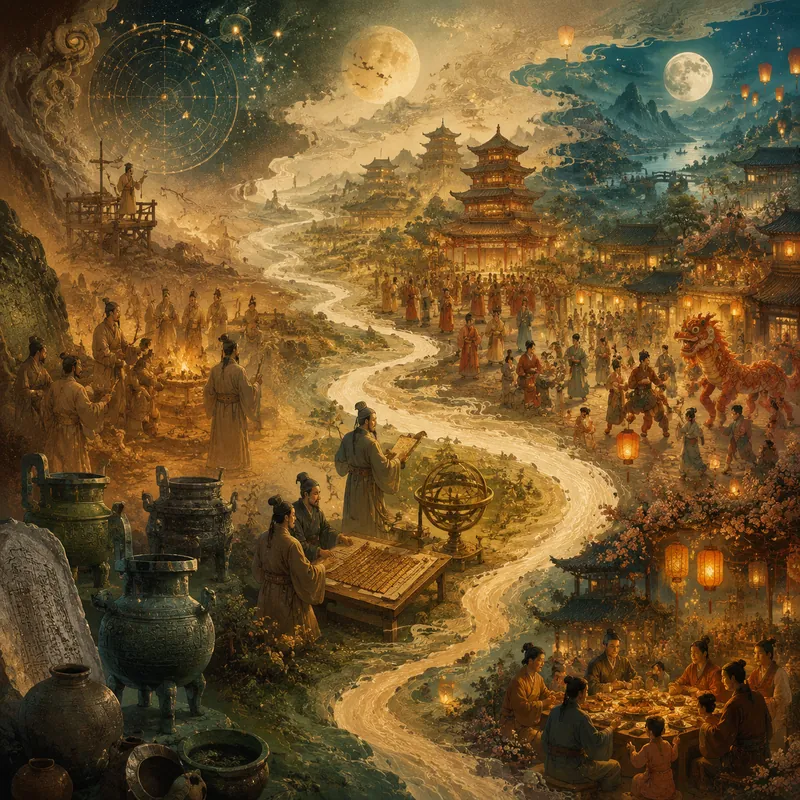
- Northern and Southern Dynasties Period Some Chinese historical interpretations trace the most distant precursor of later water-splashing customs to Pohan Huxi, which is associated with western or Central Asian cultures and is sometimes linked with ancient Persia.
- Tang Dynasty By the Tang dynasty, Pohan Huxi was known in China.
- Song and Yuan Periods The form of the Water-Splashing Festival most directly connected with modern Dai practice developed in association with the spread of Theravada Buddhism into the Dai regions of Yunnan.
- Ming and Qing Dynasties During the Ming and Qing periods, the Water-Splashing Festival became increasingly embedded in local Dai society.
- Modern Era: After 1949 A particularly famous episode in the modern history of the festival occurred in April 1961, when Chinese Premier Zhou Enlai visited Xishuangbanna.
- Contemporary Era: Intangible Cultural Heritage Protection On 20 May 2006, the Dai Water-Splashing Festival submitted by Xishuangbanna Dai Autonomous Prefecture, Yunnan, was included in the first national list of intangible cultural heritage of China.
Festival Customs
Customs · Local Traditions · Everyday Life
Festival Foods
Food Traditions · Local Flavors · Taste
Seasonal Flavours · Seasonal Menu
Folk Arts
Song & Dance · Living Tradition · Heritage
Living Folk Arts · Of Song and Dance
Through Song and Dance · A Living Tradition
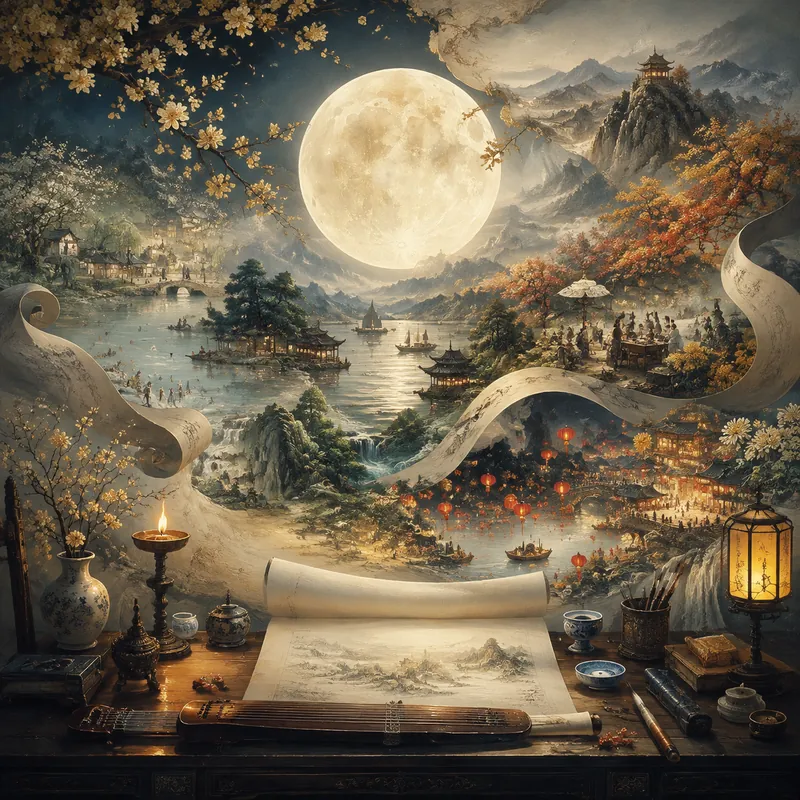
Opening Verse: 欢快时节圣水扬,污秽随清泼洒净。 Introduction: Water-Splashing Festival poetry centers on blessings conveyed through splashing water and the excitement of dragon-boat racing. “欢快时节圣水扬” evokes the cleansing of dust and the offering of blessings through water; “龙舟竞渡,人山人海,万面鼓声喧” captures the fervor of dragon-boat competition; and “清水瓢瓢泼喜悦,深情洒向心中逑” presents water-splashing as an expression of affection. Poetry associated with the Water-Splashing Festival often takes the cleansing of dust with water and the welcoming of the new year as its central themes. One poem reads: “欢快时节圣水扬,污秽随清泼洒净,祈福永续万年长”, bringing together the ideas of purification through water, the removal of impurity, and the wish that blessings endure for generations. Another lyric describes the festive spectacle of the Water-Splashing Festival: “彩色长裙短雪衫……龙舟竞渡,人山人海,万面鼓声喧。无忧花放浴新欢。相泼水,笑连天”, vividly recording Dai people dressed in festive finery, racing dragon boats, and joyfully splashing water upon one another. Another poem writes, “清水瓢瓢泼喜悦,深情洒向心中逑”, elevating the act of splashing water into an expression of emotion. In Water-Splashing Festival poetry, water becomes the medium through which blessings, joy, and deep affection are conveyed.
Global Features
Overseas · Chinese Communities · Celebrations
Overseas Celebrations · Lights of Chinese Communities
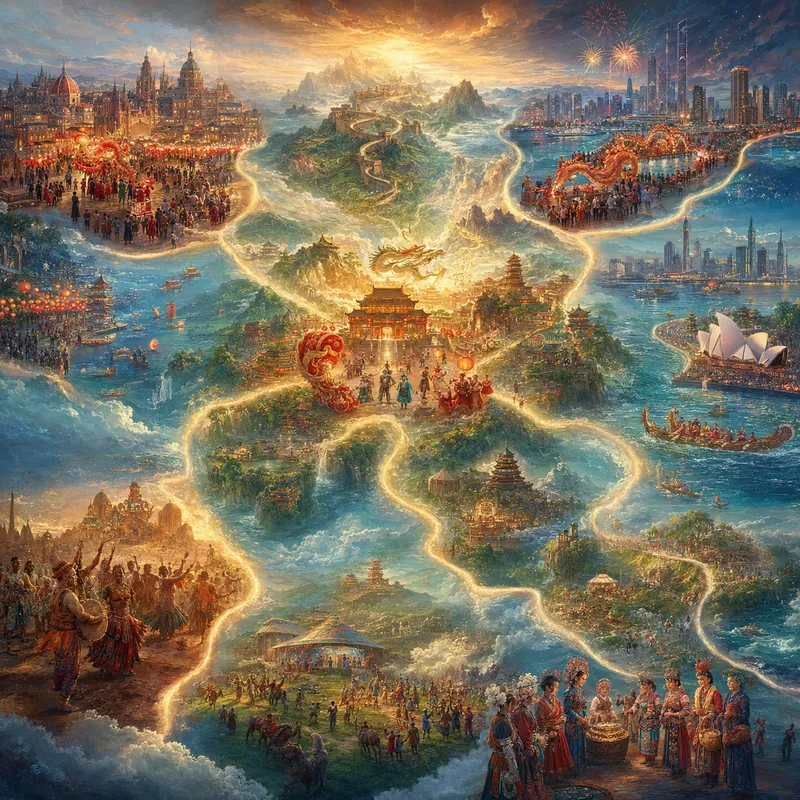
The United States is one of the countries with the largest Thai and Southeast Asian immigrant populations in the world. Although the Water-Splashing Festival is not a federal public holiday, in Thai-populated areas such as New York, Minnesota, Chicago, Massachusetts, and Los Angeles, Songkran has become one of the most important annual cultural events. New York State: an official resolution formally recognizes Songkran. On April 7, 2025, the New York State Legislature passed a resolution formally recognizing Songkran—the traditional Thai New Year, observed from April 13 to 15—as an important cultural celebration for New York State’s Asian American communities. On April 9, the New York State Legislature held a Songkran celebration at the Legislative Office Building in Albany, attended by Thai Consul General in New York Somjai Taphaopong. Activities included the traditional Thai water-pouring rite, classical Thai dance, and musical performances. The resolution emphasized that Songkran is “an enduring cultural heritage celebrated by Thai communities in New York and across the United States—a festival that preserves and transmits the essence of Thai identity while proudly reflecting the contribution of the Thai diaspora to the rich cultural diversity of American society.” Minnesota: Songkran in front of the State Capitol. On May 10–11, 2025, Minnesota Songkran was held at the Minnesota State Capitol in Saint Paul. Thai Ambassador to the United States Dr. Suriya Chindawongse and Thai Consul General in Chicago Katanawadee Kalayanamit attended the opening ceremony. Minnesota Commissioner of Public Safety Bob Jacobson attended on behalf of the governor and formally presented a proclamation to the Thai Cultural Council recognizing Minnesota Songkran 2025. The event officially opened with a ribbon-cutting and water-pouring ceremony. Chicago: Songkran at Wat Dhammaram. On April 12, 2025, the Thai Consul General in Chicago attended a Songkran celebration held at Wat Dhammaram. The event was jointly organized by the Sunday Buddhist School, Thai Music Academy, Thai Classical Dance School, and other groups. Massachusetts: a multiethnic Songkran celebration. On April 26–27, 2025, Wat Nawamintararachutis held Songkran celebrations, with the Thai Consul General in New York attending the opening ceremony. The event embodied a spirit of cultural exchange, with communities from Thailand, Laos, Cambodia, and Vietnam jointly participating in traditional performances. Activities included Buddhist merit-making rites, almsgiving, bathing the Buddha, pouring water over elders’ hands to offer blessings, a food market, a Miss Songkran beauty pageant, and cultural performances by students from the Sunday Buddhist School. Los Angeles: the 16th annual Thai New Year Songkran Festival. East Hollywood in Los Angeles hosts a Thai New Year Songkran Festival every year, reaching its 16th edition in 2025. Activities included live music, Muay Thai demonstrations, religious ceremonies, Thai cuisine, and the Miss Songkran USA pageant. Following a vehicle attack in Vancouver, Los Angeles police increased patrols around the event. Collective participation by Thai diplomatic missions in the United States. During Songkran 2025, officials and staff from the Royal Thai Embassy in Washington, the Thai Consulate General in Chicago, and “Team Thailand Chicago” collectively took part in preserving and celebrating Water-Splashing Festival traditions. This official participation by diplomatic institutions has given Songkran a form of recognition in the United States that extends beyond ethnic communities.
Canada also has large Southeast Asian communities. Water-Splashing Festival celebrations are centered on Vancouver and extend to major cities such as Toronto and Montreal. Unlike the United States, where Thai communities play the dominant role, in Canada the festival is more often presented through the framework of a “Chinese Traditional Culture Festival,” jointly promoted by Chinese and Southeast Asian immigrants. Vancouver: Chinese Traditional Culture Festival and Water-Splashing Festival. On July 27, 2025, the Chinese Canadian Federation hosted the 2025 Chinese Traditional Culture Festival and 17th Vancouver Water-Splashing Festival at Swangard Stadium in Burnaby. Chinese Consul General in Vancouver Yang Shu, British Columbia legislators Zhou Jionghua and Chen Hansheng, Burnaby Mayor Hou Maihao, and others attended, together with more than a thousand members of the public. Consul General Yang Shu stated that the Chinese Traditional Culture Festival “provides a platform for cultural exchange and mutual learning, allowing overseas Chinese to revisit the feelings of their homeland and enabling local communities to experience the charm of traditional Chinese culture.” The event featured six themed zones: traditional intangible cultural heritage, stage performances, interactive water splashing, a food market, charity booths, and cultural workshops. More than 60 community groups took part in the opening ceremony. Most performers were ordinary community residents, retired seniors, current students, and everyday immigrants. In 2025, the event achieved a historic breakthrough: for the first time, it moved beyond Vancouver, arriving in Toronto on August 3 and Montreal on August 10. From the West Coast to the East Coast, the “splash” of the Water-Splashing Festival is spreading across Canada. Vancouver also connects the Water-Splashing Festival with the official calendar of the Royal Thai Consulate General in Vancouver, which lists Songkran as an important annual diplomatic and cultural event.
The United Kingdom is one of the European countries where Water-Splashing Festival culture is most actively promoted. In April 2025, London hosted “the UK’s largest Thai Water Festival.” The event took place at a Buddhist center affiliated with the Royal Thai Embassy and included a series of Thai cultural activities. In Thai, Songkran means “movement” or “change,” marking the beginning of the Thai New Year. Swindon also held its first “Authentic Street Food Festival” on April 20, 2025, featuring authentic Thai cuisine, traditional dance, Thai bands, and kathoey performances. British blogger Lee also traveled specially to Xishuangbanna in Yunnan, China, to experience the Water-Splashing Festival and used video to show British audiences the festival’s “proper way to experience it.”
On the European continent, Wat Thai Dhammaram in Brussels, Belgium, held Songkran celebrations in April 2025. Activities included traditional Songkran rites—pouring water over Buddha images, monks, and elders—along with sales of Thai food and products, Thai cultural performances, and chanting ceremonies to pray for the deceased. As Belgium is home to the headquarters of the European Union, its Songkran celebrations attracted participants and spectators from countries across Europe.
Visitor Guide
Preparation · Etiquette · Take Part with Confidence
Readers’ Comments
Calendar and traditional culture enthusiasts from around the world, sharing the same moon.
Sign in or register to join the conversation. Your comment account is created automatically the first time you use a connected account.
No comments yet
Share your thoughts with readers around the world.