Creation Epic and Oral Tradition
Epic 景颇族《目瑙斋瓦》
《目瑙斋瓦》 is a long creation epic that brings together myth, legend, and poetry. It is a living oral history of the Jingpo people, passed from mouth to mouth through generation after generation and inherited to the present day, making it a precious spiritual legacy. The entire epic is marked by regular rhythm and meter, beautiful language, and a magnificent sweep. Beginning with the creation of heaven and earth, it unfolds through a wealth of moving mythological stories, vividly presenting the development and transformation of a people from remote antiquity to modern times.
The epic can broadly be divided into seven parts: the formation of heaven and earth; the conquest of heaven and earth; the birth of humanity and all living things; Ningguanwa’s leveling of heaven and earth; the age of the great flood; Ningguanwa’s marriage to the Dragon Maiden; and the opening and cultivation of the land. These sections advance one after another, recreating a historical current of immense force and grandeur. During recitation, specific forms of music, dance, painting, and other arts are integrated into the performance. Ningguanwa, the central heroic figure of the epic, is strong and courageous, filial toward his parents, and capable of accepting others. The character traits he embodies accord with the traditional moral values of the Chinese nation and have a positive role in fostering and developing the moral outlook of later generations.
Origin Legends
Among the Jingpo people, several closely connected legends are told about the origins of Munao Zongge.
Legend One: The Invitation of the Sun King and the Mission of the Birds
In ancient Jingpo legend, Munao was brought into the human world by birds from the Sun King. It is said that in remote antiquity, only the children of the Sun in the Palace of the Sun knew how to dance Munao Zongge. One day, the Sun God invited all beings of heaven and earth to attend a grand Munao Zongge gathering, and the creatures of the earth sent all the birds to take part.
The nine Sun brothers, who were supposed to appear one at a time, suddenly all rushed into the sky together and refused to return at night. All living things on earth were scorched so severely that they could no longer survive. Animals and humans therefore met and chose “Kongrang” — the hornbill — and “Wudong” — the peacock — as envoys to plead with the Sun King. When they arrived at the Palace of the Sun, the Sun King happened to be holding a “Zhan Munao” and invited them to participate. Their spirited bearing and melodious voices won the Sun King’s favor. In return, he agreed to send the deity “Mudai” down to the human world to withdraw eight of the suns and to divide time into day and night and into four seasonal conditions of coolness and warmth.
Legend Two: The Birds Transmit the Dance and Humanity Learns Munao
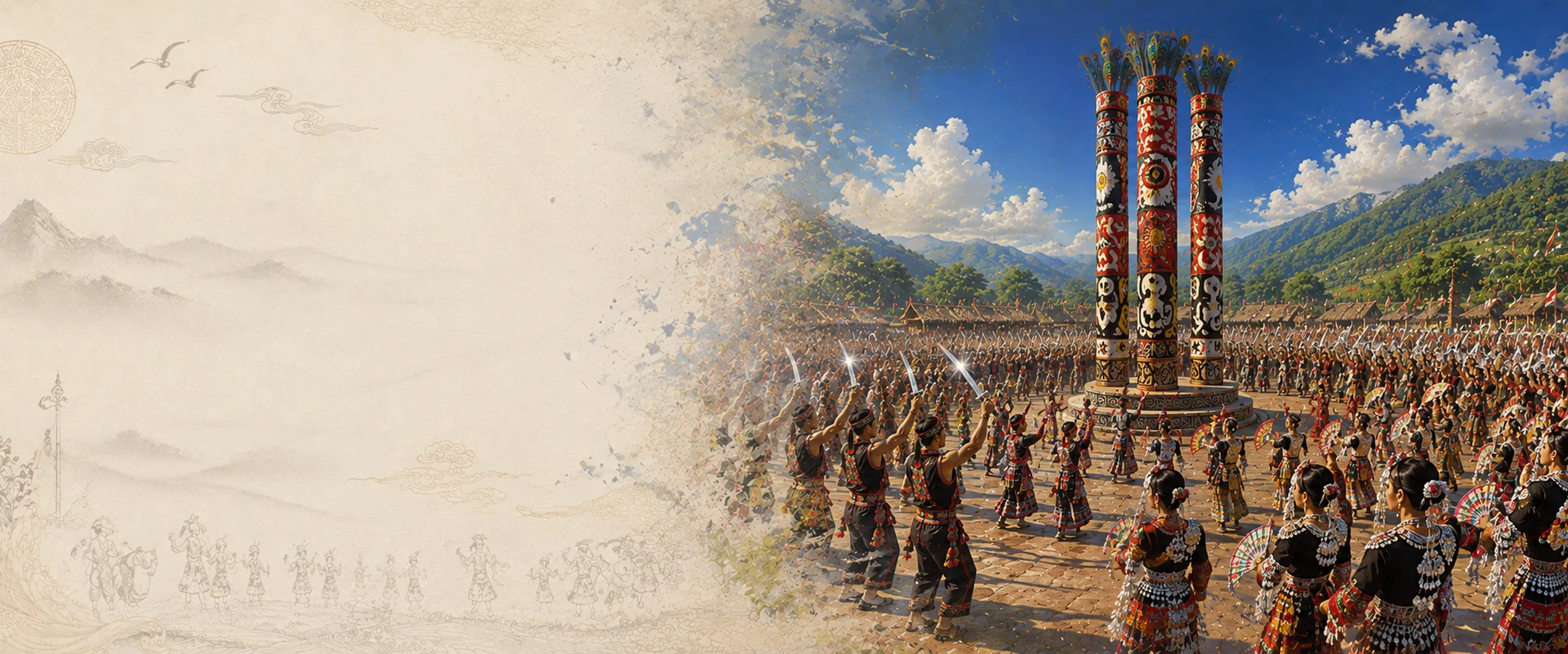
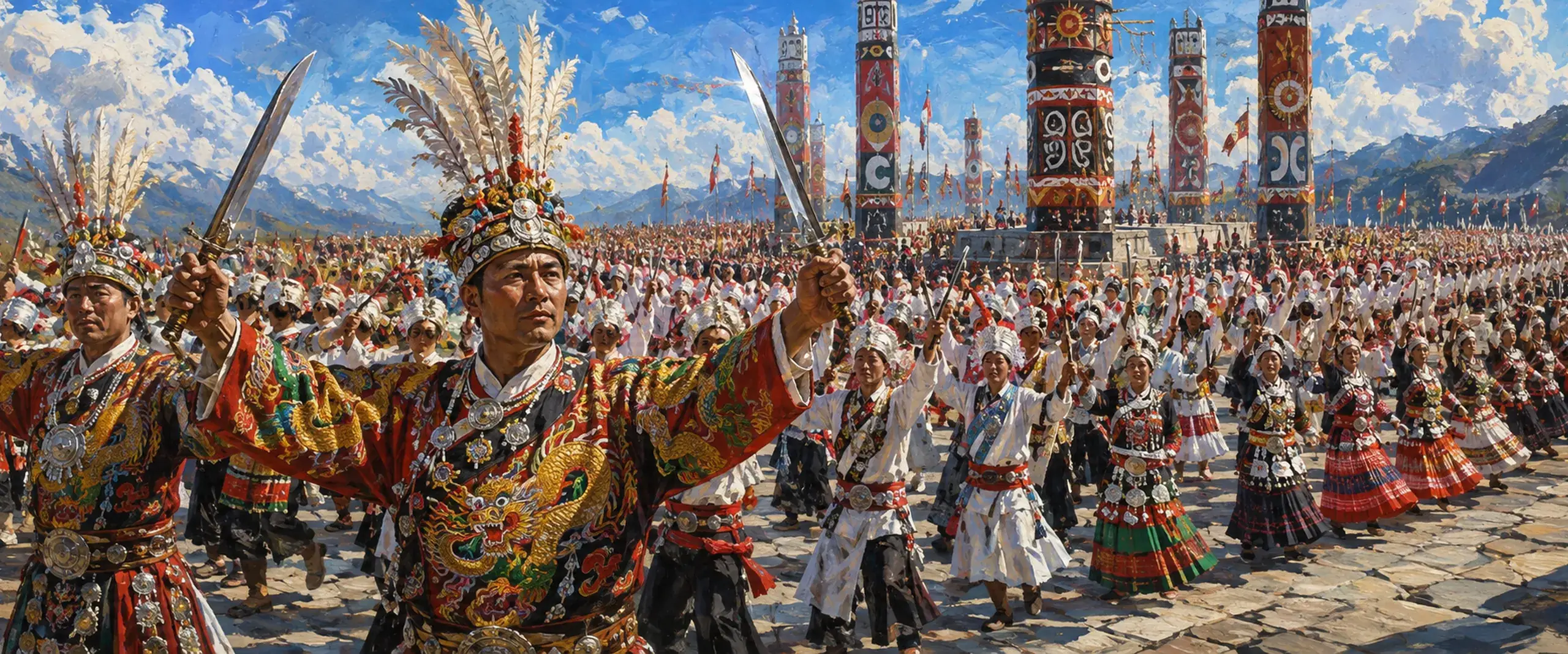
The birds learned Munao in the Palace of the Sun and came down to earth to dance it. After Jingpo ancestors saw the birds performing Munao, the Jingpo forebears also learned the dance. The birds’ Munao was thus discovered by the Jingpo ancestors and transformed into a human Munao. It developed during the southward migration of the Jingpo people and has been transmitted from generation to generation down to the present day. For this reason, when Munao Zongge is performed today, the “Naoshuang” — the lead dancers — wear headdresses made with peacock feathers and hornbill skulls as an act of remembrance.
Legend Three: The Hero Leipan and the Battle Against the Demon
Another heroic legend also circulates among the Jingpo people. In ancient times, there appeared a demon king who survived by eating children. He could summon wind and rain and flooded fields and farmland. The hero Leipan led the villagers southward, where they rebuilt their homes, but the demon king pursued them and devoured Leipan’s son. Leipan resolved to fight the demon king to the death. Deeply moved, the Sun God forged a treasured sword for him. At last the demon king was slain, and the people sang and danced with abandon to celebrate their victory. Later, in memory of their ancestors’ glorious achievement in defeating the demon, the Jingpo people began holding the great song-and-dance celebration of Munao Zongge whenever an important joyous occasion arose.
System of Types
Traditional Munao Zongge is not a single fixed form but a complete ritual system containing twelve different types, covering all the major moments of Jingpo society—from war to peace, from production to daily life, and from individual affairs to collective events:
Sumunao — attracting wealth and celebrating a good harvest
Badang Munao — celebrating victory
Dingshuan Munao — celebrating the completion of a new home
Deru Munao — taking an oath before setting out for war
Tingretu Munao — selecting a site and laying foundations
Naosai Munao — recreational activities
Kenran Munao — weddings and marriage
Tingran Munao — sworn friendship and social bonding
Kelong Munao — welcoming guests
Gongran Munao — separation and parting
Zhu Munao — funeral and sacrificial dance
These twelve forms of Munao Zongge record not only Jingpo history relating to warfare, production, everyday life, and migration, but also the content and procedures of religious worship. Over the course of history, Munao Zongge evolved from the coexistence of many different types toward a system in which one principal form predominated.
Readers’ Comments
Calendar and traditional culture enthusiasts from around the world, sharing the same moon.
Sign in or register to join the conversation. Your comment account is created automatically the first time you use a connected account.
No comments yet
Share your thoughts with readers around the world.