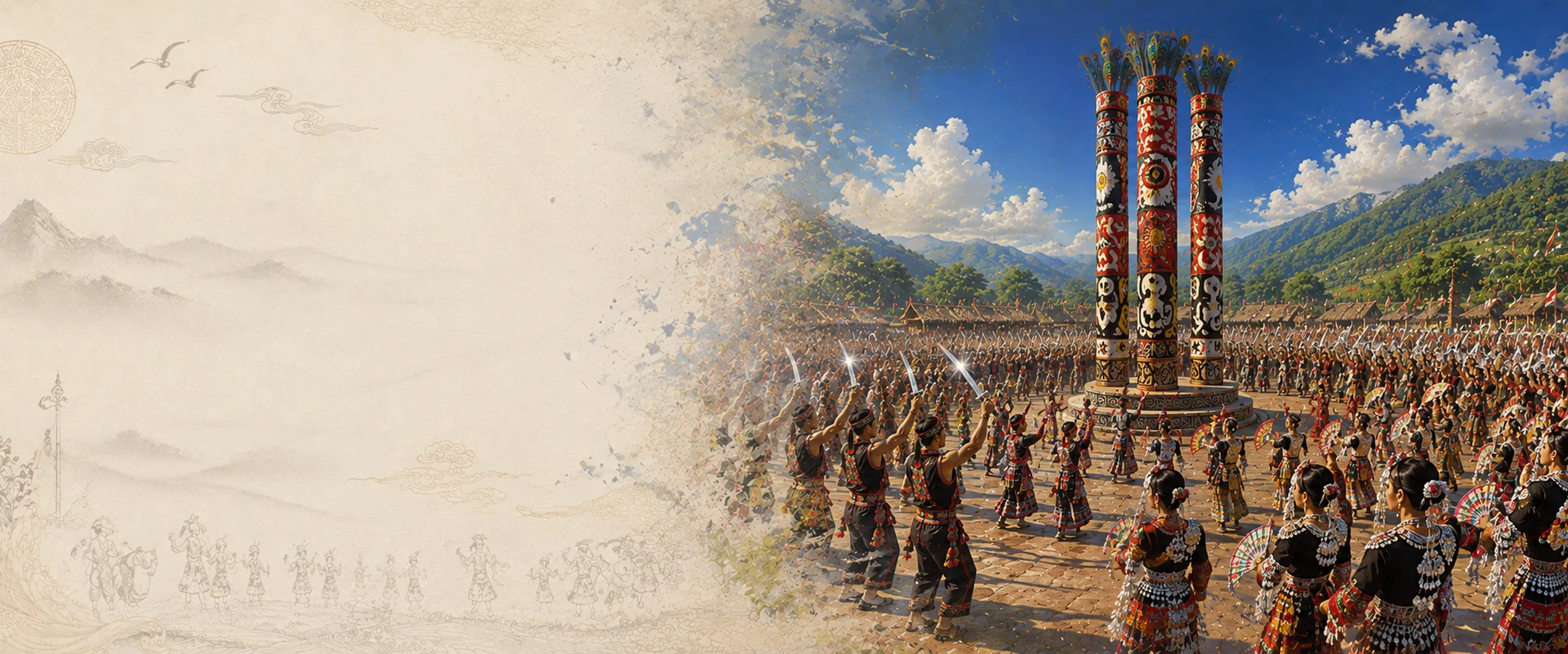
The Munao Zongge Festival is the grandest and most solemn traditional ethnic festival of the Jingpo people — a cross-border ethnic group known as the Kachin in Myanmar. It is celebrated as the “Dance of Heaven” and the “Dance of Ten Thousand Revelers.”
In 2006, Munao Zongge was included in the first batch of China’s National Intangible Cultural Heritage List.
As Jingpo culture has reached wider audiences through international exchange and social media, Munao Zongge has become an important symbol of global cultural interaction — from grand traditional celebrations in Kachin State, Myanmar, to flash-mob cultural showcases in Jakarta’s Old Town; from its striking appearance at the Colchester Carnival in the United Kingdom to cross-cultural dancing at the Edinburgh Festival Carnival.
Its infectious rhythms and the spectacular sight of thousands dancing together have spread rapidly around the world. In 2026, topics and derivative creations based on the adapted version of Munao Zongge surpassed a combined 3.7 billion views across online platforms.
Event Schedule and Venues
### Core Dates of the Munao Zongge Festival
Traditionally, the Munao Zongge Festival is held around the fifteenth day of the first lunar month each year.
Specific dates vary slightly among towns and villages, with celebrations unfolding in stages from mid-February through late March. Across Dehong Prefecture, the festival takes on the character of “celebrations blossoming in many places, one after another.”
The core schedule is as follows:
| Venue | Date | Location | Core Activities |
|---|---|---|---|
| Mangshi — New Spring Munao Zongge | February 20, fourth day of the first lunar month | Mangshi Square | New Spring Munao Zongge |
| Mangshi — Lantern Festival Munao Zongge Festival | March 2–4, fourteenth to sixteenth days of the first lunar month | Mangshi Square; China Dehong Jingpo International Munao Zongge Cultural Park | Welcome gala, opening ceremony, mass communal dancing, bonfire evening, music carnival |
| Mengdian Village, Mengxiu Township, Ruili | March 2–3 | Mengdian Munao Zongge Ground | Opening ceremony, Munao Zongge celebration, bonfire evening |
| Longchuan County — Pengsheng Tongken Munao Zongge Festival | March 3–4 | Pengsheng Square, Jinghan Town | Traditional Munao Zongge Festival and heritage base |
| Yingjiang County | March 13–15 | Jingpo Cultural Park | Grand Munao Zongge gathering |
| Kunming — Yunnan Ethnic Village | March 28 | Jingpo Village, Yunnan Ethnic Village | Munao Zongge Festival |
| Ruili City | May 2–3 | Pase Munao Zongge Ground | Munao Zongge Festival |
### Traditional Customs and Cultural Background
The origins of Munao Zongge can be traced back to early communal society.
According to legend, in ancient times Munao Zongge was a dance performed in the palace of the Sun. Jingpo ancestors brought the dance to the human world by learning the steps of the sacred peacock, and it gradually evolved into a communal celebration.
Its main customs include:
| Custom | Description |
|---|---|
| Munao Shidong | Totem poles more than ten meters high stand in the center of the dance ground, painted with the sun, moon, spiral dance patterns, and ancestral migration routes. They are regarded as a “living history book” of the Jingpo people |
| Naushawng and Nauba | Munao Zongge is led by the Naushawng, wearing peacock-feather headdresses, and the Nauba, dressed in dragon robes. The Naushawng follows prescribed ceremonial dance steps, while the Nauba leads others through freer and more energetic movement |
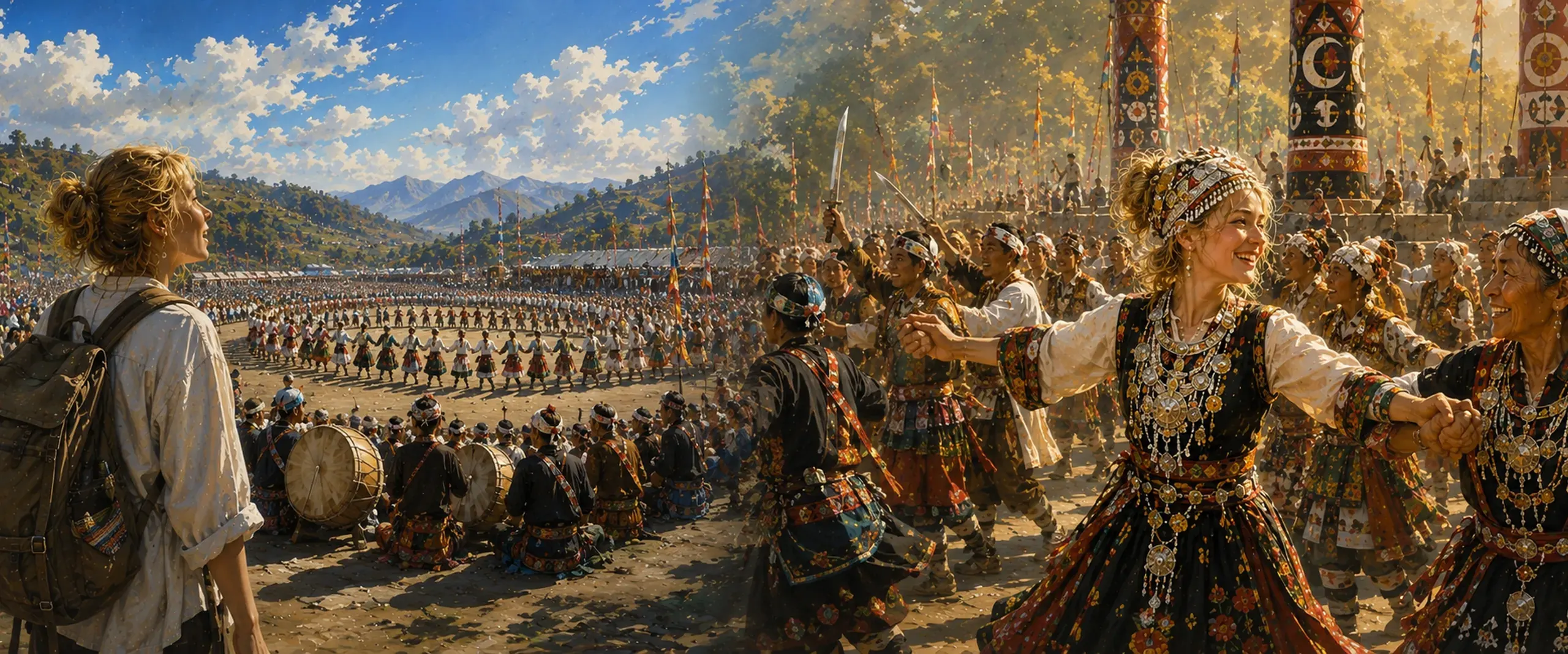
| Mass Communal Dancing | Tens of thousands follow the leaders’ steps and drumbeats. The dance is characterized by grounded steps and shoulder movements. Men carry long swords, while women hold colorful fans or handkerchiefs |
| Ritual Prayer and Blessing | Munao Zongge originated in ritual practices of early society and later developed into ceremonies seeking favorable weather, protection from disaster, and good fortune |
### Major Recommended Activities
Mangshi — Lantern Festival Munao Zongge Festival, March 2–4:
Mangshi is one of the main centers of the Munao Zongge Festival.
Activities include:
* Welcome gala, serving as the prelude to the opening ceremony and including the release of the festival theme song
* Formal opening ceremony
* Mass communal dancing, following the steps of the Naushawng and Nauba
* Bonfire evening
* Music carnival
* Cultural and artistic performances
Locations: Mangshi Square and the China Dehong Jingpo International Munao Zongge Cultural Park.
Mengdian Village, Mengxiu Township, Ruili — March 2–3:
Mengdian Village in Mengxiu Township, Ruili, hosts a two-day Munao Zongge Festival including an opening ceremony, communal dancing celebration, bonfire evening, and other activities.
Longchuan County — 42nd Pengsheng Tongken Munao Zongge Festival, March 3–4:
Pengsheng in Jinghan Town, Longchuan County, is a major heritage base for the Munao Zongge Festival. One of the most traditional celebrations is held there each year.
Thousands of Jingpo people in festive attire gather with visitors from different regions at the Munao Zongge grounds, forming long, flowing lines of dancers.
Yingjiang County — Munao Zongge Festival, March 13–15:
The nationally recognized Jingpo Munao Zongge gathering is held at the Jingpo Cultural Park in Yingjiang County.
Tens of thousands of people from different ethnic communities, together with visitors from many regions, gather to dance this thousand-year-old traditional song and dance.
Kunming — Yunnan Ethnic Village, March 28:
A Munao Zongge Festival themed “Carry Forward Munao Zongge · Strengthen a Shared Chinese Community” opens in the Jingpo Village at Yunnan Ethnic Village.
Jingpo participants and people from different ethnic groups gather together, dancing joyfully around the Munao Shidong to powerful drumbeats.
Pre-Trip Preparation
### Visas and Entry
Dehong Prefecture in Yunnan, where the Munao Zongge Festival is held, follows China’s unified visa policies:
* 240-Hour Visa-Free Transit for Citizens of 54 Countries: Travelers may enjoy up to 240 hours of visa-free transit, with the permitted stay area covering Yunnan Province.
* Tour Groups from ASEAN Countries: Groups organized through travel agencies may enter visa-free through designated ports.
* Other Nationalities: Apply in advance for a tourist visa, or L visa, through the relevant Chinese embassy or consulate and ensure that your passport remains valid for more than six months.
* Latest Policies: Before departure, consult the official website of China’s National Immigration Administration or the relevant embassy or consulate.
### Adapting to the Climate
The Munao Zongge Festival is held around the fifteenth day of the first lunar month, corresponding approximately to mid-February through late March.
At this time, Dehong has the following climatic characteristics:
* Temperature: Average daily temperatures of around 12°C–24°C. Days are warm and comfortable, while mornings and evenings are cooler.
* Sunlight: Ultraviolet exposure is relatively strong, so sun protection is important on clear days.
* Rainfall: March has relatively little rain and is predominantly sunny, making it suitable for outdoor activities.
* Clothing: Use a layered system — long-sleeved T-shirts or thin shirts during the day, with a light jacket or sun-protective outer layer for mornings and evenings.
Shoes should be comfortable athletic shoes or flat shoes, as Munao Zongge involves long periods of standing and dancing.
### Travel Insurance
It is strongly recommended to purchase travel insurance covering:
* Accidental injury and acute illness treatment, including outpatient care
* Loss of or damage to personal belongings
* Travel delays or cancellations
### Currency and Payment
* Currency: Renminbi (CNY).
* Cash: Carry a reasonable amount of cash. Network signals in towns and villages may be unstable, making cash payments more reliable.
* Cards: Visa and MasterCard may be used in larger hotels and supermarkets in urban areas such as Mangshi and Ruili; they are generally not accepted in smaller towns.
* Mobile Payment: Alipay and WeChat Pay are widely used in urban areas across Dehong Prefecture.
### Communications and Internet
* Important: The Munao Zongge Festival attracts very large crowds, and 4G/5G networks may become congested.
* It is strongly recommended to download offline maps in advance. Use Baidu Maps or AutoNavi and download the Dehong Prefecture map to your phone while connected to Wi-Fi.
How to Get There
### Core Venue: Dehong Dai and Jingpo Autonomous Prefecture
| Transportation | Details |
|---|---|
| Air | Dehong Mangshi International Airport serves Kunming, Chengdu, Chongqing, Guangzhou, and other major domestic cities. Booking flights one month in advance is recommended |
| High-Speed Rail / Train | High-speed rail between Kunming and Baoshan is in operation. From Baoshan Station, continue by road to cities and counties across Dehong; alternatively, take a train to Dali and transfer by road |
| Long-Distance Bus | Kunming West Bus Station operates direct services to Mangshi, with a journey of approximately 8–9 hours |
| Driving | Hangzhou–Ruili Expressway, G56, reaches Mangshi directly. Traffic restrictions apply around festival venues, so use designated parking areas |
### Transportation Tips During the Festival
* Longchuan County: During the festival, dedicated Bus Routes 9 and 10 operate as shuttle services from 7:20 to 21:30, at intervals of approximately 20 minutes.
* Mangshi: Traffic is heavy around Mangshi Square and surrounding roads. Prioritize walking or public transportation.
* Travel Recommendation: The essence of Munao Zongge is joining the dancing procession. Park vehicles in designated areas and participate mainly on foot.
Accommodation Reservations
| Key Point | Recommendation |
|---|---|
| When to Book | Early March is a busy tourism period in Dehong. Book more than one month in advance |
| Mangshi | Mangshi urban area — convenient transportation and many hotel options; areas near the Munao Zongge Cultural Park |
| Longchuan | Zhangfeng Town — county center; Jinghan Town — close to the Pengsheng venue |
| Yingjiang | Yingjiang County town and areas near the Jingpo Cultural Park |
| Ruili | Ruili urban area, with its China–Myanmar border atmosphere |
| Price Reference | Budget around RMB 150–300 per night, mid-range RMB 300–600, high-end accommodation above RMB 600 |
| Booking Platforms | Major platforms such as Ctrip, Qunar, and Meituan; rooms with free cancellation are preferable |
| Guesthouse Experience | Staying in a Jingpo-style guesthouse offers an opportunity to experience Jingpo food culture and hospitality |
Pre-Trip Packing Checklist
| Category | Essential Items | Special Notes |
|---|---|---|
| Clothing | Long-sleeved T-shirts, light jacket / sun-protective outer layer, long trousers | Dehong is cool in mornings and evenings but warm during the day in March. Dress in layers. Comfortable old clothing is recommended for extended dancing |
| Shoes | Comfortable non-slip athletic shoes / flat shoes | Essential — Munao Zongge involves long periods of standing and dancing |
| Sun Protection | SPF30+ sunscreen, sun hat, sunglasses | Highland UV exposure should not be overlooked |
| Rain Gear | Folding umbrella or lightweight raincoat as backup | March is relatively dry, but carrying rain protection is recommended |
| Medicine | Cold medicine, gastrointestinal medicine, adhesive bandages | Useful for climate changes and dietary differences |
| Electronics | Power bank, phone, camera | Charging facilities at activity venues may be limited |
| Storage | Small bag / waist pouch for documents and cash | Protect belongings in crowded areas |
| Other | Tissues / wet wipes, insulated bottle | Facilities may be limited in smaller towns |
Cultural Respect
### Respect for Religious Belief and Ritual Etiquette
Munao Zongge originated in ritual practices of early society and was initially associated with warfare, harvest celebrations, and ceremonial worship.
* Remain Solemn During Rituals: Stay quiet and respectful during opening ceremonies and ritual segments. Do not shout, laugh loudly, or play around.
* Do Not Interfere: Do not obstruct or disturb the normal conduct of ritual ceremonies.
* Viewing Etiquette: If permitted to observe a ritual, remain in designated areas, do not move around freely, and do not touch offerings or ritual objects.
* Photography Restrictions: Some stages of the ceremony may prohibit photography. Confirm with on-site staff in advance.
### Etiquette When Joining the Dance
* Follow the Lead Dancers: Munao Zongge is led by the Naushawng and Nauba. Follow their steps and the drum rhythm; do not cut into the procession or disrupt the formation.
* Order of Entry: Once the ritual opening dance begins, the Naushawng leads the procession into the dance ground, followed by others carrying long swords, fans, and other objects. Visitors should join from the rear or within designated areas.
* Using Props: Jingpo men dance with long swords, while women carry colorful fans or handkerchiefs. Visitors without props can simply follow the dance empty-handed.
* Respect the Leaders: The Naushawng and Nauba serve as the “spiritual leaders” of Munao Zongge. Respect their guidance.
### Photography Etiquette
* Ask Permission: Before photographing Jingpo participants in festive attire, elderly people, or children, smile and ask first.
* Respect Portrait Rights: Do not use photographs of others commercially without consent.
* Drone Regulations: Drone flights over festival venues require advance registration with local public-security authorities.
### Safety Guidelines
* Crowd Safety: Tens of thousands may dance together, creating very dense crowds. Stay alert and supervise elderly family members and children.
* Property Safety: Store valuables in the hotel safe and carry only essentials at the event.
* Traffic Safety: Traffic controls are imposed around festival venues. Follow instructions from traffic police.
* Sun Protection and Hydration: March sunlight can be strong. Use sun protection and drink enough water.
* Food Hygiene: Markets in towns and villages focus on local specialties. Choose food that has been thoroughly cooked and heated.
Practical Emergency Information
| Item | Contact / Description |
|---|---|
| Emergency Numbers | Police 110, Fire 119, Ambulance 120, Government Service Hotline 0692-12345 |
| Major Hospitals | Dehong Prefecture People’s Hospital in Mangshi; People’s Hospitals in each county and city |
| Tourist Police / Lost Property | Permanent police posts are located at all major venues. Report lost valuables immediately to the nearest police office |
| Tourist Information | Dehong Prefecture Culture and Tourism Bureau and official cultural-tourism platforms of each county and city |
| Time Zone | UTC+8, China Standard Time |
| Voltage / Plugs | 220V; plug types A / C / I |
Special Reminders:
* Multiple Main Venues: The Munao Zongge Festival is held successively in multiple locations across Dehong — Mangshi on February 20 and March 2–4, Ruili on March 2–3, Longchuan on March 3–4, Yingjiang on March 13–15, and Kunming on March 28. Confirm the exact date and location of your chosen venue before departure.
* Festival Shuttles: Dedicated shuttle buses operate for the Pengsheng venue in Longchuan County. Prioritize public transportation.
* Respect Belief: Munao Zongge originated in early ritual practices. Remain solemn during opening ceremonies and ritual segments.
* Mass Communal Dancing: Munao Zongge is the “Dance of Ten Thousand.” Crowds are extremely large, so take care of personal belongings and watch elderly family members and children.
* Weather Awareness: March weather in Dehong is warm and pleasant, but there can be significant temperature differences between morning and evening. Check weather conditions before departure.
* Jingpo Clothing: If possible, traditional Jingpo clothing can be rented or purchased locally for participation in the dance, allowing you to become more immersed in the festival atmosphere.
*May you experience the distinctive charm of a thousand years of Jingpo intangible cultural heritage amid the steps of thousands dancing Munao Zongge together, and receive the beautiful blessing of “favorable weather, good fortune, and lasting well-being” amid the powerful drumbeats and flowing melodies.*
—-
Cultural Background:
The Munao Zongge Festival is the grandest traditional festival of the Jingpo people — a cross-border ethnic group known as the Kachin in Myanmar and as Singpho in India and Nepal.
Munao Zongge means “everyone dancing together.” According to legend, the dance originated when the birds learned to dance from the Sun God. It was later learned and passed down by the Jingpo ancestor Ningguanwa, eventually developing from an ancestral ritual of worship, blessing, and harvest celebration into the festival known today.
Customs of Munao Zongge include:
* Mass Communal Dancing: Tens of thousands of participants follow the steps of the Naushawng — lead dancers dressed in elaborate ethnic attire and wearing hornbill-feather headdresses — dancing together before the Munao Shidong. It has been described as “the world’s largest collective song-and-dance ritual.”
* Munao Shidong: Wooden totem poles rise at the center of the dance ground, painted with images of the sun, moon, and the migration routes of Jingpo ancestors. They are sacred symbols of the festival.
* Long-Sword Dance and Fan Dance: Men dance holding long swords, while women carry colorful fans or handkerchiefs.
* Origins Rituals: Through festival rites, Kachin communities honor the Sun God and their ancestors, expressing reverence for nature and the divine.
Munao Zongge is a cross-border ethnic festival, practiced in Jingpo and Kachin communities across Dehong in Yunnan, China; Kachin State in Myanmar; and Arunachal Pradesh in India, among other regions.
In both Dehong Prefecture in China and Kachin State in Myanmar, the Munao Zongge Festival is recognized as a statutory holiday.
There are approximately two million Jingpo people worldwide. Beyond China, Jingpo and related Kachin communities are found in Myanmar, Thailand, Malaysia, Singapore, Japan, the United States, and other countries.
Overview of Global Activities:
Overseas transmission of Munao Zongge mainly takes the following forms:
| Type | Country / Region | Activity |
|---|---|---|
| Traditional Cross-Border Festival | Myanmar | Kachin State Manau Festival, held around January 10 and lasting 3–5 days |
| Cultural Exchange Flash Mob | Indonesia | “Friendship Envoys on the Zheng He Route” flash-mob roadshow in Jakarta Old Town |
| International Arts Festival Performance | United Kingdom | Ethnic dance performance of *Munao Zongge* at Colchester Carnival |
| International Arts Festival Performance | United Kingdom | *Munao Zongge* performed by the Chinese parade contingent at Edinburgh Festival Carnival |
| International Cultural Festival | Canada | Jingpo Munao Zongge performance at the Toronto Dragon Festival |
| International Performance Authorization | Nigeria | Huaxing Art Troupe receives authorization to perform Munao Zongge |
| Global Online Imitation Trend | Worldwide | Recreation and imitation trends across Southeast Asia, Europe, the Americas, Oceania, Canada, the United States, Nepal, Kenya, Rwanda, and elsewhere |
Recommended Activities by Region:
### Kachin State, Myanmar
Myanmar is the country where Munao Zongge has the deepest cultural roots outside China. The Jingpo people are known there as the Kachin.
Kachin State Manau Festival:
* Usually held around January 10, Kachin State Day, and lasts for 3–5 days
* The grandest and most solemn traditional festival of the Kachin people, often described as the “Dance of Ten Thousand” or the “Dance of Heaven”
* Core locations: Myitkyina, capital of Kachin State, and Manau grounds in various local communities
2026 Festival Activities:
To celebrate the 78th Kachin State Day on January 10, 2026, the Kachin State Government organized the opening ceremony of the Manaw Festival and pre-Manaw activities on the lawn in front of the state government offices.
Activities included:
* Kachin State Chief Minister U Khet Htein Nan attended the opening ceremony and delivered remarks.
* A Catholic priest offered blessings for the Manaw dance commemorating the 78th Kachin State Day.
* Manaw lead dancers guided the dance, with the Chief Minister and his wife, the Commander of the Northern Command and his wife, the Chief Justice of the State High Court, state ministers and their spouses, and other senior officials in attendance.
* Representatives of six Kachin ethnic groups and five Shan ethnic groups participated, together with representatives of literary and cultural associations of the Bamar, Rakhine, Karen, and Chin peoples.
* Participants danced together at the Manaw grounds according to traditional custom.
How to Participate:
Travelers can visit Myitkyina, the capital of Kachin State, during the festival period to experience the celebration in person. The Manau Ground is the core activity venue.
Travel Note:
A visa is required in advance for travel to Kachin State, Myanmar. Some areas may be subject to travel restrictions, so check the latest travel advice before departure. Due to the domestic situation in Myanmar, the scale of some official large-scale celebrations in parts of Kachin State has been adjusted in certain years.
### Jakarta, Indonesia
From June 28 to 29, 2026, the cultural exchange series “Friendship Envoys on the Zheng He Route” appeared in flash-mob form at Fatahillah Square in Jakarta Old Town.
June 28 Flash Mob:
* Music rose across Fatahillah Square in Jakarta’s Old Town as a flash performance of ethnic song and dance from Yunnan, China, began.
* Teachers and students from Kunming City College, dressed in festive ethnic attire, spun and danced to drums and music.
* The widely popular Munao Zongge melody began to play, and its vigorous dance steps filled the streets of Southeast Asia.
* An Indonesian woman, Komang Ayu, whose Chinese name is Wang Xiaoyun, followed the beat into the group and danced *Munao Zongge* together with teachers and students from Kunming City College.
June 30 Academic Dance Gathering:
* A symposium on the Global Civilization Initiative and the International Communication of Zheng He’s Spirit was held in Jakarta, attended by more than 60 Chinese and Indonesian experts, scholars, teachers, and students.
* After the symposium, experts and scholars from both countries danced the Yunnan dance Munao Zongge together inside the venue, replacing words with movement and conveying friendship through rhythm.
Significance of the Event:
The activities were organized by the Information Office of the People’s Government of Yunnan Province and the Foreign Affairs Office of the People’s Government of Yunnan Province. Following Zheng He’s historic routes of friendship, the ethnic cultures of Yunnan traveled to the archipelagic nation of Indonesia.
Transportation:
Fatahillah Square is located in Jakarta Old Town and can be reached by public transportation or taxi.
### United Kingdom
The United Kingdom is one of the countries where Munao Zongge has appeared most frequently on overseas arts-festival stages.
Colchester Carnival — July 18:
* On July 18, 2026, Colchester Carnival was held on a grand scale, with more than fifty community organizations from across the United Kingdom joining the parade.
* A Chinese delegation jointly organized by the Colchester Chinese Culture Society, UK-China Outdoor Sports Promotion Association, British Health Qigong Federation, London Red Peony Ethnic Arts Troupe, and Cambridge Chinese Community Centre gave performances including the ethnic dance Munao Zongge, Tai Chi Kung Fu Fan, Baduanjin Health Qigong, and traditional Chinese dragon dancing.
* The Chinese parade contingent became one of the most popular groups of the day.
Edinburgh Festival Carnival — August:
* The Edinburgh Festival Carnival parade took place in central Edinburgh, capital of Scotland.
* The Confucius Institute for Scotland’s Business and Communication joined Chinese community organizations, Chinese-language schools, arts groups, and international students from Edinburgh, Glasgow, London, and elsewhere to form a Chinese parade contingent of more than 200 people.
* In the finale, volunteer Chen Huilin took part in a performance of the Jingpo dance *Munao Zongge*. As the energetic rhythm filled the street, audience members from different countries joined the dance, and the shared celebration across languages and national boundaries brought the carnival atmosphere to its climax.
### Canada
The 7th Toronto Dragon Festival 2026 will take place from September 4 to 6, over the Labour Day long weekend, at Nathan Phillips Square in Toronto.
Highlights:
* Two forms of China’s national intangible cultural heritage will be presented: Yingge Dance, the “Chinese warrior dance” originating in the Chaoshan region of Guangdong, and Jingpo Munao Zongge.
* This will be the first appearance of Munao Zongge at the Toronto Dragon Festival.
* The festival will also feature robot performances and exhibitions and sales of various AI-powered products.
Transportation:
Nathan Phillips Square is located in downtown Toronto and can be reached from Queen Station on Line 1 or Osgoode Station on Line 1.
### Africa
Nigeria — Huaxing Art Troupe Receives Performance Authorization:
As of August 2026, the Nigerian Huaxing Art Troupe had received formal authorization to perform Munao Zongge. This marked an important step in the officially authorized presentation of Munao Zongge in Africa.
Chad — Performance by the Confucius Institute at the University of N’Djamena:
* On the morning of June 4, teachers and students from the Confucius Institute at the University of N’Djamena and its Chinese-language teaching site, Jinhǔ Martial Arts School, were invited to attend the completion ceremony of the China–Chad Friendship Park.
* The ceremony opened to the lively and melodious sound of *Munao Zongge*.
* Twelve female students from the Confucius Institute at the University of N’Djamena, dressed in traditional Chadian clothing, performed the Chinese dance *Munao Zongge* with strong ethnic character.
Rwanda — Energetic Online Recreation:
Munao Zongge has also reached Africa. As ancient Jingpo drumbeats from Yunnan echoed through Rwanda, Chinese intangible cultural heritage generated a cultural resonance across mountains and seas with its powerful vitality. Rwandan social-media users enthusiastically recreated the Munao Zongge dance.
### Global Online Transmission
The adapted version of Munao Zongge surpassed a combined 3.7 billion views across online topics and derivative creations, becoming one of the standout cultural phenomena of 2026.
Reach and Viewership:
* In spring 2026, the Jingpo song *Munao Zongge*, originating in Dehong, Yunnan, swept across global social-media platforms with more than 3.7 billion views.
* From mountain villages in Yunnan to the African continent, it inspired widespread dance imitation.
* By August 2026, views under the “Munao Zongge” topic on Douyin had exceeded 7.2 billion.
Global Reach:
* Dance videos sparked waves of imitation and creative adaptation across Southeast Asia, Europe, the Americas, and Oceania.
* People in Canada, the United States, Nepal, Kenya, Rwanda, and other countries began recreating the dance.
* Overseas audiences learned and adapted the dance spontaneously.
* One American internet user commented: “This song is so addictive!”
How to Participate Online:
Each year during the Munao Zongge Festival, around the fifteenth day of the first lunar month, you can follow related videos and livestreams through YouTube, TikTok, Douyin, and other social platforms to experience the spectacle of thousands dancing together.
Pre-Trip Packing Checklist:
| Category | Recommended Items | Notes |
|---|---|---|
| Clothing | Prepare according to local climate — Myanmar is cool in January, especially mornings and evenings, so bring a jacket; Indonesia is hot in June, so wear light clothing and sun protection; the UK is cool in July and August, so bring a light jacket | Outdoor activities may last for long periods |
| Shoes | Comfortable athletic shoes | Dance participation may involve long periods of standing |
| Camera / Phone | For photographing flash mobs, parades, and dance performances | Bring a power bank |
| Cash | Small amount of local currency | Market stalls may not accept cards |
| Translation App | Google Translate or similar | Useful for communicating with local Jingpo or Kachin communities |
Participation Etiquette:
* Respect Tradition: Munao Zongge originated in rituals of worship and blessing. Participate with a respectful attitude.
* Joining the Dance: If invited to dance, feel free to participate and follow the lead dancers’ steps.
* Respect the Munao Shidong: The Munao Shidong totem poles at the center of the dance ground are sacred. Do not climb on or touch them.
* Photography Etiquette: Before photographing Jingpo or Kachin participants in traditional clothing, smile and ask permission.
Travel Tips:
| Item | Description |
|---|---|
| Best Time to Participate | Kachin State, Myanmar: around January 10 each year; Dehong, China: around the fifteenth day of the first lunar month |
| Kachin State, Myanmar | The Manau Festival is a statutory holiday in Kachin State, held around January 10 and lasting 3–5 days |
| UK Arts Festivals | Colchester Carnival: July; Edinburgh Festival Carnival: August |
| Toronto, Canada | Dragon Festival: September 4–6 over the Labour Day long weekend |
| Plan Ahead | Travel to Kachin State requires a visa and travel permission |
| Follow Online | During the annual festival, related videos and livestreams can be followed on social media |
Special Reminders:
* Munao Zongge Is a Cross-Border Ethnic Festival: The Jingpo people are known as the Kachin in Myanmar, and the Munao Zongge Festival is recognized as a statutory holiday in both China and Myanmar.
* Myanmar Is the Best Overseas Destination for a Traditional Experience: Kachin State holds the Manau Festival around January 10 each year for 3–5 days, offering one of the most traditional overseas Munao Zongge experiences. Myitkyina is the core city.
* The United Kingdom Is One of the Most Frequent Overseas Stages for Munao Zongge: In 2026, Munao Zongge appeared at both Colchester Carnival and the Edinburgh Festival Carnival, becoming a signature performance of the Chinese parade contingent.
* Toronto Dragon Festival: From September 4 to 6, 2026, Munao Zongge will make its first appearance at the Toronto Dragon Festival.
* Follow Cultural Flash Mobs: Overseas transmission often takes the form of cultural exchange flash mobs, such as those in Jakarta. Watch announcements from local Chinese cultural centers.
* Online Participation Is Equally Lively: The infectious Munao Zongge melody has accumulated 3.7 billion views globally. Even if you cannot attend in person, social media offers a way to experience the spectacle of thousands dancing together.
* Cross-Border Travel: A visa is required in advance for travel to Kachin State, and some areas may be subject to travel restrictions. Check the latest travel advice before departure.
*May you experience the distinctive charm of Munao Zongge in different corners of the world and, amid the joy of thousands dancing together, receive the beautiful blessing of “unity in striving forward, good fortune, and fulfillment.”*
Readers’ Comments
Calendar and traditional culture enthusiasts from around the world, sharing the same moon.
Sign in or register to join the conversation. Your comment account is created automatically the first time you use a connected account.
No comments yet
Share your thoughts with readers around the world.