Naadam

NaadamFolk Arts of Naadam

「 且看男儿三艺,赛马弯弓射箭,搏克气凝金。 」

Naadam is a traditional festival with a long history among the Mongolian people. “Naadam” is a Mongolian transliteration meaning “entertainment” or “games,” generally held in summer and autumn when the grass and water are plentiful. The most…

Opening Verse:

且看男儿三艺,赛马弯弓射箭,搏克气凝金。

Introduction:

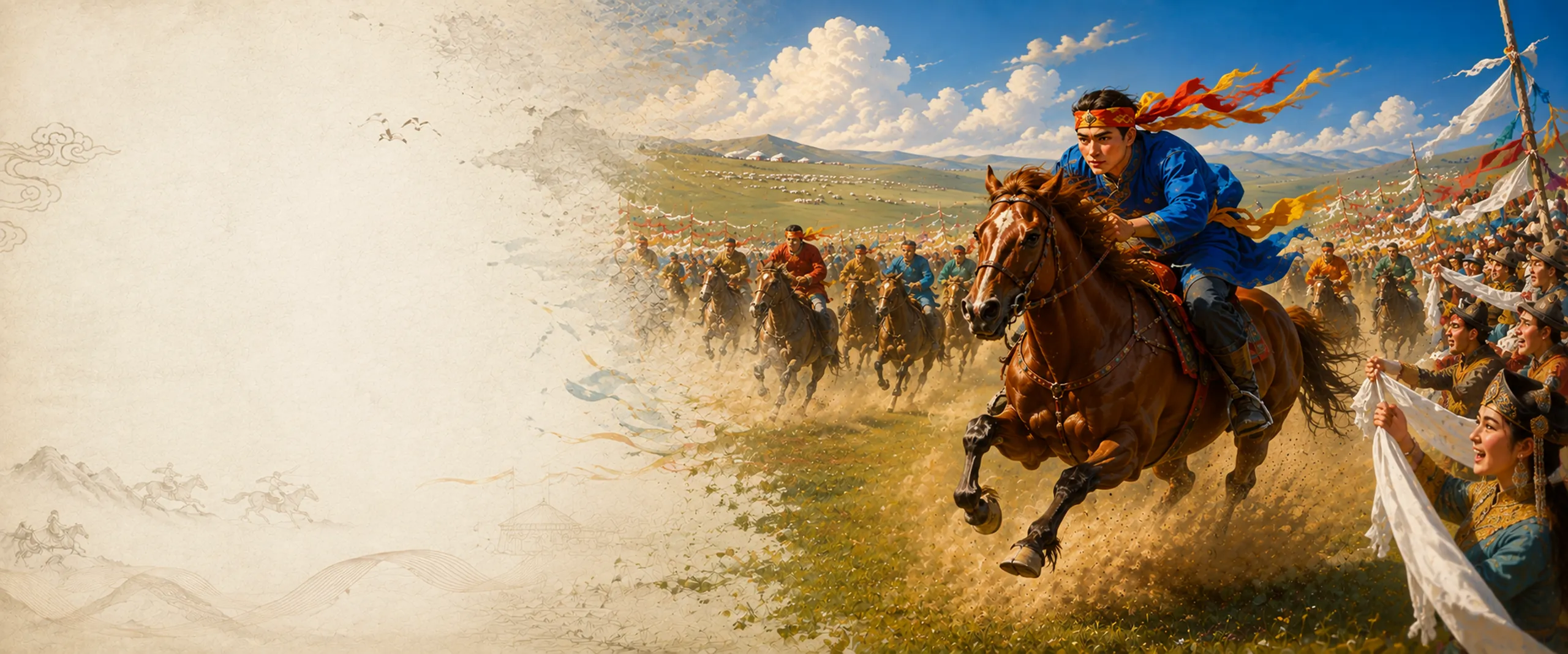
Poetry associated with Naadam centers on the “Three Manly Skills”—horse racing, archery, and wrestling. “且看男儿三艺” encapsulates the core competitions of Naadam; “执策扬鞭追赶集,毡房举酒畅心倾” evokes the bold spirit of the grassland gathering, with people raising their cups freely inside felt yurts after the races; and “彩旗猎猎舞金风,万箭齐飞惊远鸿” depicts the spectacle of the archery field.

Naadam is a traditional Mongolian festival with a long history, and poetry about it frequently portrays the “Three Manly Skills.” 《水调歌头·那达慕》 reads: “八方宾客云集,欢语动慕心。且看男儿三艺,赛马弯弓射箭,搏克气凝金。长调绕穹帐,马头伴清音”. The line “搏克气凝金” captures the tense concentration of wrestlers locked in competition. Another poem contains the lines “执策扬鞭追赶集,毡房举酒畅心倾”, depicting the bold scene of people raising their cups and drinking freely in felt yurts after the horse races. “彩旗猎猎舞金风,万箭齐飞惊远鸿” portrays the intensity of the archery competition. With a vigorous and powerful poetic voice, Naadam poetry records the courage and heroic spirit displayed by the sons and daughters of the grasslands through speed, strength, and precision.

Naadam / Folk Arts of Naadam

Art Forms

Forms of Expression

Mongolian Long Song

Other 蒙古族

Status and Characteristics

Mongolian long song, known in Mongolian as Urtiin Duu (乌日汀哆), is a treasure of traditional Mongolian music and an essential form of singing at Naadam gatherings. Long songs are indispensable at Mongolian festivals and celebrations, gatherings of relatives and friends, Naadam, and other occasions. Their melodies are extended and unhurried, their artistic conception vast and open, their words relatively few in relation to the abundance of vocal sound, and their breath lines exceptionally long, giving them extraordinary expressive power. The themes contained in long songs are closely connected with Mongolian social life; they were created through the pastoral production and labor of the nomadic peoples of the northern grasslands.

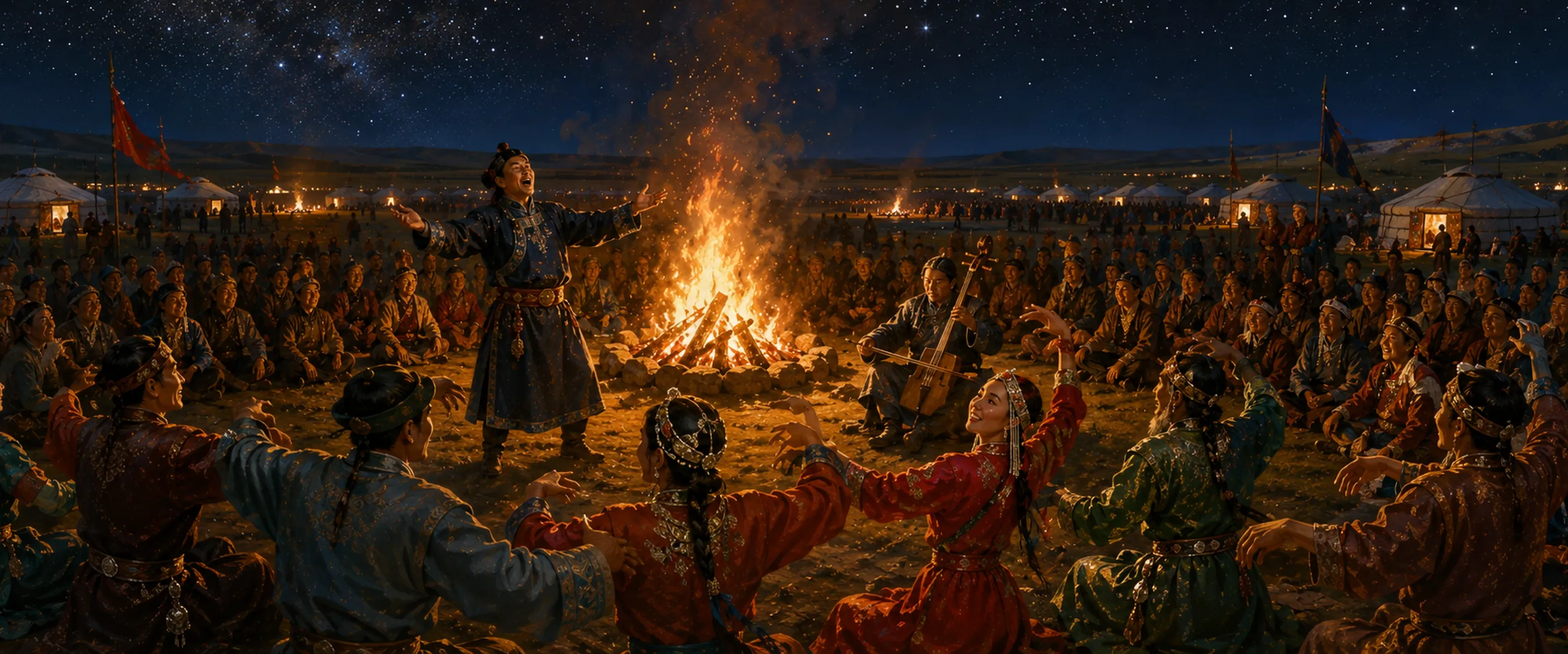
At the 2004 Naadam gathering on the West Ujimqin grasslands of Xilingol League, Mongolian singers performed long songs accompanied by the morin khuur. The long songs heard at Naadam are not performances confined to a stage, but life from deep within the grasslands—they grow from the throats of herders and drift with the wind between heaven and earth. In July 2026, at the Naadam Cultural Park in Xilinhot, long song, khoomei, and Chaoerdao seemed to “从喉咙里长出草原的辽阔”.

The long, unhurried melodies of long song resemble the endless horizon stretching across the grasslands. Their high and resonant voices find an almost celestial resonance in the vastness between heaven and earth. When long song rises over the grasslands, the world itself seems to open wider, and the human heart unfolds with it.

Vocal Style

Long song employs distinctive vocal techniques such as Nogula (诺古拉), ornamental notes, and Shurga (舒日嘎), vibrato. Its melodies are prolonged and its breath spacious; a single line of lyrics may often be sustained over an extended phrase, finding an almost natural, heavenly resonance in the vast expanse of sky and earth. The long-song style heard at Naadam carries the Mongolian people’s profound praise for the grasslands, their ancestors, and their heroes. At the Donggui Naadam gathering in Hejing County, the Donggui Oirat Folk Song Association presented a hundred-person long-song chorus of 《额尔温大走青马》, creating an exceptionally magnificent spectacle of a hundred voices singing long song together.

Intangible Cultural Heritage Status

In 2005, China and Mongolia successfully submitted a joint nomination of Mongolian long song as “World Intangible Cultural Heritage.” In the same year, Mongolian long song was proclaimed by UNESCO a “Masterpiece of the Oral and Intangible Heritage of Humanity.” To date, two traditional music projects from the Inner Mongolia Autonomous Region—Mongolian long song and Mongolian khoomei—have been inscribed on UNESCO’s Representative List of the Intangible Cultural Heritage of Humanity. Long song is not only a pinnacle of Mongolian music, but also part of the cultural heritage of all humanity.

Khoomei

Other 蒙古族

Artistic Characteristics

Khoomei, also known as Hooliin Chuur (浩林·潮尔), is a distinctive Mongolian art of polyphonic throat singing. Through specialized vocal techniques, a single performer produces two or more simultaneous parts—a deep, sustained fundamental tone and a high, brilliant overtone melody. While singing khoomei, the performer’s vocal cords sustain a low tone, while adjustments to the shape of the mouth and pharyngeal cavity cause the airflow to generate overtone resonance, producing a melodic high register. This distinctive method of sound production makes khoomei a unique vocal form in world music.

Overtone singing in the khoomei tradition runs throughout Naadam gatherings. At grassland evening concerts, khoomei, long song, short song, and other forms provide rich “nourishment” for artistic performances. At the opening ceremony of the Xilinhot Naadam in July 2026, khoomei, together with other forms of intangible cultural heritage, became an important part of “草原欢歌迎天下”.

Cultural Meaning

The origins of khoomei are closely connected with the Mongolian people’s reverence for nature. To Mongolian ancestors, the sound of the wind, flowing water, galloping hooves, and the calls of animals—all the sounds of nature—were sacred. Khoomei is precisely an art of imitating and reproducing these natural sounds. In its performance, one seems to hear the howl of the wind, the thunder of horses’ hooves, and the murmur of rivers: a deeply affectionate tribute to the grasslands.

Khoomei was inscribed together with long song on UNESCO’s Representative List of the Intangible Cultural Heritage of Humanity in 2005. During the special intangible-cultural-heritage program at Naadam in July 2026, a crossover performance in which khoomei “对撞电吉他” demonstrated the creative transformation of this ancient art in contemporary times. Khoomei is not merely a miracle of throat singing; it is also an ancient way through which the Mongolian people converse with nature.

Morin Khuur

Other 蒙古族

Legend and Form

The morin khuur is the most representative bowed string instrument of the Mongolian people and takes its name from the carved horse’s head at the upper end of its neck. A moving legend about its origin circulates across the grasslands: a herder, grieving for his beloved horse after its death, made the body of an instrument from the horse’s bones and its bow from the horse’s tail, thus creating the first morin khuur. From that time onward, the sound of the instrument has carried the deepest emotions between Mongolian people and their horses. Its tone is desolate yet far-reaching; it can imitate the neighing of horses and the howling of the wind, while also expressing the full range of human joy, anger, sorrow, and happiness.

In 2003, the morin khuur was proclaimed by UNESCO a “Masterpiece of the Oral and Intangible Heritage of Humanity.” Traditional morin khuur music was inscribed on UNESCO’s “Representative List of the Intangible Cultural Heritage of Humanity” in 2008.

Musical Role

At Naadam gatherings, the sound of the morin khuur intertwines with the voices of long song and the otherworldly resonance of khoomei, creating one of the most moving soundscapes of the grasslands. At modern Naadam concerts, diverse art forms—including the morin khuur, khoomei, long song, ethnic song and dance, and costume presentations—come together in one space. Throughout Inner Mongolia, cultural festivals devoted to Naadam, the morin khuur, long song, khoomei, and related traditions are held every year, allowing these ancient forms of folk art to take on renewed vitality in modern society.

At the opening ceremony of the Xilinhot Naadam in July 2026, 《万马奔腾》 by Qi Baoligao, a national-level representative inheritor of intangible cultural heritage, resounded through the venue, and “全场观众的血管里奔跑起马蹄的声音”. Across the strings of the morin khuur runs the soul of the grasslands—when the melody of 《万马奔腾》 rises, it is not one person performing; it is the entire grassland galloping forward.

The morin khuur is also an important component of folk instrumental performance among the traditional events of Naadam.

Words of Blessing and Praise

Other 蒙古族

Status and Characteristics

Words of blessing and praise constitute one of the traditional genres of Mongolian folk literature. They are also a general designation for Mongolian blessing texts, praise texts, sacrificial invocations, summoning texts, and related forms, and originated as forms of rhymed verse in antiquity. Blessing and praise texts are typical forms of traditional Mongolian oral folk recitation and singing and possess established melodic patterns. Their language is natural and fluent, their emotions abundant, and their artistic appeal powerful. Praise texts and blessing texts are similar in meaning and both belong to the sphere of folk literary recitation and singing. Naadam blessing-and-praise texts and wedding blessing-and-praise texts, both marked by ancient Mongolian traditions, constitute the two great systems of this genre.

Words of blessing and praise originally evolved from shamanic sacrificial invocations. Ancient people believed that everything in the world was governed by an irresistible power—the spirits—and that in order to obtain food, clothing, and peace, they had to seek the spirits’ protection and gifts. They therefore offered the finest foods to the spirits, presented dances before them, and praised them with beautiful poetry. In this way, various sacrificial rituals and their corresponding words of blessing and praise came into being. For thousands of years, this tradition has accompanied the Mongolian people through the long river of time. It embodies their love of life and existence and is filled with an uplifting spirit and beautiful wishes.

Types of Blessing and Praise Texts

The words of blessing and praise heard at Naadam are rich and varied, encompassing every aspect of the festival.

Naadam Blessing and Praise Texts form the central mode of benediction. At the opening of the gathering, they are recited by respected elders or specialist blessing reciters, invoking favorable weather for the grasslands, prosperity for people and livestock, and the successful completion of the competitions.

Bökh Blessing and Praise Texts—wrestling blessing-and-praise texts—are recited before and after wrestling contests. The “invitation-to-wrestle song” is a ritual song performed during the contestants’ entrance ceremony. As the wrestlers enter, singers raise their voices in challenge songs praising the warriors’ strength and courage. Victors are likewise honored with songs of praise.

Praise of the Horse is a widely transmitted traditional form of blessing and praise, expressing the emotional bond between human beings and horses through poetic language. Such texts commonly praise the horse’s appearance, speed, loyalty, and the martial bearing of its owner, using elaborate language to celebrate the “spirit of the horse.” In 2018, this project was included in the Representative List of Intangible Cultural Heritage Projects of Xilinhot.

Archery Blessing and Praise Texts are recited during archery competitions, praising the archers’ precise skill and composed concentration.

Cultural Value

Through the distinctive language of the grassland people, words of blessing and praise articulate the Mongolian people’s understanding of history and culture, human customs, morality, philosophy, and art. They embody and transmit the cultural traditions of the people, possess historical value, and provide an important basis for studying Mongolian culture. These blessing and praise traditions create an atmosphere of harmony and celebration among Mongolian communities and play an important role in transmitting grassland civilization, coordinating interpersonal relations, and maintaining social stability.

In 2021, the blessing-and-praise tradition of the Subei Mongolians was included in the fifth batch of China’s National List of Representative Intangible Cultural Heritage Projects. Its contents encompass historical legends, nature worship, wedding customs, and other settings, while its performance integrates recitation, music, and bodily movement. It is commonly encountered at weddings, Naadam gatherings, and other festive occasions.

Jangar

Other 蒙古族

Status and Transmission

《江格尔》 is one of China’s three great ethnic heroic epics. It circulates mainly among the Oirat Mongolians of Xinjiang and has been widely transmitted among the Mongolian people for thousands of years. Hoboksar Mongol Autonomous County is the birthplace of 《江格尔》, one of China’s three great ethnic heroic epics.

Centering on the Mongolian hero Jangar, the epic unfolds through a series of thrilling scenes of warfare involving bride capture, the seizure of wealth, the occupation of pasturelands, and other conflicts. Through these narratives, one can gain insight into many aspects of ancient Mongolian society, including its economy and culture, everyday customs, and political institutions. Through richly varied imagination and vivid, lively language, 《江格尔》 employs the flexible forms and natural style of nomadic oral singing and storytelling to create the heroic figure of Jangar, a man of extraordinary divine power and martial skill, intelligent and courageous, devoted to justice, eliminating harm for the people, and undefeated through a hundred battles.

Performance

Traditional activities at Mongolian Naadam gatherings in Xinjiang include the sung narration of 《江格尔》. At the Jangar Cultural Tourism Festival and Naadam held in Hoboksar County, performances of Jangar singing and instrumental accompaniment constitute an important cultural activity. At the Naadam gathering in Hejing County, four generations of Jangar performers appeared together on stage to perform 《宝木巴家园颂》. The presence of four generations on the same stage symbolized the continuation of this epic tradition across generations.

《江格尔》 has survived to the present day primarily through oral transmission by folk singer-storytellers. Naadam provides one of the most important performance platforms for the living transmission of 《江格尔》—it is precisely amid the joy of the festival that the ancient epic is passed onward by generation after generation of performers.

Intangible Cultural Heritage Status

In 2006, 《江格尔》 was included in the first batch of China’s National List of Intangible Cultural Heritage. Together with Mongolian long song, the morin khuur, khoomei, and other traditions, 《江格尔》 forms part of the core system of Mongolian folk arts. The Xinjiang-wide 《江格尔》 Invitational Competition has also become one of the important activities of Xinjiang Naadam gatherings.

Andai Dance

Other 蒙古族

Historical Origins

Andai dance is an indigenous dance tradition found on the Horqin grasslands of Inner Mongolia and has a history of nearly 400 years. It is a comprehensive ethnic folk art integrating song, dance, and music, marked by a strong ethnic style and distinctive local characteristics. It fully expresses the simple emotions and rough, heroic spirit of the Mongolian people and embodies the long history of Mongolian culture.

Andai dance first arose in the Hure Banner area in the late Ming and early Qing periods. At that time, large numbers of migrants participating in the movement into Northeast China entered the grasslands, and the cultural customs of many different regions gradually blended, forming the Mongolian culture of Hure and in turn giving birth to the broadly popular Andai dance. Andai dance is celebrated as a “living fossil of Mongolian dance.”

Artistic Role

Andai dance is usually performed during festivals or leisure time. At early Andai dance sites, a broken cart axle, wheel, or wooden pole was erected at the center as an object intended to suppress demons and ward off evil. Participants formed a circle around it, holding a silk scarf in the right hand or lifting the hem of the Mongolian robe, singing and dancing in response to the lead singer or dancer. Men and women, young and old alike could enter and dance freely. There were no restrictions of time or place; participants simply responded to the rhythm of the music and to the lead singer or dancer.

Whenever major festivals such as Naadam are held, people dance the Andai collectively. For nearly four hundred years, Andai dance has been deeply loved by the Mongolian people for its strong “民间本色” and its character as a “癫狂之舞”. It gradually became one of the most popular dances of revelry in Mongolian religious rituals and at Naadam gatherings in Inner Mongolia. Because its movements are easy to learn and combine singing with dancing, Andai has become one of the collective dances with the highest level of participation at Naadam.

Cultural Value

As a living fossil of Mongolian dance, Andai is an important emblem of Mongolian culture. It is not merely a form of dance art, but also an important cultural marker of the Mongolian people, possessing significant cultural and artistic value. Andai dance was included in the first batch of China’s National List of Intangible Cultural Heritage in 2006. During the special intangible-cultural-heritage performances at Naadam in 2026, Andai dance was presented free of charge at Beizimiao Square.

Sawurden Dance and Tovshuur Singing

Other 蒙古族

Sawurden Dance

Sawurden is one of the traditional dances of the Mongolian people and is mainly practiced in areas with concentrated Oirat Mongolian populations, including Bayingolin Mongol Autonomous Prefecture in Xinjiang. Its movements are broad and open, frequently imitating scenes of nomadic life such as horse riding, archery, milking, and braiding hair. It vividly embodies the Mongolian tradition in which “song and dance are one.”

At the Donggui Naadam gathering in Hejing County, performances of Sawurden dance drew repeated applause from the audience. While preserving the traditional “Three Manly Skills,” Mongolian Naadam in Xinjiang has added sheep-snatching competitions, ethnic costume presentations, Jangar singing, bonfire evenings, artistic performances, handicraft exhibitions and sales, and other activities. Traditional Naadam events include folk-dance performances.

Tovshuur Singing and Performance

The tovshuur is a plucked instrument distinctive to the Oirat Mongolians. It resembles the morin khuur but has a smaller body and a clear, bright tone. The tovshuur is often combined with performances of 《江格尔》, long song, and other traditions, making it an important form of folk music at Naadam gatherings.

At the Donggui Naadam gathering in Hejing County, a folk tovshuur ensemble presented the sung instrumental work 《巴音查汗》. In recent years, as Hejing County has continued to increase investment in the transmission of intangible cultural heritage projects, tovshuur performance, Sawurden dance, Jangar singing, and other traditions have achieved notable results. Mongolian Naadam is rooted in traditional Mongolian culture and reflects, from multiple angles and in a comprehensive manner, the realities of politics, economy, production, everyday life, folk customs, religion, and other aspects of Mongolian communities in different regions and historical periods.

Contemporary Transmission

Heritage & Transmission 蒙古族

Intangible Cultural Heritage

In 2006, Naadam was included in the first batch of China’s National List of Intangible Cultural Heritage. In 2008, the Naadam tradition submitted by Hejing County in the Xinjiang Uyghur Autonomous Region was included as an expanded project in the second batch of the national intangible cultural heritage list. In July 2026, the 36th Inner Mongolia Autonomous Region Tourism Naadam, themed “畅游内蒙古·遇见那达慕”, opened. Naadam itself is a national-level representative intangible cultural heritage project, and this edition brought together at the Naadam grounds the outstanding traditional cultural forms handed down across the grasslands.

Naadam also serves as a concentrated platform for presenting numerous national-level intangible cultural heritage traditions, including Mongolian long song, the morin khuur, Uliger (Mongolian storytelling), Andai dance, and khoomei. Mongolian long song and khoomei have successively been inscribed on UNESCO’s Representative List of the Intangible Cultural Heritage of Humanity.

Contemporary Folk Celebration

Contemporary Naadam not only preserves the traditional “Three Manly Skills,” but has also become a concentrated platform for the presentation of Mongolian folk arts. Nearly twenty types of activities are represented at the main venue, more than half of them bearing “intangible cultural heritage” plaques. Four small yurts display representative projects from the twelve leagues and cities in separate areas, while a large fourteen-meter yurt centrally exhibits and sells fine examples of Inner Mongolian intangible cultural heritage, including leather carving, clothing, felt embroidery, bone carving, clay sculpture, carpet weaving, Mongolian furniture, silverwork, and horse-tack making.

Thirteen banner- and county-level ail communities each present their own distinctive local scene. The simultaneously launched “非遗好物·匠心传承” Inner Mongolia Intangible Cultural Heritage Shopping Month allows visitors to experience intangible heritage amid the warmth of everyday life: milk tofu, airag, Buryat buns, Horqin pies, Chifeng duijia, all prepared and tasted on site; while long song, huobusi, Haolaibao, and Andai dance are performed free of charge in special intangible-cultural-heritage programs at Beizimiao Square in the evening.

Music Naadam brings khoomei into collision with electric guitar, while Motorcycle Naadam sends steel wheels onto volcanic roads—they may appear fashionable, but at their core they are all contemporary expressions of intangible cultural heritage. Naadam is not merely the continuation of a traditional festival, but also the most important platform for the living transmission of Mongolian folk arts in contemporary society. The Haixi Mongolian Naadam originated in the sea-sacrifice rituals of the twenty-nine Mongolian banners around Qinghai Lake and expresses the joy of local people celebrating the harvest. Mongolian Naadam in Xinjiang is held every year on June 23 of the Gregorian calendar and lasts from one to three days. Traditional events include folk-dance performances, Mongolian long-song singing, Jangar recitation and singing, folk instrumental performance, handicraft displays, ethnic costume presentations, wrestling, and other activities.

Closing Reflections

Overview 蒙古族

The folk artistic expression of Mongolian Naadam differs fundamentally from the “literati poetry” associated with Han festivals. It is not “written” in words, but “sung,” “played,” and “danced” at the festival itself. It does not arise from an external perspective of “watching” and “reflection,” but from an internal perspective of “speaking” and “revelry.”

From the grassland voice of long song, with its “旋律悠长舒缓、意境开阔、声多词少、气息绵长”, to the miracle of khoomei, which “通过特殊的发声技巧,让一个人同时发出两个或两个以上的声部”; from the celestial sound of the morin khuur, where “琴弦上奔跑着草原的灵魂”, to the splendid blessings of the blessing-and-praise tradition, whose “语言自然流畅,感情充沛,具有强烈的艺术感染力”; from the heroic epic 《江格尔》, which works “通过丰富多彩的想象力和生动活泼的语言”, to the collective revelry of Andai dance, marked by its powerful “民间本色” and “癫狂之舞”—the folk artistic expression of Mongolian Naadam takes song and music as its twin wings, and ritual and celebration as its core, forming a complete, living, and continuously flourishing system of cultural expression.

The activities of Naadam are manifestations of strength and beauty, contests of physical ability and intelligence, and competitions of speed and endurance, comprehensively displaying the qualities of the grassland people. Naadam is also a traditional folk cultural activity with broad public participation and strong recreational character. It has become an important vehicle of Mongolian cultural tradition, carrying extensive and profound cultural meanings and deeply reflecting Mongolian values and aesthetics. Naadam originated in oboo worship, took form under the Mongol Khanate, flourished in the prosperous age of the grasslands, and continues today through intangible cultural heritage—it has crossed nearly a thousand years of history and, with its distinctive cultural appeal, continues to thrive across the boundless grasslands.

The artistic expression of Naadam is precisely one of the most concentrated embodiments of the Mongolian spirit: distant and profound like long song, wondrous and awe-inspiring like khoomei, desolate yet heroic like the morin khuur, passionate and sincere like words of blessing and praise, vigorous and magnificent like 《江格尔》, and exuberant and uninhibited like Andai dance. When the morin khuur sounds 《万马奔腾》 across the Xilingol grasslands, when the final notes of long song echo between heaven and earth, and when the overtones of khoomei meet the roar of the electric guitar at Music Naadam—that is the Mongolian people, through their own voices, their own bodies, and their own dance, offering their deepest and most enduring declaration of love to “the grasslands” and “life.” The folk arts of Naadam are an undying cultural flame upon the grasslands, the cultural heartbeat of a people of the saddle who, after a thousand years of wind and rain, remain as bold and unrestrained as ever.

—-

Continue exploring Naadam culture

Readers’ Comments

Calendar and traditional culture enthusiasts from around the world, sharing the same moon.

Sign in or register to join the conversation. Your comment account is created automatically the first time you use a connected account.